


The Long Call is one of the basic strategies in options trading and is mainly used by private investors and traders to trade on rising prices of a stock, an index, a currency, a commodity, etc. The advantage is a limited maximum loss with unlimited profit potential. The advantage is a limited maximum loss, with unlimited profit potential at the same time. In this article you will learn what a long call is and what to look for when trading it.
Definition Long Call
The term "long call" refers to the purchase of a call option (call option). The option buyer acquires the right to buy an underlying asset at a certain price (strike price) on a certain date (European type option) or by a certain date (American type option).
The option buyer (long call position) decides unilaterally whether to buy the Law perceive and would like to buy the underlying asset or not.
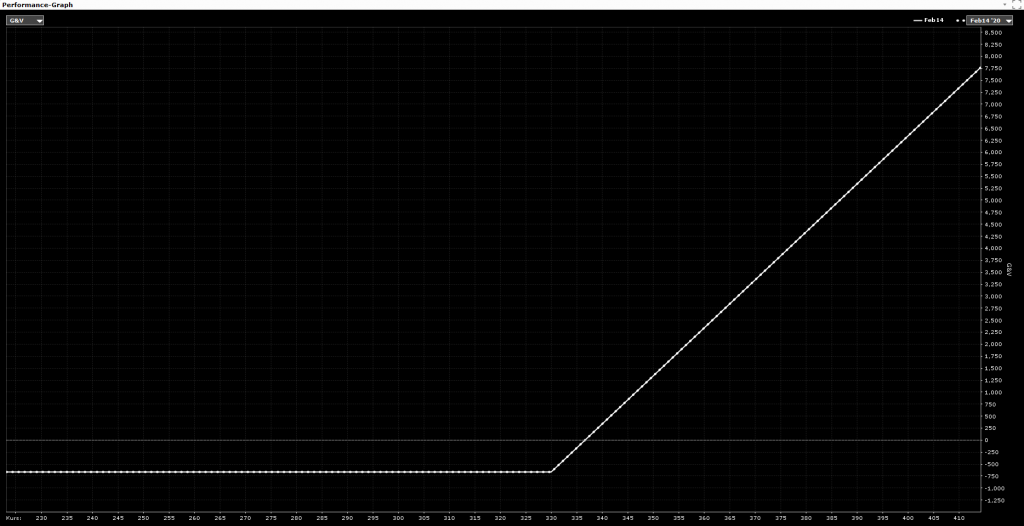
P&L diagram of a long call
In the profit and loss diagram, you can see that the long call Unlimited profit potential at the same time on the option premium limited maximum loss offers. How the profit, the loss and the break even point are calculated, you will learn below.
Possible applications
In the original sense, options are instruments used to hedge against price fluctuations/risks. This means that commercial market participants buy call options, for example, to hedge against sharply rising commodity prices or currency risks. On the stock markets, there is generally no risk for investors in rising prices, which is why put options are primarily used here as hedging instruments to protect against falling prices.
Among private as well as institutional traders with a speculative trading approach, the long call is often used to bet on rising prices of the underlying asset (underlying).
What should I pay attention to when trading a long call?
The purchase of call options for speculative purposes offers the advantage that a high profit can be generated with limited capital and risk, resulting in a leverage effect of the capital employed. However, a strong movement of the underlying is necessary for this. If this does not occur, the long call suffers from the loss of time value.
Maximum loss
The maximum possible loss of a long call is limited to the option premium paid limited. This occurs if the option is out of the money on the expiration date (the underlying is quoted below the strike price). After opening a long call position, the purchased option can be sold again at any time. This allows you to close the trade early if it does not develop as desired and thus limit the loss.
Maximum and realized profit
The maximum possible profit of a long call cannot be calculated, since the price of the underlying can theoretically rise infinitely.
The actual profit can be calculated by determining the difference between the price of the underlying on the expiration date and the strike price of the option and deducting the option premium paid (debit) from this.
Profit = (price underlying - strike price option) * multiplier - debit
Break Even Point
Since a sum must first be spent to buy a call option, the underlying must rise by at least this amount to reach the break-even point. For example, if you pay EUR 200 for a 110 call on a stock, the stock must be quoted above EUR 112 on the expiration date for a profit to be made. (The multiplier for stock options is 100).
Break Even Point = Base Price Call + Debit
Choice of the base price
The choice of the strike price plays an important role in the success of a long call. The further the strike price is Out Of The Money, the lower the delta and the cheaper the option is. The further the strike price is In The Money, the higher the delta is and the more expensive the option is.
The possible Lever of a successful long call is therefore greater with an OTM option. However, the Probability of success lower, as the underlying requires a strong price increase in order to generate a profit.
The lower the long call ITM, the lower the leverage. However, the option suffers less from the time value loss and the break even point is much closer to the current price of the underlying.
Market assessment
The long call is a bullish strategy. Besides the assessment of the Market direction however, is also a very good Timing necessary to achieve a profit. Especially for Out Of The Money options, a moderate to very strong movement is necessary, depending on the selected strike price. In addition, this must occur within the remaining term of the option.
Implied volatility
In addition to the price development of the underlying, the implied volatility has a major influence on the option price. The long call Benefits from rising implied volatility and therefore has higher chances of success if traded at low IV or in anticipation of rising IV.
Residual term and fair value expiry
Also the Choice of the expiry date or the remaining term have an influence on the success or failure of an option strategy. Since the time value loss of options increases exponentially until the expiration date, buyers of OTM options have to expect a high loss in value per day, especially in the last 30 days.
This can be counteracted by choosing a longer remaining term, but this increases the option price. Purchased call options thus suffer the smallest loss in time value when they are deeply in the money and have a long remaining term.
Exercise of option on expiry date
As a buyer of an option, you can exercise your right to exercise the option during the entire term of the option in the case of American-type options (e.g. stock and futures options). If you hold the option beyond the expiration date, it will either expire worthless or be exercised automatically if the option is in-the-money.
In the case of a long call, you get the underlying asset. tendered (booked to the securities account) if the price of the underlying is higher than the strike price of the option, and if it is an option with the Settlement method "physical delivery acts.
If it is an option that is settled in cash (Settlement method: "cash(e.g. in the case of index options), the profit is offset and booked to your securities account. You can find out which settlement method is used in the contract details of the option (double-click on an option in the TWS).
If you want to exclude the risk of physical delivery of the underlying, you must close the trade before the expiration date.