


To buy or sell any financial instrument at a predefined price, traders usually use a stop order or a limit order. A lesser-known alternative is the Market If Touched Order, or MIT Order for short. This also has the purpose of executing a buy or sell order when a predefined "trigger price" is reached. In this article you will learn what exactly an MIT order is and how it differs from the limit order and the stop order.
What is a Market If Touched Order?
A Market If Touched (MIT) order is an order to the broker to immediately buy or sell any underlying at a previously defined trigger price as soon as this is reached. The buy or sell order is converted into a market order when the trigger price is reached and executed at the next possible price. An MIT Buy Order is usually used to buy at a lower price than the current market price. An MIT Sell Order is used to sell at a higher price than the current market price.
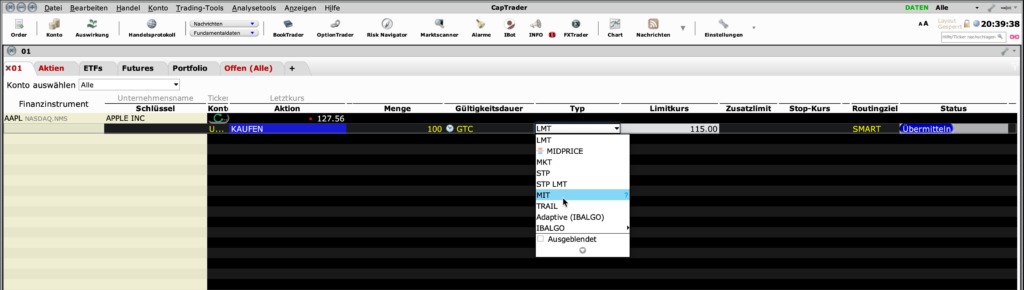
Difference from Stop Order and Limit Order
At first glance, the Market If Touched Order seems to have great similarities with a Stop Order or a Limit Order. In all cases, a buy or sell order is automatically executed at a previously defined price.
In contrast to a limit order, an MIT order, like a stop order, is executed immediately when the trigger price is reached as a market order.
While a Buy Stop Order is used to buy at a price higher than the current market price and a Sell Stop Order is used to sell at a price lower than the current market price, the reverse is true for a Market If Touched Order.
A Market If Touched buy order is used if you want to buy an underlying at a lower price than the current market price as soon as the trigger price is reached. In contrast to a buy limit, you receive immediate execution (market) and slippage may occur depending on market conditions.
A Market If Touched sell order is used if you want to sell an underlying at a higher price than the current market price as soon as the trigger price is reached. In contrast to a sell limit, the order is executed immediately when the trigger is reached (market) and slippage can also occur, whereas with a limit order the limit price is guaranteed.