


Similar to the P/E ratio (price/earnings ratio) and the KUV (price/sales ratio), the KBV (price/book ratio) is a share ratio that is used for the fundamental valuation of a company or a share. Here, the share price is put in relation to the book value per share. In this article, you will learn what the P/B ratio is, how it is calculated and what the price-to-book ratio means.
What is the price-to-book ratio (P/B ratio)?
The price-to-book ratio of a share (KBV for short) is determined by dividing the share price by the book value per share. A P/B ratio of over one means that the company's stock market value is higher than its book value. A KBV of less than one means that the company's stock market value is lower than its book value.
P/B = Share price / Book value per share
The stock market value of a company is also referred to as its market capitalization. Market capitalization can be calculated by multiplying the number of shares (outstanding shares) by the share price. The price-to-book ratio expresses the difference between market capitalization and book value. So instead of the formula used above, the P/B ratio can also be calculated as follows:
KBV = market capitalization / book value
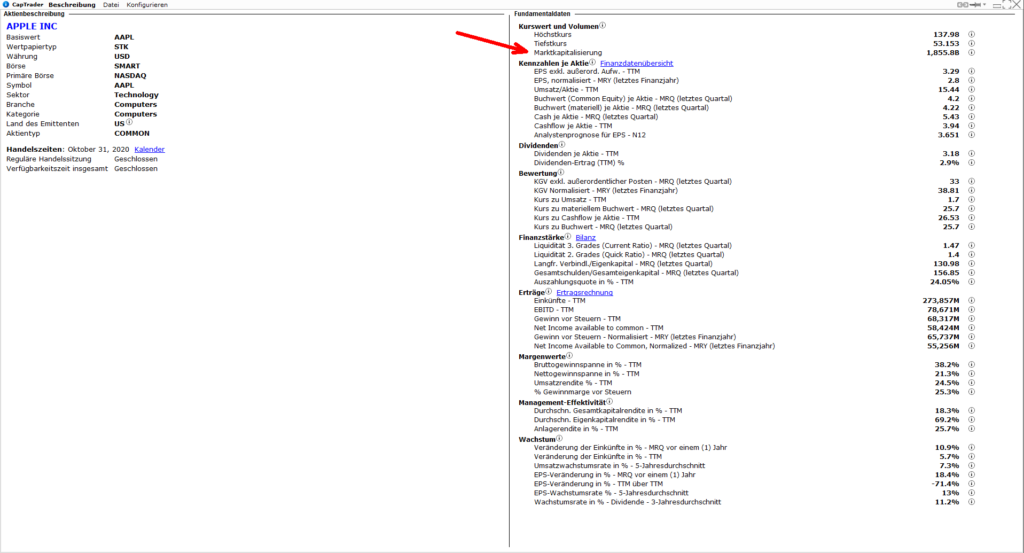
Carrying amount
The Carrying amount describes the total value of all assets of a company (acquisition or production costs, adjusted for depreciation and write-ups). You can find more information in our article on book value.
Book value per stock
The book value per share can be determined by dividing the book value of a share by the total number of all shares. For more information, please refer to our article on book value per share.
Interpretation of the KBV
There is no generally applicable rule on how to interpret a stock's P/B ratio, or at what point a P/B ratio is considered high or low. Similar to the price-earnings ratio (P/E) and the price-sales ratio (P/S), the P/B ratio allows an assessment of whether a share is relatively expensive or cheap, or overvalued or undervalued.
A high P/B ratio initially indicates that the market values a company highly. On the one hand, this can be an overvaluation, on the other hand, it can also be interpreted as high growth potential.
A low P/B ratio, on the other hand, can be interpreted either as a favorable buying opportunity or as a warning that a company has serious problems and that declining sales and profits are to be expected.
It is often observed that entire industries typically have a high or low P/B ratio. It therefore makes little sense to compare the P/B ratio of industries with strong growth potential or growth stocks with the P/B ratio of stocks/industries that have little growth potential. In addition, certain industries (such as the automotive industry) have more intrinsic value due to their business model than, for example, a software company, which also has an impact on the P/B ratio.
The price-to-book ratio should therefore not be considered in isolation, but in combination with other fundamental share ratios and taking into account the specifics of the respective industry.