Your Broker for worldwide trading

Trading Journal: Your path to becoming a successful trader in 2026

In the fast-paced world of trading, there are numerous methods and strategies that can be used to increase success. However, one tool that is often overlooked yet invaluable is the trading journal or trading diary. 

A trading journal serves as a detailed log of all trading activities and offers the opportunity to analyze and improve trading strategies. In this article, you will find out exactly what a trading journal is, why it is indispensable for traders and how you can use it effectively to optimize your trading strategy and become more successful in the long term.

A simple outline of a document with horizontal lines and a yellow magnifying glass in front of it, symbolizing the document check or search.

The most important in a nutshell

  • A trading journal is a detailed log of all trading activities
  • It helps to analyze and improve trading strategies
  • A trading diary promotes discipline and systematic trading

What is a trading journal and what purpose does it serve?

A trading journal is more than just a simple record of trades. It is a comprehensive document that captures all aspects of your trading activity, from the technical details to the emotional and psychological factors that influence your decisions. 

The purpose of a trading journal is to help you understand your trading habits, recognize patterns and trends and continuously improve your strategy. A well-managed trading journal gives you the opportunity to identify your strengths and weaknesses and make informed decisions.


An astronaut floats in space next to ad text promoting stock trading features such as global exchanges, short selling and fractional shares. A yellow button reads "Open an account".

What are the advantages of a trading journal?

The advantages of a trading journal are manifold and extend far beyond the simple recording of trades. One of the main benefits is the improvement of your trading strategy. By regularly analyzing your trades, you can identify patterns and trends that help you adjust and refine your strategy. This continuous improvement is crucial for long-term success in trading.

Another important benefit is the increase in discipline. Keeping a journal forces you to trade in a disciplined and systematic way, which can lead to better results in the long run. Discipline is one of the most important traits of a successful trader, and a trading journal can help to foster this.

A trading journal also allows you to track performance. You can see exactly which trades were successful and which were not, and thus base your trading decisions on real data. This helps you to make objective decisions and avoid emotional mistakes.

A trading journal can also help you to better control your emotions. By noting your emotional states while trading, you can minimize emotional mistakes and make more rational decisions. Self-discipline is encouraged by scrutinizing and systematically documenting your trading decisions.

Good to know:

A trading journal improves your trading strategy, increases discipline and allows you to objectively track performance to make informed decisions.
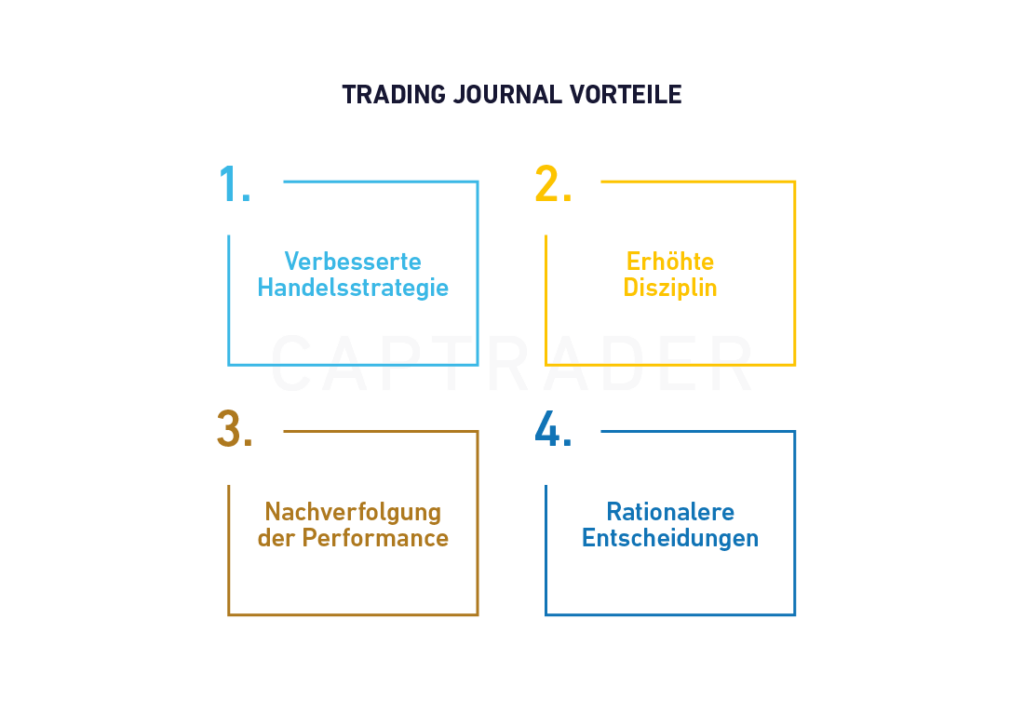
Trading Journal Advantages

What content should be included in a trading journal?

A comprehensive trading journal should contain a variety of information to help you analyze and improve your trading decisions. Basic content includes the date and time of the trade. Note when you opened and closed a trade to better understand the timing of your decisions.

The trading instrument is also an important part of your journal. Indicate which instrument you have traded, be it shares, currency pairs or other financial products. This information allows you to compare your performance in different markets.

Entry and exit points are crucial for evaluating the efficiency of your trading strategy. Make a note of the exact prices at which you entered and exited. This data will help you to analyze and adjust your trading decisions.

Last but not least, the results of the trade should be documented. Make a note of the profit or loss and any fees. This gives you a clear overview of the profitability of your trades and allows you to adjust your strategy accordingly.

Good to know:

A good trading journal contains information such as the date and time of the trade, trading instrument, entry and exit points and the results of the trade.

Psychological aspects of trading

Emotional intelligence plays a crucial role in trading. A trading journal helps you to document the emotional aspects of your trading decisions. By regularly reflecting on your feelings and emotions, you can learn how they influence your decisions and find ways to minimize emotional trading.

Trading can be very stressful, especially when it comes to trading large sums of money or in volatile markets. A trading journal can serve as an outlet to relieve stress and organize your thoughts. By identifying your stress factors and developing strategies to deal with them, you can trade with greater calm and focus.
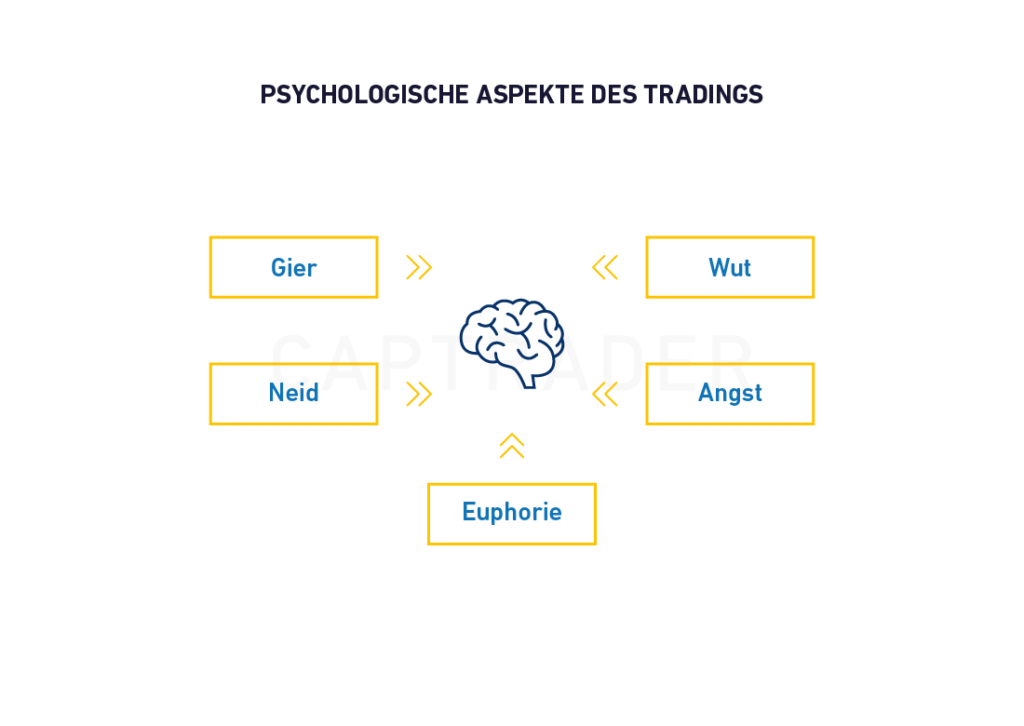
Trading Journal Psychological Aspects

Technical Analysis and Trading Journal

Technical analyses are an essential part of trading. A trading journal can help you to systematically document your technical analyses. You can record charts, indicators and trading signals in your journal and analyze the results to refine your trading strategy.

Various technical indicators and trading signals can be integrated into the trading journal. Make a note of which indicators you have used and which signals were decisive for your decisions. This allows you to track and analyze the effectiveness of these indicators in detail.

Long-term success strategies

An annual review of your trading journal can help you to develop and adapt long-term trading strategies. Analyze your annual performance, identify strengths and weaknesses and adjust your strategy accordingly. This regular review is crucial for continuous improvement.

Set yourself realistic goals and track them with the help of your trading journal. Document your progress and adjust your strategies to achieve your goals. A well-managed journal will help you stay focused and motivated.

Famous investors who use a trading diary

Many of the world's most successful investors and traders emphasize the importance of a trading diary to their success. One of the best known is Paul Tudor Jones, a legendary hedge fund manager and founder of Tudor Investment Corporation. Jones is known for meticulously documenting and analyzing his trading activities. He not only records his trades, but also his market observations, ideas and the reasons behind his decisions. 

By recording his expectations and the results, he can continuously adapt and improve his strategies.

Another prominent example is Jesse Livermore, a famous trader from the early 20th century, whose trading diaries were later published in his book "Reminiscences of a Stock Operator". Livermore not only documented his trades, but also his thoughts and emotions while trading. 

He kept an extensive watchlist of exciting stocks and noted important key figures and market conditions that influenced his decisions.

Also Ray Daliofounder of Bridgewater Associates, one of the world's largest hedge funds, has repeatedly emphasized the importance of writing down your thoughts and decisions in order to continuously learn and improve. 

Dalio uses his trading diary to carry out detailed analyses and record his expectations of the market. He notes the reasons for his entries and documents exactly what results he expects and why he chooses a particular share or strategy.

Person holding a smartphone on which a trading app is displayed; the text lists functions of an investment platform and contains a button labeled "Open account".

How do you create and maintain an effective trading journal?

Creating and maintaining a trading journal requires discipline and care. The first step is to choose the right medium for your journal. You can keep your journal on paper, in an Excel spreadsheet or using specialized software. Each medium has its advantages and disadvantages, and it is important to choose the one that suits you best.

Another important aspect is the regular entry of data. Make it a habit to note down all relevant information immediately after each trade. This will ensure that your records are complete and up-to-date and that you can access accurate data at any time.

Honesty in your records is also crucial. Be honest and objective in your entries to enable a realistic analysis. Only through honest records can you draw accurate conclusions and improve your strategy.

Good to know:

Many renowned investors show that a trading diary is a valuable tool for market analysis and strategy development.

What examples and tools can help with keeping a trading journal?

There are numerous examples and tools that can help you keep your trading journal. A typical entry could look like this:

DateTrading instrumentEntry pointExit pointResult
01.07.2024EUR/USD1.20001.2100+100 pips

Such entries give you a clear overview of your trading activities and help you to recognize patterns and trends.

Useful tools and software

There are various tools and software that can make keeping a trading diary much easier for you. These tools are specifically designed to help you keep a structured and systematic record of your trading activities. One of the leading trading journal software solutions on the market is Edgewonk. 

It offers a wide range of functions that go far beyond the simple recording of trades. Edgewonk allows you to perform detailed analysis of your trading strategy by automatically evaluating your trades and identifying weaknesses. Key features include automated analysis, emotion tracking, a tagging system and the ability to set targets and track progress. These comprehensive features help you to improve your trading decisions and minimize emotional errors.

Source: Edgewonk

Image description: The image shows the dashboard of an exemplary trading journal from Edgewonk with important key figures.

Another powerful tool is TradingDiary Pro, which offers a user-friendly interface and numerous functions for optimizing your trading strategy. 

TradingDiary Pro enables the automatic import of your trading data from various broker platforms, advanced reporting functions, risk and money management tracking and the analysis of your performance using various key figures and metrics. These functions provide a deeper insight into your trading activities and help you to make informed decisions.

For those who prefer a simpler and more cost-effective solution, Excel templates are an excellent option. Excel offers a high level of flexibility and customization, allowing you to design your trading journal according to your own needs. With Excel, you can customize templates to your specific requirements, analyze your trading data and create charts and graphs to visually represent your trading performance.

There are numerous advantages to using these tools and software. They not only help you to systematically record your trading activities, but also offer additional functions such as automated analyses and reports. These functions allow you to continuously optimize your trading strategy and make informed decisions. 

Automated import and analysis functions save you time and effort, while detailed reports and analysis improve the accuracy of your performance evaluation. Regular and systematic record keeping encourages trading discipline and helps you to identify weaknesses and continuously improve your trading strategy. Choose the tool that best suits your needs and trading style and take advantage of the many features and benefits these tools offer.


Advertisement for CapTrader with a view of Europe from space at night, a list of trading advantages and a yellow button labeled "Open account".

Conclusion: You should always keep a trading journal

A trading journal is an indispensable tool for any trader who wants to improve their trading strategy and be successful in the long term. By systematically recording and analyzing your trades, you can gain valuable insights and make more informed trading decisions. 

A well-managed trading diary offers you the opportunity to identify your strengths and weaknesses, adapt your strategy and be successful in the long term. Start your trading diary today and experience the positive effects on your trading performance.

FAQ - Frequently asked questions about the trading journal or trading diary

How often should I update my trading journal?

You should update your trading journal after every trade to ensure that all relevant information is complete and up-to-date. Regular entries help you to carry out a precise analysis of your trading activities.

Can I keep my trading journal digitally? 

Yes, you can keep your trading journal digitally. There are various tools and software, such as Edgewonk and TradingDiary Pro, that make it easier for you to keep a digital trading journal. Excel templates are also a popular option.

What information is most important for a trading journal? 

The most important information in a trading journal is the date and time of the trade, the trading instrument, the entry and exit points and the results of the trade. This data helps you to analyze and improve your trading strategy.

Why is honesty so important in a trading journal? 

Honesty is crucial, as only accurate and objective records allow for realistic analysis. Honest entries allow you to draw accurate conclusions and adjust your trading strategy effectively.

Philipp Gilg with short, light-colored hair and a beard wears a light blue button-down shirt. He stands in front of a pane of glass and looks into the camera.
Philipp Gilg

Philipp Gilg is a freelance SEO expert and financial editor. He regularly publishes SEO-optimized articles about shares, trading, options and investing on the CapTrader blog. He also works with well-known financial influencers and supports them in gaining organic reach on Google. He developed a great passion for the stock market at a young age, trading his first shares at the age of 16. As a result, he now has years of experience and expertise in this area.

Mandatory information and disclaimer

This is a marketing communication within the meaning of Section 63 (6) of the German Securities Trading Act and does not contain investment strategy recommendations, investment recommendations or financial analyses in accordance with Section 85 of the German Securities Trading Act and Article 20 of the Market Abuse Regulation. It therefore does not fulfill the legal requirements to guarantee the objectivity of investment strategy recommendations/investment recommendations/financial analyses. CapTrader GmbH or its employees are therefore not legally prohibited from trading or providing services in the securities products mentioned therein prior to publication of the information.

Past performance, simulations or forecasts are not a reliable indicator of future performance. Mandatory information and limitation of liability for CapTrader and any third-party content providers can be found at https://www.captrader.com/marketingmitteilung/angaben
Please note that investing in financial instruments involves high risks and take note of our disclaimer and the mandatory legal information at the locations indicated.

  1. Mandatory information

Responsible: CapTrader GmbH, Elberfelder Straße 2, 40213 Düsseldorf; Commercial Register Number: HRB 86537 Düsseldorf Local Court; VAT ID DE323771603; Managing Directors Andreas Weiß, Christian Weiß, Michael Heyder; Tel: +49 211-740786-00, Fax: +49 211-740786-90.

Zuständige Aufsichtsbehörde: Bundesanstalt für Finanzdienstleistungsaufsicht, Graurheindorfer Straße 108, D – 53117 Bonn und Marie-Curie-Str. 24-28 D – 60439 Frankfurt am Main, Tel: 0228 4108 – 0 Fax: 0228 4108 1550 E-Mail: poststelle@bafin.de; Institutsnummer 10156708

Conflicts of interest CapTrader in marketing communications: CapTrader GmbH confirms that it does not hold any positions in the mentioned financial instruments beyond the positions mentioned in the marketing communication itself, if applicable. There are also no other conflicts of interest within the meaning of CapTrader GmbH's Financial Analysis and Marketing Communication Policy.

Conflicts of interest and mandatory disclosures by the third-party content provider for marketing communications with financial instrument recommendations: See under https://www.captrader.com/marketingmitteilung/angaben  to creators of third-party content

The copyright to the marketing communication is reserved. Reprinting and distribution is only permitted with our consent.

  1. Disclaimer

By accepting the content, the recipient accepts the binding nature of the limitation of liability.

a) Disclaimer for third-party content

CapTrader GmbH offers authors - such as editors, guest commentators, agencies and companies - the opportunity to publish comments, analyses, news and company announcements. Their opinions do not necessarily reflect the opinions and views of CapTrader GmbH and its employees. CapTrader GmbH assumes neither liability nor guarantee for this content. This applies in particular to incomplete or incorrectly reproduced reports, incorrect price information and editorial errors. Liability claims relating to material or immaterial damage caused by the use or non-use of the published information or by the use of incorrect or incomplete information are fundamentally excluded.

b) Exclusion of liability for CapTrader's own content

CapTrader has taken its own information in this marketing communication from sources believed to be reliable, but has not verified all such information itself. Accordingly, CapTrader makes no warranties or representations as to the accuracy, completeness or correctness of the information or opinions contained herein. Subsequent changes cannot be taken into account. The marketing communication does not constitute an offer or solicitation to buy shares of the issuer and is in no way a substitute for advice appropriate to the investor and the property. We cannot verify whether the information in the marketing communication is in line with your personal investment strategies and objectives. We recommend that you consult an investment advisor for advice that is appropriate to the investor and the property. The marketing communication cannot and should not replace a securities prospectus and/or expert investment advice required for an investment. It can therefore never be the sole basis for an investment decision. By accepting the marketing communication, the recipient accepts the binding nature of the above limitation of liability.

CapTrader provides the information despite careful procurement and provision only without guarantee for the correctness / completeness, timeliness or accuracy and availability of the stock exchange and economic information, prices, rates, indices, general market data, valuations, assessments and other accessible content held and displayed for retrieval. This also applies to third-party content. Historical observations and forecasts are not a reliable indicator of future developments. The facts presented in particular in connection with product information are for illustrative purposes only and do not permit any statements to be made about future profits or losses. Any conditions stated are to be understood as non-binding indications and are dependent on market developments on the day of conclusion.

CapTrader accepts no liability for any direct or indirect damage caused by and/or related to the distribution and/or use of this marketing communication.

The information, opinions and statements correspond to the status at the time of preparation of the marketing communication. They may be outdated due to future developments without the publication being changed.

CapTrader is not obliged to update, amend or supplement the information in this marketing communication if a circumstance mentioned in this publication or a statement, estimate or forecast contained therein changes or becomes inaccurate. The presentation of the performance of financial instruments over previous periods does not provide a reliable indication of their future performance. No guarantee can therefore be given for the future price, value or income of any financial instrument mentioned in this publication.

Despite careful control of the content, we assume no liability for the content of external links. The operators of the linked pages are solely responsible for their content.

Distribution: This publication may only be distributed in accordance with the laws of the respective countries, and persons in possession of this publication should inform themselves about the applicable local regulations. The information contained herein is not intended for natural or legal persons who, due to their place of residence or business, are subject to a foreign legal system that imposes restrictions on the distribution of such information. The contents are therefore exclusively in German. In particular, this publication contains neither an offer nor an invitation to purchase securities to citizens of the USA, Great Britain and Australia.

Taxes: The tax treatment of financial instruments depends on the personal circumstances of the respective investor and may be subject to future changes, which may also have a retroactive effect.

Historical observations and forecasts are not a reliable indicator of future developments. The facts presented in particular in connection with product information are for illustrative purposes only and do not permit any statements to be made about future profits or losses. Any conditions stated are to be understood as non-binding indications and are dependent on market developments on the day of conclusion.

CapTrader accepts no liability for direct or indirect damage caused by and/or in connection with the distribution and/or use.

The information, opinions and statements correspond to the status at the time of preparation of the marketing communication. They may be outdated due to future developments without the publication being changed.

CapTrader is not obliged to update, amend or supplement the information if a circumstance mentioned in this publication or a statement, estimate or forecast contained therein changes or becomes inaccurate. The presentation of the performance of financial instruments over previous periods does not provide a reliable indication of their future performance. No guarantee can therefore be given for the future price, value or income of any financial instrument mentioned in this publication.

Despite careful control of the content, we assume no liability for the content of external links. The operators of the linked pages are solely responsible for their content.

Distribution: This publication may only be distributed in accordance with the laws of the respective countries, and persons in possession of this publication should inform themselves about the applicable local regulations. The information contained herein is not intended for natural or legal persons who, due to their place of residence or business, are subject to a foreign legal system that imposes restrictions on the distribution of such information. The contents are therefore exclusively in German. In particular, this publication contains neither an offer nor an invitation to purchase securities to citizens of the USA, Great Britain and Australia.

Taxes: The tax treatment of financial instruments depends on the personal circumstances of the respective investor and may be subject to future changes, which may also have a retroactive effect.

Email:

info@captrader.com

Send e-mail

Phone:

Hotline (Germany)
0800-8723370

Hotline (International)
00800-08723370

Further contact options