


For many investors, silver stocks offer an interesting opportunity to profit from the precious metals market. Silver serves as both a store of value during times of rising inflation and as an indispensable raw material in future technologies such as solar energy and electric mobility.
Therefore, those who invest in silver stocks are betting on a mix of crisis protection and growth opportunities. Nevertheless, investors should note that the silver price is heavily dependent on economic conditions and industrial demand. Which stocks are currently solid and where opportunities, but also risks, lie, you will learn in this article.

The most important in a nutshell
- Investors simultaneously benefit from silver as a store of value and as a key commodity for solar energy, electromobility, electronics, and AI infrastructure.
- Studies expect a steadily increasing silver demand by 2035. In addition, the market has been in structural deficit for several consecutive periods.
- Accordingly, the price of silver could continue to rise in the future.
What are silver stocks?
Silver stocks are shares of companies that are active along the silver value chain. This includes, for example, companies that explore for silver deposits, develop mines, mine silver, or further process and market the metal. They thus operate at the intersection of commodity investment, industry, and corporate participation.
Silver remains a relevant commodity despite fluctuating raw material markets, as it not only plays a role in investment but is also needed in many future industries. Silver is particularly important for electronics, solar energy, and medical technology.
Silver stocks can be roughly divided into different areas of the value chain. These segments react differently to the silver price, demand, and economic conditions.
- Producers Producers include companies that explore for silver deposits, develop mines, and extract silver. Their profits often depend heavily on the price of silver. When the price rises, their margins typically improve as well.
- Exploration company Exploration companies are searching for new silver deposits and developing initial projects. They carry a higher risk, but if successful, they also offer particularly great price potential.
- Processing and refining companies: These companies prepare mined ore or further process silver, for example for industrial use or jewelry production. Their revenues depend not only on the silver price but also on the demand in the respective sales markets.
- Trading and recycling company These include companies that trade, store, or recycle silver. They often benefit from high market activity and increasing demand for recycled materials, especially when new mining output is limited.
- Mine Service Provider Mining service providers supply technology, equipment, and services for silver mining. These include, for example, drilling technology, exploration, maintenance, or other specialized services. Their business development depends primarily on the investments of producers and thus indirectly also on the silver price.
Some silver companies operate across multiple stages of the value chain. This allows them to better offset fluctuations in individual business areas and achieve more stable earnings.


The Market Potential of Silver Stocks in 2026
Silver stocks offer an attractive risk-reward profile in 2026, driven by several fundamental factors: a years-long market deficit, robust investment demand, and dynamic industrial demand from future-oriented sectors such as solar energy, electronics, and electric mobility.
Many established silver producers generate solid free cash flows on this basis, allowing them to pay dividends and in some cases, buy back shares. This offers investors a combination of current income and potential for possible price increases.
Key drivers of the market potential for silver stocks include:
- Structural supply deficitThe silver market will, according to Silver Institute will likely experience a deficit for the sixth consecutive year, estimated at around 67 million ounces.
- Strong investment demandThe demand for bars and coins is expected to pick up significantly, driven by inflation concerns and the search for safe havens.
- Growth in future-oriented industriesIn particular, the solar, electronics, and automotive industries are increasingly relying on silver, and could account for a significantly higher share of total demand by 2030.
- Attractive valuation opportunities: Analysts point to silver's high potential for appreciation relative to gold should the historical gold-silver ratio return to normal.
For silver stocks, this means that companies with high-quality deposits, cost-efficient production, and a solid balance sheet are particularly attractive in an environment of rising or consistently high prices.
Why demand is expected to increase by 2035
Global silver demand is expected to develop dynamically by 2035, as several megatrends such as the energy transition, electrification, digitalization, and geopolitical uncertainty are all pointing in the same direction.
Unlike many traditional commodities, silver is not only an industrial „fuel“ but also a store of value that sees increased demand during times of crisis.
This means that investors in silver stocks not only face investment demand but also a growing need from technology and industry.
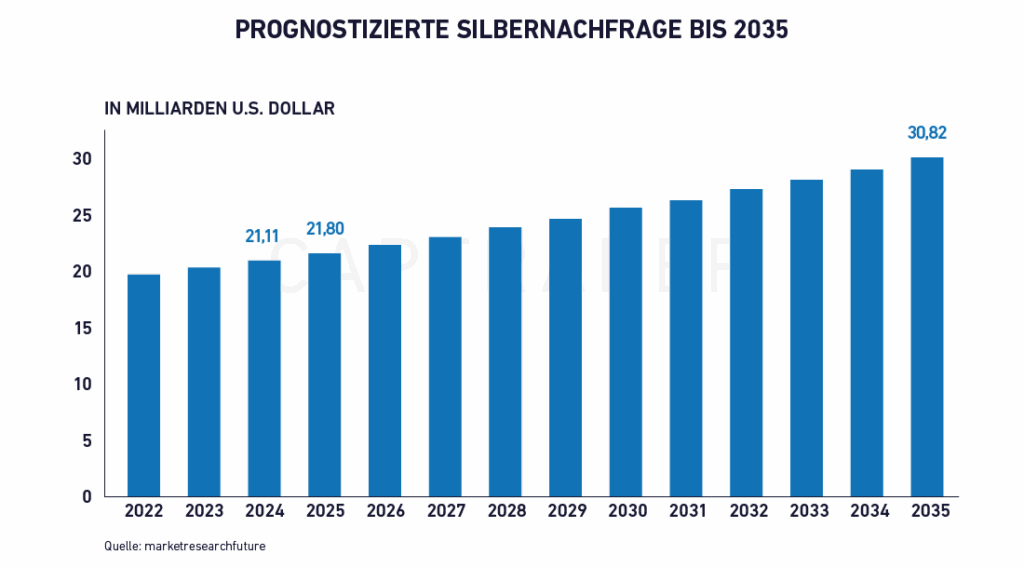
The following chart projects steady growth in the global silver market, from $21.11 billion (2024) to $30.82 billion in 2035. This corresponds to a compound annual growth rate (CAGR) of 3.25%.
Renewable Energies / Solar (Photovoltaics)
Silver remains indispensable for modern solar cells because no other metal offers this combination of conductivity, reliability, and processability. Studies and industry reports paint a clear picture:
- The solar industry could account for approximately 29 to 41% of the global silver supply by 2030.
- Silver demand from the PV industry is expected to increase by about 1.6 to 2.3 times by 2030.
- Silver demand from solar cells alone could rise to 10,000 to 14,000 tons, or roughly 450 million ounces, by 2030 (from about 200 million ounces today).
Despite all efforts to promote „thrifting“ (energy conservation), studies conclude that energy savings only slow down demand but do not reverse it: even with more efficient cells, total consumption is rising because installed PV capacity is growing massively.
If technological development in the solar sector advances as predicted and no massive new silver sources are tapped (or silver is replaced by other materials), demand will far exceed supply by 2030. This has potential implications for the price of silver and the pace of the global energy transition.
Automotive sector / E-mobility
The electrification of transportation is making silver a key component in modern vehicles. Electric cars, in particular, require significantly more electronics and power components than traditional combustion engine vehicles, which noticeably increases the demand for silver per vehicle and across the entire sector.
Studies show that this trend will structurally increase silver consumption in the automotive industry by 2031.
- Projected CAGR (compound annual growth rate) of approximately 3.4% for global silver demand in the automotive industry from 2025 to 2031
- Expected annual silver volume of approximately 94 million ounces by 2031.
- Electric vehicles use an average of 67 to 79% more silver than internal combustion engine vehicles, with about 25 to 50 grams of silver per vehicle.
- Electric vehicles are expected to account for about 59% of automotive silver demand by 2031, replacing internal combustion engines as the main driver.
- Additional requirements for charging infrastructure such as wallboxes and fast charging stations with silver-containing contacts and power components.
Data centers, AI, and electronics
Alongside e-mobility, digitalization is driving a second strong growth pillar for industrial silver demand. Every expansion of cloud services, data centers, and AI infrastructure requires more servers, network technology, and power electronics.
And therefore also more silver-containing contact and functional materials. Silver remains the first choice when it comes to high conductivity, reliability, and signal quality in electronic applications.
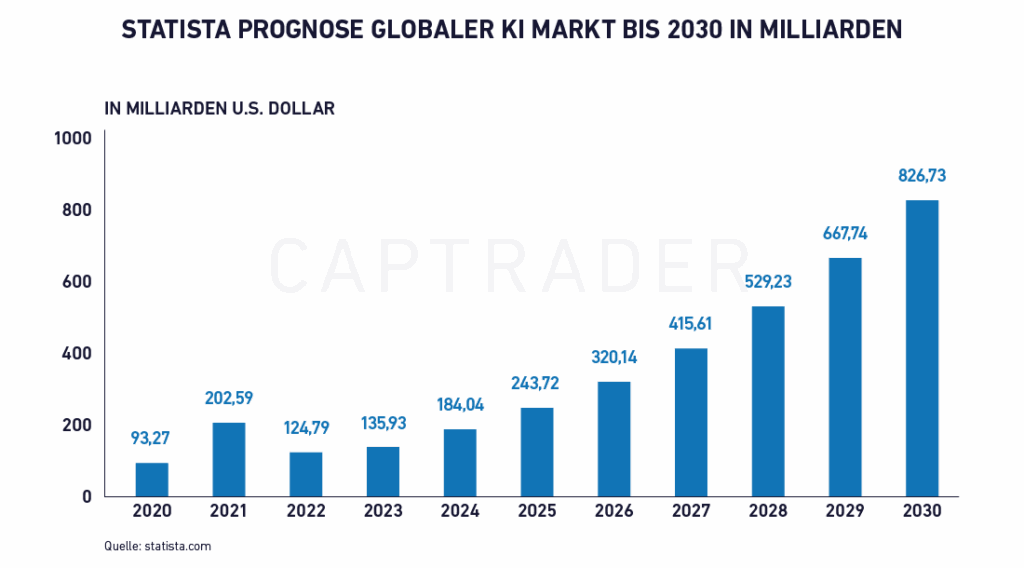
Behind the projected annual AI growth of over 27 % lies a massive expansion of hardware infrastructure. This has a direct impact on the commodities sector, particularly on silver.
To realize the estimated market volume of $826 billion by 2030, vast quantities of new high-performance chips and server components must be produced, driving the demand for silver as a critical material to new heights.
Why doesn't the supply grow at the same pace?
In contrast to the dynamic demand side, fueled by technological leaps like artificial intelligence and photovoltaic energy, the supply side of the silver market is a cumbersome tanker. While the AI industry can scale its capacities within months, raw material extraction reacts in cycles of decades.
This structural inertia leads to a growing market deficit, where annual production simply can no longer keep pace with the rapid hunger of industry and investors.
Limited Mine Production: Stagnation at the Source
Global mining is the backbone of supply, but this backbone is showing significant signs of fatigue. There is no "turn on the tap" in mining.
- Production plateauFor over a decade, global production has stagnated within a narrow corridor between 800 and 850 million ounces. Despite significantly higher prices, the industry has struggled to sustainably break through this mark.
- The burden of the bear marketsBetween 2011 and 2019, the precious metals sector experienced a pronounced phase of weakness. The consequence: exploration budgets were cut, investments in new machinery were forgone, and existing mines were run "to the bone." As a result, the necessary pipeline of new, production-ready projects is now lacking.
- Declining ore grades: A physical problem is exacerbating the situation: the concentration of silver in the rock (grade) is declining worldwide. In recent years, ore grades at many large mines have fallen by an average of about 25%.
The consequence: To extract the same amount of silver, a quarter more rock must be moved, crushed, and chemically processed today, which massively drives up costs (energy, water, labor).
Long development times: The factor of time as the biggest enemy
Even if the decision to open a new mine is made today, that ounce of gold won’t reach the market until the next decade. In the mining industry, "time-to-market" is one of the longest industrial processes there is.
- The "Permitting Marathon": Today, it takes an average of 7 to 15 years from the initial geological discovery to the first commercially mined gram of silver. Strict environmental regulations, lengthy permitting processes, and issues related to social acceptance (ESG) have tended to lengthen rather than shorten this timeframe in recent years.
- Complex Infrastructure: A modern silver mine is a major technological undertaking. It often requires the construction of hundreds of kilometers of roads, power lines, and water treatment facilities in remote regions (such as the Andes or the Mexican mountains).
- Capital intensityFinancing a new project devours hundreds of millions to billions of U.S. dollars before the first ounce can be sold. In an environment of fluctuating interest rates and commodity prices, this is a massive risk that causes many companies to hesitate.


Risk Factors in Silver Stocks: A Detailed Analysis for Investors
Investing in silver stocks offers the opportunity to benefit disproportionately from the performance of this precious metal. However, silver mining stocks are subject to specific risks.
A profound understanding of these dynamics is crucial, as the stock price development of a company can often deviate massively from the purely physical price development of silver.
1. The operating margin trap and cost inflation in silver stocks
The profitability of a mining company is primarily determined by the difference between the realized selling price and production costs. In 2025 and 2026, it became apparent that inflation in the industrial sector was putting pressure on the profit margins of many silver mining stocks.
- Rising energy costsSilver mining is an energy-intensive process. From blasting and transporting the ore with heavy machinery to crushing it in mills, enormous amounts of fuel and electricity are required. If energy prices rise faster than the silver price, the profit margin decreases despite an otherwise positive market environment.
- AISC as a critical benchmark: The so-called all-in sustaining costs (AISC) form the basis for evaluating a mine. This metric includes not only direct production costs but also expenses related to facility maintenance and the exploration necessary to secure future reserves. Companies with high AISC are extremely sensitive to price declines in the silver market.
- Shortage of skilled workers and wage increasesThe shortage of experienced mining engineers and geologists is leading to rising labor costs worldwide. Especially in remote regions, companies must pay significant premiums to retain qualified personnel, which permanently increases fixed operating costs.
2. Geological Risks and Declining Ore Grades
Silver is a finite resource, the extraction of which becomes physically more challenging as a project progresses.
- Degradation of ore gradesExperts worldwide are observing a trend of declining silver concentrations in ore. If a mine yields only 150 grams of silver per ton of rock instead of 200 grams, the company must move and process 33 percent more material to produce the same amount of silver. This inevitably leads to higher costs per ounce.
- Exploration risksThe discovery of new, economically viable deposits is expensive and carries a high degree of uncertainty. Many junior exploration companies invest millions in drilling programs without ever finding a mineable deposit. A failure in resource expansion can lead to a massive loss of confidence on the stock market for smaller companies.
3. Geopolitical Instability and Legal Frameworks
Since silver deposits are location-specific, companies are subject to the respective political and legal conditions of the mining countries.
- Resource nationalizationIn many silver-rich regions, particularly in Latin America, there is a risk of sudden legislative changes. Governments could drastically increase mining taxes or demand state profit participation during economically difficult times. Such interventions fundamentally alter a project's economic calculation.
- Social acceptance and environmental regulationsModern mining is under intense scrutiny. Protests from local communities concerning water consumption or environmental impacts can lead to months of production downtime. Furthermore, international standards are demanding increasingly stringent ESG criteria, the implementation of which requires high investments in new filtration technologies and land reclamation projects.
4. Financial risks and currency effects
The balance sheet structure of a silver company often determines its survival during periods of weakness.
- Currency mismatchSilver is traded on the world market in US dollars. However, the costs for mining operators are usually incurred in the local currencies of the producing countries, such as the Mexican Peso or the Australian Dollar. If the local currency appreciates against the US dollar, the production costs for the operator increase purely arithmetically, which reduces profitability.
- Cost of capital and debtThe construction and expansion of a mine consume enormous sums. In times of high interest rates, financing such projects becomes significantly more expensive. Companies with high debt levels, in particular, come under pressure when the interest burden exceeds operating cash flows.
Summary of Risk Structure by Company Type
| Risk factor | Senior Producer (Large Corporations) | Junior Explorer (Auditing Company) |
| Financial strength | High due to diversified revenue streams | Low, often reliant on capital increases |
| Operational risk | Chargeable across multiple mines | Very high, since it is often just a single project |
| Permissions | Established processes in place | High uncertainty due to bureaucracy |
| Markthebel | Strong lever on the silver price | Extreme leverage, but high risk of loss |
As an investor, when choosing silver stocks, you should therefore not only look at price forecasts for the metal but also conduct a detailed analysis of the production costs and political stability of the respective locations.
A healthy mix of established producers and speculative explorers can help balance the sector's specific risks.
A Overview of the Best-Known and Largest Silver Stocks
The following list gives you an overview of a selection of stocks from companies involved in the exploration, development, and production of silver. All values are sorted by market capitalization (as of April 2026).
Here is the updated overview of leading silver companies worldwide, sorted by market capitalization. This list includes both primary mining companies and specialized streaming companies that form the foundation of the silver stock market.
Top 10 Silver Stocks Worldwide by Market Capitalization
| Company | ISIN | Country | Market capitalization in US dollars 1 |
| Wheaton Precious Metals | CA9628791027 | Canada | 67.2 billion |
| Fresnillo plc | GB00B2QPKJ12 | Mexico / UK | 36.9 billion |
| Pan American Silver | CA6979001089 | Canada | 24.6 billion |
| Coeur Mining | US1921085049 | USA | 21.9 billion |
| Hecla Mining | US4227041062 | USA | 13.2 billion |
| First Majestic Silver | CA32076V1031 | Canada | 10.6 billion |
| Fortuna Silver Mines | CA3499151080 | Canada | 3.3 billion |
| MAG Silver Corp. | CA55903Q1046 | Canada | 2.6 billion |
| Aya Gold & Silver | CA05466C1095 | Canada | 2.6 billion |
| SilverCrest Metals | CA8283631015 | Canada | 1.5 billion |
Before you can specifically invest in silver stocks, you need to open a securities account to participate in the global commodities market. A precise step-by-step guide to Open an account find in the detailed guide from CapTrader, where you will also benefit from particularly advantageous Trading fees benefit.
For building your portfolio, the proven approach is recommended Core-satellite strategy as a solid foundation: In this approach, stable core holdings form the core of the portfolio, while riskier growth stocks are added to optimize returns.
This investment concept is universally applicable and can be used effectively for silver mining stocks as well as AI shares, Bank stocks, Tourism stocks or Oil stocks apply.
In the following section, we will introduce you to selected silver stocks in more detail, which could be lucrative investments in 2026 due to their market position and current industrial demand.
Wheaton Precious Metals
Wheaton Precious Metals (ISIN: CA9628791027) is not a typical mine operator, but rather a Blue chip share and one of the world’s largest precious metals streamers. Instead of building and operating mines itself, Wheaton provides capital to other mining companies and, in return, receives contractually guaranteed shares of future silver and gold production at a predetermined, low price.
| Tax year | estimated revenue (in millions USD) 1 | Change compared to previous year 1 |
| 2025 | 2.315 | 80,18 % |
| 2026 | 4.011 | 73,28 % |
| 2027 | 4.334 | 8,05 % |
Wheaton makes a larger upfront payment to a mine operator plus a small ongoing payment per ounce, but in return, it can purchase a percentage of the production at very favorable costs for years or decades and then sell those metals.
For investors, this means participating in the precious metal price with less operational risk, because Wheaton does not face issues such as labor disputes, floods, or cost explosions in the mines themselves. At the same time, the long-term streaming contracts ensure predictable cash flows and high margins, so Wheaton is often seen as a kind of „more stable alternative to mining stocks“ in the precious metal sector.
2. Fresnillo plc
Fresnillo plc (ISIN: GB00B2QPKJ12) is one of the world's largest primary silver producers and also a significant gold producer, with a clear operational focus in Mexico. The company controls several large mines, development projects, and exploration areas along Mexico's „Silver Belt,“ a geologically rich silver region.
| Tax year | estimated revenue (in millions USD) 1 | Change compared to previous year 1 |
| 2025 | 4.561 | 30,45 % |
| 2026 | 6.656 | 45,92 % |
| 2027 | 6.646 | -0,14 % |
Fresnillo's core business is the mining of silver and gold, often extracted from lead and zinc concentrates, with revenues predominantly derived from these two precious metals and further supported by by-products. A characteristic feature is the focus on large, extensive deposits with substantial reserves, which analysts estimate will enable production for decades.
The business model is strongly margin-oriented: Fresnillo relies on efficient production, economies of scale, and cost control to remain profitable even with weaker precious metal prices and to profit disproportionately from price upturns. For investors, Fresnillo is therefore a classic blue-chip producer that simultaneously offers leverage on silver and gold without the speculative nature of smaller explorers.
3. Pan American Silver
Pan American Silver (ISIN: CA6979001089) is a highly diversified silver and gold producer with mines in Peru, Mexico, Argentina, and Bolivia. The company covers the entire value chain, from exploration and development to mining and reclamation of mineral properties.
| Tax year | estimated revenue (in millions USD) 1 | Change compared to previous year 1 |
| 2025 | 3.619 | 28,38 % |
| 2026 | 5.170 | 42,87 % |
| 2027 | 5.093 | -1,49 % |
In its core business, Pan American operates in several segments: silver, gold, and an „other“ category where metals like zinc, lead, or copper are accounted for as by-products. This multi-metal model provides the company with additional revenue streams and reduces its dependence on the pure silver price.
Of particular interest is the company’s strategic focus on Latin America, where it has significantly expanded its production base in recent years following several acquisitions. For investors, Pan American Silver is thus a well-diversified producer with a broad geographic and metal portfolio, yet one that maintains a clear focus on silver, making it a solid „core holding“ in the silver sector.
4 First Majestic Silver
First Majestic Silver (ISIN: CA32076V1031) is considered one of the best-known pure-play silver stocks and is often traded in the markets as a „high-beta silver play,“ meaning a highly leveraged bet on the price of silver. The company operates several silver mines, primarily in Mexico, including well-known projects such as San Dimas, Santa Elena, and La Encantada.
| Tax year | estimated revenue (in millions USD) 1 | Change compared to previous year 1 |
| 2025 | 1.248 | 115,56 % |
| 2026 | 1.918 | 53,66 % |
| 2027 | 1.797 | -6,29 % |
First Majestic’s core business is clearly focused on silver, although a portion of its production is reported as silver equivalent (i.e., including the gold content). It is noteworthy that, in addition to mining, the company also produces and directly markets its own bullion, which gives it a certain brand presence among precious metal investors.
Due to its heavy dependence on the price of silver and its focus on a small number of core projects, the stock often reacts disproportionately to price movements in either direction. For your readers, First Majestic is therefore the typical stock for investors who are willing to accept high volatility in order to reap above-average returns in the event of a potential silver supercycle.
5. Aya Gold & Silver
Aya Gold & Silver (ISIN: CA05466C1095) is a relatively young but dynamically growing silver producer with a clear regional focus on Morocco. The company sees itself as a „pure-play silver producer“ with a portfolio of projects ranging from producing mines to exploration areas. At the center is the Zgounder silver mine, which is one of the few pure silver mines in Africa and is considered the group's core project.
| Tax year | estimated revenue (in millions USD) 1 | Change compared to previous year 1 |
| 2025 | 202,1 | 416,66 % |
| 2026 | 460,4 | 127,81 % |
| 2027 | 479,1 | 4,07 % |
Aya is pursuing a strong growth-oriented strategy: the capacity of Zgounder is continuously being ramped up through expansion projects, with the company aiming for an annual production in the high single-digit million ounces range in the medium term. In parallel, an extensive exploration program with tens of thousands of meters of drilling is underway to define additional resources in the vicinity of the existing mine and in other areas.
Particularly exciting is the „first-mover position“ in Morocco: Aya benefits from a relatively mining-friendly environment in which only a few international silver producers have been active so far, thus enabling it to take on a pioneering role in the North African silver sector.
CapTrader can do that:
At CapTrader, the trading fees are extremely low: you can trade US shares from as little as $ 0.01 per share (order minimum $ 2.00) and German shares from as little as 0.1 % of the order volume (order minimum €2.00), options from €2.00, futures from €1.00, ETFs from €2.00 and much more!


Conclusion: Are silver stocks worth it in 2026?
Silver stocks could be interesting for investors in 2026 because they could benefit from both a potential price increase and long-term megatrends such as the energy transition, electrification, and digitalization.
The interplay of structural supply shortages, growing industrial demand, and robust investment demand suggests a continued attractive risk-reward profile for the sector.
At the same time, the sector remains clearly cyclical: rising production, energy, and ESG costs, declining ore grades, and politically sensitive mining countries can significantly impact margins and prices. Therefore, investors in silver stocks should pay attention to solid balance sheets, low all-in sustaining costs (AISC), and politically stable mining regions, as well as diversify their positions broadly.
As a supplement to a diversified portfolio, large producers and streaming companies can form the core, complemented by smaller growth stocks or explorers for additional return opportunities, ideally through a low-cost, international depot like CapTrader, which facilitates access to global commodity stocks.
List of sources:
Marketscreener from 04/15/26
