Kamala Harris or Donald Trump? The 2024 US presidential election is considered one of the highlights of the current year and has been casting its shadow for months. The elections are attracting a great deal of attention not only in the US but also worldwide and are therefore likely to set the course for the global economy and thus act as a decisive driver for the global financial markets. Below you will find all the background information on the US election and what influence it could have on current market developments.
The most important facts in brief:
- The US presidential election 2024 will take place on 04.11.2024 - Kamala Harris (Democrat) and Donald Trump (Republican) will compete against each other
- While Kamala Harris increasingly stands for social justice and climate protection, Donald Trump is pursuing an "America First" strategy, which could result in a trade war with China and Europe, among other things
- Volatility could remain high in the run-up to and after the elections
- Impacts on stock markets, commodities and crypto assets in particular are conceivable
Election basics
The elections for the future and 60th US President will take place on November 5, 2024. Following the withdrawal of current President Joe Biden, current Vice President Kamala Harris (60) from the Democratic camp is running against former President and Republican Donald Trump (78).
Worth knowing: Tim Walz is considered a candidate for the office of Vice President should Kamala Harris win the race.
James David "JD" Vance is likely to become Vice President if Donald Trump wins the election.


Election poll: neck-and-neck race between Kamala Harris and Donald Trump
A classic neck-and-neck race is emerging between Kamala Harris and Donald Trump. According to the industry portal Predictlt, Trump is currently 56 pence ahead of Harris (48 pence). (As at: 20.10.2024)
However, since mid-July, when the current US President Joe Biden announced his resignation, both candidates have been more or less on an equal footing.
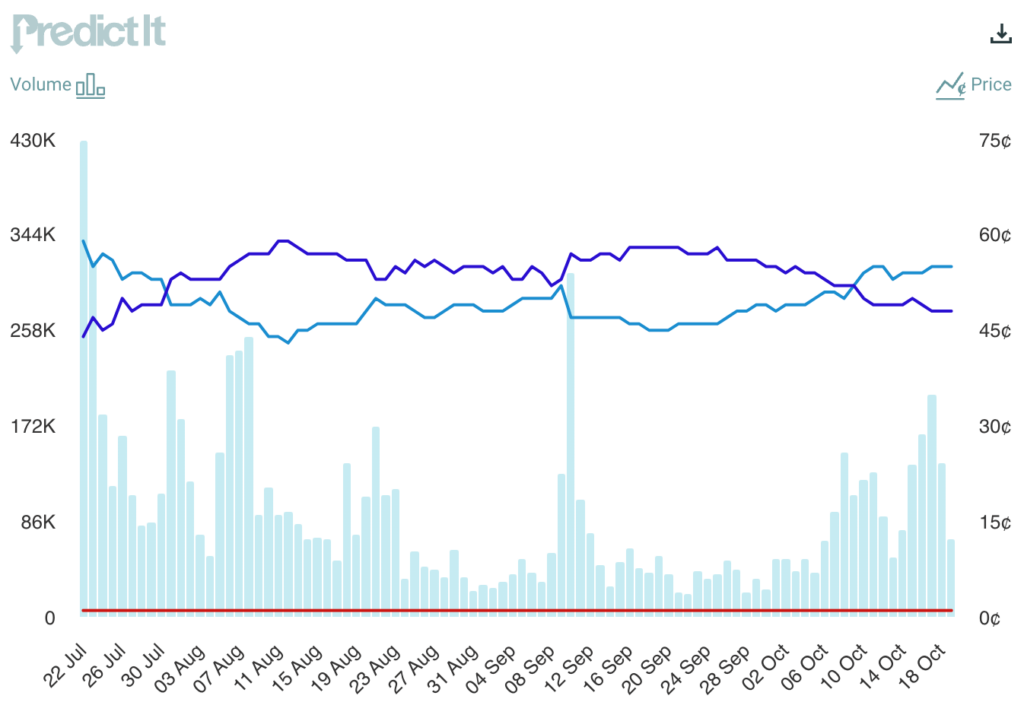
Source: https://www.predictit.org/markets/detail/7456/Who-will-win-the-2024-US-presidential-election(as at: 20.10.2024)
Bitcoin - The "Trump barometer"
The development of the Bitcoin price can also be seen as a possible "Trump barometer". As Trump is seen as a crypto-friendly US president, an election victory for the 78-year-old could benefit the crypto sector, whereupon investors could anticipate a re-election and thus stock up on Bitcoin. In October alone, the leading crypto asset gained around nine percent in value.
However, investors should not overestimate the development of the Bitcoin price in relation to the US election. Influencing factors such as the prospect of further interest rate cuts in the US should not be neglected.
Bitcoin Chart
VIX: The "fear index"
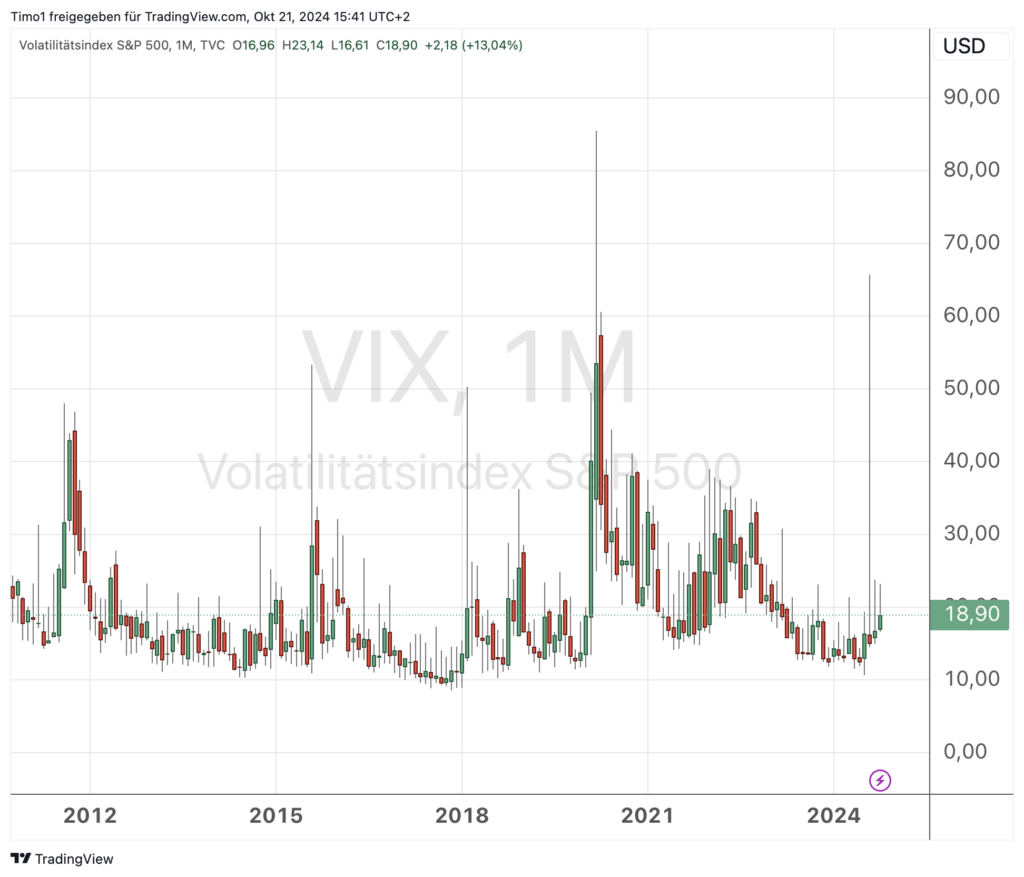
The "VIX Index" is also regarded in investor circles as the so-called fear index of the stock market. Uncertainty or unrest is consequently reflected in a rise in the VIX and vice versa.
In the past, an increase has been recorded in October in election years. A distinction is made between historical and implied or expected volatility. While the former uses values from the past to measure volatility, the implied counterpart measures the expected fluctuation based on options on an index. In the election years of 2012, 2016 and 2020, for example, the VIX shows that volatility fell significantly in the following month and thus after regulation was introduced.
VIX Chart


Kamala Harris' political positions in business and trade
Kamala Harris stands in particular for social justice and climate protection. From an economic perspective, she wants to strengthen the middle class through tax relief, especially young families and small businesses. However, she does not want to pursue Trump's harsh immigration policy, but rather fair solutions.
The 58-year-old plans to provide relief for the middle class and lower income brackets. The plan is to be financed by raising the corporate tax rate to 28%, which was recently reduced to 21% by Donald Trump.
Worth knowing: Again, Trump wants to reduce the rate to 20 percent if he wins. In Germany, the tax burden on companies is around 30 percent.
Climate investments could also be seen as an opportunity for new jobs. As Vice President, Harris already campaigned for the provision of a 20 billion dollar fund to support disadvantaged communities feeling the effects of climate change.
In addition, the USA would commit to doubling energy efficiency and tripling the capacity for renewable energies by 2030, as Harris announced at the World Climate Summit in Dubai.
In terms of foreign policy, it wants to strengthen international alliances such as NATO. However, China's influence is to be curbed.
Donald Trump's political positions on business and trade
Donald Trump stands for an "America First" strategy, which logically pursues US interests in particular. In addition to the introduction of protectionist measures such as tariffs and trade restrictions, Trump is pursuing a strict immigration policy and tax breaks for companies and the wealthy.
In contrast to Harris, Trump is skeptical about measures to combat climate change.
During the election campaign, Trump announced "the biggest tax giveaways in the history of the USA", which are intended to initiate a new economic boom. As in 2017, he wants to build on the "Tax Cuts and Job Act" and reduce income tax and corporate taxation from 21% to 15%.
Existing tariffs are to be increased or new tariffs imposed in order to be able to implement the tax cuts. To bring jobs back to the USA, Trump wants to act true to the motto "America First".
Imports of basic goods from China are to be scrapped in the medium term. The imposition of flat-rate tariffs of 60 percent on Chinese imports is also being considered. Chinese investors should also no longer be allowed to buy US companies. However, US companies should no longer be allowed to invest in China.
Possible impact on the stock markets, commodities and crypto in the event of Kamala Harris' election victory
Stock markets
If Kamala Harris becomes the future President of the United States, this could mean a continuation of a more expansive fiscal policy, which could result in higher government spending and taxes.
Investors should keep an eye on sectors such as the environment and health in particular, as Harris is likely to push for climate protection, among other things.
In contrast to Trump, Harris could focus primarily on trustworthiness and political stability, which should tend to benefit the stock markets.
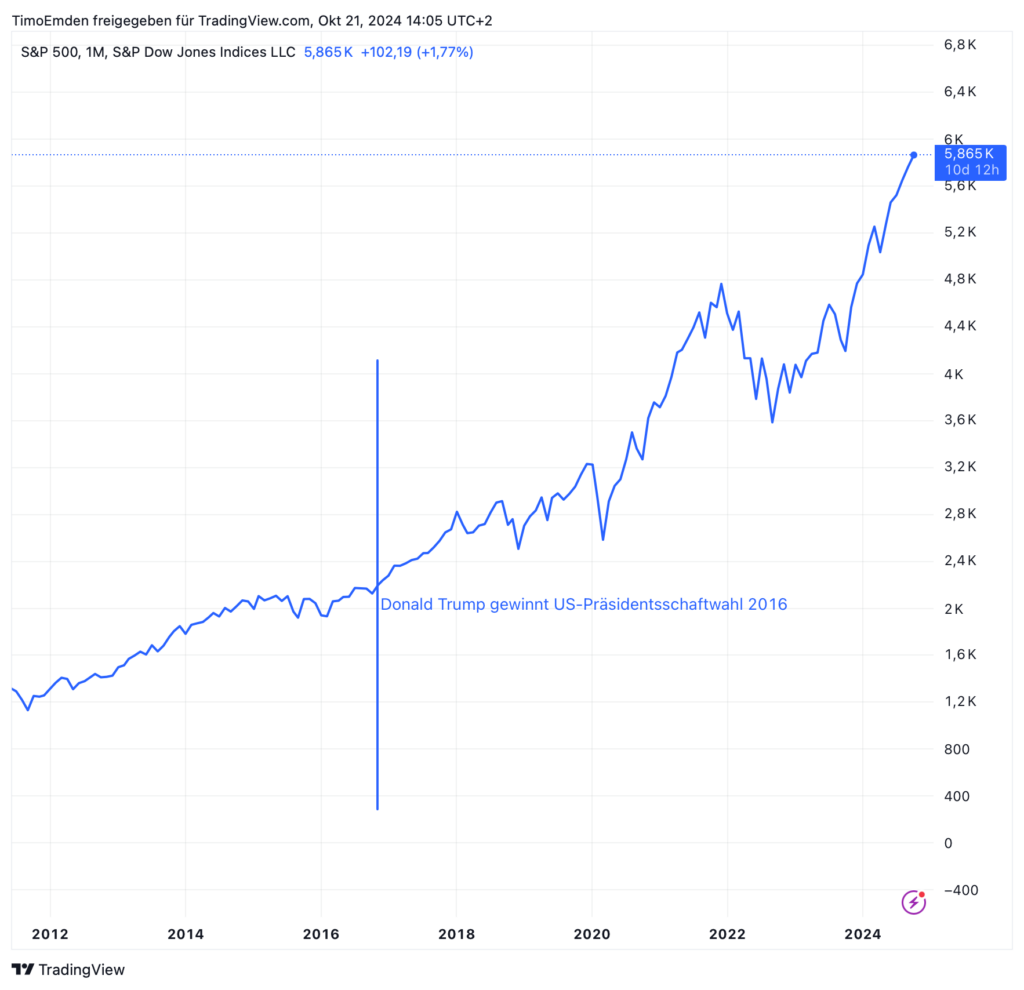
S&P 500 Chart


Raw materials
As Kamala Harris stands for climate protection, an election victory could have an impact on the commodities markets. As a result, renewable energies could benefit and thus boost demand for raw materials such as copper or lithium, which are used in green technologies.
Harris could also significantly increase spending on infrastructure, which suggests increased demand for industrial metals such as aluminum, copper and steel.
Bitcoin
The crypto sector could also benefit from Harris. In the past, she has been open to Bitcoin and the like and therefore less strict than the Biden government. According to her, a regulatory framework should promote innovation but also ensure consumer protection. In her opinion, a transparent set of rules is important in order to create a secure environment.
Possible impact on the stock markets, commodities and crypto in the event of Donald Trump's election victory
Stock markets
A Trump administration is likely to cut corporate taxes and loosen regulations, which should fuel hopes of rising corporate profits. It is also possible that Trump, who stands for low interest rates, could exert pressure on the Federal Reserve (Fed) to push ahead with an expansive monetary policy. The prospect of falling capital market interest rates should increase the attractiveness of interest-bearing investments such as US government bonds.
Trump's planned trade and foreign policy should not be neglected. Should tensions arise between China and the eurozone, this could have a negative impact on the stock markets.
However, the risks that a possible Trump administration would entail should not be underestimated. A protectionist policy on the part of Donald Trump through the introduction of tariffs or restrictions on immigration could be detrimental to economic growth and at the same time fuel inflation. The planned tax cuts are also likely to widen the budget gap.
Raw materials
As Trump wants to rely on fossil fuels such as crude oil, this could benefit the entire oil industry. If an expansive energy policy is pursued, this could result in a rise in the price of oil. In 2023, the USA was the world's largest producer of crude oil, behind Russia and Saudi Arabia. However, an oversupply of crude oil due to less regulation could also have a negative impact on the price of oil and thus also reduce the profits of energy companies.
As the 78-year-old wants to introduce tariffs on imports, for example, this is also likely to have an impact on commodity prices.
In addition, many commodities are quoted in US dollars, so investors should not underestimate Trump's influence on the greenback.
The precious metal gold could also benefit if Trump wins the election. In times of political uncertainty, investors are likely to continue to buy the yellow precious metal.
Bitcoin
At a crypto conference in Nashville (Tennessee), Donald Trump promised to make the United States the leading nation for crypto assets. At the same time, he wants to dismiss the chairman of the Securities and Exchange Commission (SEC), Gary Gensler. Gensler is considered to have an extremely restrictive attitude towards Bitcoin and the like. Bitcoin is also to be used as a strategic national reserve.
Surplus energy from power plants is also to be used for Bitcoin mining.
In 2019, however, Trump still referred to Bitcoin as a "scam". The change in his stance in 2024 could be seen as a political move to win votes. Whether the promises made in advance will actually be kept at the end of the day remains to be seen.
Summary: The US election sets the course for the global financial markets
The election of the future US president has the potential to decide the weal and woe of the financial markets not only until the end of the year, but also far beyond. Investors should be prepared for increased volatility not only before the event, but also in the days and weeks following November 5.
While Kamala Harris from the Democratic camp would increasingly tackle issues such as climate protection and social justice, Republican Donald Trump is likely to pursue a protectionist "America First" strategy.
In this context, a wide variety of effects on stock markets, individual stocks, commodities and crypto assets are conceivable.
Compared to the 2016 US election, investors should also bear in mind that Donald Trump's election as US president in this period would not come as a major surprise. Various election polls have been signaling a neck-and-neck race for months.