Dear traders, dear stock market friends.
The Nasdaq had one of the most turbulent trading weeks of the year. The sell-off continued even before last week's central bank meeting and accelerated again immediately after the Fed meeting from Wednesday evening, before a strong rebound followed on Thursday.
In addition to the Fed meeting, the quarterly results of the big tech companies were also in focus. Microsoft and Meta reported on Wednesday evening, Apple and Amazon on Thursday evening, with very different stock reactions.
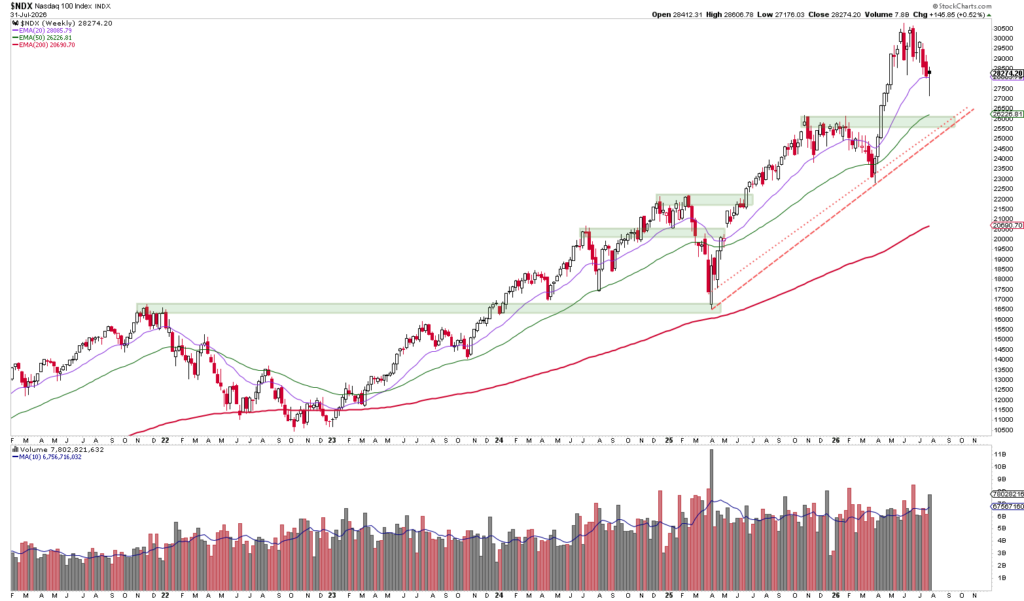
Nasdaq 100 defends weekly EMA 20
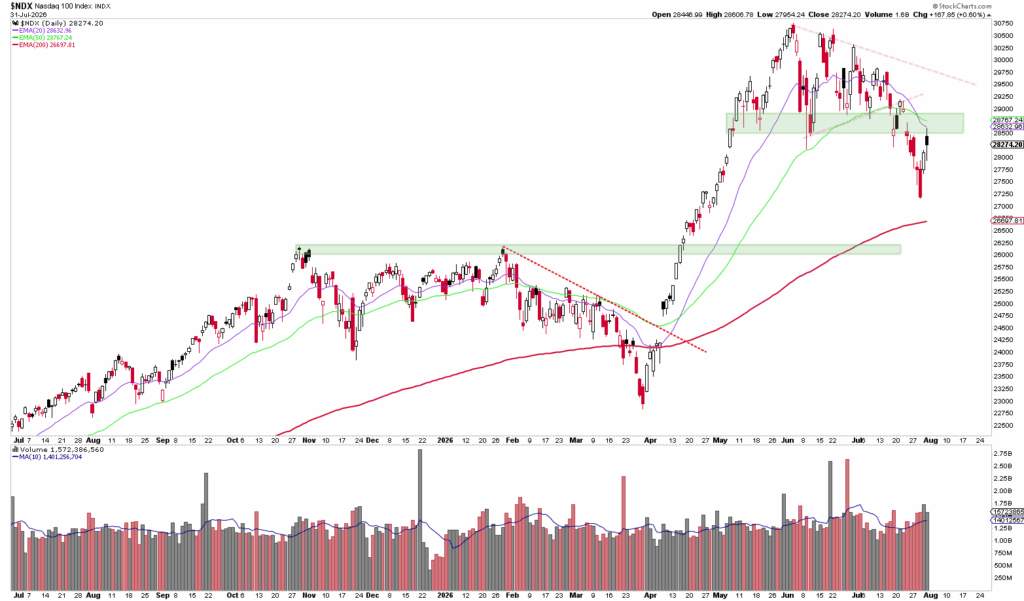
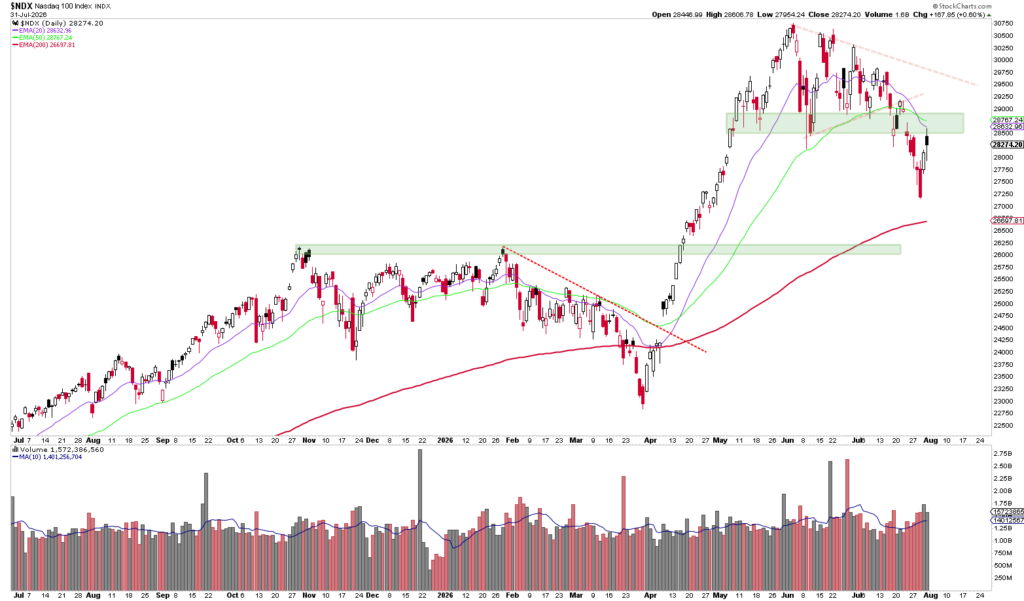
Following the breakdown of support at 28,600 to 28,800 points, the downward movement continued at the beginning of last week and even accelerated. From the previous week's closing price of 28,128 points, the Nasdaq 100 fell back to 27,192 points by Wednesday evening's close. The index lost a good two percent on Wednesday alone. From the all-time high of 30,762 points in June, this represented a decline of almost twelve percent.
On Thursday, a strong counter-movement then set in, which led to a 3.4 percent increase and, together with follow-on buying on Friday, completely neutralized the previous price losses from the first half of the week.
Nevertheless, a loss of around 6.6 percent is recorded for the entire month of July, the weakest month for the Nasdaq 100 since March 2025.
From a technical analysis perspective, breaking the aforementioned support opened the way down to the 200-day line, which is currently at around 26,700 points. However, thanks to the turnaround on Thursday and Friday, the Nasdaq 100 was able to close back above the 20-week EMA.
However, this is not yet a final clearance. As long as the previously broken support, which is now acting as resistance, is not recaptured, the technical chart picture remains shaky, and the danger of a renewed downward movement persists. Only a sustainable recapture of the 28,750 mark, including the daily EMA 20 and 50, would significantly brighten the chart picture again.
Central bank surprises with lack of transparency
The Fed left the benchmark interest rate unchanged for the fifth consecutive time on Wednesday, keeping it in the 3.50 to 3.75 percent range. Thus, an interest rate hike did not occur. However, the voting pattern was noteworthy: the decision was made by a vote of 9 to 3. Beth Hammack, Neel Kashkari, and Lorie Logan voted for a 0.25 percentage point increase. Three dissenting votes in the same direction were last seen in September 2016.
Fed Chairman Kevin Warsh's subsequent press conference then provided markets with exactly what they needed least: no guidance. There was again no forward guidance, and Warsh consistently avoided giving any signal about the September meeting. He answered journalists' questions evasively, referring to the data. The statement deliberately refrains from making forecasts; market participants should react to data, not the central bank. He did not reveal his hand regarding the future interest rate path. He was only clear on the inflation target: there is no soft target, only one, namely two percent, and five years of inflation above target cannot be cured in nine weeks.
10-year and 30-year yields rise significantly
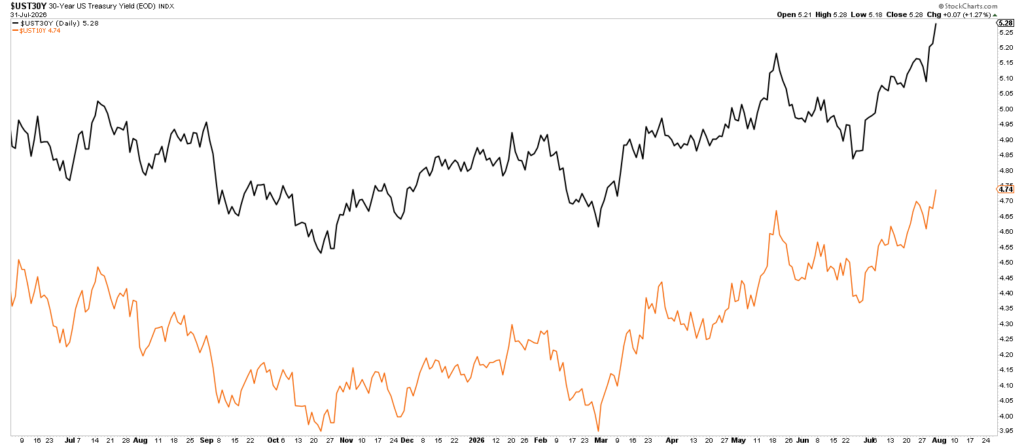
The reaction in the bond market was clear. The yield on ten-year US Treasury bonds rose by about eight basis points to 4.69 percent, and the thirty-year yield climbed above 5.2 percent. High bond yields thus remain one of the most significant potential dangers, especially for technology stocks.
Liquidation of hedge fund increases volatility
Volatility was further amplified by another event: the forced liquidation of the AI hedge fund Situational Awareness. Leopold Aschenbrenner's fund was positioned with up to four times leverage on AI infrastructure and memory chips (including SK Hynix, Nebius, CoreWeave, Sandisk, and Micron), while simultaneously holding short positions in software stocks like Adobe.
Both sides were coming after him. Following margin calls from Goldman Sachs, JPMorgan, and Bank of America, the entire public stock portfolio was sold to Citadel in a single block trade before the market opened on Thursday. This marked the concrete source of the selling pressure visible in storage chip and infrastructure stocks in the preceding days.
With the completion of the transaction, the largest forced seller disappeared from the market, and the counter-movement began precisely from that point. Such liquidations, as a rule, often mark local extremes because the selling pressure is technically driven and not fundamental.
Big Tech companies' quarterly results in focus
In the last two weeks, five of the Magnificent Seven have released their quarterly earnings. The market has neatly sorted them into winners and losers. The dividing line wasn't along the amount of AI investment, but along the question of whether these expenditures are already being met with visible revenue.
- Microsoft delivered the strongest forecast. Revenue rose 18 percent to $90.0 billion in the fourth fiscal quarter, and the Azure business grew 43 percent, its fastest pace since early 2022. The order backlog climbed 84 percent to $678 billion. The stock jumped about 15 percent on Thursday, the company's biggest ever daily gain, and carried the index almost single-handedly.
- Amazon The stock rose on Friday. The company's revenue increased by 20 percent to $200.6 billion, and AWS grew by 37 percent to $42.2 billion; the strongest growth in 18 quarters. The fact that the investment forecast for 2026 was simultaneously raised from $200 billion to $220 billion did not bother anyone, because the order backlog of $496 billion proves the demand. The stock closed up a good 15 percent.
- On the other side stood Meta and Apple. Meta's revenue increased by 28 percent to $60.8 billion, but earnings per share fell significantly short of expectations. The free cash flow, in particular, made negative headlines: it plummeted by 91 percent to $784 million, while the capex forecast was raised to $130 to $145 billion. The stock lost about eight percent. Apple, in turn, reported a record quarter with $109.4 billion in revenue, but disappointed with an outlook of nine to eleven percent growth. Retiring CEO Tim Cook cited memory chip shortages as a significant issue. The stock plunged by about 7.4 percent on Friday, and several analysts lowered their price targets.
- The kickoff already took place last week Alphabet achieved 82 percent growth in the cloud, but a negative free cash flow for the first time since its IPO in 2004 and an increased investment forecast of 195 to 205 billion US dollars. This was also followed by a stock price drop of around seven percent, before the stock gained a good six percent again on Friday.
Author: Tobias Schmid
Date: 08/03/2026