Dear traders, dear stock market friends.
The Dow Jones ended the last trading week with a decline of around 0.9 percent. Although the index itself also fell, it performed significantly better than the Nasdaq 100, which lost around 2 percent over the course of the week. The development on Friday was even more striking: While the Nasdaq fell by 2.9 percent, the Dow Jones only lost 1.1 percent.
Behind this relative strength lies primarily an increasing rotation within the stock market. While large technology and AI stocks were once again sold off heavily, capital flowed into other sectors. The Russell 2000 even rose by 1.3 percent over the week, and the balanced S&P 500 also rose by around 0.8 percent. Nine of the eleven major S&P sectors ended the week in positive territory.
The tech sell-off thus looks much more dramatic than the development of the overall market.
Tech sales hit the Dow significantly less
The selling pressure of the last week focused primarily on the major technology and AI stocks. Alphabet lost around 12.6 percent over the week, after weaker search revenue and again very high investments in AI infrastructure raised doubts about whether the billions of dollars invested would pay off quickly enough. Amazon, Nvidia and Salesforce also came under pressure.
On Friday, the sell-off intensified again. Intel plummeted by almost 29 percent following the quarterly results, AMD lost nearly 11 percent, and Nvidia more than 4 percent. The Nasdaq thus recorded its strongest daily loss since early June.
CHART
The Dow could not completely escape this development. In addition to Alphabet, Caterpillar, Boeing and Salesforce were among the biggest losers in the index. Caterpillar lost 9.4 percent, Boeing 8.9 percent and Salesforce 7.8 percent. Among other things, Boeing was burdened by weaker production prospects and a disappointing free cash flow outlook.
Nevertheless, the overall damage to the Dow remained manageable.
Financial and health data support the Dow Jones
The reason for this is evident when looking at the individual Dow indices. 16 of the 30 stocks rose over the course of the week, while 14 fell. Healthcare stocks, basic consumer goods, and financial stocks performed particularly well.
Amgen gained around 6.1 percent, McDonald's 3.9 percent, Nike 3.7 percent, Johnson & Johnson 3.6 percent and Walmart 3 percent. Goldman Sachs, American Express and JPMorgan were also among the winners. Within the Dow, healthcare stocks rose by an average of around 2.4 percent and financial stocks by about 1.6 percent.
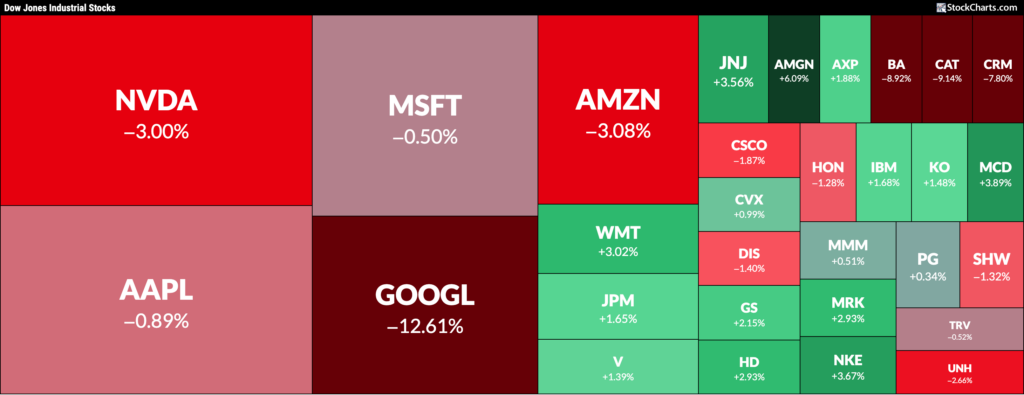
What is particularly interesting here is once again the pricing weightings of the Dow. A few high-priced stocks can significantly move the entire index. Therefore, despite the many winners, Caterpillar and Alphabet were among the biggest contributors to the decline.
But even more important is the overall picture: The tech sell-off has not yet developed into a broad pullback from stocks. This rotation is also evident outside the Dow. The S&P 500 Equal Weight Index rose by 0.8 percent last week, despite the normal S&P 500 losing 0.6 percent. Over the entire month of October, the Equal Weight Index even gained nearly 5 percent.
Therefore, the current development speaks more to a shift within the market than to a true risk-off mode.
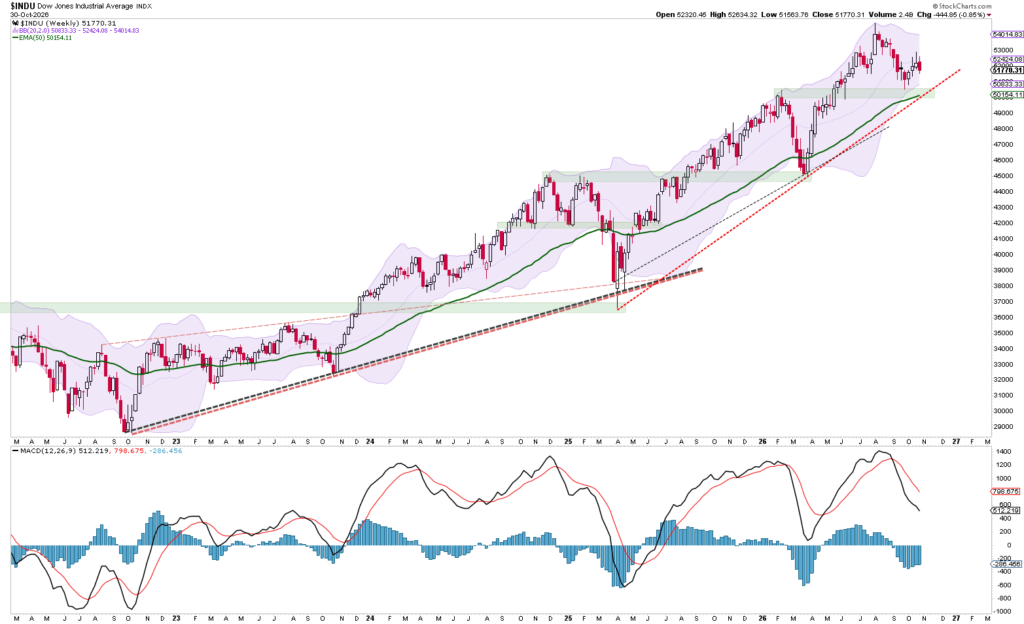
The Dow Jones is above 51,500 points
Chart-technically, the Dow continues to be in a correction, which is however significantly less pronounced than in the Nasdaq.
At the end of the week, the index stood at 51,770 points. The range around 51,500 points thus initially forms a short-term support. The zone between around 50,500 and 51,000 points is once again coming into focus under this. The 200-day line currently also runs in this area at approximately 50,650 points.
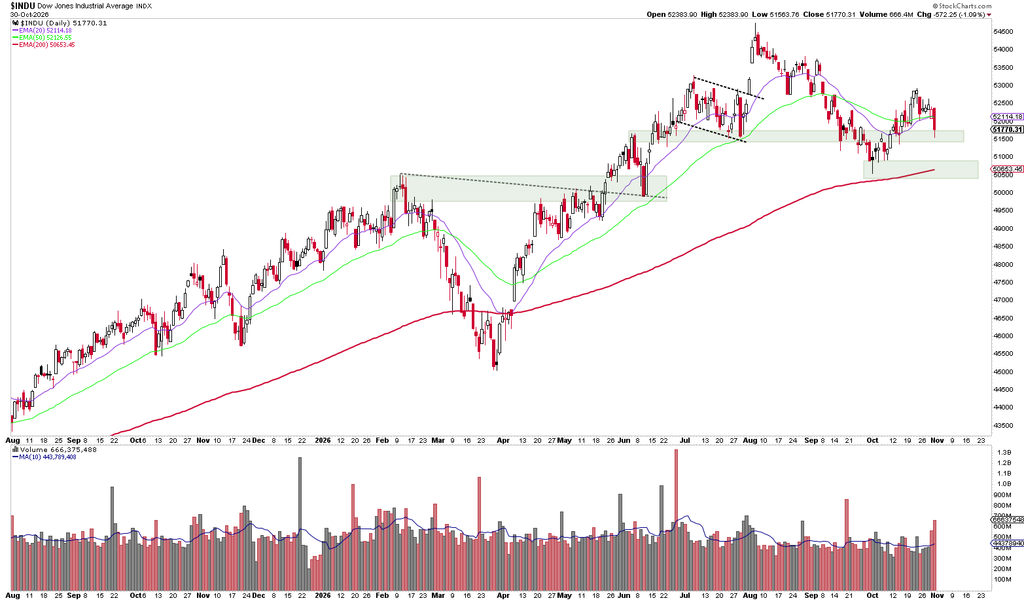
On the upside, the first important resistance area lies between about 52,500 and 52,650 points. The Dow has already failed to break through this level several times in the past week.
As long as the index remains above the 200-day line, the long-term upward trend remains intact. However, for a renewed attack on the all-time high at just under 54,750 points, the Dow would first have to rise sustainably above 52,500 points.
Apple, US elections and the labor market in focus
The new trading week also has plenty to offer. Already on Monday after the stock market closed, Apple will release its quarterly results. After the strong sell-off in many other tech stocks, it will be interesting to see whether Apple can continue to perform better and how the company assesses the outlook for the Christmas quarter.
The US midterm elections will follow on Tuesday. Also on Tuesday, AMD will report after the close of trading, while Palantir will already publish its quarterly results on Monday.
At the end of the week, the focus will once again be on the labor market. On Friday, the U.S. labor market report for October will be released. After the Fed left the key interest rate unchanged last week at 3.75 to 4.00 percent, the new labor market data are expected to be particularly important for the question of whether a further interest rate hike will follow in December.
Author: Tobias Schmid
Date: 02.11.2026