


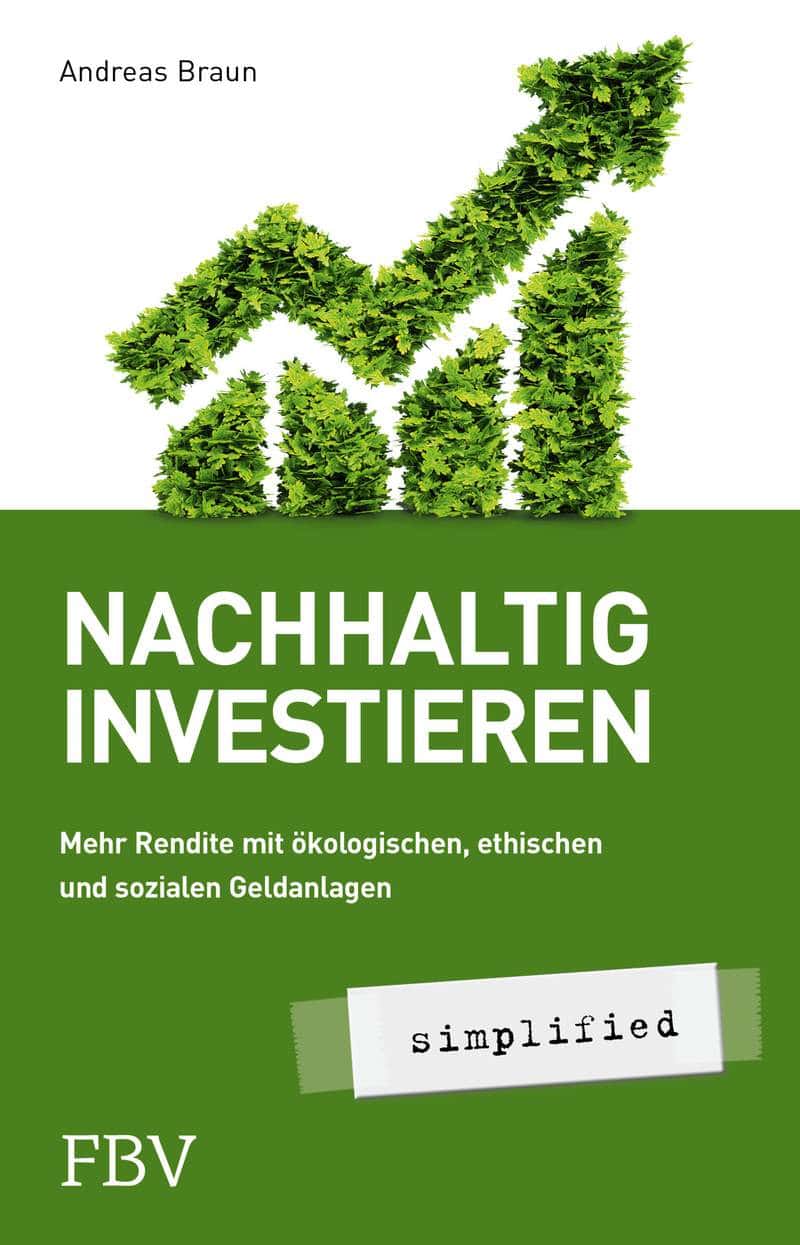
by Andreas Braun is a really good and easy-to-understand work on an increasingly relevant topic. Because more and more investors are asking themselves how they can also protect their ethical and sustainable standards without sacrificing yield or diversification.
In this work, too, it quickly becomes clear that sustainable investing is almost automatically accompanied by increased effort. In particular, the more one searches and filters the market according to one's own more or less strict criteria. In this context, the subtitle of the book is not only not entirely correct, but may also be somewhat misleading. After all, sustainable investing has and should primarily have nothing to do with wanting to achieve higher returns.
Moreover, if we reduce the number of stocks and funds that are basically eligible - in line with our preferences - we must assume that we will probably only keep the same expected return, but that our risk will increase slightly due to lower diversification. The author himself emphasizes this in many places, but it still seems somewhat misleading in the subtitle. Particularly in the area of sustainability, narrow preferences run the risk of selecting more and more companies with similar performance, which then hardly have any diversification effects in a large number.
"More return with ecological, ethical and social investments", therefore, should not be the focus, but rather "Invest money according to your own environmental, ethical and social preferences."
A good conscience and respectable returns do not have to be mutually exclusive when it comes to investing. With his work in the simplified series of the Finanzbuchverlag, which I already know very well, Andreas Braun wants to provide orientation. Because hardly anything is as individual as "sustainable investing". What is sustainable for me does not necessarily apply to the vast majority and certainly not to any other individual. And although the market for sustainable funds is growing, the complexity is also increasing.

Different concepts of sustainability and very different approaches to filtering and selection do not always make it easy to find the right product for oneself and one's own preferences. What should go in, what should come out, what should at least be the "best" and what should at least not be the "worst" companies? All questions about questions, which certainly do not make investing easier and more relaxed.
Andreas Braun, for his part, has worked for more than 15 years as a financial journalist and as an expert on sustainable investment products for the ARD stock market portal. He sheds light on the diverse products and points out possible risks. This goes far beyond the right fund and the right shares, to the right bank and the appropriate green depot.
Sustainability is the trend. There's no denying that. There are a lot of good reasons to focus more on sustainability in private investments: Climate change is threatening our livelihoods. Companies often exploit the earth's resources, but also their employees, or manufacture products that are ethically questionable. Many countries are rife with corruption and nepotism. However, it should never be the intention to mindlessly follow a trend, but to have deeper reasons to back it. In this context, the possibilities are manifold:
"Investors can invest directly in environmental projects such as wind farms, water parks or solar parks. They can participate in companies that operate sustainably or manufacture corresponding products simply by buying their shares. By purchasing green bonds, bonds issued by governments or companies, they can help finance specific environmental or social projects. A large number of investment funds bundle shares or bonds in their fund portfolios that take sustainability criteria into account. The fund shares can be purchased directly from the fund company or traded on the stock exchange. Microcredits can be used to provide direct support to people in less developed countries who want to build up an existence there as craftsmen or farmers, for example. It is also possible to exert a direct influence on the management of certain companies or to invest in certain sectors of the economy and technologies. As a so-called impact investor, one can target the concrete impact of one's own financial investment. For savers, even "green" savings bonds or overnight and time deposits are an option. In doing so, the banks must ensure that only environmental projects are supported with the savings in question."
Andreas Brown
For investors, this is an unmanageable variety of options in many places. In addition, the question often arises as to how sustainable the sustainable product actually is. The various approaches and seals are not always self-explanatory. Very different approaches can be taken under the sustainability label, because the topic is so individual.
This book is intended to help with the understanding of sustainability. But also in the evaluation and selection of investment opportunities, the assessment of individual products and the sensible composition of a sustainable private portfolio.