


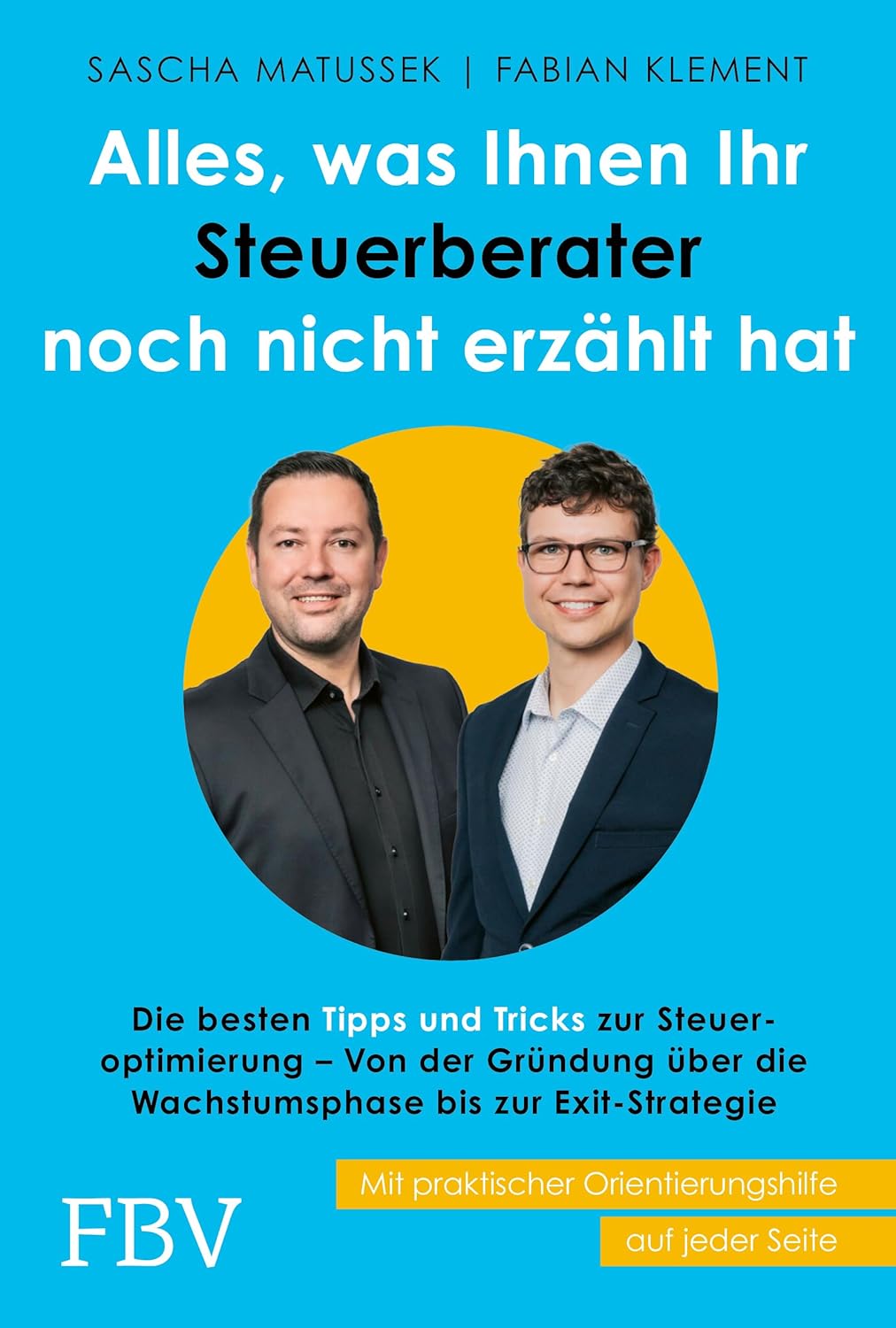

by Sascha Matussek & Fabian Klement is a small but excellent tax book. The book offers its readers a whole range of practical tax strategies. The target group is medium-sized entrepreneurs, start-ups and founders. From the foundation to the sale of a company, the book presents relevant topics in a clearly structured manner.
The book is divided into six main sections. These follow the typical company phases - foundation, growth, maturity and exit - as we know them from business studies. The clear chapter structure enables the authors' readers to quickly orient themselves according to their own maturity phase as a company.
Basic knowledge as a foundation
At the beginning, Sascha Matussek and Fabian Klement provide basic tax knowledge. Readers learn about the most important types of tax: VAT, trade tax, income tax and corporation tax. The authors also explain why these types of tax account for around 80 percent of the tax burden in Germany.
A simple calculation principle is at the heart of this: income minus expenditure equals profit. This forms the basis for taxation.
At the same time, the authors clarify the differences between economic and taxable profit. They thus sensitize their readers to common misunderstandings.
The start-up phase as a tax game changer
In the second part, Sascha Matussek and Fabian Klement focus on the start-up phase. Readers will learn how tax potential can be successively and, above all, strategically exploited in this early company phase.
The recommendations include:
- Careful documentation of all expenses
- Use of separate business accounts
- Early tax registration
- Obtaining targeted advice
Important topics such as tax loss offsetting or net wage optimization are also explained in a practical way.

Tax optimization in the growth phase
In the third part of the book, the authors deal with operational business. They provide concrete tips on tax optimization in everyday business life - as most people will know it. A particular focus here is on optimizing net wages and dealing with trade tax.
Practical tips on preparing for tax audits and dealing with the tax investigation complete this chapter - also very timely, as the NRW tax authorities have begun to mobilize against influencers on a grand scale and are launching one tax audit after another. Sascha Matussek and Fabian Klement independently show how tax leeway can also be used in everyday business life.
Strategic design in the maturity phase
The fourth part focuses on optimizing the corporate structure. Readers are given insights into holding structures and foundation models for tax optimization. Two topics that have become an integral part of the social media expert bubble. Sascha Matussek and Fabian Klement show how companies above a certain size - which always refers to the expected taxable profit - can be restructured.
The authors consider both the tax and organizational advantages of such structures.
Exit strategies and company succession
The fifth section is dedicated to the sale of the company and succession planning. Readers are given specific tips for tax-optimized transfers. Various options such as sale, gift or transfer for partial consideration are presented. Unfortunately, however, none of this is as detailed as I would have liked.
The authors also discuss practical emergency strategies for safeguarding the company.
Curiosities to deepen your knowledge
Finally, Sascha Matussek and Fabian Klement provide a humorous guide to tax curiosities. Examples such as "The horse as a company car" or "Tax-free Christmas bonus for animals" illustrate the complexity of tax law in an entertaining way.
Methodology and target group approach
The book is clearly structured and phase-oriented. Readers are guided to use the chapters that correspond to their current company phase. Key words and marginal notes make orientation even easier.
The authors dispense with legal jargon and explain complex issues in simple language. The use of practical examples reinforces understanding.
"Taxes are one of the biggest costs your company bears. They can quickly become a confusing mess of rules and regulations. This is where we, Sascha Matussek and Fabian Klement, want to help you with our book. We take the complexity out of tax laws and convey their content to you in an understandable way. We have written this book to give you an understanding of the tax issues that are crucial to the success of your business - in clear and simple language."
Sascha Matussek & Fabian Klement
A few words about the authors at this point:
Sascha Matussek is known as "Mister TAXellence" from the press, TV and stage events. In his law firm, Matussek partners GmbH, he develops individual tax-saving strategies for medium-sized companies. His work has received numerous awards, including "Tax Expert of the Year".
Fabian Klement, M.A., is an auditor and tax consultant with his own law firm in Stuttgart. After completing his studies in Bochum, he worked for leading tax consulting firms. As a lecturer in tax law at the Stuttgart Chamber of Industry and Commerce, he imparts his specialist knowledge in a practical and understandable way.
"The importance of a solid basic understanding of tax matters cannot be overemphasized. An inadequate or even incorrect understanding of the tax framework can not only lead to unnecessary financial burdens, but in the worst case can also mean the end of your company. Especially in the current tense economic situation, we believe that every euro counts. For this reason, it is of the utmost importance to understand the basics of taxation and to establish a solid knowledge base - ideally right at the start of your entrepreneurial journey and even more so if you have already been an entrepreneur for several years."
Sascha Matussek & Fabian Klement

At first glance, the book appeared to be a technically exciting and high-quality bound work. The hardcover binding by Finanzbuchverlag is solid as usual. The 25 euros for just under 275 pages is acceptable, but not a bargain. Personally, I prefer softcover books for around 20 euros.
Visually, the inside of the book is kept simple. The layout is dominated by gray, with some highlighting to break up the text.
My interest was immediately piqued - and not just because I come from a family of tax consultants. As an entrepreneur, the topic of taxes has also been with me since the beginning of my self-employment. Although I read up intensively on the subject early on and received professional advice, the closer contact with the tax office came sooner than I would have liked. Special audits, tax audits, queries - sometimes justified, sometimes less comprehensible. Anyone who is self-employed knows the game.
This makes it all the more important not to start off naively. This is where the book offers real added value. In my opinion, it is almost a must-read for founders. The title seems slightly exaggerated, which is now almost common in business literature. It doesn't contain everything - as you can see from the number of pages. Nevertheless, the book offers a wide range of topics.
Compared to other standard works, such as the Concertit is written in a much more accessible way. I enjoyed reading it and found it very successful in terms of language and content. Anyone who has previously found it difficult to understand tax literature will be well catered for here.
Reading this, I realized once again that our tax system is in urgent need of reform. It is complicated and - in my view - deeply unfair. Sole traders in particular bear a disproportionate tax burden and are fully liable at the same time. It was only as a self-employed person and employer that I understood how high the actual tax burden is. I often ask myself how large companies can even cope with this.
Then there is the paralyzing bureaucracy. If you consider the obligations described in the book, you may have doubts about becoming self-employed. Of course, a tax consultant can help - but that also costs money. As a sole trader and later managing director of a limited company, I felt the structural costs time and again.
Many government employees earn money from your work. The inquiries and questionnaires - especially during tax audits - often seem like a test of your patience. Especially as an influencer, mistrust and arrogance are unfortunately commonplace in some official processes.
Nevertheless, I have never regretted being self-employed. And I would like to clearly encourage you to take care of your taxes and optimize where possible. Because that's crucial - never make yourself vulnerable.
"A close look at the details and an understanding of basic tax correlations can often make a big difference without the need for extensive or costly measures. It is often not large investments or drastic restructuring that make the difference, but small, well thought-out optimizations that are easy to implement. These subtle changes add up to a considerable reduction in costs."
Sascha Matussek & Fabian Klement
Conclusion
Everything your tax advisor hasn't told you yet by Sascha Matussek and Fabian Klement offers readers a comprehensive, if not always in-depth and practical handbook on tax optimization. From basic knowledge about tax types to exit strategies, the book covers all company phases.
Readers receive clear instructions and can implement these themselves without prior tax knowledge or at least use them to work with their trusted tax advisor. The book is particularly suitable for (prospective) entrepreneurs who want to actively use and understand tax structuring options. Sascha Matussek and Fabian Klement convey sound specialist knowledge in a very comprehensible form - and make tax optimization a strategic component of everyday business life. I can report from my own experience that, given the enormous tax burden in Germany, there are hardly any companies that don't at least prick up their ears when it comes to tax optimization.