



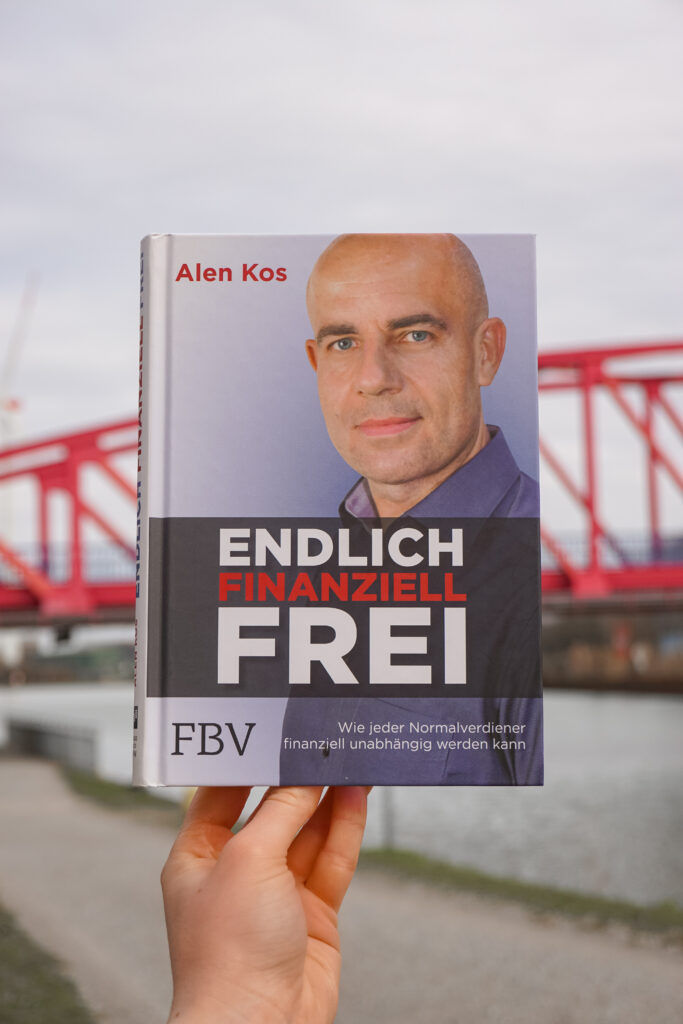
by Alen Kos already sounded very interesting to me from the title. Because if you're on the way there yourself, then of course you also like to keep an eye out for tips and tricks to the left and right of the path. I particularly liked the focus on normal earners, because the myth still persists that you can only ever be financially free with a significantly above-average income.

The core problem that the author addresses in this book is the fact that the vast majority of people in this country work very hard, but in the end there is still not much left over. But it doesn't have to stay that way permanently, because often it's just a few simple basic rules that need to be followed to break the cycle. Alen Kos goes so far as to claim that almost all of us can achieve financial freedom - as long as we have the right money mindset. And that the effort will be worthwhile is something he hopefully doesn't need to convince anyone of anymore. After all, being able to spend every day the way you want to, without time or performance pressure, is certainly not unattractive.
In his book, the author goes through the implementation of these simple basic rules in dealing with money and one's own finances in countless practical examples. He describes what it can influence and, above all, change in the long term.
I found it worrying that the author reports from his lived practice that most of his clients have long since accepted their condition and resigned themselves to it. Despite well-paid jobs, they don't have much left over at the end of the month, but they don't try to understand the reasons for this with full vigor. For them, it has become normal that costs eat up income, while most of these people know that it really shouldn't be this way.
Derived from this is the central question of this book: "How should I handle money so that it doesn't all slip between my fingers?"

This is precisely the question that the author addresses in his book in an attempt to help people develop the right and, above all, goal-oriented approach to money. The way there begins with simple derivations of the terms desires and goals, over the life organization, the question about the true needs and the overconsumption and the different kinds its money to invest and increase.
In this way, he tries to break through blockades and present mechanisms that make it easy for the reader to understand and implement the relationships between income, expenditure, saving, investing and wealth. In order to ultimately be able to put themselves in a position to realize their own individual wishes and ideas.
All in all, this is a really interesting book to brush up on all aspects of the money mindset. Nevertheless, it is of course aimed more at beginners who have so far been characterized by suboptimal behavior with money or who are generally only taking their first steps.