


What are swing trades?
The swing trading strategy is a popular method in stock market trading that attempts to profit from short to medium-term price movements. In contrast to the Day tradingIn contrast to swing trading, where positions are opened and closed within one trading day, swing traders often hold their positions for several days or even weeks.
The aim of swing trading is to profit from both upward and downward movements in the markets. Swing traders look for specific price patterns and indicators to identify potential reversal points or trend continuations. They try to enter the market when the price breaks through a support or resistance line and then close their position when the price has reached its profit potential or the market momentum reverses.
Es gibt verschiedene Swing-Trading-Ideen, darunter Trendfolge, Breakout, Pullback und Fibonacci-Retracement-Strategien. Jeder Handelsansatz hat seine eigenen Regeln und Kriterien für den Ein- und Ausstieg aus dem Markt. Swing-Trader nutzen oft technische Analysewerkzeuge wie gleitende Durchschnitte, Trendlinien, Indikatoren wie den Relative Strength Index (RSI) und Chartmuster, um ihre Handelsentscheidungen zu unterstützen.
Swing trading requires a certain amount of discipline and patience, as positions can be held over a longer period of time. It is important, Risk management techniques to limit potential losses and protect gains. However, as with any investment strategy, there is no guarantee of success and there are systematic risks involved in trading securities. It is therefore advisable to inform yourself thoroughly before using swing trading strategies or Education and training with professionals to book.

Definition: How does swing trading work?
Swing trading, derived from the English, means "trading with momentum". It is a trading strategy in which traders try to profit from sustained movements in rising or falling markets.
Im Gegensatz zu anderen Strategien wie Scalping or Day tradingSwing trading has a longer holding period than trading where positions are closed within seconds, minutes or a day. Swing traders often hold their positions for several days. Trading takes place in higher time frames, such as the 4-hour chart or the daily chart.
The aim of swing trading is to profit from smaller price movements within a larger trend. The basic assumption here is that price behavior is rarely linear and always exhibits high fluctuations.
Certain basic requirements apply to swing trading. The motto is "buy cheap, sell high". Traders must have the expertise to recognize potential turning points in the market. At the same time, they should Loss limits to minimize risks and determine a sensible time to take profits. Here it helps to have a Trading plan to create.
Discipline and knowledge of charting techniques are essential for successful swing trading. It is important to note that trends rarely follow clearly defined paths where swing trading would be easy. Therefore, this strategy requires continuous analysis, a certain degree of adaptability and trading decisions based on current market events.
Swing trading can be a lucrative strategy, but it also involves risks. It is advisable to inform yourself thoroughly, possibly take advantage of training or education and seek professional advice from an expert. Experts before you start swing trading.


How do swing trades work?
Swing trades are a trading strategy that focuses on the points at which momentum changes direction. In contrast to traditional investment strategies, swing trading allows profit-taking in a shorter time frame.
Swing traders try to profit from positive or negative events that can influence the market. They keep their trades open as long as the current momentum continues. The time frame for swing trades can range from a few hours to several days, depending on the volatility of the market and the profits sought.
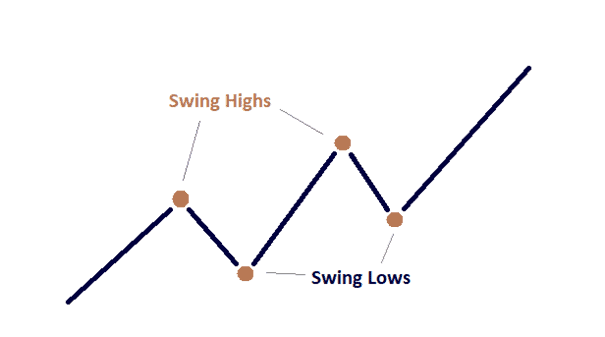
With swing trades, it is important to pay attention to two types of "swings". First, there are the "swing highs" where a market peaks before pulling back. This provides an opportunity for a Short tradewhere the trader speculates on a falling price. Secondly, there are "swing lows", where a market reaches its low and then bounces back to its normal level. This is an opportunity for a long trade, where the trader bets on rising prices.
Um Swing-Trades erfolgreich durchzuführen, ist es wichtig, technische Analysen und Chartmuster zu verwenden, um potenzielle Wendepunkte und Ein- und Ausstiegspunkte zu identifizieren. Trader müssen auch die Marktbedingungen und mögliche Einflussfaktoren wie Unternehmensnachrichten, Wirtschaftsindikatoren oder politische Ereignisse berücksichtigen.
Das Risikomanagement ist ebenfalls entscheidend beim Swing-Trading. Trader setzen Stop-loss orders, um Verluste zu begrenzen und Gewinnziele festzulegen, um ihre Gewinne zu sichern. Disziplin und eine klare Handelsstrategie sind für den Erfolg beim Swing-Trading unerlässlich.
Overall, swing trading allows traders to profit from short-term price movements by reacting to the change in direction of momentum. It requires close observation of the market and a quick reaction to potential trading opportunities. By taking advantage of swing highs and swing lows, traders can try to make profits regardless of whether the market is rising or falling.
What are the best swing trading markets?
Swing trading can be practiced on various markets, including stock markets, currency markets and futures. Choosing the best market for swing trading depends on individual preferences, level of experience and the instruments being traded. Here are some examples of good swing trading markets:
- Stock marketETFs (Exchange Traded Funds) or indices such as the DAX or the S&P 500 are often suitable for beginners. These offer a wide range of tradable shares and enable diversified positioning.
- Forex marketThe Forex market is characterized by high liquidity and volatility, which makes it attractive for swing traders. There are various currency pairs that may be suitable for swing trading, such as EURAUD, EURCAD, EURJPY, EURGBP, USDJPY, JPYCAD, GBPJPY, GBPAUD, GBPCAD, GBPCHF, USDNZD, USDCAD and EURUSD.
- Equity indicesSwing trading can also be applied to stock indices. Popular examples of this are the DAX 40, CAC 40, DJI 30, Nasdaq 100 and Nikkei 225. These indices represent a basket of shares and therefore offer broader market coverage.
When choosing the best swing trading market, traders should consider factors such as liquidity, volatility, trading hours, trading costs and their own expertise. It is important to note that swing trading is not limited to specific markets and the choice of market ultimately depends on the trader's individual preferences and objectives. It is advisable to choose a market that fits well with your trading objectives and available time. In addition, a comprehensive market analysis should be carried out to identify potential trading opportunities.
These are the most important swing trading indicators
Swing trading indicators play a crucial role in identifying trading opportunities and determining entry and exit points. Here are some of the most important indicators for swing trading:
- Moving averagesMoving averages calculate the average of price movements over a certain period of time. They are used to confirm trends and can be used as an indicator for possible entry or exit points. Short-term moving averages (5-50 periods) are suitable for short-term trends, while medium and long-term moving averages (50-200 periods) are suitable for corresponding time periods.
- VolumeVolume provides information about the strength of a trend. High volumes can indicate a strong trend continuation, while a low volume can indicate a possible reversal or consolidation. Volume plays a particularly important role in breakouts, as an increase in volume is often associated with a breakthrough.
- Relative Strength Index (RSI)The RSI is a momentum indicator that measures the overbought and oversold conditions of a market. A value above 70 indicates an overbought situation, while a value below 30 indicates an oversold situation. These conditions can be seen as potential turning points for swing trades.
- Stochastic oscillatorThe stochastic oscillator is another momentum indicator which, like the RSI, measures overbought and oversold conditions. It consists of two lines, and the crossing of these lines can indicate possible trend reversals.
- SampleChart patterns such as wedges, pennants, triangles and shoulder-head-shoulder patterns can serve as early signs of price movements. A falling wedge in a downtrend or a rising wedge in an uptrend can indicate an imminent reversal. Pennants and triangles are often seen as consolidation patterns and can lead to breakouts. The shoulder-head-shoulder pattern can indicate a possible trend reversal.
These indicators and patterns serve as tools for swing traders to identify trading opportunities and make their trading decisions. It is important to use these indicators in conjunction with other analysis and market information to make accurate and informed decisions. A comprehensive knowledge and experience in using these indicators is crucial to be successful in swing trading.

These swing trading strategies are available
Strictly speaking, swing trading is a trading style and not a specific strategy. The style is defined by the chosen time frame, which in turn forms the basis for countless trading strategies.
Swing trading is mainly practiced in medium to long time frames. It lies between the short time periods of day trading and the long-term approaches of position trading. This time frame allows traders to profit from medium-term trends and price movements without getting too involved in short-term volatility.
Among the different swing trading strategies, there are a variety of approaches used by traders. Some of the most common strategies are:
- Trend following - The trend is your friend
Swing traders use the trend-following strategy by trading in the direction of the overriding trend and taking advantage of counter-movements. They rely on a trend being confirmed and continuing instead of betting on it breaking. By taking advantage of corrections within the trend, they can find favorable entry points and profit from the further trend movement. The trend-following strategy makes it possible to tighten stop prices and maximize potential profits. In swing trading, the motto is: "The trend is your friend".
- Countertrend strategy
The countertrend strategy is used to profit from price setbacks that occur between cyclical peaks. Investors use this strategy by taking short positions. An important prerequisite for this is the drawing of a countertrend line, which is created by connecting at least two cyclical highs. The market often orients itself to this line, which means that the area below the line can be used as a favorable entry point for shorts. To limit potential losses, it is advisable to place a stop-loss order above the line. The countertrend strategy enables investors to profit from short-term corrections within a trend.
- Breakout strategy
The breakout strategy involves trading securities when they break out of a consolidation phase. This involves betting on large movements caused by the breakout from the previous trading range. This strategy utilizes high volatility and high trading volume, both of which often accompany a breakout. The aim is to profit from the strong price movements following the breakout. It is important to perform careful analysis and use additional indicators to avoid potential false signals.
- Swing trading on the basis of moving averages
Swing trading based on moving averages uses trend lines and especially moving averages as reference points for trading. The trader waits until the price approaches a certain average line and starts to rise from there in the desired direction. This makes it possible to set tighter stop-loss levels and realize potential profits based on other average lines. This allows the trader to benefit from long-term trends and limit risk.
- Trading range markets
The range trading strategy focuses on markets in which prices move sideways and within a limited range. The trader identifies the upper and lower limits of this range and tries to profit from price fluctuations within this range by opening short positions near the upper limit and speculating on a return to the lower part of the range. This strategy requires experience and the ability to correctly determine entry and exit points, which is why beginners should first learn basic trading principles before engaging in range trading.
- Swing trading in trend channels
Swing trading in trend channels offers an optimal opportunity for traders to profit from price fluctuations within the channel. A trend channel is created when a parallel line runs alongside the main trend line, forming the upper and lower limits of the channel. An example of this is the downtrend channel of the DAX since fall 2018. In this scenario, traders can open short positions near the upper end of the channel and possibly even speculatively take long positions at the lower end. It is also a good opportunity to take profits from short positions in line with the trend. It is particularly advantageous if the main trend line gains additional significance due to a parallel moving average. This environment provides the ideal framework for swing trades in trend channels.
- Trading according to COT data (COT data trading)
Trading according to COT data (Commitments-Of-Traders data trading) is a strategy that focuses on the futures market and is particularly suitable for professionals. The COT report provides important information about market participants' positions and can serve as a basis for swing trades. However, this strategy requires a thorough analysis of the data and an understanding of the US commodity markets.
- Swing trading in sideways trends
In contrast to many other trading approaches, swing traders can apply their strategy in sideways trends and profit from them. While the market is swinging sideways, the trader has the opportunity to take both long and short positions and profit from the large trading range. He can open a long position near the lower limit of the sideways range and hedge it with a tight stop loss, while taking profits near the upper limit and then switching to a short position.
- Forex swing trading strategy
Forex swing trading offers various scenarios for trading in the foreign exchange market. These ideas can also be applied to other asset classes. The following possibilities arise:
- In the case of a sideways trend, an upward swing can be traded by opening a long position.
- You can also trade a downward swing in a sideways trend by opening a short position.
- If an upward trend develops, a downward correction can be used to enter a short position.
- In an upward trend, you can trade an upward movement by opening a long position.
- Alternatively, you can use a downward movement in an upward trend to enter a short position.
- Finally, it is possible to trade an upward correction in an upward trend by opening a long position.
Regardless of the strategy chosen, it is important to consider areas of support and resistance. These areas reflect historical price levels where supply and demand have proven to be significant in the past. Traders use these areas to determine their entry and exit points and assess potential risks and opportunities.
It is important to note that choosing the appropriate swing trading strategy depends on various factors, including individual trading objectives, risk appetite and personal preferences. Traders should try different strategies, monitor their trading activity and adjust their approaches accordingly in order to be successful in the long term.


Swing trading for professionals
Swing trading is a suitable trading strategy for professionals. The strategy stands in contrast to day trading and scalping, which require a continuous presence during trading hours. In day trading and scalping, traders must constantly monitor the markets on the computer, which can lead to a high level of mental and psychological stress.
In contrast, swing trading requires less time, which is mainly limited to the evenings when the stock exchanges are closed. This gives working people the opportunity to devote themselves to their job and still take part in trading. With swing trading, traders only need to check the closing prices one to three times a day or after the close of trading to identify potential trading opportunities.
Swing trading is better suited to working professionals due to the reduced time required and the reduced mental strain. They can analyze their trades, open or close positions and adjust their strategy without having to spend the whole day in front of a screen. This allows them to balance their trading business with their work commitments.
However, it is important to note that swing trading also requires a certain amount of dedication and discipline. Analyzing charts, developing a trading strategy and monitoring the markets require time and attention, albeit to a lesser extent than day trading and scalping.
It is advisable to be well informed, develop a solid trading strategy and seek the support of a Stock market experts in order to achieve the best results from swing trading.

Advantages and disadvantages of a swing trading strategy
Advantages:
- Swing trading requires less time: This results in a time advantage over day trading and scalping, as it is usually sufficient to check the charts or open positions 1-3 times a day
- Swing trading exploits long-term trends
- Lower fees: Broker fees are lower due to fewer trades
- Fundamental aspects such as important economic news (e.g. upcoming interest rate hikes by a central bank) can be ignored depending on the holding period
- Trend analysis and investing in intact trends is particularly important for this strategy
- Investors can invest in existing trends and take advantage of pullbacks and breakouts
- Fundamental aspects are not taken into account here, depending on the holding period
- Gaps in the direction of the trend can bring large profits in individual positions
Disadvantages:
- The accumulation of swap costs
- Fundamental risk
- With swing trading, it may often be necessary to wait days or weeks until a valid setup is created
- Impatient people may struggle with this style of trading
- Corresponding price gaps may occur between trading hours
- Since swing trading involves trading in higher time units (H4 or D1), the Stop loss The risk is usually also set further away from the entry price than in day trading. This increases the risk in each case
- Highly volatile market phases
- Illiquid markets


Conclusion: Swing trading is not only suitable for professionals, but also for working people
Swing trading is a suitable trading strategy not only for experienced professionals, but also for professionals. There are various styles in the world of trading, including swing trading, from which various strategies can be derived. The choice of the right instruments or strategies depends on the trader's objectives and the desired results. There are basically no limits to the financial instruments that can be traded in swing trading. The choice depends primarily on the trader's risk appetite.
The biggest advantage of swing trading is that investors can also devote themselves to this strategy alongside their job or as part-time traders, as the time required is very short compared to short-term day trading. In swing trading, only the closing price of the individual trading days plays a role, which means that prices only need to be viewed once a day.
The aim of swing trading is basically to increase your own capital through efficient trading and clever positioning of swing trades. Choosing the right broker is of great importance, as the conditions vary depending on the provider. As swing traders often open or close positions several times a week or even daily, the fees incurred are a decisive factor. If the fees are very high, there is a risk that they will eat up the entire profit potential achieved.
In conclusion, swing trading is an attractive option for both experienced traders and professionals. It requires less time and allows investors to devote themselves to other commitments on the side. Through effective risk management, choosing the right broker and carefully analyzing swing trading opportunities, investors can take advantage of the potential to grow their capital.

Mario Lüddemann is one of the best-known trading and investment coaches in Germany. He started out as a private stock exchange trader on the German stock market with DM 5,000 in starting capital and achieved a million profit as a day trader on the German financial markets as early as 2001. Since 1996, the stock market professional has made over 60,000 trades with a trading volume of more than one billion euros. Today, Mario Lüddemann is financially independent and self-employed as a portfolio manager, financial analyst, book author and university-certified management trainer. As a long-standing partner of CapTrader, he also holds the regular webinar series "The Big Market Outlook". Register here free of charge.
