


A trading GmbH is currently enjoying great popularity due to the tax restrictions on offsetting losses. In addition, there are many tax advantages to share trading in an asset-managing GmbH. Which ones? Alexander Eichhorn has summarized this for you in this blog post!
What is a trading LLC?
A Trading-LLCalso known as a trader GmbH, is legally regarded as a classic GmbH. The purpose of a trading GmbH is to sell trading products or invest in buy-and-hold securities and not for operational purposes, such as a trading business. By setting up a GmbH, private individuals can avoid offsetting losses and profits on shares in the trading GmbH are virtually tax-free! More on this in a moment.
Blog recommendation: Founding a trading LLC? The 10-point plan at a glance!


When does a trading LLC make sense?
This is probably the most frequent question we receive. The legally unsatisfactory answer: It depends! Answers that we often hear, such as: "It's only worthwhile from a million" or "it makes sense from €100,000" are sweeping generalizations that may or may not be true. In the following, we have listed some factors that are good pointers for setting up a LLC (not all points necessarily apply):
- Profitable trading with profits at least in the five-digit range
- Trading of forward transactions that are no longer possible in private accounts after the loss limitation
- The trade / investment would like to be operated permanently (over a period of years)
- Equity gains will only be needed in a few years and compound interest can work in the LLC
- There is already an operative GmbH
Just as important is the question of when a trading GmbH is not useful/not necessary, including the following points, for example:
- No profitable trade or trade does not increase in volume
- One is a pure buy-and-hold investor
- An emigration is being planned
Avoidance of the loss offsetting limitation
Losses from forward transactions can only be offset against gains from forward transactions in private trading up to EUR 20,000 per calendar year. In addition, there are further restrictions on the derecognition of worthless shares and bonds. In this blog article we have explained the loss offset limitation in detail.
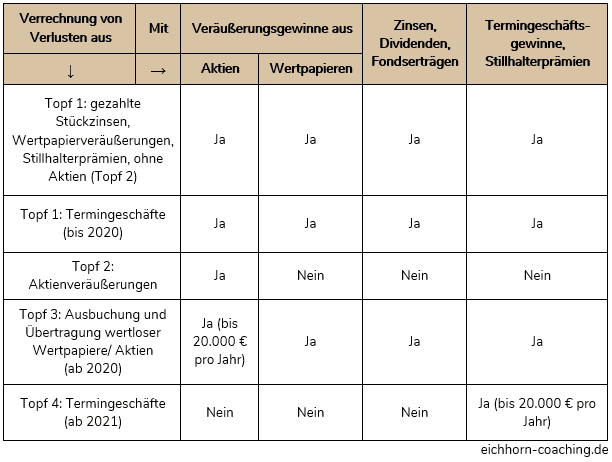
The permanent spread trading of options, for example Iron Condors or Butterflies is in principle no longer possible in private assets, and the same applies to the directional Future handl.
Since a GmbH is not taxed according to income tax, the loss set-off limitation does not apply to a trading GmbH!
But beware: The loss offsetting limitation applies to foundations! Recommended reading: Tax tricks in the trading LLC


Taxation of share profits in a trading LLC
The taxation of a trading GmbH at company level is based on corporation tax and trade tax:
- Corporation tax of 15 % plus solidarity surcharge of 5.5 % -> 15.83 %
- Business tax depending on place of residence approx. 15 %
This means that the total taxation of a GmbH in Germany is approx. 30 %. However, there is a major exception for share price gains!
Gains from the sale of shares (only shares, no ETFs/ REITs/ CfDs etc.!) are tax-privileged in accordance with Section 8b (2) sentence 1:
When determining income, gains from the sale of a share in a corporation or association of persons whose benefits are part of the recipient's income within the meaning of Section 20 (1) nos. 1, 2, 9 and 10 letter a of the Income Tax Act or in a controlled company within the meaning of Section 14 or Section 17 are not recognized.
Gains from the sale of shares are not taken into account when calculating income, but they are not completely tax-free. Of the capital gain, 5 % are considered non-deductible operating expenses and must be taxed.
Example:
- Share bought at a price of € 100
- Share sold at a price of € 200
- Profit of the trade: 100 €
Taxation in the GmbH: 5 % (non-deductible operating expense) of profit (€ 100) = € 5 tax base
Tax burden: € 5 (tax base) * 30 % Tax burden (trade tax and corporation tax) = € 1.50
Accordingly, a tax burden of approx. 1.5 % is due on share proceeds in a GmbH and is therefore almost tax-free (regardless of the holding period!). But beware: losses from the sale of shares are not deductible!
Dividends are not normally tax-privileged. For this, the GmbH would have to hold shares in the stock corporation of more than 10 %, which most people will not achieve with dividends from Coca-Cola, Apple and the like. The dividend income is therefore taxable in the GmbH at around % 30.
And the forward products? Futures products are taxed according to trade tax and corporation tax, resulting in the usual GmbH tax rate of 30 %. In contrast to trading in private assets, however, no loss limitation applies here!
Disadvantages of a trading LLC?
In this blog post, we have discussed two major advantages for traders, but there are also others: salary control, tax deduction of partial private costs, possible regulation of inheritances, ...
But a trading GmbH is not the holy grail for every trader; as always, it depends on the individual situation. A trading LLC is cost-intensive: formation costs, ongoing tax consultancy costs, Chamber of Industry and Commerce fees, ... You also need to watch out for pitfalls: For example, the disclosure of hidden reserves through a business split must be prevented! We have explained this in our wealth magazine described in detail.
Who soon emigrate should also consider setting up a trading company!


Conclusion - advantages of a trading LLC
Share trading in the Trading-LLC is almost tax-free and therefore very attractive from a tax perspective. If share trading reaches a certain level, setting up a GmbH can quickly pay off and is much better taxed than share trading as a private asset. In addition, by setting up a trading GmbH, traders avoid the loss set-off limitation. Nevertheless, the formation of a trader GmbH must be clarified in detail with a specialist tax advisor and the advantages and disadvantages weighed up.
Alexander Eichhorn is a full-time trader and investor. He is the founder of Eichhorn Coaching and portfolio manager of the Asset Management Bothe & Eichhorn Capital. His training activities have the focus on the optimal support of clients with large accounts. He also shows options traders how to quickly get started with profitable options trading through numerous blog articles and regularly publishes analysis and tips on the Eichhorn Coaching YouTube channel.
