


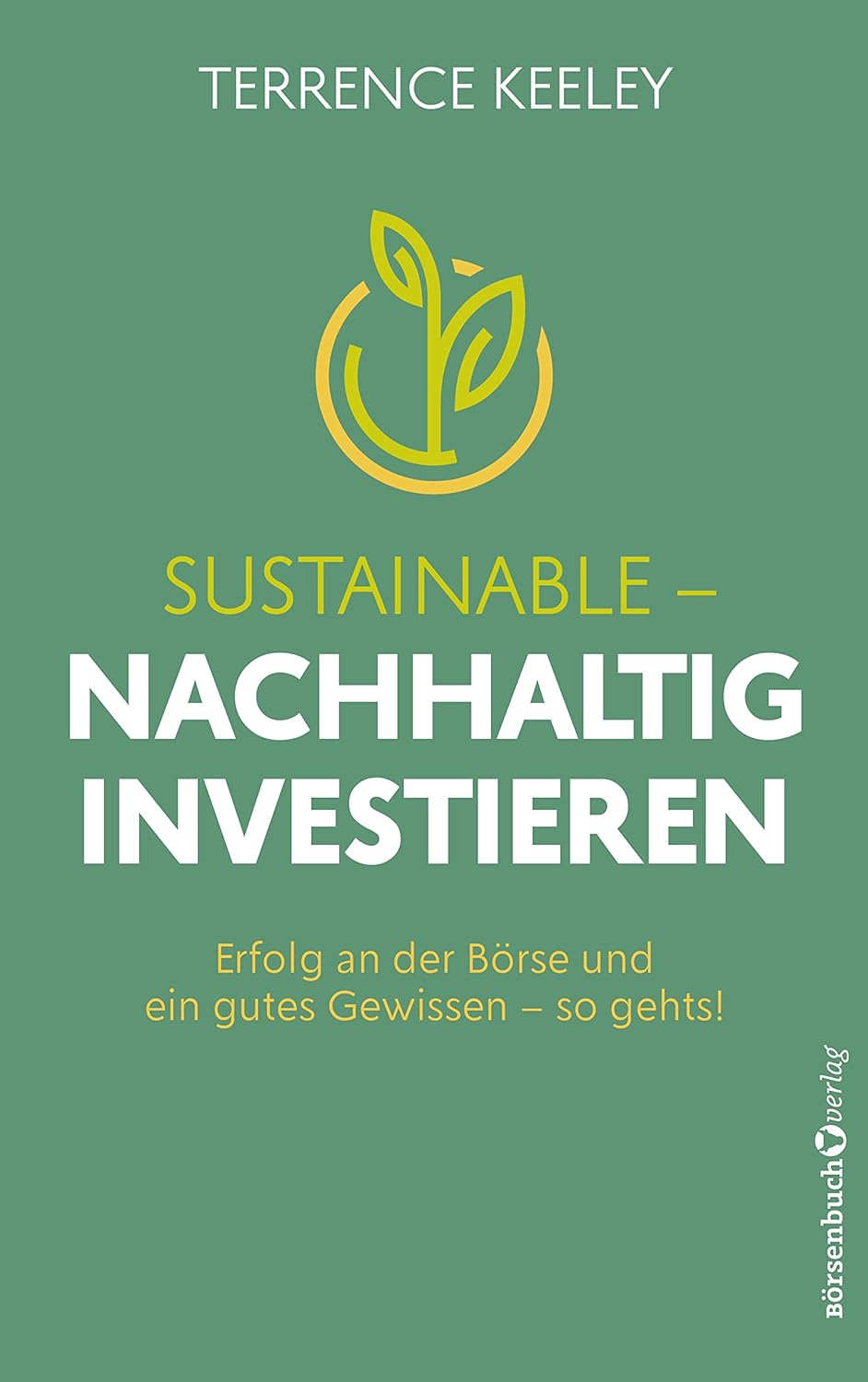

by Terrence Keeley is an ambitious contribution to the discussion on an extremely topical subject: sustainable investing and the associated ESG criteria (environment, social, governance). At a time when the market for sustainable investments is booming and more than 120 trillion US dollars have already flowed into more or less "sustainable" investments, Terrence Keeley poses critical questions: Do the means currently used to evaluate countries and companies in terms of their environmental, social and governance aspects really work? And do these investments really achieve their intended goals?

For me, it is not only topical, but also extremely important to put our finger in the wound here and look for answers instead of blindly following the activities of the financial sector, which can sometimes only be described as greenwashing. Because if two things are clear, it is that not everything that says green is green and that sustainability has its own definition for everyone.
The book has a deliberately modular structure and should be understandable for both beginners and advanced readers in the field of finance. In terms of content, it begins with the historical background, which sheds light on the emergence of ESG investments and the debate between stakeholders and shareholders. The subsequent chapters then provide a deeper insight into the workings of ESG investing and repeatedly emphasize the importance of investment stewardship in light of the undeniable challenges and risks that ESG investing faces, including potential unintended consequences - particularly due to a lack of or inadequate background information.
Terrence Keeley not only argues that ESG investments often fail to achieve their intended goals, but also offers solutions to this mess. After all, the vast majority of investors focus on these offerings for good and honest reasons and should not ultimately fall victim to the glossy brochures of the financial sector, which, as is so often the case, promise more than they deliver.
The author emphasizes the importance of business and finance in creating a "good society" and suggests that true impact investing that actually achieves ESG goals is possible. He examines the comparative advantage and highlights promising financial strategies and organizations that can contribute to more inclusive, sustainable growth.
The book is therefore not just a financial book, but rather a critical contribution to the debate on one of the most pressing financial issues of our time. Terrence Keeley clearly expresses his personal and professional responsibility as a trustee and emphasizes the need for a comprehensive debate and cooperation between various players in order to jointly overcome the challenges of the 21st century, which cannot be dismissed out of hand.
"No one doubts that ESG is still in its infancy or that much more research and data is needed before final conclusions can be drawn."
Terrence Keeley
In this book, however, he also clearly suggests that an optimal approach to the future requires more than just current ESG strategies and publicly denouncing listed companies that do not meet their own value standards: it requires a more comprehensive and coordinated effort at various levels.
"The most important question addressed in this book is what specific role business and finance should play in creating the good society - and what everyone else needs to do to make the human experiment succeed. I believe it is possible to create the good society, but we need to start with good will and a sense of common purpose. We also need to be clearer about who should do what."
Terrence Keeley
At this point a few words about the author:
Terrence Keeley, with more than three decades of experience as a top manager at BlackRock and UBS, has built a reputation as an expert in the financial world. During his career, he has advised some of the world's largest sovereign wealth funds, foundations and asset managers. His expertise and commitment to a more sustainable economy eventually led him to lead the 1 PointSix initiative. This initiative works towards more inclusive and sustainable economic growth by promoting innovative solutions and strategies that have a positive impact on society and the environment. Terrence Keeley brings his many years of experience and expertise to make a significant contribution to shaping a sustainable economy.
"I hope that regulators, financial industry insiders and company CEOs will pay particular attention to these concerns. I also hope that everyone will understand the importance of enlightened corporate governance. The best way to improve corporate behavior is from the inside out. And the best way to improve corporate behavior from the inside out is to have the right board of directors and the right executive committee working diligently toward long-term goals that advance all societal interests, including the profitability of their company."
Terrence Keeley
The book also looks great. I always like the great softcover binding with flaps best anyway, but the price of 29.90 euros is also reasonable for just under 450 pages.
"Capitalism is under attack. If it doesn't work better for more people or if it continues unchecked towards a climate catastrophe, evolution could give way to revolution. Government regulations could outlaw the free market economy. In the most extreme case, humanity could literally sacrifice itself.
[...] This book advocates a vision of capitalism that works for people and for the planet. It also offers a workable plan of action that would promote more inclusive, sustainable growth. There is an optimal path forward for the human family - a path that could maximize human well-being for centuries to come - but it is neither the easiest nor the most likely. It is also different in many ways from the path we are currently on. There are many practical things we could do now that would improve the lives of billions of people. Moreover, the risks of inaction are great ..."
Terrence Keeley

Ultimately, it is a very, very comprehensive and above all exciting book for all those people who want to engage with future-oriented capitalism. But also for those who want to better understand the sometimes cryptic ESG criteria and the criticism that often accompanies them.
It is a forward-looking work, an optistic one that offers solutions and is able to promote constructive discourse. It is not so much a book of doom and gloom, but rather a book with concrete ideas that nevertheless puts its finger in the wound where it is needed. In my view, it is equally interesting for investors and politicians. But above all for people who bluntly see capitalism as the problem and, without having any idea of the consequences, wish for a socialism that will not magically solve the problems either.
"There's an Irish joke about a tourist visiting Dublin. He stops a passing local and politely asks how he can find one of the city's most famous pubs, Temple Bar. "Oh," jokes the journeyman, "I certainly wouldn't go there from here." Then he shakes his head dejectedly and shuffles off. Well, we start from here. Actually, "here" is the only place we can ever start. As you know, "here" is full of problems and concerns, including environmental problems we wish we had never caused, another unnecessary war in Europe and social challenges for which we need to find a comprehensive way forward. "Here" is not the place we want to be.
But "here" is all we have. And if we don't make the most of 'here', we will never get to 'there'. Obviously, "there" is where we need to go. It's better if we get going!"
Terrence Keeley