


At Debt capital trading use Capital provided by a company, broker or other investor. This can massively increase both the potential profits and the risks.
There are several variants of leveraged trading available, each of which has its own advantages and disadvantages. We explain below which options are available for private individuals and professional traders and when this form of trading is really worthwhile.

The most important in a nutshell
- In leverage trading, traders use the capital of lenders to maximize their profits
- Popular forms are margin trading or cooperation with so-called "prop companies"
- Professional traders who work for hedge funds, investment banks and the like also ultimately engage in debt trading
- CapTrader Managed Accounts offer a reverse form: Professional traders trade with your capital on your behalf
Debt capital trading: what is it?
You don't need much to make profits on the financial markets: a broker who provides access to the stock markets and some money to invest in promising shares, derivatives and the like.
The more capital a trader can invest in an asset, the greater his absolute profit in the event of a price increase. However, if the price falls, the investor also loses a larger amount. In order to maximize this effect and highest possible return (with a higher risk at the same time!) is often achieved by Debt trading for use.
Traders use money that does not belong to themfor stock exchange transactions. This can work in different ways:
- Qualified individuals can receive capital from private investors
- Companies can commission traders to increase their company capital
- A private trader can borrow money from his broker in order to trade more effectively (margin trading)
- Hedge funds can trade with their investors' money
- and much more
Such cooperation can for both sidesthe investor and the trader, very worthwhile. There are different ways of splitting the profits:
- The trader keeps the profits and only pays a fee to the lender (e.g. in margin trading)
- Traders and investors share the profits in a fixed ratio, for example 80 to 20 or 50/50
- The funder keeps the profits and pays a reward or (in the case of an employment relationship) a salary to the trader
Depending on the exact constellation different regulations and laws must be observed. For example, private individuals are prohibited from investing money or trading on behalf of other people. This requires a corresponding license - in Germany from the financial supervisory authority BaFin.
In English, the term "proprietary trading" is commonly used for debt capital trading. The term has been shortened in everyday use. Today, for example, one speaks of "Prop firms", when companies provide capital to private individuals or professional traders.

Why is trading with borrowed capital so lucrative?
Debt trading enables Significantly higher profits and losses compared to transactions in which a trader only uses his own assets. The reason for this is the Leverage effect, that arises from borrowing additional money.
This is the basis of the Margin tradingwhich is probably the most widespread form of debt trading. In the process traders borrow additional capital from their broker for a (usually small) fee, depending on the provider. They are likely to keep the profits they make from this loan.
In the event of a trading success, this has enormous advantages: There is a significantly higher profit in cash (euros, dollars, etc.), as a larger amount has also been invested. In practice, this could look like this, for example:
Example 1 - without borrowed capital
You expect the price of a share to rise soon and would like to profit from the price change. To this end, you invest € 3,000 of your own capital and acquire 30 shares of € 100 each.
In fact, the price of the security rises by 10 % over the next few days. You sell the shares for €110 each and make a profit of €300 (example without additional fees).
Example 2 - with borrowed capital
As in the first example, you anticipate an increase in the share price, which is currently € 100. Instead of investing just € 3,000 of your own assets, you borrow a further € 3,000 from your broker. You are now in a position to invest € 6,000 in the company and purchase 60 shares at € 100 each.
A few days later, the price has risen by 10 %, which corresponds to a return of €600. You sell the securities and pay the borrowed € 3,000 back to your broker. After deducting a loan fee of €10, you are left with a profit of €590.
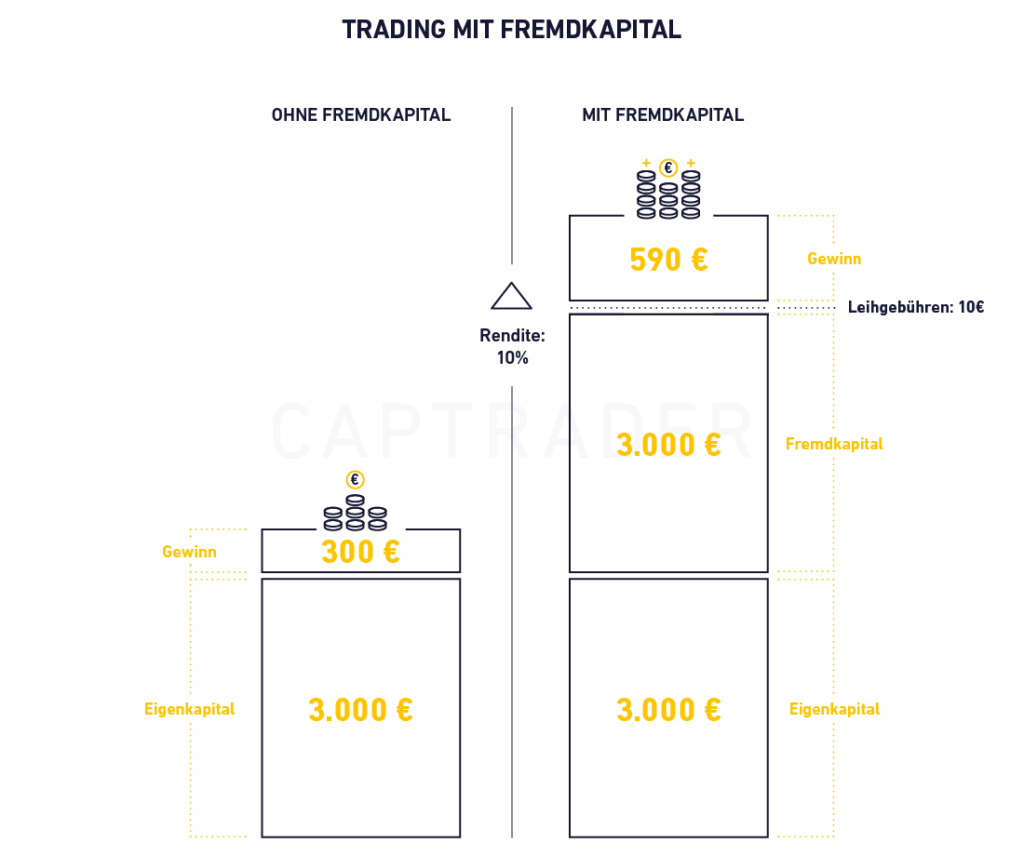
Through the use of leveraged trading, your Massive increase in profitfrom around €300 in the first example to €590 in the second. But even the additional risk must be considered!
Let us assume that your Forecast wrong and the share price does not rise, but instead falls by 10 %. In the first example (without borrowed capital), you would have to pay a Book loss of 10 % or € 300. Annoying, but not the end of the world: in this case, you could simply leave the securities in your portfolio and wait for the price to recover.
The situation is quite different when they Margin trading and have borrowed an additional € 3,000 from your broker (example 2). A A ten percent loss then corresponds to €600 - and accounts for 20 % of your total equity!
Through In our example, your entire capital will be used up in the shortest possible time. These risks must always be considered before making an investment and appropriate hedging, for example through options, must be undertaken.
We have also not calculated any broker fees for our examples. In reality, however, these would be added and at CapTrader, for example, would amount to USD 2 per transaction (for US shares). With other providers, costs in the double-digit range are possible.
CapTrader can do that:
CapTrader is one of the few German online brokers to offer margin trading. We combine the comprehensive product catalog (including leverage) of a professional broker with the low fees offered by modern online providers.
Further advantage: access to investments with a high minimum amount
In general, access to various asset classes is now cheaper and easier than ever before. Even financial products such as futures, which used to require high minimum amounts, can now be used with small amounts of capital. For example, for a E-Mini Future only a tenth of the usual amount.
Some Asset classes are bucking this trend, however, and continue to remain can only be used with a certain minimum capital. This becomes particularly clear when they Trade options would like to.
A Option contract on shares includes, for example always 100 securitieswhich, depending on the current exchange rate, can result in very high costs. The Trading with leverage can allow you to trade options despite the high prices.
Here too, margin trading, where you receive the borrowed capital from your broker, is predominantly used. Other options, such as prop trading with options, are also theoretically conceivable; in practice, however, they only account for an extremely small proportion.


Forms of debt trading
Debt capital trading is basically a simple concept that requires a lot of effort to execute. Different shapes can assume. In the following, we would like to introduce you to the most important variants, their special features and their respective advantages and disadvantages.
Margin trading is the most common form of leveraged trading
Due to the simple implementation and the strong synergy effects Margin trading is by far the most common form of leveraged trading. Here a trader borrows additional capital from his brokerin order to acquire an asset with it or through a Short sale to bet on falling prices.
Since the actual trading is also carried out via the broker, the trader receives everything here "from a single source". Once the required margin account has been set up, leveraged trading can be executed in a matter of seconds.
The amount of capital available depends on the chosen broker and various parameters. The costs can also differ. However, a margin account is not available with all providers! Only high-quality brokers such as CapTrader offer such a custody account.
Every margin trade consists of a minimum deposit amount (also known as a "minimum margin requirement"), which you must finance from your own capital. In addition, there is the margin, i.e. the amount that your broker lends you. The amount of the margin, i.e. the ratio of equity to borrowed capital, also depends on the broker.
The Margin trading is generally considered riskyas losses can quickly add up. If price developments are too negative, your broker will ask you to rectify the situation immediately. If you do not comply with this request quickly enough, the service provider closes the position for you.
The broker thereby attempts to prevent the borrowed amount from being lost. In this case, there could be the threat of a lengthy recovery process, which the provider would like to avoid.
This protective mechanism does not exist for other forms of debt trading. If, for example, a licensed financial portfolio manager generates a huge loss with its clients' capital, the lenders cannot pull the "emergency brake" at short notice. The broker therefore has an advantage here and can lend the money with less risk and therefore at more favorable prices.
Prop trading provider
Some companies use Debt trading as a business model and act as professional donors. They provide traders with the necessary capital and keep part of the profits for themselves.
Since this business is only really worthwhile if the traders also achieve corresponding results, the comprehensive tests common. Prop trading firms usually require a formal qualification and/or a practical test in which traders must demonstrate their skills.
However, some providers also take alternative approaches and use gamification, for example, to discover outstanding traders. For example, they offer stock market simulators that are similar to the CapTrader Demo account work. They use prize money to attract numerous users, among whom they can select the best and engage them in leveraged trading.
However, it is also Caution is advised:
- Profits that you make from working with prop trading companies are taxed differently depending on the company, country and type of contract. They may not be subject to capital gains tax, but could count as income from non-self-employed work or other forms of income.
- The companies often operate in a legal gray area, so the framework conditions should be checked carefully before starting. Prop trading companies are extremely rare in Germany, for example, as they would have to pay social security contributions for the traders involved.
- Some providers earn money from trading in users' private data or hidden subscriptions and other costs. We recommend that you check the terms and conditions, fees and user reviews on the Internet carefully before starting a collaboration.
In order to Labor law issues many prop firms use a detour for leveraged trading: traders execute their trades on a demo platform (so-called "signal provider account") without real capital. However, the activities are mirrored in the background by the company with real money.
The prop trading provider thus benefits from the trader's success and in return pays out a portion of the profits. From a formal point of view, however, there is no employment relationship, so no social security contributions are due.
CapTrader can do that:
CapTrader provides you with a margin account that gives you access to professional trading. Here you can use lucrative leverage on forex, options, futures, shares, ETFs and more - with the most favorable conditions!
Investment banks, hedge funds and co.
Financial institutions such as hedge funds and banks also use a form of debt trading. They provide qualified traders with capital, which they use profitably on the financial markets.
These activities are associated with risks (excessive leveraged trading by financial institutions, for example, is partly blamed by some experts for the 2008 financial crisis), but are also very lucrative! For the institutions, this form of trading is often the biggest profit earner in the portfolio.
Depending on the structure of the company, there are different requirements and conditions. For example Hedge funds are accountable to their clients. If they lend capital to traders, they must comply with appropriate rules and communication channels.
In the case of banks, however, there is usually no such obligation, as the assets belong to the company.
Debt capital trading and VvGmbH
Many private investors and traders use the Vorteile einer Trading-GmbHalso known as "Vermögensverwaltende GmbH", "VvGmbH" or "Spardosen GmbH". This special form of company manages assets, real estate and investments with the aim of generating profits.
VvGmbH benefits from considerable tax advantagesbut is also linked to numerous conditions. As the owner of such a company, you can capital contributed for various financial transactions use. As these are not their own assets, but the company's money, is formally considered to be debt trading.
Larger piggy bank GmbHs in particular often also commission external asset managers to use the company's assets profitably.
The capital is only transferred from your VvGmbH back into your personal possession when it is paid out. Most owners of a trading GmbH leave the assets in the company for as long as possible, where they can continue to grow thanks to the minimal tax burden.
CapTrader Managed Account
CapTrader offers you with the Managed Accounts an exciting offer that also falls into the category of debt trading. Here you become a donor and make your capital available to professional traders and investors.
There are several portfolio managers to choose from, each with their own strategy. You can obtain detailed information in advance about the respective variant, its advantages and disadvantages, risks, etc. Once you have decided on a managed account, the entire settlement via CapTrader.
This brings you numerous advantages. You can be sure that it is a reputable offer and that everything complies with the rules and regulations of the financial supervisory authorities. You also have Full overview at all times: In the account area, you can see which activities have been carried out on your account.
Because the Capital remains in an account under your name at all times! The traders are only granted the right to execute trades on your behalf. You can of course revoke this permission at any time.
In this way, Managed Accounts from CapTrader offer a High level of security - the accounts themselves are absolutely secure. The However, the risk of the actual investments remains! The chosen strategy may fail and also generate losses. As always, past successes are no guarantee of future profits!
Debt trading Taxes
The question comes up again and again, which taxes are incurred for debt trading. The answer depends on the exact type, i.e. who the backer is and what the relationship is with the retailer.
The simplest variant here is also the Margin trading. If the broker lends you the capital via your margin account, this does not change your tax situation. You must pay tax on all your income as usual (usually via the flat-rate withholding tax of 25 % plus solidarity surcharge and church tax, if applicable). It is irrelevant whether your gains were generated solely from your capital or with the help of a loan.
The situation is different for Debt trading via prop trading companies off. Here is a Large number of possible tax scenariosdepending on where the respective provider is based and how the cooperation works. We therefore strongly recommend working with a qualified tax advisor.
It is important to provide a written description of the business relationship with the prop trading provider and, in particular, the distribution of profits. Unfortunately, many companies do not take the relevant documents too seriously or are not prepared to comply with the requirements of the German authorities.
Conclusion: High profits and greater risk through leveraged trading
In leveraged trading, traders use borrowed moneyto carry out their financial transactions more effectively. This is because greater assets earn higher sums if you are successful on the stock market.
The simplest and most popular form is the Margin trading. Here, a broker lends you additional capital for a specific transaction. This allows you to trade larger positions and generate higher profits - but the losses also increase if your plan goes wrong! Afterwards, you refund the loan, but can keep the generated return (or the losses).
So-called "Prop trading companies" have made this process the core of their business. They lend capital to traders and receive a share of the profits in return (usually between 1 and 20 %). Potential users must first prove themselves in challenges, as only successful traders are profitable for the companies.
The activities of many financial institutions also fall under the heading of debt trading. They employ financial experts who carry out stock market transactions with money from banks, hedge funds and the like.
CapTrader has a special variant for you: With the Managed Accounts you can become a donor yourself! Select one of the teams of professional traders with whom we work. They are then authorized to trade with your assets - but your capital remains under your name in a secure CapTrader account at all times.
