


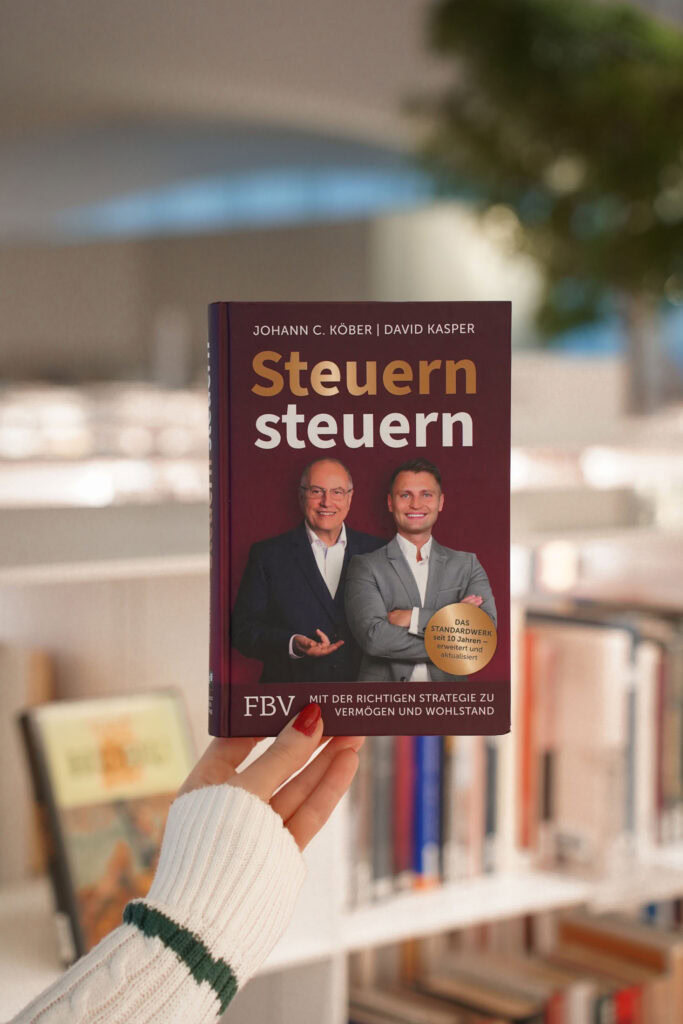
by Johann C. Köber and David Kasper is aimed at people who want to effectively optimize their tax burden. The tenth anniversary edition of this book provides practical strategies for managing taxes in a targeted manner and building long-term wealth.
Content and structure
The book begins with an introduction to the basics of the German tax system and highlights the relevance of personal responsibility when dealing with taxes. Johann C. Köber and David Kasper explain the complexity of German tax laws and show how their scope can be utilized. They emphasize that the strategies presented are one hundred percent legal.
A central concept of the book is the so-called "three-pillar strategy". This strategy includes optimizing taxes and contributions, creating value and building sources of income. Readers learn how to apply these principles to their individual financial situation in order to achieve financial independence.

Important topics
The authors go into detail about the importance of values, income, debt and expenditure - presented as a "money propeller". They explain how assets such as real estate or shares not only generate income, but can also build wealth in the long term. Debt is viewed in a differentiated way: While "bad debt" (such as consumer debt) should be avoided, "good debt" (such as loans for rented property) can be used in a targeted way to accelerate wealth accumulation.
A practical section is dedicated to optimizing personal finances. Readers learn how they can increase their income and structure their spending sensibly without being subject to a "spending diet". The authors emphasize that financial freedom begins with clearly defined goals and consistent personal responsibility.
Practical examples and relevance
Case studies, such as Anna's story, illustrate the consequences of poor financial decisions. Anna gets caught in a spiral of rising interest payments due to consumer debt and learns the importance of sustainable financial planning in a painful way. Such examples make the content tangible and show how readers can avoid similar mistakes.
The authors also deal with complex topics such as the valuation of assets. For example, they explain the long-term costs of a property using Peters' formula. Such detailed analyses help readers to make informed decisions.
Strengths and weaknesses
The book shines with its clear structure and understandable language, which makes even complex topics accessible to beginners. It encourages readers to actively manage their finances and minimize their tax burden. However, the focus on individual strategies could be underpinned even more with scientific findings. Especially when it comes to topics such as the profitability of certain asset classes or the long-term effects of tax strategies, the book remains superficial in places.
"How about understanding the many paragraphs of tax law as rules of the game instead of closing your eyes to the inevitable? Our complex tax law shows that we can only optimize taxes if we take an individual approach. Individual responsibility means work, but it opens up a variety of starting points for reducing taxes and duties. At the end of the day, this leaves much more money to build up wealth."
Johann C. Köber and David Kasper
A few words about the authors at this point:
Johann C. Köber, founder and tax consultant, asked himself early on why financial success varies so much. After studying economics and social sciences, he opened his own tax office and specialized in strategies for optimizing tax and duty burdens.
David Kasper has been Managing Partner of KASPER & KÖBER Partner GmbH in Fürth since 2021. He develops individual tax and foundation concepts and shares his knowledge as a speaker, workshop leader and on his YouTube channel "Steuern steuern". Together, the authors share practical strategies for financial independence and wealth accumulation.
"Values have two central functions in wealth accumulation: They increase their value or retain it and provide their owner with income. This includes rented real estate, securities with dividends or interest and company shareholdings. However, it is important to identify assets unsentimentally and ask the question: Do they generate income or are they a drain on my wallet? Wealth is formed according to purely mathematical criteria, not according to preferences or hopes."
Johann C. Köber and David Kasper
At first glance, the expanded and updated edition seems smaller than I remembered. However, I could be wrong, as the previous edition has not taken up a permanent place on my bookshelf.

The binding, cover and design correspond to the typical standard of the financial book publisher: high-quality, structured and clear.
I was pleasantly surprised by the price of the book. Whereas I used to strongly criticize the price of just under 50 euros for just over 200 pages, the price is now 35 euros. Despite revision, expansion and inflation, the price has improved significantly. Nevertheless, I still find it to be around 10 euros too high, even if it is now approaching a reasonable level.
I would like to make a general appeal to publishers: in my opinion, the focus on tax topics does not justify a price premium of 10 to 30 euros compared to other non-fiction books.
The clear structure of the previous issues has been retained, but unfortunately the somewhat outdated layout in the inner section has also been retained. More could have been done here for an anniversary edition. Nevertheless, the overall layout is appealing.
In terms of language, the book remains easy to understand, although the subject of taxes is a rather dry and unpopular field for many. The authors rightly emphasize that taxes are often the biggest expense item in life and therefore deserve more attention.
In terms of content, the book is strongly oriented towards the typical topics of successful people and offers impulses in these areas. However, I think the title "standard work" is inappropriate. Neither in terms of taxes, entrepreneurship nor success does it reach the depth and breadth of other established works such as KONZ or similar titles in these fields.
The book is by no means bad as a result, but it lacks the substance to be a standard work. The impulses on just over 200 pages are interesting, but not profound.
"Poor people consume, rich people invest. The biggest difference often lies in the mentality: poor people ask themselves which car or cell phone they should buy. Rich people, on the other hand, are concerned with questions such as: What investments do I make next? What strategies will help me pay less tax? If you want to become rich, you should act like the rich: Create value, invest and persevere consistently."
Johann C. Köber and David Kasper
Conclusion
Control taxes is a well-founded and practice-oriented work that shows readers how they can legally and effectively reduce their tax burden. It offers valuable insights into wealth accumulation and motivates readers to take personal financial responsibility. For people who want to strategically optimize their finances, the book is a useful resource. Readers are given concrete tools to manage taxes in a targeted manner and become financially independent in the long term.