


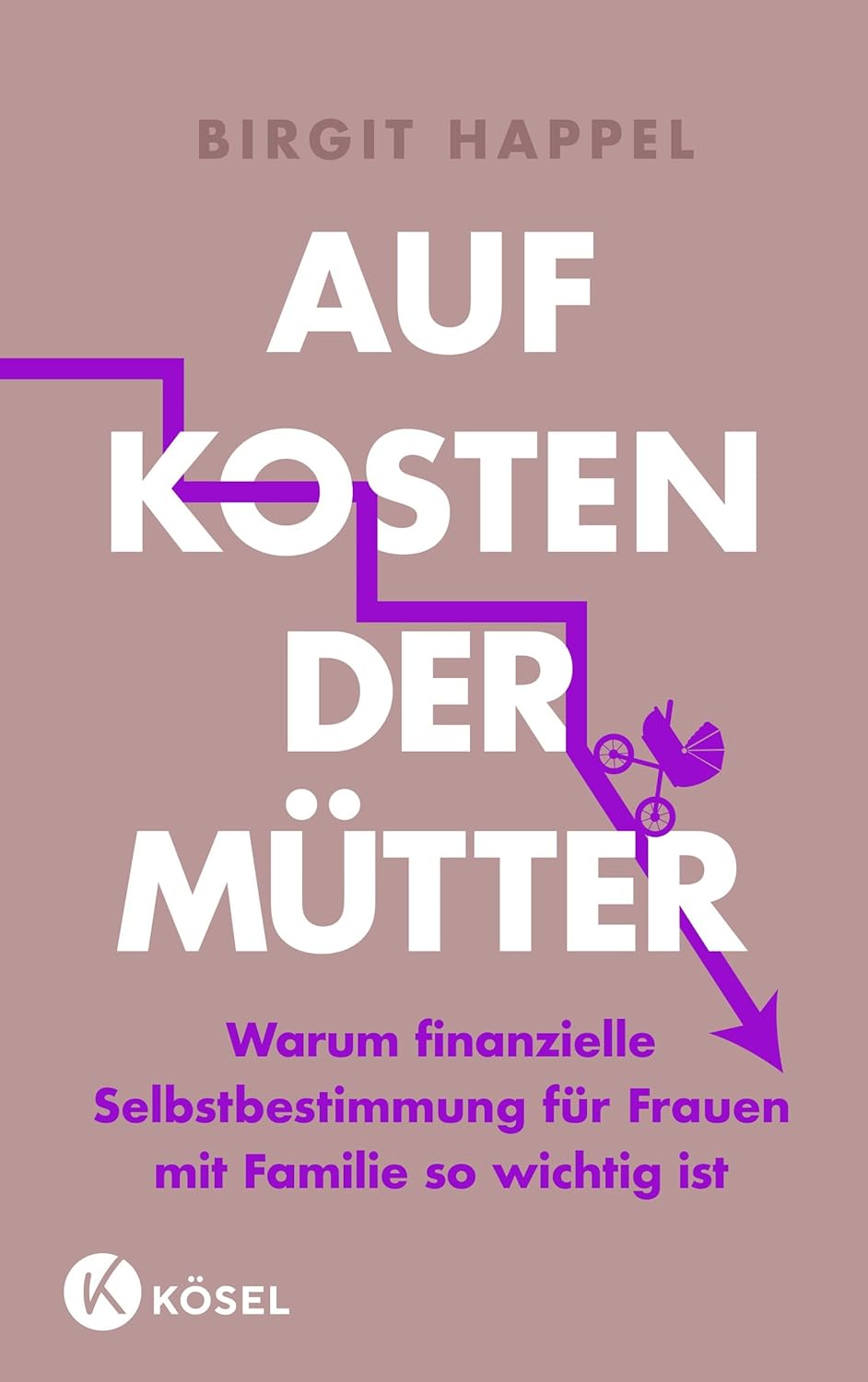
by Birgit Happel offers an in-depth analysis of the structural disadvantages faced by women, especially mothers, in society. The book combines sociological insights with concrete financial guidelines to encourage women to lead a self-determined life. Birgit Happel's readers can expect an unsparing and inspiring examination of social norms, economic conditions and individual scope for action.
Content and structure
The book is divided into six extensive chapters that shed light on all relevant aspects of women's financial self-determination. Birgit Happel analyzes structural discrimination and shows how it shapes the reality of mothers' lives. In doing so, she combines personal stories, scientific studies and practical checklists. In addition to theoretical principles, the chapters offer numerous tips and reflections that help readers to strategically shape their own financial and life planning.
The author vividly describes how unpaid care work is not sufficiently appreciated as a cornerstone of society. A central point here is the unequal distribution of paid work and care work, which puts women at an economic disadvantage. Birgit Happel writes: "Women's unpaid work is work that society as a whole depends on and benefits from." This statement illustrates the systemic grievance, which the author backs up with numerous examples and figures.

Messages and core topics
Birgit Happel appeals to her readers to take a conscious look at their money biography - a term she coined herself in one of her earlier publications. She makes it clear that financial self-determination goes far beyond managing income. Rather, it influences how women shape their life decisions and what perspectives arise from them.
A particularly impressive example is the chapter The cluster risk of motherhoodin which Birgit Happel sheds light on the long-term costs of starting a family for women. She shows how much this decision can affect women's lifetime income, pension entitlements and economic independence. "According to calculations by the Bertelsmann Stiftung, a West German mother with three children loses an average of almost 70 percent of her lifetime income"Birgit Happel explains. These figures underline the urgency of strategically planning financial decisions.
The book also contains a critical reflection on the social framework conditions. Birgit Happel calls not only for individual efforts, but also for structural changes such as the abolition of tax bracket V, fair pay and a better childcare infrastructure. Her call for a new family policy illustrates how closely financial self-determination is linked to political reforms.
Relevance for readers
In addition to sound analyses, Birgit Happel's readers also receive practical advice on how to strengthen their financial independence. The book is primarily aimed at women who are dealing with the challenges of gainful employment and care work. It also appeals to mothers who want to rethink their financial foundations, as well as younger women who are about to start a family.
It is the combination of individual tips for action with socially critical perspectives that makes the book stand out. Birgit Happel shows how important it is to establish financial education at an early age and to question gender roles. "It's not the women who have to change, but the rules of the game"she emphasizes and provides convincing arguments for a fairer distribution of resources.
"Care work is the elementary prerequisite and basis of all social and economic activity - before a community can be administered, a machine put into operation, a car built or a business decision made, a person must first be born, raised and educated. [...] Nevertheless, care work remains invisible in the economic data. Because only wage labor is included there. A significant proportion of mothers' money is therefore missing from the overall economic balance sheet."
Birgit Happel
An dieser Stelle ein paar Worte zur Autorin:
Birgit Happel holds a doctorate in sociology and is the founder of the financial education portal Geldbiografien®, which places financial education and gender equality in a socio-economic context. She is involved as a UNESCO ESD actor, a member of UN Women Germany and in numerous initiatives for the economic independence of women. With her research focus on equal opportunities, social innovation and financial psychology, she provides important impulses for a conscious approach to money. Further information can be found at www.geldbiografien.de.
"A new father asked me a good question at an event on the topic of 'Women strengthening their finances': 'Are there also things you would like us men to do? [...] The OECD statistics confirm that despite an increase in employment, women in Germany still do the majority of unpaid domestic work, including childcare, at 65%. Too much care work remains the responsibility of mothers, especially if they are employed."
Birgit Happel

At first glance At the expense of mothers directly. I was expecting a mixture of self-determination guide, financial book and political manifesto - and the book fulfilled these expectations. The high-quality binding, the attractive cover and the well-used inner sections of the cover make an excellent first impression. The "10 tips for your financial self-determination" and the checklist for financial equality are real highlights.
The interior design is less elaborate, but still very tidy and clearly structured. For just under 250 pages at a price of 18 euros, readers really get a lot here.
In terms of language, the book is aimed at both beginners and advanced readers. Not every technical term is explained down to the smallest detail, but a good balance is struck. The style is engaging and emotional without being flippant - rather a successful mix of academic and motivational.
In terms of content, the work is largely a political book that focuses on supporting mothers and women in relationships and different life situations. In the last third, it also offers solid basics on finance and investing, which I found to be a very fitting addition.
Many sections are pleasingly in-depth, especially those backed up by interviews with experts and case studies. I have not seen some of the topics covered in such detail in any other book. This book fills an important gap by addressing a target group that faces conscious and unconscious systemic challenges, the consequences of which are often only felt in old age.
You don't have to agree with the author's arguments on every point to recognize the value of this book. It is targeted, valuable in terms of content and absolutely worth reading and recommending!
"Many young people fall into the trap of thinking that we have already achieved everything in terms of equality. [...] In fact, Germany ranks poorly in the sub-category 'economic participation and opportunities' in a global comparison. [...] According to calculations by the Bertelsmann Foundation, a West German mother with three children loses an average of almost 70 percent of her lifetime income. [...] This book aims to support women and families in taking care of their financial security, defining their own values and strengthening their financial self-confidence."
Birgit Happel
Conclusion
At the expense of mothers by Birgit Happel is more than just a guidebook. It is a socio-political plea for equal rights and financial self-determination. Birgit Happel's readers benefit from a successful mixture of well-founded analysis, practical assistance and motivating impulses. This book is a valuable companion for women who want to strategically shape their financial future and a call to society to fundamentally improve the framework conditions for mothers.