


In April 2025, the international stock markets experience one of the most severe slumps since the coronavirus crisis. What began as a political measure quickly developed into a global financial shock.
Donald Trump's tariff policy is causing the markets to tremble, billions in assets are disappearing into thin air and investors are faced with a crucial question: What should I do now?
In this article, you will not only receive a comprehensive analysis of the current situation, but also possible strategies for the best possible response.

The most important in a nutshell
- Trump's new tariffs trigger stock market crash in 2025: +34 % on imports from China, withdrawal from talks. Confidence in the global economy collapses.
- International indices plummet by double digits: DAX -11.8%, Hang Seng -14.5%, Nasdaq -7.4%. The nervousness is palpable worldwide.
- Safe havens fail: Even gold (-3.1 %) and Bitcoin (-8.2 %) are falling, while the need for liquidity dominates.
- Avoid emotional reactions: Panic selling is expensive. Those who are prepared can profit anti-cyclically.
- Targeted use of options and liquidity: Strategies such as long calls, puts or covered calls open up opportunities. Provided that risk management is in place.
The stock market crash 2025 at a glance: Facts, figures, causes
To understand the extent of the current stock market quake, just take a look at the market movements. Within a very short space of time, the most important indices around the world plummeted. The trigger: a new round of tariffs imposed by the USA under President Donald Trump, which is causing economic uncertainty worldwide.
How did the crash happen? Trump's tariff package as the trigger
The stock market crash of April 2025 was caused by the Massive escalation in the global trade conflict The US and China are at the center of this trend.
Donald Trump, back at the helm of the United States, announced a series of drastic measures that will not only shake up bilateral trade with China, but also the entire global economy.


Record tariffs: escalation between the USA and China
At the beginning of the year, Trump had already raised tariffs on imports from China to 20 % was raised. This was followed shortly afterwards by a further increase of 34 %which brings the total amount of US tariffs on Chinese goods to 54 % brought. As a direct reaction China counter tariffs in the same amountwhich has already weighed heavily on the markets.
However, on April 6, 2025, Trump went one better: if China does not withdraw its tariffs, he will impose further tariffs. 50 % Punitive tariffs on all remaining Chinese imports raise.
According to the announcement, these additional duties are already on April 9, 2025 come into force. The cumulative burden on Chinese goods could thus be reduced to up to 104 % increase. That would be an economic escalation of historic proportions.
Affected worldwide: Trade networks collapse
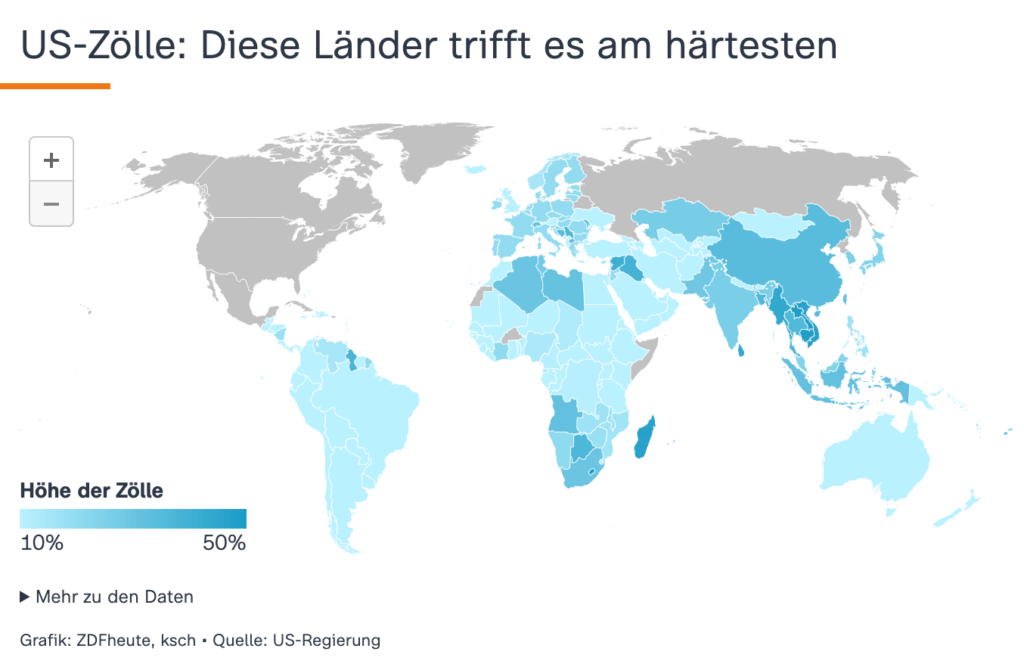
The effects of this approach can be felt globally. Not only China is affectedbut also numerous other economies that are closely intertwined with international trade.
These include above all the European Unionabove all Germany as an export nation, but also Japan, South Korea, Vietnam, India, Canada, Mexico and Brazil.
Many of these countries are either affected by US tariffs themselves or are part of complex supply chains that are severely disrupted by the trade war.
In a globalized world economy, this creates a Uncertainty on a broad frontwhich is reflected directly on the stock markets: Investors are withdrawing capital, leading indices are plummeting and fears of a new global recession are growing. The result: economic shockwaves around the globe.
Facts at a glance:
- Customs package 2025: +34 % on imports from China, at least 10 % on all other countries
- Additional measures: Withdrawal from talks with the EU and China
- Trump's reasoning: "The markets sometimes have to swallow medicine to get better."
These statements led to a loss of confidence across the board. Investors worldwide now fear a global recession of the kind last seen in 2008.
International markets in free fall: DAX, Nikkei, Hang Seng, Nasdaq - all affected
Hardly any market was spared. Below you will find the losses caused by the stock market crash 2025 between the announcement of the tariffs (Wednesday, April 2 to Monday, April 7):
| Index | Loss (%) |
| DAX | -11,8 % |
| Nikkei 225 (Japan) | -13,7 % |
| Hang Seng (Hong Kong) | -14,5 % |
| Nasdaq 100 | -7,4 % |
| Dow Jones | -21,4 % |
| SMI (Switzerland) | -12,3 % |
These price losses represent historic slumps within a single trading day. The nervousness is palpable everywhere. From Frankfurt to Tokyo.
Key figures at a glance: Daily losses and historical comparisons
Such a broad sell-off can only be compared with historical events. The stock market crash of 2025 is already being compared with the "Black Monday" of 1987 or the coronavirus crash of 2020.
Historical comparisons:
- Corona crash (March 2020): DAX -12.2 % in one day
- Black Monday (1987): Dow Jones -22.6 % in one day
- Crash 2025: DAX -11.8 % within 5 days since the announcement
The combination of political uncertainty, economic slowdown and algorithmic selling is adding to the momentum. economic slowdown and algorithmic selling is adding to the momentum.

Why Bitcoin, gold and commodities were not safe havens either
In classic times of crisis, investors flee into so-called safe havens. In particular Gold, Bitcoin or raw materials such as Oil. But this time it turned out that if the panic is great enough, capital will be withdrawn there too.
Market reactions from April 7, 2025:
- Bitcoin: -8,2 %under the brand of 75,000 US dollars please
- Gold: -3,1 %, decrease to 2,960 US dollars per ounce
- Crude oil (WTI): -6,5 %due to demand concerns and geopolitical uncertainty
The reason: many institutional investors were forced to Create liquidityto service margin calls or reduce risks. In the process, positions were also sold that were actually Fuse were intended to counter precisely such crises.
What investors need to know now: Why calm and strategy are more important than quick reactions
When stock market prices suddenly plummet, the media is filled with red figures and dramatic headlines and panic spreads, it is particularly difficult for investors to keep a cool head. But it is precisely in such phases that it is decided who will invest successfully in the long term and who will realize unnecessary losses.
The most important principle in crash phases is: Do not panic. Because those who make decisions out of fear act emotionally instead of rationally. This usually has fatal consequences for your own returns.
Why no rash decisions should be made now
The stock market is not a sprint, but a marathon. Short-term falls are part of it. They are not an exception, but a recurring pattern. If you want to build up long-term wealth, you need to be aware of this: Fluctuations are part of the system. They offer risks, but also opportunities. Especially for disciplined investors.
Before you rush to sell, reallocate or even exit the market completely, it is worth taking a look at proven strategies.
Because Many of the most successful investors of the world, from Warren Buffett to Peter Lynch, emphasize time and again: Market turbulence is the time when fortunes are made. And not through hectic trading, but through patience.
Why panic selling is almost always a mistake
Emotions such as fear, uncertainty or anger often lead to impulsive decisions. In crash phases, many investors sell precisely when prices are at their lowest. Out of fear that things could go even further downhill. But in doing so, they realize losses that they might never have had to bear if they had been patient.
Typical mistakes in times of crisis:
- Sales at rock bottomWhoever sells after a slump usually misses out on the subsequent recovery.
- Reallocation to illiquid investmentsMany investors then flee into less tradable or high-risk alternatives.
- Focus on headlines instead of fundamentals: Media thrive on attention. And not from long-term orientation.
In the past, the markets have recovered after every crisis. Be it after the dotcom bubble burst, the financial crisis in 2008 or the coronavirus crash in 2020. If you sell before the markets recover, you usually get back in too late - and miss out on the most profitable phase of a recovery.


Why your preparation determines your stock market success
Crisis phases are not a time for spontaneous decisions. Instead, the basic principles of long-term investment philosophies are now proving their worth. Those who have their capital structure, liquidity reserves and decision-making mechanisms already structured in advance acts more confidently and successfully.
It is not unusual for a well-thought-out plan to separate the successful investors from those who realize losses and are annoyed afterwards.
Liquidity as a strategic weapon: Why cash is more important than short-term returns in a crisis
In uncertain market phases, this becomes apparent time and again: Liquidity is not a standstill, but room for maneuver. Those with sufficient liquid funds are not forced to sell under pressure, but can take advantage of opportunities when others are selling in panic.
Why a cash reserve is essential
Cash fulfills several central functions in the asset structure:
- Buffer function: You do not have to sell positions to obtain liquidity. For example, in the event of unexpected expenses or margin calls.
- Anticyclical action: You are in a position to buy quality shares when they are trading at historically low prices.
- Psychological safety: A liquid portion in the portfolio reduces your emotional burden and helps you to remain calm during the crisis.
Common cash ratios according to risk type
| Investor type | Recommended cash ratio |
| Defensive investors | 20 to 30 % of total assets |
| Conservative ETF investors | 15 to 25 % for targeted additional purchases |
| Active investors & traders | 30 to 50 % with high volatility |
Yield-oriented cash alternatives
The following alternatives are available to ensure that your liquidity is not completely interest-free:
- Multi-currency accounts with CapTrader mit Interest
- Short-dated government bonds with a high credit rating (e.g. Germany, USA)
- Money market funds with daily availability
- High-quality corporate bonds with a short term (only with a stable credit rating)
Good to know:
Liquidity is not a wasted return. It is your ticket to being able to act actively and independently in a crisis.
Systematic investing: How to avoid emotional mistakes and seize opportunities with a clear plan
Those who invest systematically remain capable of acting and recognize not only the risk but also the opportunity in a crisis. A structured investment plan prevents you from getting caught up in the maelstrom of herd instinct during hectic market phases.
It gives you security, orientation and a set of rules that you can hold on to. Even when prices are falling and the headlines are worrying.
The 4-step model for targeted additional purchases: how to invest intelligently when prices fall
One of the most frequently asked questions in times of crisis is: "When should I get back on?" The simple answer: not all at once. If you invest in stages, you can take advantage of market fluctuations and significantly reduce your average entry price.
The 4-stage model is a proven concept that many professional investors use during crash phases. The aim is to make targeted investments when prices continue to fall. Without having to speculate on the exact low.
This is how it works:
- 25 % at the first significant decline (e.g. -10 %)
- 25 % with further -5 %
- 25 % further -10 %
- 25 % on signs of a bottom formation or technical rebound
This strategy spreads out your risk and allows you to take advantage of More shares for less money to buy. At the same time, you protect yourself from investing everything at once. For example, in an early downward movement.
Attention:
This method does not require perfect predictions. Only discipline and clear rules.
Alternative strategy: savings plans as an anti-stress mechanism in volatile markets
If you prefer to invest automatically and for the long term, the Cost-average effect regular savings plans make particular sense. You invest a fixed amount every month. And regardless of how the market performs.
In falling markets, this gives you more shares for the same moneywhich leads to a more favorable average entry price in the long term. In rising markets, you automatically benefit from the compound interest effect.
Your advantages at a glance:
- Automated investing. No timing necessary
- More emotionally independent of market fluctuations
- Ideal for ETFs or broadly diversified equity portfolios
- Perfect for building wealth with a long horizon
This method is worth its weight in gold, especially in times of crisis, because it gives you security and at the same time enables solid returns in the long term.
The buy-the-dip checklist: Check quality before you invest
Not every price drop is a buying opportunity. In many cases, there are fundamental reasons for falling share prices, such as when a company gets into economic difficulties.
You should therefore never buy blindly during crash phases, but rather Back up every investment decision with a checklist.
Important questions before every subsequent purchase:
- Is the company sustainably profitable?
- Does it have a stable and crisis-tested business model?
- Is the valuation significantly below the historical average?
- How solid is the balance sheet? (e.g. low debt, high cash flow)
- Are there geopolitical or sector-specific risks?
Good to know:
Keep a digital or physical investment journal in which you document your post-purchase rules, assessments and decisions. This strengthens your discipline. Especially in psychologically stressful phases.
Pro tip: Invest and profit during the crisis
While many market participants sell their shares or simply wait and see, there are completely new ways for well-prepared investors not only to survive in the midst of the crisis, but even to build up assets in a targeted manner: Through the Use of Options.
Options strategies are considered one of the most flexible tools in stock market trading. They make it possible to bet on rising or falling markets with a low capital investment, to hedge portfolios in a targeted manner or to generate regular premiums in the event of high volatility.
The market is particularly "nervous" during crash phases. And this nervousness can be converted into capital in a targeted manner. Because: Volatility is the currency of the options markets.
Why options are particularly attractive in crash phases
The most important prerequisite for lucrative option strategies is a High implied volatility. This describes the expected fluctuation range of an underlying asset and rises sharply when investors are uncertain.
In a stock market crash, volatility literally explodes. A circumstance that significantly increases option prices.
For buyers of options this means: The premiums are more expensive, but the chances of winning are greater. For sellers of options, on the other hand Higher income by selling calls or puts. Both can be used with the right strategies to bet on movement, sideways markets or even reversal formations.
The great strength of options: They allow you to every market situation implement a suitable strategy. Even (and especially) when traditional equity investments appear difficult or risky.
The best option strategies in a stock market crash are explained in detail below
Long call: controlled speculation on the recovery
A Long Call is one of the simplest and most effective strategies in a stock market crash. Especially if you assume that prices will recover after an initial slump. Recover promptly be
By buying a call, you secure the right to buy an underlying asset at a predetermined price. Regardless of how the market develops.
Example:
- Underlying value: DAX ETF
- Strike: 18,000 points
- Running time: 3 months
- Premium: 3 € per share
- Break-even: 18,300 points
If the DAX rises to 19,000 points by the end of the term, you make a profit of 700 points per contract. If, on the other hand, the DAX falls or remains below 18,300 points, you only lose the premium paid. Your risk is therefore limited from the outset.
When does it make sense?
- At V-shaped recoveries
- If you are bullish but only want to invest a limited amount of capital
- As part of a rebound plan
Advantages:
- Strong Risk-reward ratio
- No infinite capital requirement
- Also ideal for smaller depots
Long Put: Your insurance against further price losses
If you have existing positions and want to protect yourself against further break-ins Long Puts the instrument of choice. A put gives you the right to purchase an underlying asset at a fixed price. Sellwhich leads to rising option values when prices fall.
Example:
You own 100 SAP shares at € 120 each. By buying a put with a strike of € 115, you hedge your position: if the share falls to € 100, the put price rises significantly and you limit your losses automatically.
Application:
- Portfolio hedging
- Speculation on further downward movement
- Psychological reassurance in volatile markets
Straddle & Strangle: speculating on extreme movements in both directions
Especially in crash phases unclear in which direction the market will move next. But one thing is certain: It will not stay quiet. A straddle (call + put with the same strike) or a strangle (call + put with different strikes) benefits precisely from this uncertainty.
Target:
You are counting on the market to clearly moved. No matter where. The strength of movement only has to be sufficient to overcompensate for both premiums.
Ideal for:
- Central bank decisions
- geopolitical shocks
- Panic phases with extreme daily volatility
Risk: Both options expire worthless if the market hardly moves.
Covered call: collecting premiums when markets stagnate
A Covered Call is particularly interesting if you already hold shares but expect a sideways phase in the near future, for example after the first major slump. Here you sell call options on your shares and receive a premium. Regardless of whether the market rises.
Advantage:
- Additional returneven without price movement
- Risk minimization in slightly falling markets
- Very suitable in calmer phases after the crash
Risk management with options: What you need to consider
In crash phases, it is crucial to work with clear Risk Management to work. Options can quickly expire worthless if you misjudge the market movement.
Basic principles:
- Maximum 1 to 2 % of the portfolio value per individual strategy
- No leverage products without a plan
- Define stops or exit criteria before entry
- Develop an understanding of the "Greeks":
| Greek | Meaning |
| Delta | Sensitivity to price movements |
| Gamma | Change in the delta when the price changes |
| Theta | Time value loss: daily decreasing value |
| Vega | Sensitivity to volatility |
Straight Theta (time value loss) can tip a strategy if you wait too long or the market moves too little.


Conclusion: The crash as an opportunity for those who are prepared
The Stock market crash 2025 marks a historic turning point, triggered by aggressive US trade policy measures.
For investors, the situation is a stress test, but also an opportunity. Those who are prepared, act with liquidity and make targeted use of strategies such as staggered purchases, savings plans or options can not only limit losses, but also profit in the medium term.
The most important rule in such times remains: Keep calm, think strategically and don't react emotionally. Because it is precisely during a crisis that the foundations for future success are laid.
