The stock market acts as a mirror of the global economy. However, if this begins to falter, it can shake entire economies. Unconventional price movements, panic selling and losses running into the billions can be the result, although these can also mark significant turning points in history and should be seen as a lesson. The following will give you an Overview about the most turbulent stock market crashes of all time from 1929 to the present day.

The most important in a nutshell
- Stock market crashes can not only be understood as a warning signal for the economy, but can also mark significant turning points in history and serve as a lesson
- Black Thursday" on October 24, 1929 is considered one of the most significant stock market crashes in stock market history since 1929, which also triggered a global economic crisis
- The "dotcom internet bubble", the real estate crisis in 2008 and the coronavirus crisis in 2020 show that a wide variety of crises with a wide variety of triggers can occur at any time
October 24, 1929: "Black Thursday" - Wall Street collapses
On October 24, 1929, the so-called "Black Thursday", the Dow Jones plummeted by over 22% at the start of trading. Nevertheless, the book losses were capped at 2.1 percent at the end of trading. Just four and five days later, there were further massive price losses of 13% and 12% respectively. The stock market crisis also marked the start of the "Great Depression" in the United States and the beginning of the most massive global economic crisis of the 20th century.
This was preceded by a long period of Boom and rising stock market prices in the United States, which also made the USA the richest country in the world. Industries such as cars, electronics and construction experienced a real boom. However, the euphoria came to an abrupt end in the fall.

October 19, 1987: "Black Monday"
The Dow Jones plummeted by 22.6 percent on "Black Monday", October 19, 1987. The resulting panic sent shockwaves around the globe and also caused share prices to plummet. In addition to a trade and budget deficit in the USA, the background to this was the raising of interest rates. This is likely to Automated trading programs computer-based sales and triggered a veritable chain reaction. Numerous shares had already risen sharply beforehand and were therefore overvalued. Consequently gripped monetary authorities and governments to calm the markets.
There was no central trigger for the price slide on "Black Monday".
March 2000: Bursting of the "dotcom internet bubble"
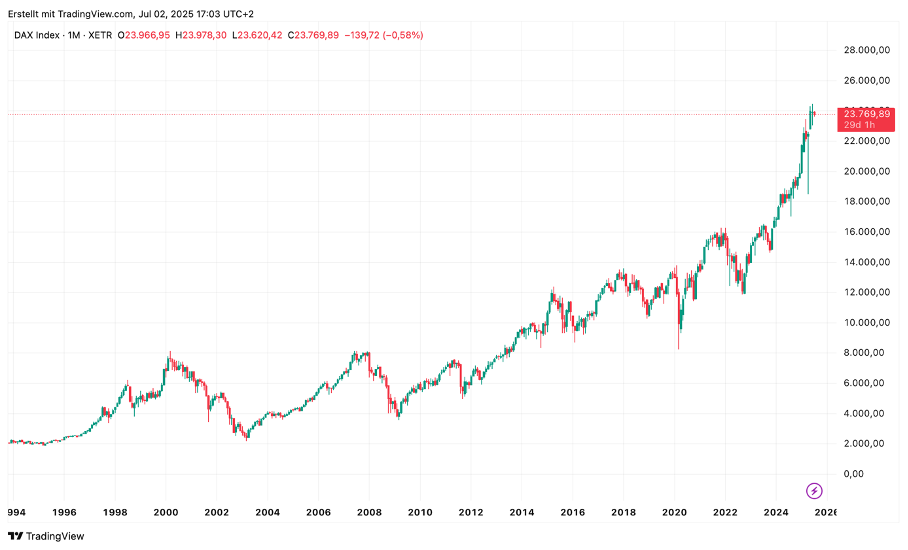
The bursting of the so-called "Dotcom Internet bubble"The "dotcom" stands for the domain extension ".com" on the World Wide Web and is another of the most significant stock market crashes of all time since 1929. A combination of euphoria, exaggerated expectations and greed led to the emergence of the internet bubble in the age of the new market (new economy) from 1995 onwards. In some cases, Internet start-ups went public even though they were barely able to report any turnover or profits.
The year 2000 was followed by disillusionment at the lack of viable business models for numerous companies. In many cases, the high turnover and profit expectations could not be met. Numerous dotcom companies went bankrupt - Trillion US dollars in stock market value were destroyed.
Worth knowing: On September 11, 2001 terrorist attacks in New York and Washington, causing the DAX in Frankfurt am Main to plummet by over 400 points to 4,247 points. Wall Street consequently remained closed for several days. However, the short-term uncertainty is followed by a rapid recovery.
2008: Global financial crisis: Real estate crisis in the USA spreads
The global financial crisis in 2008 is also considered one of the biggest and best-known crises in history.
Financial institutions in the USA granted real estate loans to borrowers with a poor credit rating (subprime loans) and often without corresponding collateral or proof of income. However, as interest rates rose, it became increasingly challenging for borrowers to pay the installments on their own four walls.
Your Zenith The financial crisis reached its peak with the collapse of the US investment bank Lehman Brothers in September 2008, which triggered a veritable domino effect, causing further banks to fail and ultimately even plunging the United States into recession. The real estate crisis developed into a full-blown banking crisis in 2009.
March 12, 2020: Corona pandemic hits stock markets worldwide
One day after the official declaration the World Health Organization (WHO) on 12 March 2020, the announcement caused a great deal of chaos. COVID-19 is declared a pandemic and causes the leading index in Frankfurt am Main, for example, to plummet by 12% and in New York by -10%. On the trading days after March 12, 2020, there are further price losses and panic selling. Uncertainty about the virus, the associated restrictions on the economy and the collapse of global supply chains fueled fears of a recession around the world.
Conclusion: Stock market crashes from 1929 to the present day as turning points - between opportunity and risk
The history of the biggest stock market crashes since 1929 shows how unexpectedly and with what force stock markets around the world can collapse. "Black Thursday" on October 24, 1929 is considered one of the most significant stock market crashes in that period, which also triggered a global recession. However, the "dotcom internet bubble", the real estate crisis in 2008 and the coronavirus crisis in 2020 also show that a wide variety of crises with a wide variety of triggers can occur at any time.
Stock market crashes can reflect fears, exaggerations as well as weaknesses in the economy and the financial system.
However, crashes can not only be understood as a warning signal for the economy, but can also mark significant turning points in history, act as a lesson for markets and politics and thus promote innovation. However, every crash is likely to leave its mark and, not least, has repeatedly demonstrated the vulnerability of the market in an impressive way.
It should be noted that crashes can be painful in the first instance, but may even be necessary to correct market exaggerations, reveal weaknesses and create a resilient system in the long term.