


Restaurant stocks are increasingly gaining importance among many investors, as they offer an opportunity to profit from the global growth of the gastronomy industry. The sector is driven in particular by changing consumer behavior, the boom in the delivery business, technological innovations in ordering and payment systems, and the expansion of international brands.
In addition, there are efficient business models such as franchise concepts, which ensure stable margins and scaling potential. In this article, you will get an overview of which restaurant stocks currently appear promising and what opportunities and risks you as an investor should expect in this market environment.

The most important facts in brief:
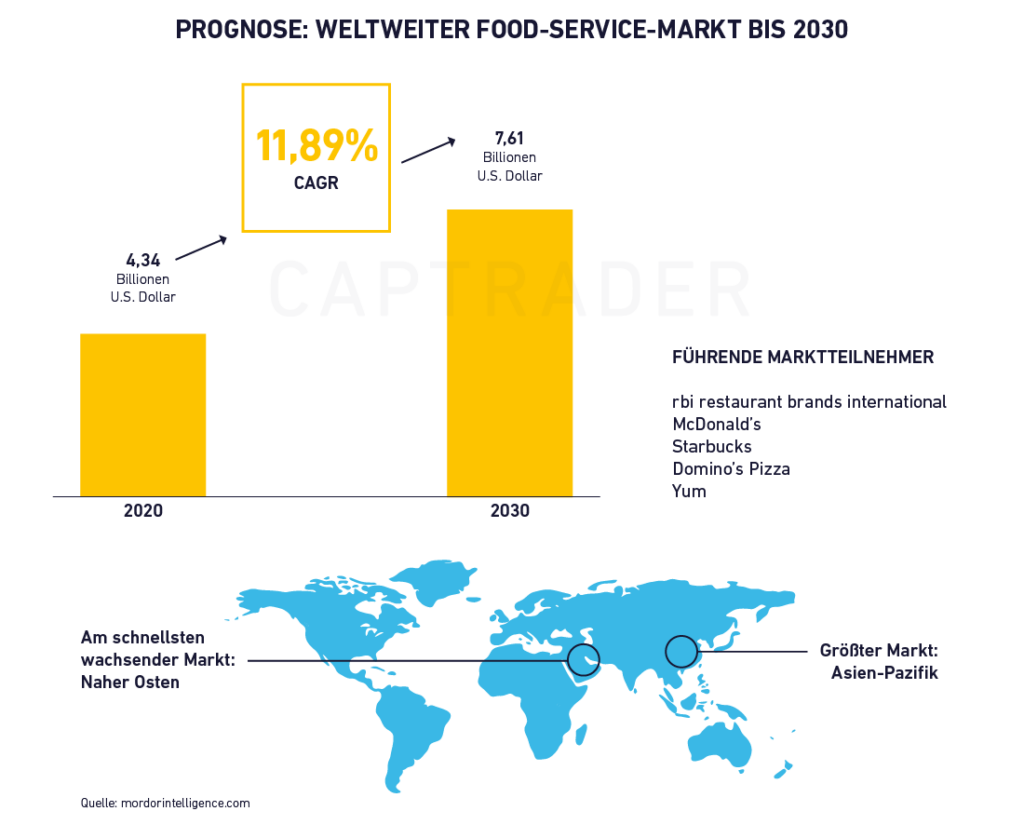
- The global foodservice market could grow from around 4.34 to approximately 7.61 trillion US dollars by 2030.
- The cloud kitchen market is expected to grow to well over 200 billion US dollars by the 2030s.
- Investors should keep an eye on risks such as cost inflation, cyclical demand, and competition, despite the growth trend.
What are restaurant stocks?
Restaurant stocks and hospitality stocks comprise shares of companies operating along the entire value chain of the food service industry.
This includes, for example, restaurant chain operators, franchisors, delivery service providers, chain restaurant companies, and firms that develop and provide digital ordering and payment solutions for the industry.
You are thereby operating at the intersection of the consumer goods market, technology, and scalable business models. Despite economic fluctuations, the gastronomy sector remains a relevant market, as dining and out-of-home dining are among fundamental consumer needs.
Restaurant stocks can be roughly categorized into different areas of the value chain. These segments react differently to economic developments, consumer trends, and technological innovations.
- Pure restaurateursThis includes companies that operate their own brands and store networks, such as McDonald's or Chipotle. Their business development depends heavily on location strategy, brand strength, and operational efficiency.
- Franchise companiesCompanies like Yum! Brands or Restaurant Brands International rely on franchise models. They benefit from recurring revenues through licensing fees and often exhibit stable margins with lower capital commitment.
- Delivery service and platform providersCompanies like DoorDash or Delivery Hero connect restaurants with end customers. Their growth is largely driven by the demand for online orders and delivery solutions.
- Chain restaurants and fast-casual conceptsThese providers combine standardized processes with higher quality, thereby appealing to a broad target audience. They benefit particularly from economies of scale and the growing demand for fast yet high-quality meals.
- Suppliers and industry-specific service providersThis includes companies that provide packaging, kitchen technology, or digital point-of-sale systems. Their development is closely tied to the expansion and investment readiness of hospitality businesses.
- Technology provider for the hospitality industryCompanies that develop software solutions for ordering processes, payment processing, or customer loyalty. They are increasingly benefiting from the digitalization of the industry and rising demands for efficiency and data analysis.
Some restaurant stocks cover multiple areas at the same time, such as through a combination of company-owned operations, franchising, and digital platforms. This allows them to better diversify risks and stabilize their earnings base.


The market potential of restaurant stocks in 2026
The global foodservice market is one of the most dynamic growth markets of all. According to a recent analysis by Mordor Intelligence The market size is expected to grow from 4.34 trillion U.S. dollars (2025) to 7.61 trillion U.S. dollars (2030), representing a compound annual growth rate (CAGR) of 11.89 %.
Several structural factors are simultaneously driving the growth of the global food service market and reinforcing each other.
- Convenience and digitalizationToday, consumers expect fast, flexible ordering channels, whether via app, at the drive-thru, or through delivery services. Omni-channel strategies have long been standard for large chains. New technologies, such as autonomous delivery systems, are also changing the operational logic.
- Health and TransparencyThe social shift toward more conscious consumption is forcing providers to adjust their menus. Plant-based proteins, nutrient-dense alternatives, and options for special dietary needs (vegan, gluten-free, low-carb) are particularly in demand. Especially in North America and Western Europe, even classic fast-food chains must continually reform their offerings to remain competitive.
- Expansion into emerging regionsThe QSR sector (Quick Service Restaurants) is experiencing particularly strong growth in emerging markets. In Asia-Pacific, advancing urbanization is driving out-of-home consumption. In the Gulf region, government programs such as Saudi Arabia's "Vision 2030," growing tourism, and a young population are driving explosive growth, which international chains are capitalizing on through aggressive franchise expansion.
- Culinary globalizationSocial media and international travel are making consumers worldwide more curious about foreign cuisines. Concepts such as Japanese ramen bars, Korean BBQ, or fusion kitchens are experiencing a global boom. This increases the pressure to innovate on established providers while simultaneously opening up significant growth opportunities for new market concepts.
Cloud kitchens and delivery services as growth drivers
A central growth driver for restaurant stocks is scalable concepts such as cloud kitchens. Under this model, companies operate production kitchens without a dining area that are designed exclusively for delivery orders.
Market researchers expect the global cloud kitchen market to grow significantly from a volume in the tens of billions of dollars in the mid-2020s well into the 2030s, implying double-digit annual growth rates.
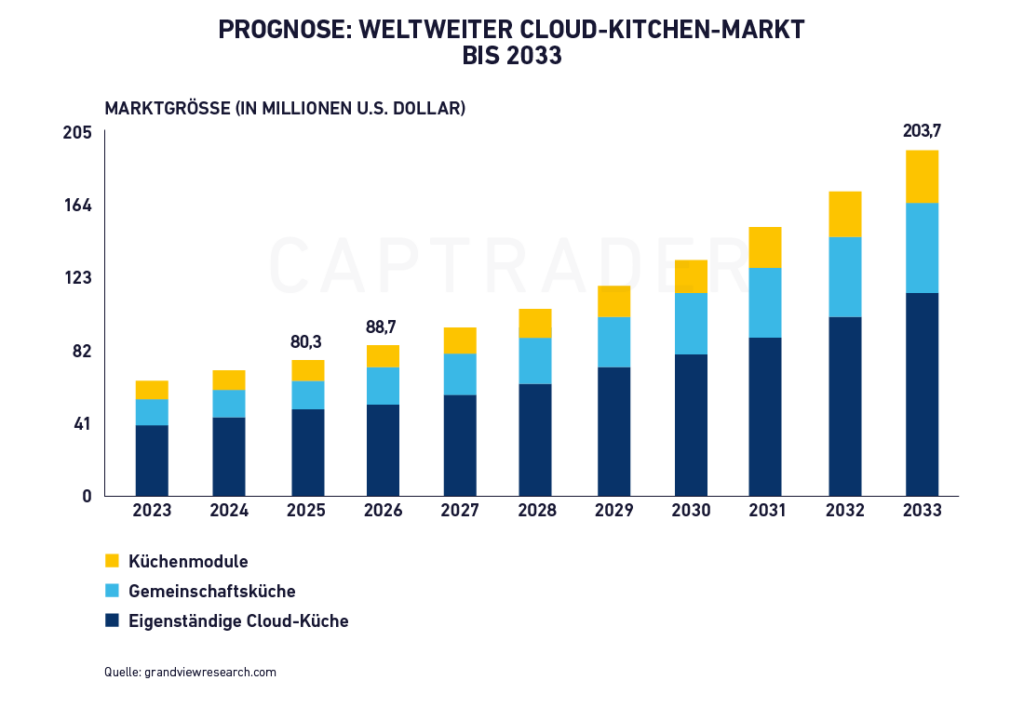
The chart shows the forecasted development of the global cloud kitchen market from the mid-2020s to the early 2030s. Starting from a market volume of around 80 billion US dollars in 2025, an increase to over 200 billion US dollars is expected by 2033.
The chart illustrates the annual growth rate of over 12 % and highlights the role that delivery-focused kitchen models can play as growth drivers for restaurant and delivery stocks.
US restaurant sales at record levels
Revenues in the US food services and drinking places sector have increased significantly since the beginning of the corona pandemic.
Laut Statista Seasonally adjusted monthly sales for restaurants and bars rose by about 45 % to $97.4 billion between February 2020 and May 2025. During the same period, prices for food consumed off-premises rose by about 32 % and prices for alcoholic beverages consumed off-premises rose by 22 %, meaning that revenue growth exceeded the pure price effect.
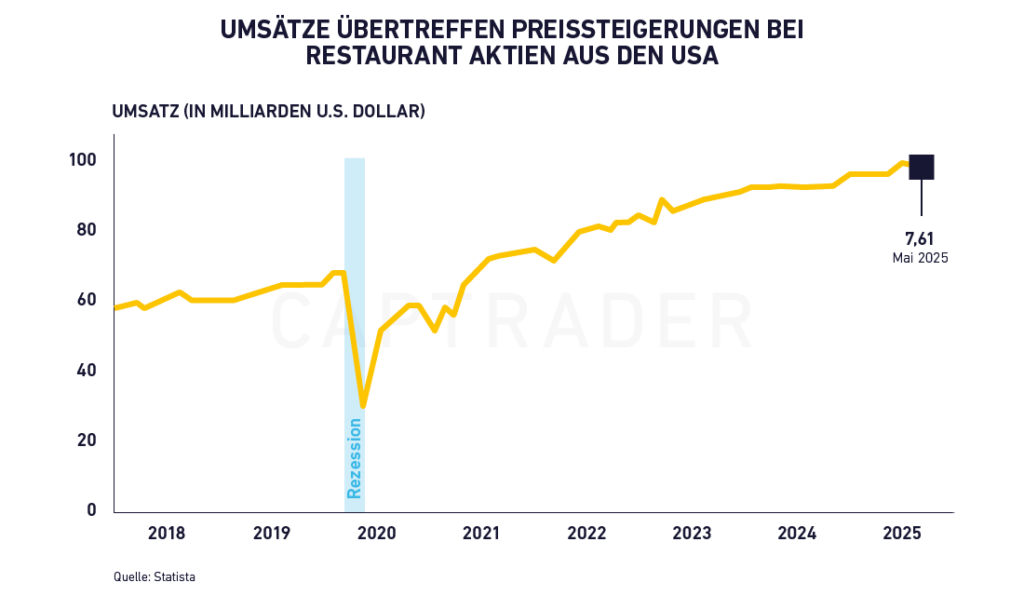
- Industry revenue May 2025: $97.4 billion, seasonally adjusted.
- Revenue growth since February 2020: approximately +45 %.
- Price increase for eating out: approx. +32 %.
- Price increase for alcoholic beverages consumed outside the home: approx. +22 %.
- Revenue growth is thus above the rate of price increases.
- Gastronomy stocks offer exposure to this revenue trend, but remain dependent on economic cycles and costs.
For investors, this reveals an industry with strong nominal growth, in which selected restaurant stocks can be considered as an investment in this trend.
The best restaurant stocks and dining stocks
The following overview presents a selection of significant publicly traded restaurant stocks whose business models are closely linked to chain restaurants, delivery concepts, franchise structures, or the digitalization of the restaurant industry.
| Company | ISIN | Country | Market capitalization in US dollars¹ |
| McDonald's Corp. | US5801351017 | USA | 197 billion |
| Starbucks Corp. | US8552441094 | USA | 108 billion |
| Compass Group PLC | GB00BD6K4575 | Great Britain | 56 billion |
| Yum! Brands Inc. | US9884981013 | USA | 41 billion |
| Chipotle Mexican Grill Inc. | US1696561059 | USA | 38 billion |
| Restaurant Brands International Inc. | CA76131D1033 | Canada / USA | 25 billion |
| Yum China Holdings Inc. | US98850P1093 | China / USA | 14 billion |
| Aramark | US03852U1060 | USA | 14 billion |
| Texas Roadhouse Inc. | US8826811098 | USA | 11 billion |
| Darden Restaurants Inc. | US2372661015 | USA | 9 billion |
To invest in stocks, you need a brokerage account. With CapTrader, you can easily open one and gain access to over 170 international stock exchanges. Trade now at attractive commission rates: for US stocks, you pay 1 cent per share, with a minimum of $2.00 per order.


1. McDonald's Corp.
Apart from the pure restaurant business, the Dividend aristocrat McDonald’s (ISIN: US5801351017) relies on an extremely profitable real estate and licensing system that is considered the industry gold standard.
The unwavering consumer need for affordable meals, state-of-the-art point-of-sale technology, and an invaluable portfolio of corporate-owned real estate around the globe form the foundation of this success.
Because the restaurant network is growing continuously, ongoing royalties and lease income from franchise partners pour very steady, easily predictable cash flows into the coffers. The global brand recognition protects the company from significant losses in sales even in times of high inflation.
Additionally, the constant adaptation of the menu to regional tastes ensures that local markets also remain profitable in the long term.
| Tax year | estimated revenue (in millions USD)¹ | Change compared to previous year¹ |
| 2025 | 26.885 | 3,72 % |
| 2026 | 28.491 | 5,97 % |
| 2027 | 30.171 | 5,89 % |
2. Compass Group PLC
Regardless of fluctuations in the traditional consumer business, Compass Group (ISIN: GB00BD6K4575) secures very robust and reliable cash flows through long-term framework agreements, tangible economies of scale in purchasing, and future-proof payment options.
The business benefits sustainably from the fact that both companies and public institutions are increasingly outsourcing their catering to specialized external providers in order to reduce costs and leverage the market leader's expertise.
As an integral component of major European substance and dividend indices, the stock represents a solid large-cap option for oriented investors.
The high customer loyalty means that existing contracts are generally renewed over many years with little effort. As a result, the group can keep its operating margin remarkably stable even in economically challenging phases.
| Tax year | estimated revenue (in millions USD)¹ | Change compared to previous year¹ |
| 2025 | 46.127 | 9,37 % |
| 2026 | 50.691 | 9,89 % |
| 2027 | 54.554 | 7,62 % |
CapTrader can do that:
At CapTrader, trading fees are extremely low: You can trade UK stocks starting at 0.10 % of the order volume, with a minimum of 8.00 GBP per order.
3. Starbucks Corp.
In addition to the traditional coffeehouse experience, Starbucks (ISIN: US8552441094) operates a strong digital ecosystem, whose leading app and payment strategies generate enormous sums of interest-free prepayments for the corporation.
The company is meeting the sustained demand for lifestyle coffee beverages, tapping into the potential of the growing popularity of pickup and delivery services, and generating high revenues through its high-yield licensing business.
As an industry heavyweight, the group plays a prominent role in numerous consumer goods and dividend ETFs and is considered by many investors to be an indispensable core holding.
Furthermore, the continuous expansion of the store network in key Asian markets opens up attractive long-term growth opportunities for the giant. At the same time, exclusive merchandise and personalized loyalty programs strengthen the bond with the affluent regular customer base.
| Tax year | estimated revenue (in millions USD)¹ | Change compared to previous year¹ |
| 2025 | 37.184 | 2,79 % |
| 2026 | 37.611 | 1,15 % |
| 2027 | 38.325 | 1,9 % |
4. Restaurant Brands International Inc.
Instead of concentration risk in a single brand, Restaurant Brands International (ISIN: CA76131D1033) relies on a broadly diversified portfolio that minimizes expenses thanks to lean administrative costs and specifically accelerates global expansion.
The group is profiting from the global triumph of standardized restaurant concepts, the strong appeal of established brands, and ambitious expansion plans in new growth markets.
The platform-based model allows the parent company to transfer operational best practices to all subsidiaries at lightning speed. In addition, the targeted digitization of ordering channels in the drive-thrus significantly increases revenue per location.
| Tax year | estimated revenue (in millions USD)¹ | Change compared to previous year¹ |
| 2025 | 9.434 | 12,23 % |
| 2026 | 9.851 | 4,42 % |
| 2027 | 10.007 | 1,58 % |
CapTrader can do that:
At CapTrader, trading fees are extremely low: you can trade Canadian stocks starting from just 0.01 CAD per share, with a minimum of 1.00 CAD per order.
5. Chipotle Mexican Grill Inc.
The principle of freshness places high-quality ingredients at the center, which is why industrially processed frozen goods are avoided and complemented by efficient kitchen operations for the online rush. Chipotle Mexican Grill Inc. (ISIN: US1696561059) thus caters to the trend toward more conscious eating on the go and makes optimal use of its market position.
Thanks to this clear positioning, the company demonstrates remarkable pricing power, which translates directly into outstanding operating margins and high profitability per location.
The introduction of special pick-up lanes for app orders has drastically increased efficiency at the locations once again. This enables the chain to process an enormously high volume of orders without errors, even during peak times.
| Tax year | estimated revenue (in millions USD)¹ | Change compared to previous year¹ |
| 2025 | 11.926 | 5,41 % |
| 2026 | 12.982 | 8,86 % |
| 2027 | 14.377 | 10,75 % |
CapTrader can do that:
At CapTrader, the trading fees are extremely low: you can trade US shares from as little as $ 0.01 per share (order minimum $ 2.00) and German shares from as little as 0.1 % of the order volume (order minimum €2.00), options from €2.00, futures from €1.00, ETFs from €2.00 and much more!
Risk Factors in Restaurant Stocks: An Analysis for Investors
Restaurant stocks offer you the opportunity to profit from the growth of a global consumer trend. At the same time, the sector is characterized by structural risks that can directly impact revenue, margins, and valuation.
There are three main areas of focus that you should consider in every investment decision.
1. Margin pressure due to costs and low profitability
The restaurant industry traditionally operates on relatively low net margins. Even relatively small fluctuations in food, labor, or energy costs can therefore quickly determine the success or failure of a business model.
Industry analyses show that many operators have been facing significantly higher costs for cost of goods sold, personnel, and operations for several years, which is noticeably impacting their earnings position.
Important risk factors are:
- rising food prices and volatile purchasing conditions that make calculation difficult
- higher labor costs and ongoing staff shortages, which can lead to overtime, loss of efficiency, or a decline in service
- fixed cost blocks such as rent, energy, and insurance that can only be adjusted to a limited extent in the short term
For your analysis of restaurant stocks, therefore, the gross margin, labor cost ratio, cost of goods sold, rent burden, and the development of the net margin are crucial.
Companies that manage costs transparently, standardize processes, and use technology to increase efficiency are generally positioned more robustly in this environment.
2. Consumer behavior, price perception and intense competition
Restaurant stocks are closely linked to consumer sentiment. Studies show that many patrons increasingly view dining out through the lens of value for money, as meals away from home have become noticeably more expensive in recent years.
When household budgets come under pressure, consumers react not only through their visit frequency, but also through their choice of format and average spending per visit.
Key risk factors in this regard are:
- growing price sensitivity that makes it harder to push through further price increases
- the shift from higher-priced full-service concepts to cheaper formats like quick service, fast casual, or self-cooking
- intense competition from new concepts, delivery platforms, and virtual brands competing for the same customer base
For restaurant and hospitality stocks, this means that brand strength, a clear positioning, and a compelling perceived value are becoming increasingly important.
Therefore, in your analysis, you should consider not only figures but also qualitative factors such as customer loyalty, reviews on digital platforms, menu innovation capabilities, and the ability to tailor offerings specifically to different budget levels.
3. Business model-specific risks of franchises, platforms, and cloud kitchens
The diversity of business models in the restaurant sector opens up attractive scaling opportunities, but each brings its own risk profile. Franchisors benefit from recurring fees and lower capital expenditure, but depend on the economic stability and quality of their franchisees.
Problems in individual regions or partner networks can quickly impact brand image and growth prospects.
Digital and delivery-focused models are also in particular focus:
- Platform and delivery providers depend heavily on utilization, commission structures, and their relationships with affiliated restaurants.
- Cloud and ghost kitchens offer high scalability, but rely on reliable demand, efficient capacity management, and strong digital visibility.
- Operators who rely too heavily on individual sales channels or partners take on concentration risks, for example in the event of changes to business terms or regulatory requirements.
Therefore, for you as an investor, it is important to understand the respective business model in detail. Examine how risks are distributed between headquarters, franchisees, and partners, how diversified the sales channels are, and whether the concept remains viable even in a challenging market environment.
Companies with a clear strategic focus, solid partner structures, and demonstrable operational strength are generally better positioned to manage these specific risks.
Conclusion: Are restaurant stocks or gastronomy stocks worth it?
Restaurant stocks could offer investors access to a global growth market driven by increasing away-from-home dining, digitalization, and international expansion strategies.
At the same time, investors should consider that the industry operates on low margins and is sensitive to cost increases, consumer trends, and competitive pressure.
Those who diversify broadly across various gastronomy models and rely on structurally well-positioned quality companies could benefit in the long term from stable cash flows, brand strength, and the ongoing trend toward restaurant and delivery services.
One possible approach is the Core-satellite strategy.Furthermore, if you are looking for a structured way to invest regularly, a Aktiensparplan make sense. You continuously pay in a fixed amount and thus build up a portfolio step by step, for example with restaurant stocks, Dividend stocks or broadly diversified Consumer stocks.
This principle can be flexibly applied to various subject areas, for example to Crypto shares, Gold Stocks, Automotive stocks, Tech stocks or AI shares.
List of sources:
(1) Source: Marketscreener, June 9, 2026
