November could be an exciting month for options traders. While the stock market continues to be characterized by a strong bull market, there are also technical signals and market conditions that point to increased uncertainty. Low volatility, attractive premiums on more defensive stocks and the recurrence of the Hindenburg Omen present traders with decisions: Should you simply go with the trend, take a cautious wait-and-see approach or hedge via structured option strategies? In this article, we take a look at the current market situation, explain the most important signals and show how options traders can currently position themselves without taking unnecessary risks.
The stock market remains bullish
There is little doubt that the S&P 500 is currently in a strong bull market and is trading close to its all-time high. This environment is fundamentally bullish and the probability that the upward trend will continue is significantly higher than that of a sudden setback. Nevertheless, a crash remains possible at any time, which is why appropriate caution is required.
Options traders are therefore faced with the question of how best to position themselves at present. We recommend taking advantage of the bull market and going directionally long on strong stocks. It is by no means forbidden to use other instruments in addition to options in order to profit from the trend.
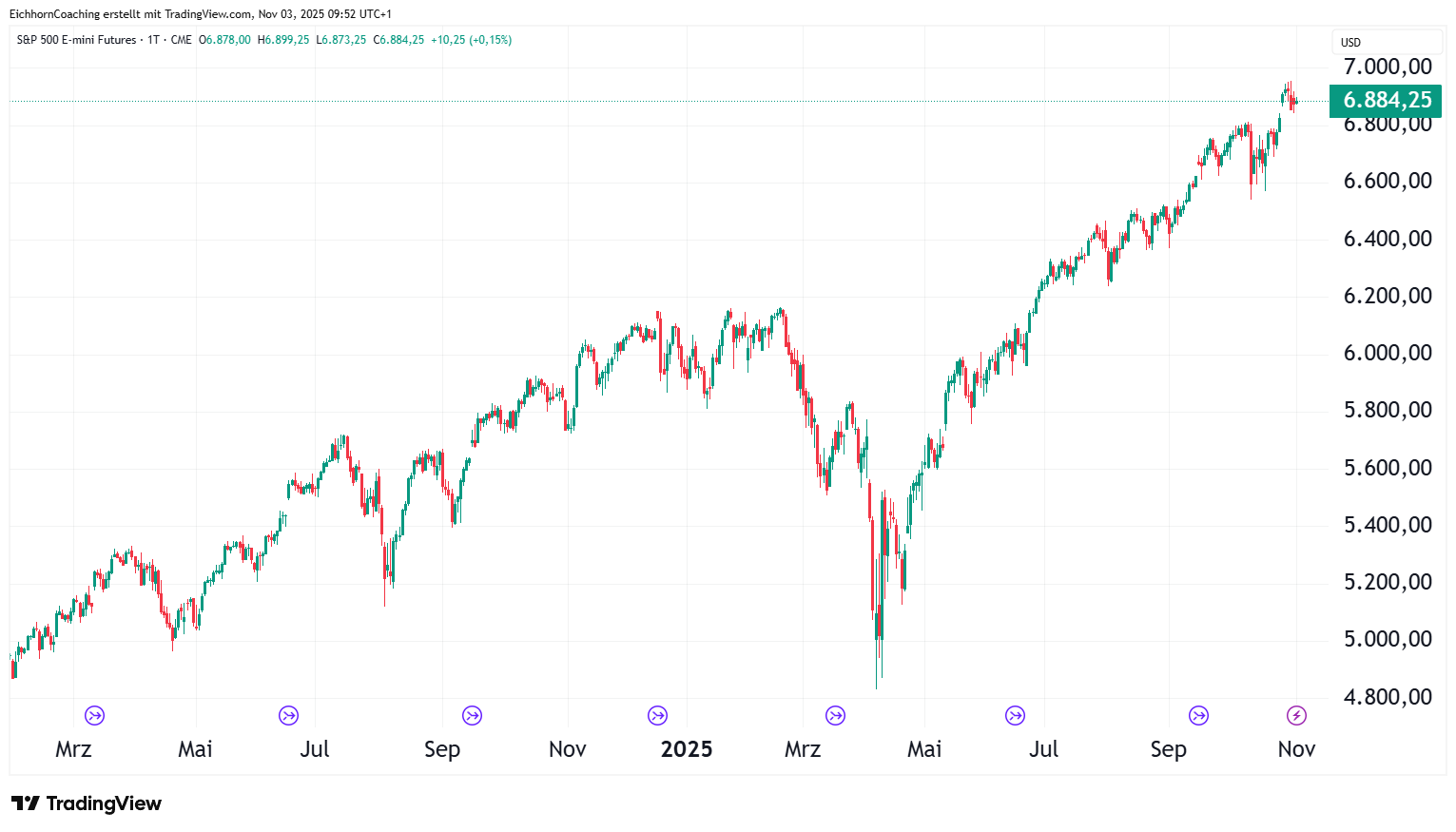
Alternatively, various option strategies are available, such as Bull Call Spreads or Ratio spreads, that profit from a rising market without taking the risk of building up an unprotected position. However, caution is advised when selling put options on a massive scale. The Volatility index VIX is currently around 17, which corresponds to the long-term average. Although there is a high probability that sold puts will expire worthless, the potential profit would be comparatively low due to the low implied volatility, while the risk of a sudden increase in volatility is considerable.
Technical indicator strikes: Hindenburg Omen active
The Hindenburg Omen is a technical indicator that is considered a possible warning signal for major market distortions. It is based on an unusual market breadth: if many shares on the New York Stock Exchange reach new 52-week highs and many others reach new 52-week lows at the same time, this indicates an increasing divergence in the market - in other words, that investors disagree about the future direction. This combination is considered a sign of an unstable market phase in which major corrections or even crashes may become more likely.
In the last trading week, this signal was triggered several times - on several days in a row. This indicates that the market is currently characterized by growing uncertainty: while some sectors are still showing strength, others are already slumping significantly.

Historically, the occurrence of a Hindenburg Omen does not necessarily lead to a market crash, and it would make little sense to rely solely on this indicator. Nevertheless, its repeated occurrence is a warning signal that calls for increased attention. In particular, if the VIX volatility index rises above the 20-point mark at the same time, this should be taken as an indication of an increasingly tense market situation - an environment in which caution and appropriate risk management are particularly important for options traders.
Volatilities at rock bottom - but still high premiums?
Volatility in the overall market is currently low. As already mentioned, the VIX is trading close to its long-term average. Other volatility indices, such as the VXTLT for long-term government bonds or the GVZ for gold, are also at low levels or are currently falling.
Away from the big tech stocks, however, the situation looks different, especially for many non-cyclical consumer goods stocks. Large dividend stocks such as Clorox, Hormel Foods and similar companies are sometimes trading well below 50 % of their respective all-time highs. An illustrative example is Kenvue (KVUE), a spin-off of the dividend champion Johnson & Johnson (JNJ), which sells well-known brands such as Listerine and Tylenol. The latter even made political headlines when US President Donald Trump claimed a supposed link between the use of Tylenol during pregnancy and autism in children.
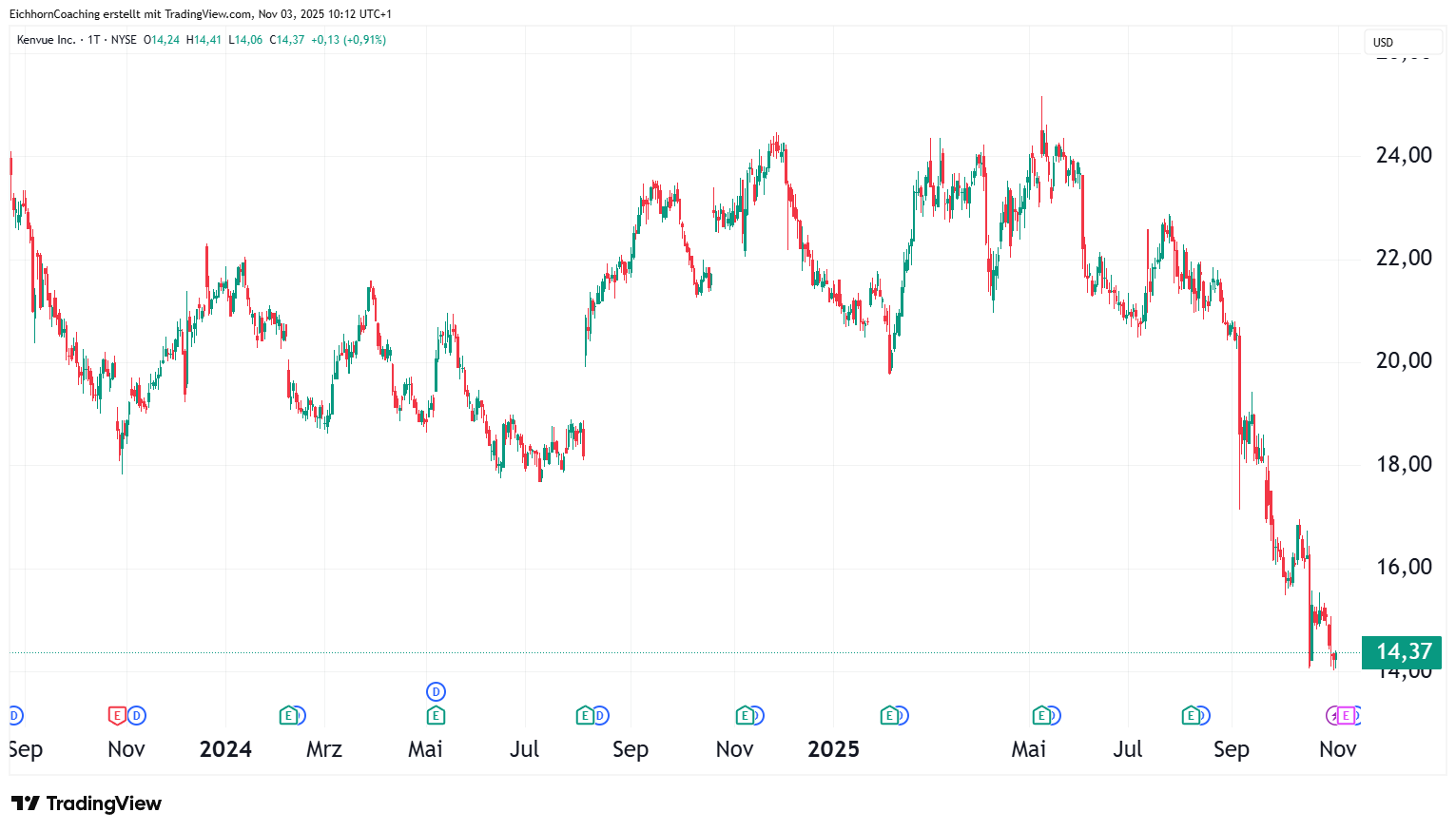
Kenvue currently offers a dividend yield of almost six percent. With a share price of around USD 14, trading of Cash Secured Puts may also be interesting for smaller accounts. With a strike of USD 14 and a term of around 70 days, a premium of USD 140 can be achieved for an at-the-money option. In absolute terms, this sounds moderate, but relative to the possible tender amount of USD 1,400, this corresponds to around ten percent. This results in an effective entry price of USD 12.60. A note: Earnings are due shortly and should be taken into account.
It is important to note that this is not a trading call, but merely an example of how Cash Secured Puts can be traded on rather „boring“ stocks to achieve attractive premiums. Instead of selling out-of-the-money options with low premiums of 0.5 % on the potential put amount, it may make more sense to wait for price declines where implied volatility increases. Although this offers no guarantee of a profit, the risk/reward ratio improves significantly as the achievable premium is higher.
Conclusion
November confirms that the market is currently sending complex signals. On the one hand, the S&P 500 is close to all-time highs, a clearly bullish environment that offers many opportunities for directional trading. Trading strong stocks long in a targeted manner or using structured option strategies such as bull call spreads or ratio spreads appears to make sense here in order to participate in the upward trend without exposing oneself unnecessarily.
On the other hand, warning signals such as the Hindenburg Omen and the persistent divergence in the market call for caution. The repeated occurrence of this indicator shows that not all sectors are rising in unison - some are already showing clear weakness. Options traders should keep an eye on these divergences and the low, but potentially rising volatility at any time. In particular, selling put options when volatility is currently low should only be done with caution, as the potential profit is comparatively low, but the risk increases sharply in the event of sudden jumps in volatility.
Defensive, non-cyclical dividend stocks with prices well below their all-time highs are also interesting. Attractive premiums can be achieved here with cash-secured puts, especially if you wait for short-term price setbacks that increase implied volatility. Such strategies can significantly improve the risk/return ratio, but require discipline, patience and precise timing.
Overall, it is clear that options traders are benefiting from a balanced approach in the current market: taking advantage of the bull market, recognizing opportunities in strong stocks, but at the same time taking warning signals seriously and actively managing risk. Those who maintain this balance can benefit from attractive premiums and stable price movements without taking excessive risks.