On August 17, the VIX fell to 14.18, its low for the year. A few days later, it was trading at 15.13, while the S&P 500 stood at 7,674 points, roughly 16 percent higher than at the start of the year. The year's range in the VIX has so far spanned from 14.18 to around 35. In such an environment, far out-of-the-money options are cheap, bringing an old term back into focus: teenies.
The term originates from the pre-decimalization era. Options under three dollars were quoted in sixteenths back then, and above that in eighths. One-sixteenth of a dollar is 6.25 cents; the price could not go any lower. Today, the expression stands for everything at the bottom of the price ladder: Delta 1 or less, strike far below the market, ask price five or ten cents. In SPX, the smallest tick under three dollars is five cents, in SPY, QQQ, and IWM one cent. The basic concepts for this can be found in Glossary of Options.
Sales page and purchase page
Most option writers first encounter teenies as a selling position. The put is 25 percent out of the money, the bid stands at five cents, and thirty sold contracts yield a premium of 150 dollars. What is missing from this calculation is demonstrated by August 5, 2024. The VIX closed the Friday before at 23, stood at 65 pre-market on Monday, and finished the day at nearly 40. The index itself was only moderately in the red at that time. Margin requirements rose significantly overnight, and there was hardly any liquidity in the far-out strikes. At a price of 3.00, buying back the thirty contracts costs 9,000 dollars, leaving a loss of 8,850 dollars after deducting the premium. How initial and maintenance margin are calculated can be found in the Margin calculation.
On the buy side, the loss is limited, but there is another problem. Purchases are made at the ask price, which in the example is ten cents instead of the five cents on the bid side. The model value of these strikes is close to zero. What gets paid is the minimum tick plus the market maker's risk premium. As a result, both sides are poorly priced: the buyer pays a multiple of the model value, while the seller receives five cents for open jump risk. The position serves as insurance, the cost of which accrues over the cycle.
Normalized vola: A 25 percent distance is not a fixed distance
A strike 25 percent below the market sounds like a clear magnitude. In option prices, it is only as far away as volatility allows. The useful measure is the distance in standard deviations, depending on implied volatility and remaining time to maturity.
The conversion is done via the square root. An annual volatility becomes the volatility of the period by multiplying it by the square root of the fraction of the year. With a VIX of 15 and 45 days of remaining maturity: 0.15 × √(45/365) = 5.27 percent. That is a standard deviation for this period. On a daily basis, it is 0.15 / √252 = 0.94 percent, whereas with a VIX of 45 it is 2.83 percent. A daily move of two percent is a two-sigma event in one regime and unremarkable in the other.
This makes a strike comparable. SPX 7,674, put with a 5,750 strike, 45 days to expiration:
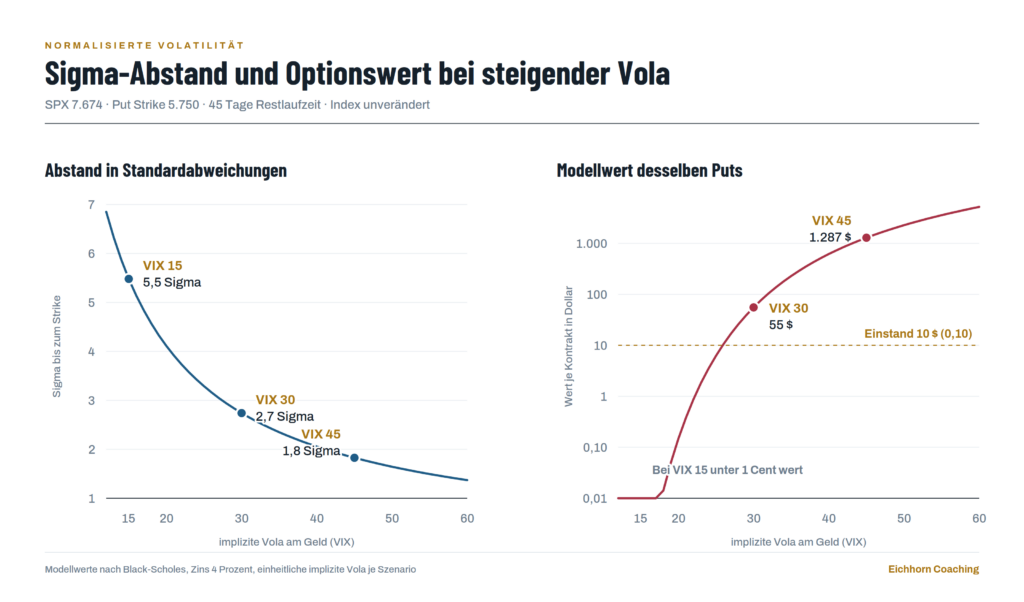
With a VIX at 15, the strike is 5.5 sigma away. With a VIX at 30, it is 2.7 sigma, and with a VIX at 45, it is 1.8. Meanwhile, the strike price and the index level remain unchanged. The calculated probability of the index being below that level at expiration increases from practically zero to 0.3 percent and then to 3.4 percent.
The price does not follow this movement linearly. The same put is worth less than a cent at VIX 15, around 55 dollars per contract at VIX 30, and nearly 1,290 dollars at VIX 45, assuming the index level remains unchanged in each case. The sigma distance falls inversely proportional to the volatility, while the price reacts exponentially.
What a bought teenager provides in an emergency
Twenty SPX puts at 0.10 is a $200 investment. The value of the position depends on two variables that usually move together during a crash.
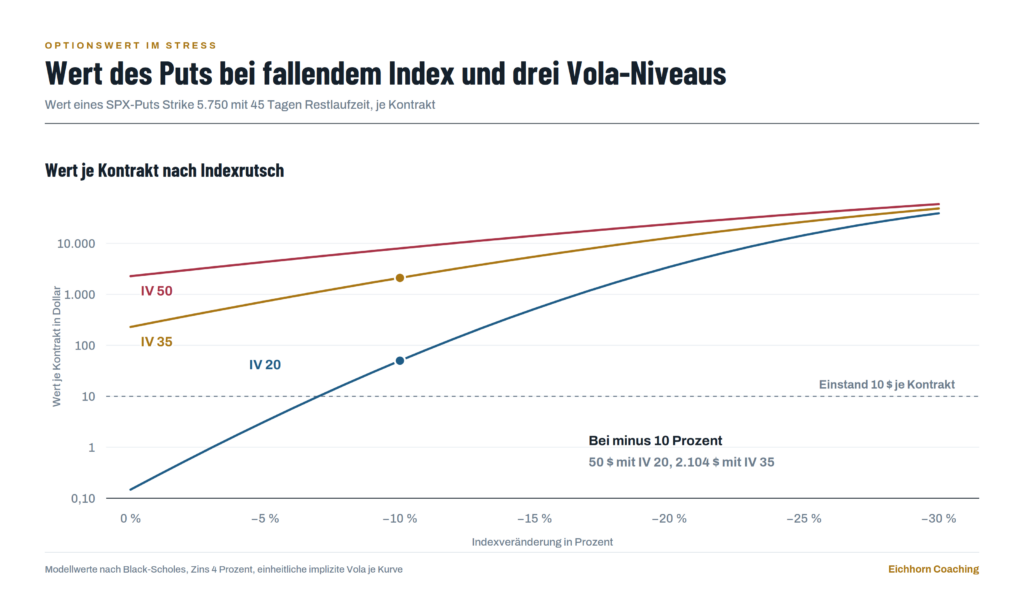
If the index drops by ten percent and the IV at this strike is 35, the contract is mathematically worth around 2,100 dollars, making the position a good 42,000. At minus 20 percent and IV 50, it is just under 23,900 dollars per contract. If the vola stays at 20, the same slide of ten percent yields 50 dollars per contract, totaling 1,000 dollars. Both cases assume the same price loss; the gap between fivefold and two-hundredfold deployment is created by the vola. A ten-percent slide with unchanged IV is rare in the index; the 50 dollars mark the lower limit.
This dictates how the position is handled: it must be sold during stress. If the index rises again two weeks later, the same option is once again priced at five cents because the skew has compressed. This is not a hedge you can simply set and forget.
Why the long-range strikes
The reason lies in the ratio of Vega to price. At an IV of 15, an at-the-money SPX put with 45 days to expiration costs about $14,300 per contract, and one volatility point moves it by roughly $1,070. That is 7.5 percent of its price. At an IV of 30, the 5,750 strike costs about $55, where one volatility point yields $19, or a solid 34 percent. Per dollar invested, the volatility sensitivity far out-of-the-money is thus several times higher. This comparison applies to an IV of 30 at this strike, meaning after the initial volatility spike. At the entry point when the VIX is 15, the Vega there is still close to zero, and the price of ten cents is determined by the minimum tick and risk premium.
In addition, there is the skew. Under stress, the implied volatility of deep puts rises more sharply than that of at-the-money puts, making the curve higher and steeper. The far-out-of-the-money strike thus has a vol beta greater than one and benefits disproportionately from this repricing. The selection of strikes via the delta ladder is in the Delta-10-E-Book by Eichhorn Coaching described.
The third point is capital commitment. 200 dollars for twenty teens does not tie up margin required by the short vol book. An at-the-money put costs about five times the annual expense of a teen position per contract and yields little in a moderate pullback because it is already largely priced in there.
How much the protection costs per year
The relevant figure is the annual expense. Twenty contracts at 0.10, repurchased every 30 days, is 200 dollars per roll and 2,400 dollars a year. Added to this are the commission fees, which have a significant percentage impact here: at one dollar per contract, that is another 240 dollars on 240 contracts a year, which is a ten percent surcharge on the premium. In total, around 2,640 dollars. On a portfolio of 250,000 dollars, this corresponds to a 1.06 percent return per year. The rates applicable to your trading venue are listed in the Conditions for options trading.
In addition, there is the spread. In deep out-of-the-money strikes, the bid is often zero and the ask is ten cents. The mid-price is therefore five cents: anyone who pays the ask is immediately down 50 percent, and at the bid price the position is worthless. A limit order is mandatory here. Anyone who wants to trade the chain via volatility rather than price will find among the Order types the volatility order, whose limit is calculated as a function of the implied volatility.
VIX Calls: Pricing is based on the future
The second common way is through VIX calls. Strike 60 for a few cents, and in March 2020 the VIX was above 80. The crucial factor here is the design: The pricing basis of a VIX option is the VIX future of the respective expiration. The spot VIX is not included in the calculation, and in calm phases the future trades above the spot. Options on volatility indices run as index options in the trading authorization, see Options at CapTrader.
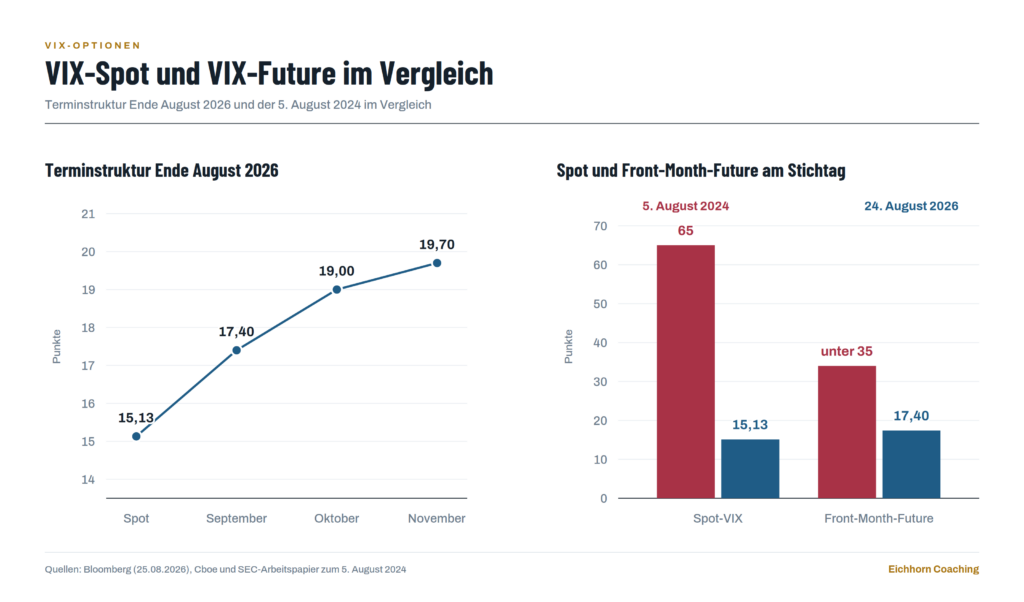
The current curve clearly shows this. Bloomberg reported on August 25 of 17.4 in the September future, 19 in October, and 19.7 in November, while the spot was well around 15. The premium for the midterm elections in November is thus priced in. Anyone buying a November call today pays 19.7. The initial position is around 30 percent higher than what the VIX level would suggest.
August 5, 2024, reveals the second part of the problem. While the spot VIX jumped above 65 pre-market, the front-month future remained below 35. A working paper by the SEC’s research division later examined this divergence in detail. Whoever had VIX calls in their portfolio received a fraction of what the spot level suggested. Added to this is the structural design: VIX options are European, so early exercise is not possible. On the expiration date, settlement is in cash against the VRO settlement value; prior to that, selling is the only option. In 2024, the extreme value of 65 lasted only a few hours, and usable prices were available for a few days.
Before the first contract
Two points must be determined in advance.
First, the exit rule in numbers. Example: Sell half when the position is at ten times, the rest when the front-month future trades above 30. Without a previously defined threshold, the decision falls right in the middle of a phase of high uncertainty and poor liquidity.
Second, the annual budget as a percentage of the portfolio. One percent per year is a manageable figure. It determines the number of contracts and prevents the position from growing larger during calm phases just because premiums happen to be low.
For option sellers, a third option is added: reducing the position size. Selling one fewer delta-15 put costs the forgone premium and does not require an ongoing payment. A short-volatility book that is reduced by a quarter achieves part of the effect of a purchased teeny in many scenarios, without the 1.06 percent per year.
A trading idea that combines both is the ratio buildup: investing a portion of the premium from the sold delta-15 put into two or three long teenies further down. This is a put ratio spread with the corresponding characteristics. Risk remains open between the strikes, the margin is determined by the short leg, and below the short strike, the picture only improves in the event of a larger decline. The Account window of Trader Workstation displays the requirement in real time. Calculates the scenario for minus 15 percent before the position is booked.
The VIX is at 15, the curve has priced in the November premium, and the cheapest part of the term structure is in September.
Conclusion
Teens work through volatility; the strike alone does not carry the position: the same put is worth less than a cent at a VIX of 15 and nearly 1,290 dollars at a VIX of 45, without the index moving. This protection is paid for continuously, in the calculation example at around 1 percent of portfolio return per year including fees. With VIX calls, the term structure premium is added, currently 19.7 in November versus 15 in the spot. Anyone building the position defines the annual budget and exit threshold in advance, because the profit is only realized through a sale during stress. For sellers (writers), the smaller position remains the cheaper alternative as long as premiums are as thin as they currently are.