Equity investments have been experiencing a noticeable renaissance in Germany for years. While the capital market has long been a niche topic in this country, this picture seems to be changing noticeably. More and more people are discovering shares, funds and ETFs as investment opportunities for long-term wealth accumulation and private provision across all age groups, genders and regions.
The latest figures from Deutsches Aktieninstitut show that this development is not a trend, but rather an expression of structural change.
Find out below what is driving the change, who is driving the growth and what the implications are for investors in this context.
Notice: The following figures are based on the information provided by Deutsches Aktieninstitut (DAI) on 13.01.2026 (source: https://www.dai.de/detail/aktionaerszahlen-2025-aktienanlage-im-aufwind)

The most important in a nutshell
- With 14.1 million investors, share ownership in Germany has reached a new high in 2025
- The bottom line is that one in five people aged 14 and over is involved in the stock market
- With 1.2 million new investors, the under-40s in particular contributed over 60 percent to the overall increase
- ETFs, savings plans and digitalization have simplified and expanded access to the stock market
Record participation in the stock market in 2025: 14.1 million investors
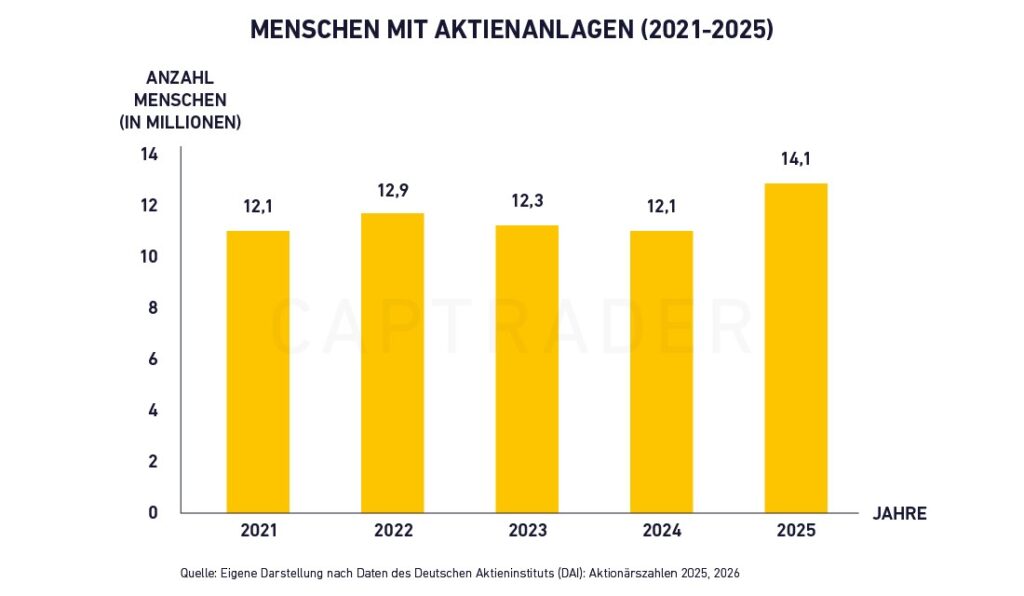
With 14.1 million investors, share ownership in Germany has reached a new high in 2025. Compared to 2024, this corresponds to an increase of around 2 million people. The bottom line is that one in five people aged 14 and over is invested in the stock market - a clear sign that the positive trend of the past ten years has continued.
Savings plans continue to grow in importance - funds and ETFs are popular investment vehicles
The importance of savings plans, particularly in the case of funds and ETFs should be emphasized. In Germany, 5.3 million people invested with the help of a savings plan, which corresponds to an increase of 1.7 million people compared to the previous year. Savings plans were primarily used in the ETF segment: More than half of ETF investors invested via this instrument. Savings plans also played a role in so-called actively managed equity funds, albeit less frequently. Savings plans were less important for individual purchases.
With 1.2 million new investors, the under-40s in particular contributed over 60 percent to the overall increase
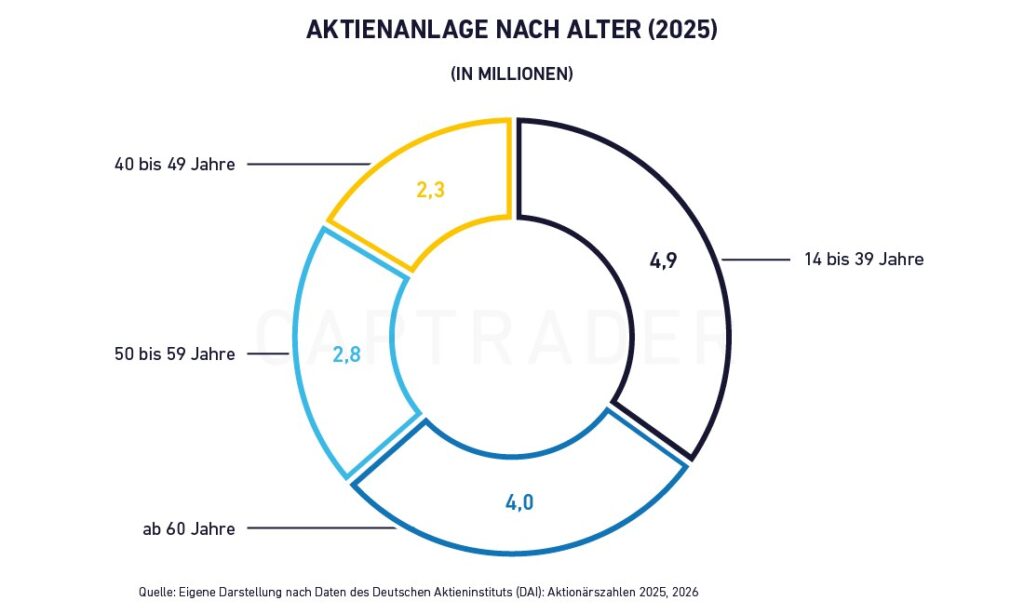
The under-40 age group is particularly noteworthy, with an increase of 1.2 million investors, accounting for more than 60% of the overall increase. It is also worth noting that around half of equity investors under the age of 40 own an ETF or invest with the help of a savings plan.
Robust demand for equities in 2025 despite a market environment characterized by uncertainty
Although the economic environment was characterized by uncertainty, demand for securities remained robust in 2025. In addition to digital offerings, access to the capital market was facilitated by the growing use of ETFs.
According to the DAI Stocks The investment of capital in the long term, broadly diversified and regularly used, for example as a building block of private pension provision. Last but not least, the topic is also present in the public debate. In addition, younger people in particular are facing the challenge of building up pension strategies due to demographic developments and the pay-as-you-go pension system.
The relatively high use of a savings plan also indicates a reflective approach to equity investments.
Women are catching up significantly in terms of share investments - share ownership strongly dependent on income
Of a total of 14.1 million investors with equity investments last year, 5.4 million were women and 8.7 million were men. Compared to the previous year, there was an increase of 24% (approx. 1 million female investors). Among men, there was an increase of 12% (940,000 investors). In 2024, the number of female investors was still declining, while the number of men increased.
In 2025, the number of investors with equity investments increased in all income groups. However, it is clear that share ownership is strongly influenced by income. Almost half of investors with a net income of over EUR 4,000 were invested in 2025 and only around one eighth of those with an income of less than EUR 2,000.
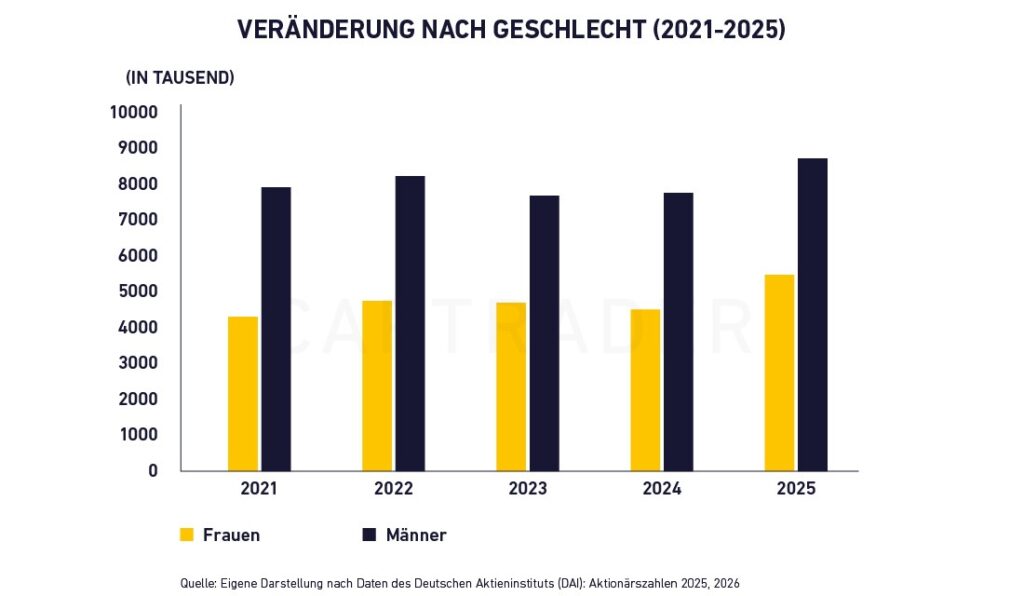
While both men and women were increasingly looking to invest in shares in 2025, the year-on-year increase among female investors was significantly higher than among women (12%). It is also worth noting that share ownership remains strangely dependent on income. While around half of all investors with a net income of over EUR 4,000 were invested, the proportion with a net income of less than EUR 2,000 was only around one eighth.


Summary: Between progress and pent-up demand - young generation drives change
The DAI's shareholder figures from 2025 are less of a snapshot than a longer-term change in investment behavior. In addition to digitalization, products such as ETFs and savings plans have made access to the stock market easier and more widespread.
Younger generations in particular are responding to the current challenges of retirement provision. However, it should also be emphasized that the proportion of equities in Germany remains comparatively low and that although progress has been made in this country, it may not yet be finalized.