Dear traders, dear stock market friends.
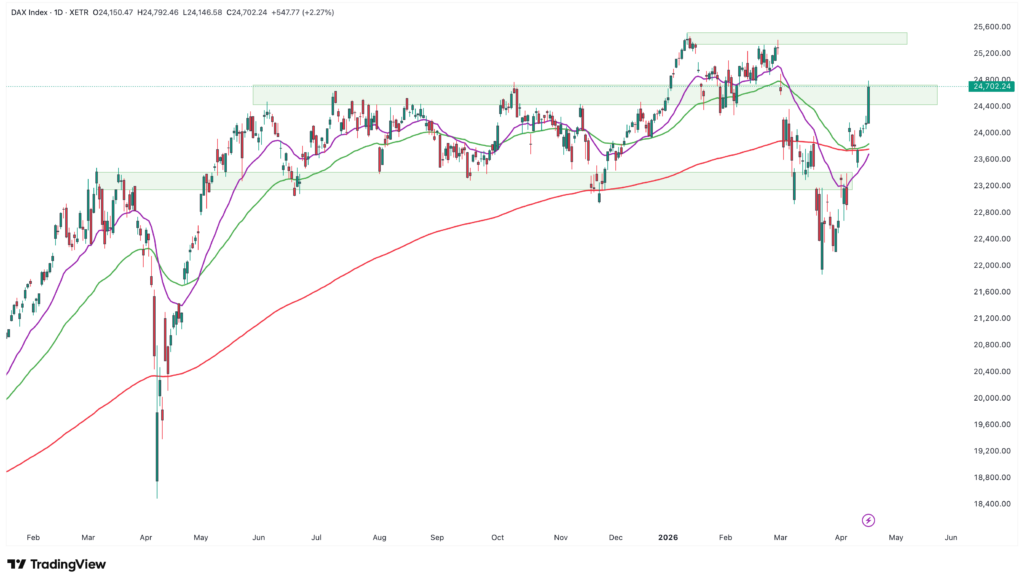
After the DAX came under pressure again at the beginning of the past trading week, a noticeable recovery rally followed in the course of the week against the backdrop of easing tensions in the Middle East conflict and falling oil prices. There was a strong upward movement, especially on Friday, which brought the index to a closing price of 24,702 points and intraday even close to 24,800 points. This resulted in a weekly gain of around 3.8 %. At the start of the week, uncertainty following failed talks and ongoing tensions around the Strait of Hormuz had weighed on the DAX, before sentiment gradually brightened.
DAX recaptures the 200-day moving average
With the correction in March, the DAX broke through the important support zone at 23,250 points. At the same time, the index fell below all important moving averages on the daily chart. The DAX has since reclaimed both the broken support and the daily EMA-200, as well as the EMA 50 and EMA 20.
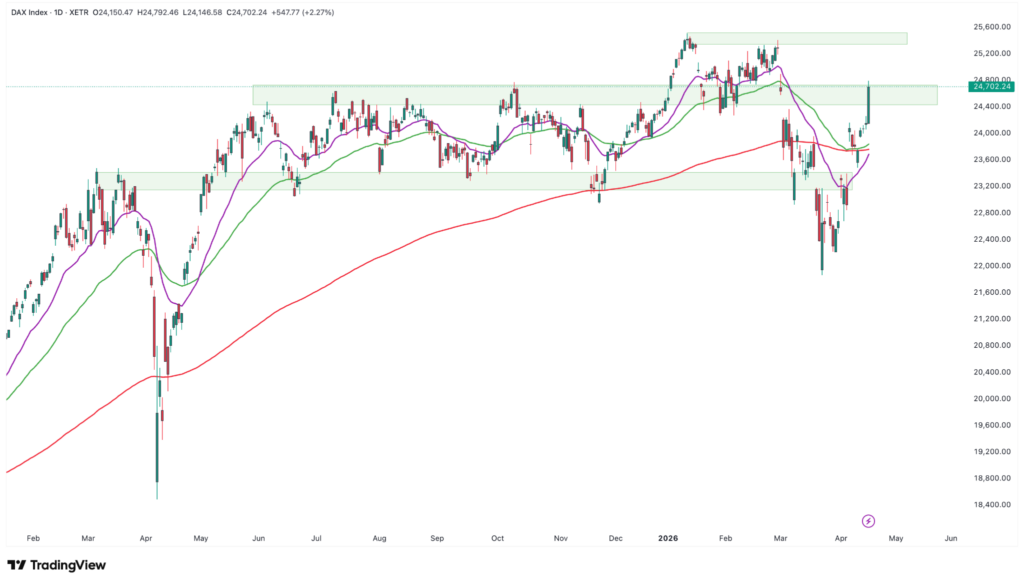
While there is still short-term resistance in the 24,600 point range, the medium to long-term chart pattern has already brightened considerably again. In the event of a rebound or correction, the price zone between 23,800 and 24,000 points would be the most important short-term support. As long as the index remains above the recovered EMAs, the potential for a continuation of the uptrend remains.
Falling oil prices bring relief.
The most important course driver of the week was undoubtedly the developments in the oil market. At the beginning of the week, there was still concern that the situation in the Middle East could escalate further and the Strait of Hormuz could remain closed. Accordingly, the geopolitical risk premium remained high initially.
As sentiment shifted in the course of the week and the opening of the strait dominated the headlines, oil prices plunged massively on Friday; Brent and WTI suffered their sharpest daily decline since early April, while European stock markets and the DAX also rallied strongly. For the stock market, this was a clear signal: falling energy prices relieve inflationary pressure in the short term and simultaneously boost cyclical industries.
Escalation potential remains.
Despite the easing, the situation remains fragile. Negative headlines already reappeared over the weekend: uncertainty surrounding the ceasefire increased again, tankers were turned away, and the discussion about control over the Strait of Hormuz flared up once more. This is precisely the point that needs to be kept in mind for the start of the week. Although the DAX made an impressive comeback last week, the recovery stands on a foundation that remains strongly headline-driven. If new reports of escalation emerge, the market could immediately shed risk again at the beginning of the new week.
American stock markets at all-time highs
Another important benchmark for the DAX remains the US stock markets. The S&P 500 and the Nasdaq Composite already reached new all-time highs last week. On Friday, both indices achieved their third consecutive record close. The technology sector in the US, in particular, remains enormously important for global risk appetite. When new highs are bought on Wall Street, it generally also improves the sentiment for European stocks, even if Europe is currently on weaker fundamentals.
Inflation risks and weaker macroeconomic data from Germany
As positive as the stock market recovery was over the course of the week, so important is a look at the overall fundamental picture. Because beneath the surface, the situation for the German stock market remains comparatively fragile. Germany is more economically vulnerable to energy price shocks than the US, and that is precisely why the geopolitical situation carries more weight here. At the same time, it is becoming increasingly clear that the economy is not only struggling with short-term uncertainty, but also with a generally weaker growth outlook. For the DAX, this means: the rally was convincing, but it faces a macroeconomic environment that is far from as friendly as last week's development might suggest at first glance.
Growth forecasts under pressure
The concerns are particularly evident in the latest growth forecasts. The outlook for the German economy was once again lowered last week. The German government now expects only 0.5 %growth in 2026, down from 1.0 % previously, and expectations for 2027 have also been reduced. At the same time, the IMF also cut its expectations for Germany, now expecting only 0.8 % growth in 2026 and 1.2 % in 2027. For the DAX, this means that even if sentiment turns around in the short term, the fundamental tailwind remains limited.
What Lagarde's statements mean for the DAX
The statements by Christine Lagarde deserve additional attention. The ECB President made it clear that the war in the Middle East could burden growth in the Eurozone and at the same time push inflation beyond already elevated projections. This is precisely the combination that is inconvenient for stock markets: weaker growth coupled with inflationary pressure. While the market has recently not considered an immediate reaction from the ECB likely, the central bank's statements continue to caution against complacency. For the DAX, this means that monetary policy is not a reliable tailwind. Should oil prices rise again or secondary effects on prices become apparent, interest rate cut or easing fantasies could be further dampened. 
Author Tobias Schmid
April 20, 2026