Dear traders, dear stock market friends.
The DAX ended the past trading week with a gain of 3.9 percent. The main drivers were signs of de-escalation in the Iran conflict, surprisingly solid German economic data (Q1 GDP growth and rising Ifo business climate), and tailwinds from the US, where the major indices also posted gains.
Macro & Geopolitics: Hope for an Iran Solution and Surprisingly Strong Economic Data
After a nervous start to the week, sentiment noticeably improved from the middle of last week. The combination of diplomatic signals from Washington and Tehran, as well as unexpectedly robust domestic economic data, led to a shift in sentiment and propelled the DAX to its strongest weekly gain of 2026. This again shows how much the DAX depends on two levers: the oil price and the economic outlook for the export-oriented German economy.
Diplomatic rapprochement eases market relief
Following weeks of a fragile ceasefire, which has repeatedly hung by a thread since the military exchange of fire at the end of February, signs of genuine progress in negotiations increased towards the end of last trading week. Conciliatory tones came from both Washington and Tehran, which dampened concerns about a resumption of hostilities and an associated oil price shock.
Over the weekend, there were further reports confirming a (at least temporary) peace. U.S. President Donald Trump stated on his platform Truth Social on Saturday that an agreement had been "largely negotiated" and was only subject to finalization between the U.S., Iran, and other involved states. U.S. Secretary of State Marco Rubio confirmed on Sunday morning in New Delhi that "some progress" had been made and that news could be expected in the coming hours or days. The U.S. portal "Axios" reported, citing a government official, that the draft envisions a 60-day extension of the ceasefire. During this time, the strategically crucial Strait of Hormuz is to be reopened, Iran is to clear mines laid there, and in return, it is to be allowed to export oil again. Furthermore, both the Pakistani army chief as mediator and a delegation from Qatar traveled to Tehran on Friday, which is a clear signal that the negotiation machinery is running at full speed.
Robust Q1 GDP and rising Ifo business climate support the leading index
In addition to the looming geopolitical de-escalation, there was also economic data last week that provided further tailwind for the bulls. Despite all the naysayers, the German economy grew slightly by 0.4 to 0.5 percent year-on-year in the first quarter, proving its resilience despite the ongoing crisis sentiment.
Furthermore, the unexpected increase in the Ifo business climate sparked further optimism. The index, compiled by the Ifo Institute in Munich, climbed to 84.9 points in May, up from 84.5 points in April. Economists surveyed by Dow Jones had actually expected a decline to 84.1 points, given the burdens of the Iran conflict. Thus, the positive surprise was all the greater. Both sub-indices also rose: the assessment of the current business situation increased to 86.1 (from 85.4) points, clearly exceeding the consensus of 85.0. Business expectations improved to 83.8 (from 83.5) points. Particularly noteworthy was the significant leap in the services sector, where expectations recovered considerably after the slump in the previous two months.
However, the improvement in the Ifo index should not be overinterpreted. The level remains historically low with values around the 85 mark, far from growth signals. Nevertheless, the stabilization suggests that German companies are coping better with the burdens of the Iran war, high energy prices, and global uncertainties than feared.
In contrast, a warning signal came from the eurozone: The composite PMI, compiled by S&P Global, fell by 1.3 points to 47.5 in May. This is the weakest figure in about two and a half years. The index thus clearly fell below the growth threshold of 50. Service providers in particular collapsed to their lowest level in more than five years with 46.4 points. S&P chief economist Chris Williamson already sees the eurozone shrinking by 0.2 percent in the second quarter.
Technical outlook for the DAX
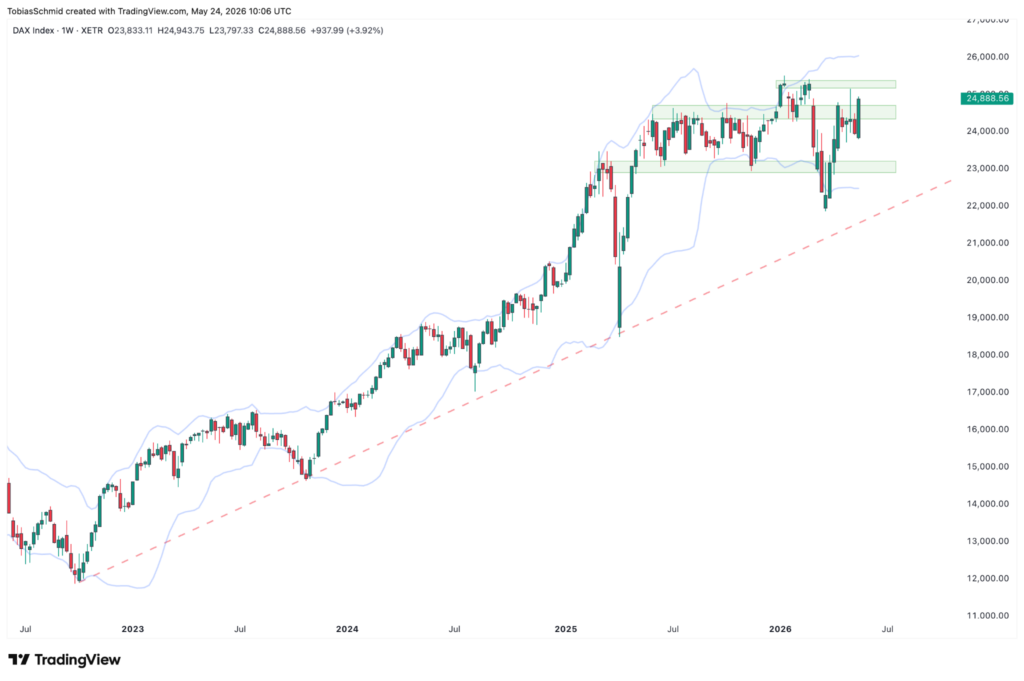
To assess the DAX's technical chart situation, it's worth taking another brief look back at the second half of 2025. Between June and December, the DAX remained in a sideways trend, fluctuating between 23,000 and 24,500 points.
Although there was an upper breakout in January 2026, it was short-lived, and the DAX subsequently fell back into its old sideways range, followed by another false breakout, this time on the downside.
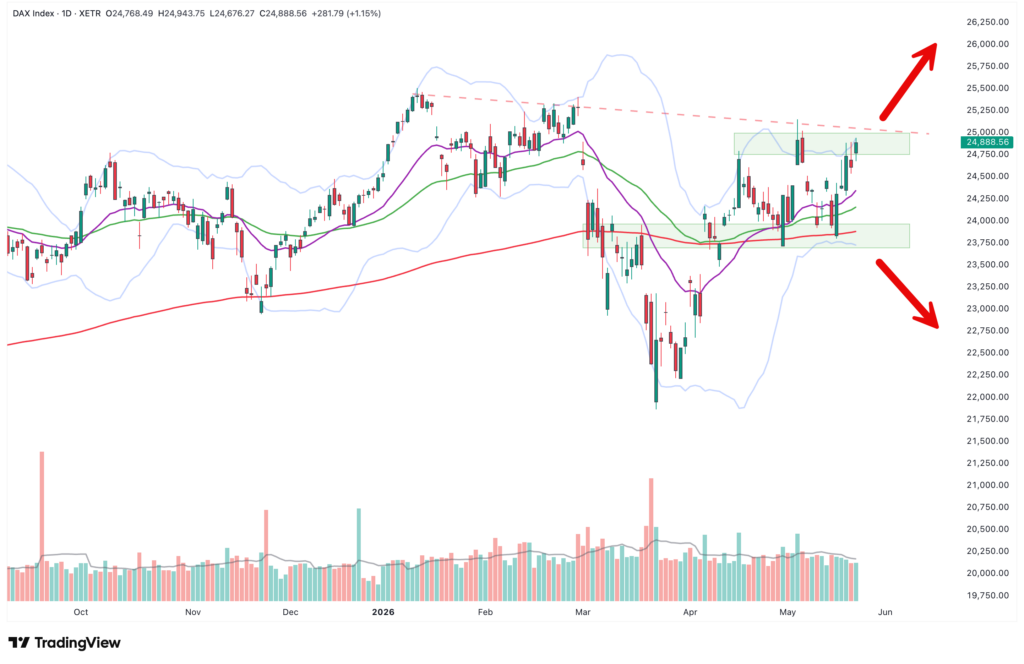
Last week, the DAX once again rose above the 24,500-point mark. However, on the daily chart, it can be seen that there is currently still short-term resistance in the area of the upper Bollinger Band between 24,900 and 25,000. If this is overcome, the chart pattern breakout would be complete, and the probability of a trend continuation would significantly increase.
Author Tobias Schmid
Date: 05/25/2026