


For many investors, gold stocks offer an interesting opportunity to participate in the development of the international commodities market. The sector benefits primarily from factors such as the price of gold, the demand for safe investments, extraction costs, and the strategic positioning of the companies.
However, as an investor, you should note that gold stocks are heavily dependent on gold price movements, production volumes, geopolitical influences, and operational risks. You can find out which stocks are currently in a solid position and what opportunities and risks the market offers in this article.

The most important facts in brief:
- Gold stocks offer attractive opportunities in 2026 due to high gold prices, rising industrial demand, and low correlation to stocks and bonds
- Forecasts project the gold market to grow to $438 billion by 2035, driven by AI infrastructure, electronics, and sustained safe-haven demand
- Newmont, Barrick, and AngloGold Ashanti are the largest producers with high margins at low production costs, while Franco-Nevada and Royal Gold are considered low-risk royalty providers without their own mines
What are gold stocks?
Gold stocks are shares of companies that operate along the gold value chain. This includes, for example, firms that mine gold, operate mines, develop new deposits, or produce and market gold. They thus operate at the intersection of raw material extraction, financing, and corporate equity investment.
The gold sector remains relevant despite fluctuating markets because it is not only important for precious metal production, but is also considered an investment in economically uncertain times. Gold stocks are particularly significant for investors who want to benefit from rising gold prices, geopolitical uncertainties, and the demand for stable assets.
Gold stocks can be roughly divided into different areas of the value chain. These segments react differently to the gold price, production costs, and market sentiment.
- ProducersProducers include companies that mine gold, operate mines, and process the precious metal. Their profits often depend heavily on the price of gold. When the price rises, their margins typically improve as well.
- Exploration companyExploration companies are searching for new gold deposits and launching initial projects. They carry a higher risk, but in the event of success, they also offer particularly high price potential.
- processing and treatment companyThese companies extract, refine, or process gold further, for example for resale or industrial use. Their revenues depend not only on the gold market, but also on demand in their respective target markets.
- Trading and service companyThis includes companies that trade, store, finance, or hedge gold. They often benefit from high market activity and rising demand for precious metal solutions, especially during uncertain market phases.
- Service providerService providers supply technology, software, and services to the gold industry. These include, for example, geology, conveying technology, maintenance, or other specialized services. Their business development depends primarily on the investments of producers and, thus, indirectly on the gold market as well.
Some gold companies operate along multiple stages of the value chain. This allows them to better offset fluctuations in individual business segments and make their earnings more stable.


The market potential of gold stocks in 2026
The investment bank J.P. Morgan assumes that gold demand will remain high until at least 2027, driving prices even higher. An average of around 5,055 US dollars per ounce is expected in the fourth quarter of 2026 and about 5,400 US dollars in the fourth quarter of 2027.
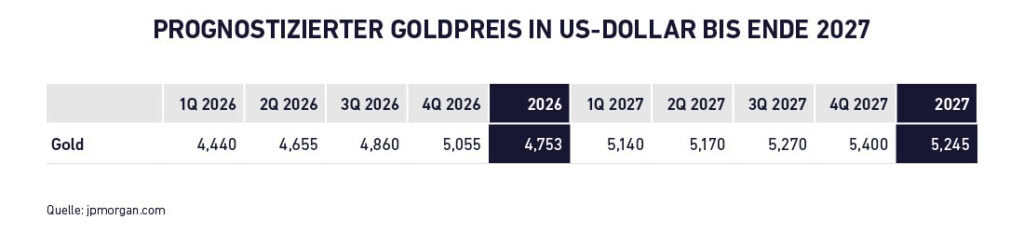
According to J.P. Morgan, the following factors are driving the rising demand:
- Strong central bank purchasesJ.P. Morgan calculates central bank purchases for 2026 to average around 190 metric tons per quarter (about 755 metric tons for the full year). That is less than the record highs of recent years, but still significantly above the pre-2022 average of 400 to 500 metric tons annually. This signals that central banks are continuing to build up their gold reserves for diversification away from the US dollar.
- Robust investment demandIn addition, there is strong demand from private and institutional investors in the form of bars, coins, and ETFs. J.P. Morgan expects bar and coin demand of about 330 metric tons per quarter for 2026 (over 1,200 metric tons for the year) as well as additional ETF inflows of around 250 metric tons, bringing the combined demand from central banks and investors to an average of about 585 metric tons per quarter. This is significantly higher than the mark defined by the bank as a „threshold“ of around 350 metric tons.
- Macro and risk environmentThe analysts also point to an environment of a weaker US dollar, generally lower or falling US interest rates, and persistently high geopolitical tensions, which structurally makes gold more attractive as a non-yielding, „safe“ investment. In combination with the aforementioned demand, this steadily supports the scenario of rising gold prices through 2027 depicted in your chart.
Growing industrial demand for gold
In addition to investment and jewelry demand, the industrial use of gold is becoming increasingly important. Industry, electronics, medical technology, and aerospace rely on gold because the metal offers outstanding conductivity, corrosion resistance, and reliability in safety-critical applications.
The following bar chart shows the projected revenue development of the global gold market from 2025 to 2035: with a clearly rising trend from USD 249.5 billion (2025) to USD 438.45 billion (2035):
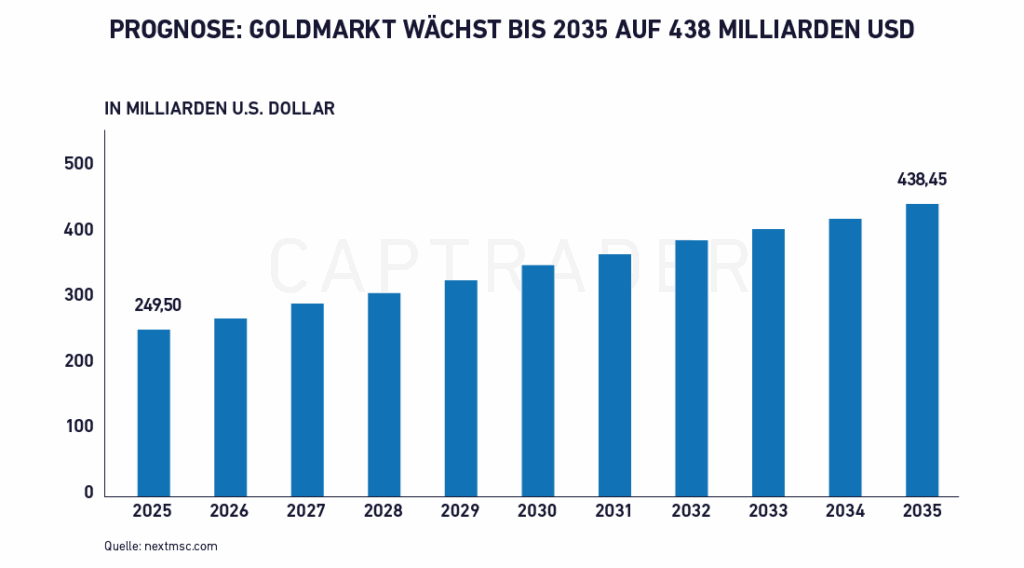
According to the forecast, the following industries in particular will increase the demand for gold:
- ElectronicsContacts, printed circuit boards, semiconductors and high-frequency components, growth through AI infrastructure, 5G and Wi-Fi 7
- Medical technology: Implants, diagnostic devices, and biocompatible applications
- Other industriesAerospace, automotive, LEO satellites, LiDAR systems
According to market analyses, industrial and technological demand for gold is expected to grow at a CAGR of 5.8 % through 2035. This increase is driven by miniaturization, digitization, and the expansion of AI. For gold stocks, this pillar of demand creates a broader foundation beyond pure investment interest and has a stabilizing effect on the overall market.
Gold stocks as a building block for inflation protection
Gold and gold stocks are considered by many investors to be an important component for making a portfolio more resilient against persistently high inflation and currency depreciation. The World Gold Council classifies gold as a strategic asset that delivers real returns over the long term, diversifies risks in the portfolio, and can serve as a liquid reserve in times of crisis.
Over several years, studies show that gold has largely maintained or increased its purchasing power in many currencies, even if the price fluctuates sharply in the short term.
- Gold reacts primarily to inflation expectations, real interest rates, and market uncertainty.
- Over longer periods, gold can help preserve purchasing power, but it is not a perfect hedge in every year.
- Gold stocks amplify the effect of rising gold prices on corporate profits, but come with higher volatility and business risks.
- A moderate allocation to gold and gold equities can help make the overall portfolio more robust against phases of inflation and crisis.
The chart shows the current gold price. The development of recent years makes clear why gold and gold stocks are used in the portfolio as long-term protection against inflation and crisis, especially during phases of increased uncertainty.
Good to know:
If the gold price rises due to inflation fears or expansionary monetary policy, the profits of mining companies can increase disproportionately because higher selling prices have a direct impact on margins.
Low correlation of gold to other asset classes
An important advantage of gold is its low correlation to other asset classes. The chart makes it clear that gold often moves independently of traditional markets such as equities, bonds, or the US dollar.
Especially during phases of weak stock markets or increased uncertainty, gold can have a stabilizing effect. While traditional asset classes come under pressure, the price of gold often moves in the opposite direction or at least proves significantly more resilient. This can cushion losses in other areas of your portfolio and at the same time open up return opportunities.
- In the presented evaluation, gold shows the strongest positive deviation and thus demonstrates a particularly independent development compared to other assets.
- Silver, copper, and oil (Brent) are also still relatively high, but remain clearly below gold.
- The US Dollar Index (DXY), on the other hand, is standing out negatively, pointing to an inverse relationship with gold.
- Stock indices such as the S&P 500 or the Dow Jones show very little correlation, which makes gold interesting as a component for risk diversification.
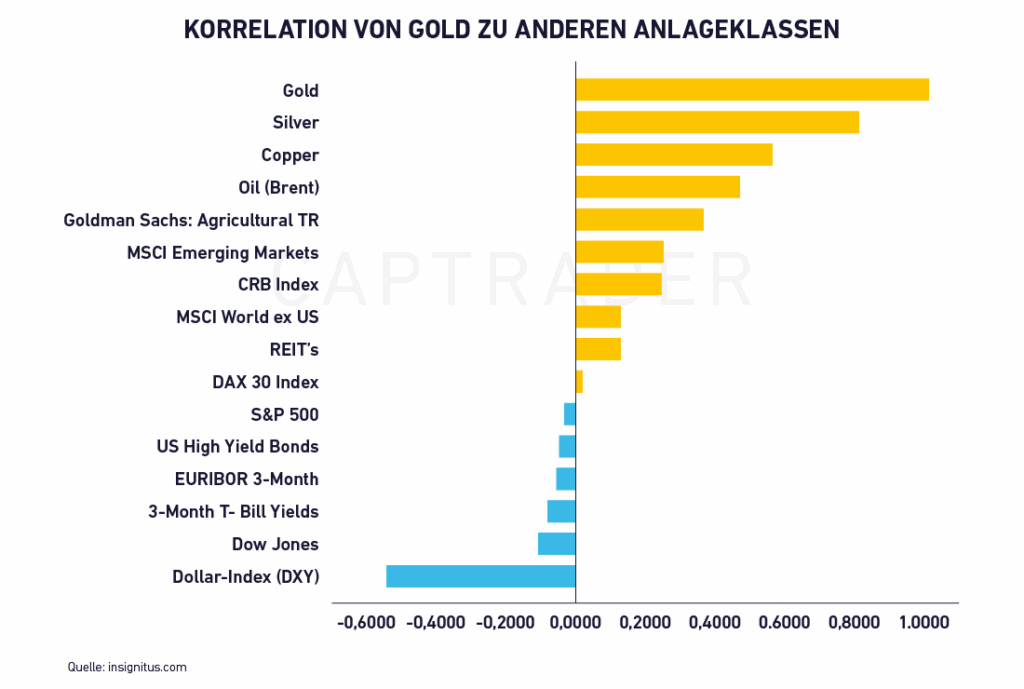
The chart shows that the precious metal has a low or negative correlation with many other asset classes, meaning that gold acts independently of their fluctuations.
By the way, when the price of gold rises and the prices of other assets fall, you can also profit from this through a short sale.
Top 10 gold stocks worldwide by market capitalization
The following stocks provide an overview of the largest companies in the gold sector by market capitalization.
When it comes to the best Value-Aktien to select for your portfolio, you should focus on companies characterized by a strong market position, a solid Dividendenhistorie and feature a stable business model.
| Company | ISIN | Country | Market capitalization in US dollars¹ |
| Newmont Corporation | US6516391066 | USA | 124 billion |
| Agnico Eagle Mines Ltd. | CA0084741085 | Canada | 97 billion |
| Barrick Mining Corp. | CA06849F1080 | Canada | 72 billion |
| Wheaton Precious Metals | CA9628791027 | Canada | 63 billion |
| AngloGold Ashanti PLC | GB00BRXH2664 | South Africa / UK | 54 billion |
| Franco-Nevada Corp. | CA3518581051 | Canada | 45 billion |
| Gold Fields Ltd. | ZAE000018123 | South Africa | 40 billion |
| Kinross Gold Corp. | CA4969024047 | Canada | 38 billion |
| Royal Gold Inc. | US7802871084 | USA | 20 billion |
| Alamos Gold Inc. | CA0115321089 | Canada | 18 billion |
To invest specifically in automotive stocks, you need a brokerage account. With CapTrader, you can open an account and trade stocks directly on more than 170 international exchanges. The trading fees are particularly low: for US stocks, you pay 1 cent per share, with a minimum of $2.00 per order.


1. Newmont Mining
Newmont Mining (ISIN: US6516391066) is the world's largest gold producer in the commodities sector, mining not only gold, but also copper, silver, zinc, and lead.
The company controls a diversified value chain with mines in North America, Australia, Africa, and Latin America, as well as holdings such as Nevada Gold Mines in a joint venture with Barrick Gold.
| Tax year | estimated revenue (in millions USD)¹ | Change compared to previous year¹ |
| 2025 | 22.669 | 21,34 % |
| 2026 | 28.695 | 26,58 % |
| 2027 | 30.251 | 5,42 % |
Instead of pure production, Newmont focuses on efficient operations, cost control, and sustainable ESG standards, complemented by strategic divestments and debt reduction for higher free cash flows. Additional revenue is generated from by-products such as copper, as well as through dividends and share buybacks.
2. Barrick Mining
Barrick Mining (ISIN: CA06849F1080) is one of the world's largest gold producers in the commodity sector, with a focus on gold and copper mining in tier-1 mines.
The company controls a global value chain with operations in North and South America, Africa, Papua New Guinea, and Saudi Arabia, including the Nevada Gold Mines joint venture with Newmont.
| Tax year | estimated revenue (in millions USD)¹ | Change compared to previous year¹ |
| 2025 | 16.956 | 31,22 % |
| 2026 | 22.714 | 33,96 % |
| 2027 | 25.018 | 10,14 % |
Barrick pursues an efficient business model with cost pressure, high free cash flow, and dividend growth, complemented by strategic projects such as Reko Diq and Lumwana for copper. Additional revenues come from byproduct metals and share buybacks.
3. Franco-Nevada
Franco-Nevada (ISIN: CA3518581051) is the world's leading royalty and streaming provider and a stable gold stock in the precious metals sector, without operating its own mines.
The company finances mining projects in exchange for royalty-based interests in gold, silver, or energy production, thereby benefiting risk-free from commodity prices.
| Tax year | estimated revenue (in millions USD)¹ | Change compared to previous year¹ |
| 2025 | 1.823 | 63,69 % |
| 2026 | 2.762 | 51,53 % |
| 2027 | 3.049 | 10,37 % |
For investors, Franco-Nevada offers a defensive equity interest in the mining sector with high margins, years of dividend growth, and global diversification, and can be described as gold without a shovel.
4. AngloGold Ashanti
AngloGold Ashanti (ISIN: GB00BRXH2664) is a global gold producer with mines in Africa, Australia, and the Americas.
Unlike pure producers such as AngloGold Ashanti, precious metals streamers and royalty companies (e.g., Royal Gold, Franco-Nevada) operate without mines of their own: they finance mining projects and, in return, receive a fixed share of production (streamers) or a percentage of revenue (royalties).
| Tax year | estimated revenue (in millions USD)¹ | Change compared to previous year¹ |
| 2025 | 9.730 | 71,51 % |
| 2026 | 13.427 | 37,99 % |
| 2027 | 14.054 | 4,67 % |
AngloGold Ashanti offers investors direct exposure to the gold price, virtually 1:1 like physical gold or ETFs, but with the added benefit of its own mining business.
The company relies on low production costs, growing gold production volumes, and plenty of free cash flow. This causes profits and dividends to explode, especially when gold prices are high.
CapTrader can do that:
At CapTrader, trading fees are extremely low: You can trade Chinese stocks starting at a 0.20 % order fee (with a minimum of 50.00 CNH).
5. Royal Gold
Royal Gold (ISIN: US7802871084) is a leading precious metals streamer and royalty company, as well as a well-known enterprise in the commodity sector, without operating its own mines.
The company acquires streams and royalties on gold, silver, and other metals worldwide and benefits passively from rising commodity prices through the financing of mining projects.
| Tax year | estimated revenue (in millions USD)¹ | Change compared to previous year¹ |
| 2025 | 1.030 | 43,24 % |
| 2026 | 2.038 | 97,74 % |
| 2027 | 2.281 | 11,93 % |
For investors, Royal Gold offers a risk-minimized participation in the precious metals market with high margins, stable cash flows, and continuous dividend growth. Similar to Franco-Nevada, gold can be viewed without operational risks.
CapTrader can do that:
At CapTrader, the trading fees are extremely low: you can trade US shares from as little as $ 0.01 per share (order minimum $ 2.00) and German shares from as little as 0.1 % of the order volume (order minimum €2.00), options from €2.00, futures from €1.00, ETFs from €2.00 and much more!
Risk factors in gold stocks: A detailed analysis for investors
Gold stocks offer you the opportunity to benefit from the development of an entire commodity sector. At the same time, they are heavily dependent on margin pressure, structural change, and ESG requirements, as well as interest rates and demand risks. Political regulations and the risks of the respective location also play an important role.
1. Margin pressure and cost structures in gold equities
The profitability of gold mining companies depends significantly on the gold price, all-in sustaining costs, and mine utilization. In recent years, several factors have driven costs upward:
- Rising energy and labor costs
- Stricter environmental regulations and higher license fees
- Lower ore grades and thus higher effort per ounce
Analyses show that the industry's average All-in Sustaining Costs (AISC) currently stand at around 1,600 US dollars per ounce, which enables record margins given high gold prices.
However, even moderately rising costs or a stagnating gold price can quickly reduce this buffer. For your analysis of gold stocks, the cost structure, hedging strategy, and quality of the deposits are therefore key criteria.
Good to know:
AISC stands for All-in Sustaining Costs, which are the total costs per ounce of gold in the mining industry (production, maintenance, exploration).
2. Structural change through sustainability and ESG requirements
The gold sector is increasingly in the focus of environmental and social standards. Organizations like WWF are drawing attention to risks from deforestation, water pollution, and the use of chemicals in gold mining.
This results in several risk areas for gold stocks:
- Additional investments in environmental technology and safety standards
- Risk of project delays, revocation of licenses, or local protests
- Reputational and financing risks in the event of weak ESG performance
Companies that neglect ESG requirements risk higher capital costs or exclusion from sustainable indices. For you as an investor, therefore, a close look at ESG reports, sustainability goals, and transparency in dealing with environmental and social risks is worthwhile.
3. Gold price, interest rates, and demand risks
Gold stocks are sensitive to interest rates, inflation, and economic expectations. Studies and market data show that gold is often in demand when real interest rates are low or negative, while higher rates tend to reduce the appeal of the non-yielding metal.
Typical risk drivers are:
- Unexpectedly rapid interest rate hikes or tighter monetary policy
- Declining investment interest in gold ETFs and bars
- Fluctuating demand from the jewelry industry and central banks
These factors can significantly influence the gold price and thus the earnings position of the mines, even if operational production remains stable. For your investment decision, you should therefore not only look at the current gold price, but also include interest rate scenarios, inflation prospects, and the positioning of major market participants.
4. Regulation, Politics and Location Risks in Gold Mining
Many gold mines are located in countries with unstable political and legal frameworks. Changes in taxes, royalties, or licensing terms can directly impact valuations and cash flows.
Important risk factors are:
- Tax increases, export bans, or stricter mining laws
- Expropriation risks or conflicts with local stakeholder groups
- Supply chain risks for machinery, chemicals, and spare parts
Disruptions caused by sanctions, natural events, or logistical bottlenecks can lead to production stoppages and cost increases. Therefore, always examine how truly diversified a company is regarding its source countries and locations.
Conclusion: Buying gold stocks – is it worth it?
Gold stocks could be a sensible addition for investors in 2026 who want to profit from rising gold prices, inflation protection, and geopolitical uncertainty. Particularly interesting are established producers like Newmont and Barrick with high free cash flows, as well as defensive royalty companies like Franco-Nevada, which deliver stable returns without mining operations.
Due to the low correlation with traditional asset classes, gold stocks can stabilize your portfolio while offering return potential, especially if gold continues to gain importance as an industrial raw material and store of value through 2035.
If you want to dive even deeper into the topic of stock investing, you can find further articles from us on Silver stocks as an addition to gold, to monthly stock savings plans mit Dividend shares, as well as on opportunities and risks regarding Automotive stocks, Crypto shares and AI shares.
List of sources:
(1) Source: Marketscreener from 05/09/26
