

Over the past few trading days, investors have once again been driven by discussions surrounding US monetary policy. In addition to a hawkish Powell speech, investors were confronted in particular with robust economic data from the world's largest economy.
As the week draws to a close, attention is likely to turn to important US price data, which could send out monetary policy signals.
DAX
Source: TradingView
Powell speaks of "challenging situation" - investors in the dark about interest rate cuts
On Tuesday evening, Fed Chairman Jerome Powell spoke of a "challenging situation" at the highly anticipated speech in Providence, Rhode Island. He also referred to "fairly high valuations" on the financial markets. "Short-term inflation risks are on the upside and employment risks are on the downside." In his view, this would lead to a dilemma for the central bank, which should promote stable prices as well as full employment.
"There is no risk-free path". In Powell's opinion, both mandates must be taken into account and a compromise found.
In the previous trading week, the US Federal Reserve had lowered interest rates for the first time in around nine months and adjusted the key interest rate level by 25 basis points to a range of 4.00 to 4.25 percent.
Ifo Business Climate Index disappoints - economic recovery not in sight
New data on the ifo business climate index caused a stir in the middle of the week. In Germany, an economic recovery does not appear to be in sight. In September, the index fell by 1.2 points to 87.7 points, according to the Munich-based institute. Around 9,000 companies are surveyed every month.
New orders for durable goods and US GDP better than expected
Thursday, however, was dominated by important economic data in Germany and especially on the other side of the Atlantic.
Overall, the GfK consumer confidence index for October came in at -22.3 points, which was as high as expected after -23.5 points in the previous month.
At 2.9% (compared to the previous month), incoming orders for durable goods were significantly better than expected (-0.5%), following -2.7% in the same period of the previous year.
Annualized US gross domestic product also exceeded expectations (3.0%). From April to June, GDP increased by 3.8% on an annualized basis.
Focus on core rate for personal consumption expenditure - consumer confidence (Uni Michigan) rounds off the trading week
At 14:30, new data on the core rate of personal consumption expenditure (price index) will consequently await market participants.
Consumer confidence from the University of Michigan could provide important impetus at 16:00.
There could also be monetary policy impulses with Thomas Barkin from the Richmond Fed and Vice Chair Michelle Bowmann (19:00).
Dow Jones Industrial Average Index
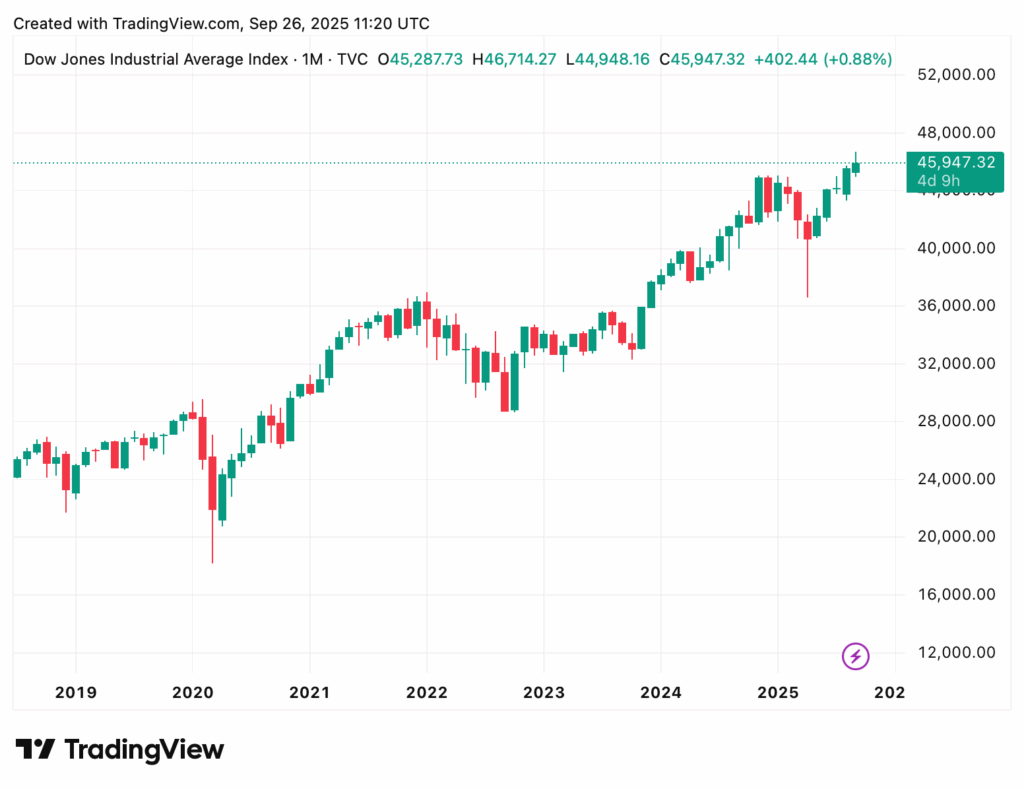
Source: TradingView