


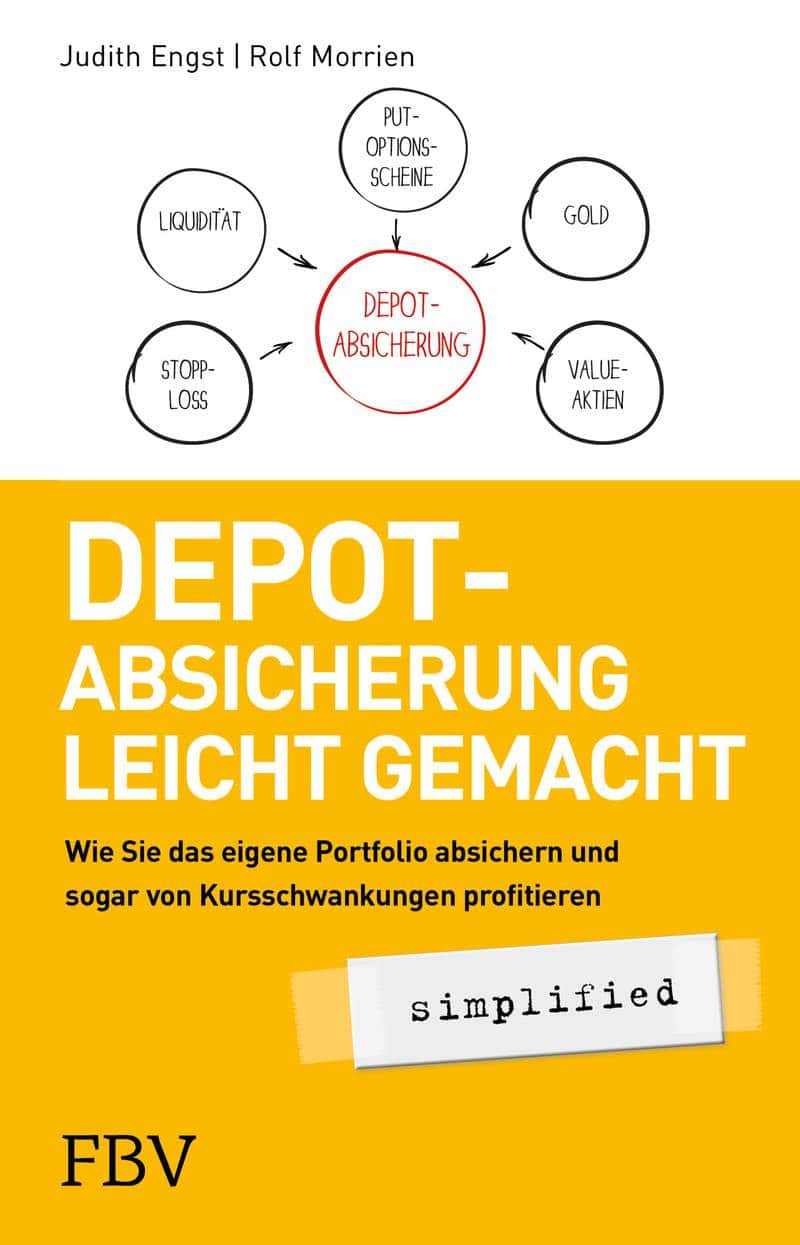

by Judith Ernst is yet another book from my beloved simplified series by Finanzbuchverlag. Even if these books never really go into the depth of the topics, they still give you a good overview of a topic on a few pages. And should it really be of further interest, you can always switch to more extensive technical and non-fiction books. In addition, they are written very easily and are therefore also suitable for beginners.
In this book, the topic of portfolio hedging is first differentiated on the temporal track. Thus, the authors devote two separate sections to the short- and long-term options for portfolio hedging.

Thus, this book is suitable for all investors who are dependent on their portfolio volume in the short and medium term, because they have planned investments or withdrawals and these would be risked with a price collapse or the retirement provision is gone. Those who have already dealt with the topic of withdrawal strategies know what effects a few bad years can have on the development of a portfolio in the withdrawal state. In these or similar situations, there are many investors who can sleep better if they have taken out some kind of crash insurance or secured themselves in some other way.
But also long-term investors get their money's worth in this book, when the essential elements of a sensible portfolio structure are described in the area of long-term portfolio hedging.
Thus, this book is especially for shaky investors who are actually too deeply invested in the stock market based on their risk profile.
However, risk hedging is very expensive depending on the hedge and can cost 5 - 12 % of the portfolio value per year. At this point, one or the other should have understood that you can also protect your portfolio broken, for example, if you followed too early one of the many crash prophets and three years in a row came no crisis, but you have paid the insurance premium.

Besides insurance, various other forms of hedging are described, such as put warrants or short ETFs (perhaps better known to others as inverse ETFs). If you haven't heard of such things, you should at least have skimmed through this book. In the end, you don't necessarily have to implement it, but you should already know your options.
For the average investor, most of these instruments will be too complex and non-transparent anyway, which is why I first advocate building up a basic understanding before putting your money into something like this. Simpler stop-loss hedges should be sufficient for most.
Much more important are the long-term hedges, which in my opinion every investor should have already implemented in his portfolio anyway, but reading up certainly does not hurt. Here it is about nest eggs, risk-adjusted investing (money management), diversification, savings plans etc. Only with the guarantee products and ETCs it becomes again a little more unknown.
The last chapters, however, do not belong in this book for me, because I can only recommend it as an overview brochure. General investment tips are better obtained from a Graham.