


AI stocks are among the most promising topics in financial markets. Artificial intelligence is driving innovation in industries such as the automotive sector, healthcare, and cloud technology. For investors, AI stocks offer the opportunity to participate in this dynamic development early on and benefit from long-term growth.
This guide will show you which AI stocks have shown strong development in recent years. You will also get an overview of the factors that play a role in valuing such stocks and which trends can influence the industry in the future. In this way, you will recognize opportunities and risks in good time before investing in this innovative sector.

The most important facts in brief:
- AI stocks give you access to one of the world's fastest-growing markets in 2026 and benefit from high global demand for automation and data analysis.
- Leading companies like NVIDIA, Microsoft, and Alphabet are investing billions in AI infrastructure, increasing their revenue potential.
- Forecasts predict the global AI market will exceed $800 billion by 2030, representing annual growth rates of well over 25 percent.
What are AI stocks?
AI stocks are company investments in firms that develop or actively use technologies in the field of artificial intelligence. This includes providers of software, cloud platforms, chip manufacturers, and data-driven services. These companies benefit from the increasing demand for automated solutions and intelligent systems that are deployed in more and more industries.
The AI sector encompasses the development and application of machine learning, robotics, data analysis, and language processing. It connects traditional technology companies with innovative startups that are building new business models around intelligent systems. AI can be found in almost all areas, from healthcare, energy, and transportation to financial services.


Key Categories for AI Stocks
To better understand the AI stock market, it's worth taking a look at the different players involved in the value creation of artificial intelligence. Three main categories can be distinguished here:
- AI Technology ProvidersCompanies that develop software or chips that AI systems work with.
- AI solution usersCompanies integrating Artificial Intelligence into existing products and processes.
- AI Trading Service ProvidersProviders of platforms, cloud services, or data solutions that enable the use of AI in financial and corporate environments.
Examples of leading AI companies include NVIDIA, Alphabet, Microsoft, Amazon, Meta, and IBM. These corporations are investing billions in research and development to secure a technological lead.
For those who want to familiarize themselves with the basics of investing first, our guide offers Aktien für Anfänger a helpful introduction.
What characterizes AI stocks?
AI stocks offer investors the opportunity to participate in one of the most promising trends in the global economy. They benefit from increasing automation in industry and services. Furthermore, they open up new opportunities in research, production, and digital infrastructure.
Key characteristics of AI stocks are:
- High growth rates due to increasing demand for AI applications.
- Strong innovative strength and technological market leadership.
- Diversified applications in many industries.
- Long-term potential through global digitalization and automation.
These characteristics make AI stocks a dynamic, growth-oriented segment in the financial markets. They offer opportunities for above-average returns but also require careful analysis of the respective business models. From data centers to self-driving cars, they shape technological progress and make AI trading a hotly discussed topic with great future potential.
The market potential of AI stocks in concrete numbers
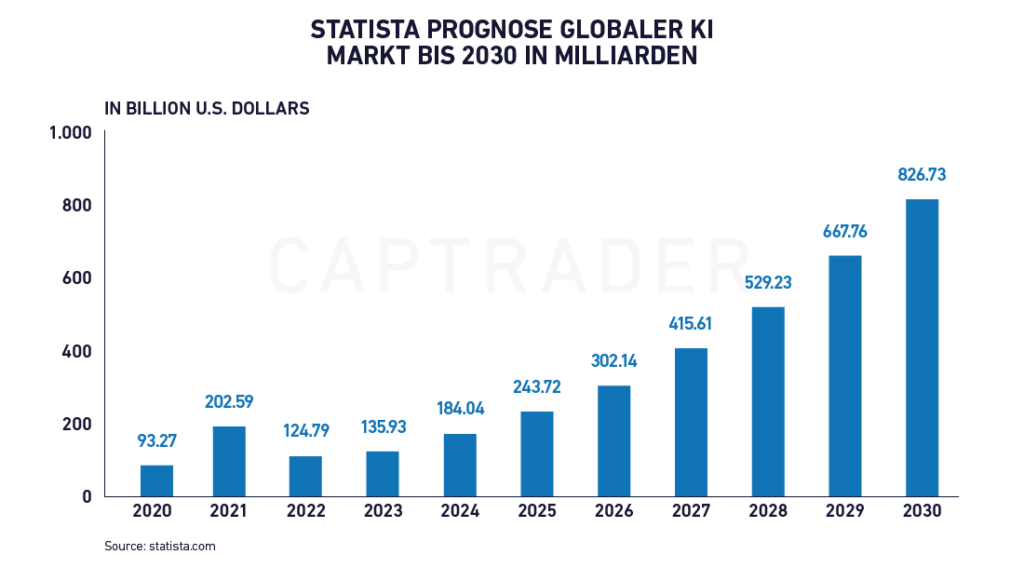
The global Artificial Intelligence market is growing at a rapid pace, forming the basis for the potential of AI stocks. Estimates suggest that the worldwide AI market volume in 2025 was approximately 243 billion US dollars and could rise to about 826 billion US dollars by 2030, representing a annual growth rate of more than 27 % corresponds.
Global prosperity gains through AI by 2030
One Die PwC Study shows that artificial intelligence will generate enormous global economic growth by 2030 and become the decisive basis for competitiveness in almost all industries.
- AI will boost global GDP by about 14 % by 2030, representing an additional value of approximately $15.7 trillion.
- The greatest growth is expected from China (up to 26 %higher GDP) and North America (around 14.5 % ), which together account for almost 70 % of global AI effects.
- Europe profits moderately with an expected GDP increase of 9 to 12 %, while developing countries are expected to see less than 6 %growth from AI due to lower AI utilization.
- About half of the economic gains from AI will come from rising labor productivity, primarily through automation, robotics, and the augmentation of human work by AI systems.
- An additional approximately 9 trillion US dollars will come from improved products and changed consumer preferences and behavior thanks to AI solutions.
According to the AI Impact Index, the healthcare sector (e.g., data-driven diagnostics, pandemic detection, medical imaging), financial services (personalized financial planning, fraud detection, transaction automation), and retail (personalized products, customer data analysis, inventory and supply chain management) are expected to benefit the most.
Other important winners include the automotive industry, transport & logistics, technology/communication/entertainment, energy, and manufacturing, for example through autonomous vehicles, smart grids, predictive maintenance, and optimized production.
Growth Drivers: Billion-dollar investments in AI hardware and data centers
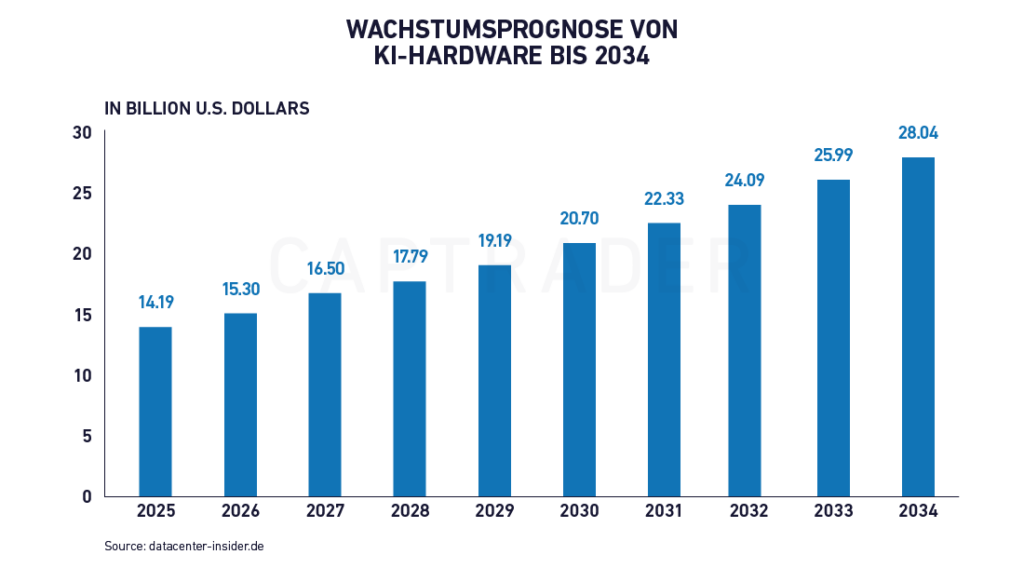
The market for data center CPUs is projected to grow from $14.19 billion in 2025 to $28.04 billion in 2034, nearly doubling within nine years.
This corresponds to an average annual growth rate of 7.87 % and underscores that data centers worldwide are massively investing in new capacity to handle compute-intensive AI workloads.
Parallel forecast, that the entire AI data center market is growing by more than 30 % per year in the same period and could reach a volume of well over $900 billion by 2030. This result supports the estimates described by Statista and highlights the role of AI hardware as a key growth driver in the industry.
Against this backdrop, billion-dollar alliances between chip manufacturers and cloud operators appear to be a consistent response to the increasing demand for scalable, energy-efficient AI infrastructures.
In the described partnership, Nvidia and Intel are pooling their multi-billion dollar investments to develop tightly coupled CPU-GPU systems specifically optimized for AI training and inference in hyperscale data centers.
In addition, capital is flowing into new factories, manufacturing processes, and network technologies that are intended to enable extremely large AI clusters with tens of thousands to hundreds of thousands of accelerator chips. For operators, these investments mean that they can increasingly factor in the growing computing power of modern AI models in the future.
Risk factors in AI stocks: What you should know
AI stocks are considered growth drivers of the future. Nevertheless, there are risks that investors should not ignore. Even technology giants struggle with challenges that directly impact stock price developments and returns.
The years 2025 and 2026 have clearly shown that the AI hype does not benefit all companies equally. Many AI stocks now have to contend with real economic and regulatory hurdles.
1. Chip shortage and pressure on margins
Fluctuating semiconductor prices are massively straining the entire AI sector. GPUs, memory components, and specialized AI chips are continuously becoming more expensive. NVIDIA reported record demand in 2025, but production costs rose significantly in parallel.
These cost increases cannot often be fully passed on to end customers or businesses.
Cloud providers like Amazon and Microsoft are pushing for lower prices to secure market share. This is leading to shrinking profit margins for manufacturers and suppliers. Mid-sized chip designers are particularly affected, being squeezed between large corporations. In the long term, this threatens a consolidation process where only the strongest players will survive.
2. Supply chain issues and geopolitical tensions
Geopolitical conflicts are more than headlines in 2026. They directly threaten global supply chains for AI stocks. US export restrictions against China are limiting access to advanced chips. Taiwan, where TSMC manufactures the majority of global AI hardware, remains geopolitical risk number one.
Regional bottlenecks in rare earth elements and lithium can delay production cycles. Many AI companies rely on a few suppliers. Companies with globally diversified suppliers, like Samsung or Intel, have clear competitive advantages. Smaller players without such networks risk production outages of several months.
3. Regulation costs billions
Stricter AI laws are not a temporary debate. They will become a permanent reality for all AI stocks. The EU AI Regulation calls for comprehensive risk analyses and transparency obligations. Large corporations like Alphabet are already investing billions in compliance departments and security research.
Possible regulations include:
- Data protection requirementsAny AI that processes personal data is subject to strict regulations.
- CO₂ targetsAI companies in the EU can be affected by CO₂ pricing due to the high electricity consumption of their data centers.
While considering regulations will negatively impact short-term quarterly results, they are essential in the long term to secure market access in regulated regions like Europe. Companies without a clear regulatory strategy risk hefty fines or market exclusion.
4. Currency risks should not be underestimated
Internationally operating AI companies are massively exposed to currency fluctuations. A strong US dollar benefits the USA macroeconomically. For exporters like NVIDIA or AMD, however, it automatically means higher prices on global markets. European and Asian customers hesitate at price increases and switch to local alternatives.
- Revenue in foreign currencies shrinks noticeably when converted to dollars.
- A project showing dazzling growth figures in Euros often appears sobering in USD statements.
- Conversely, a strong US dollar bothers Asian chip manufacturers.
TSMC and Samsung import manufacturing equipment in dollars but sell locally in yen or won. Rising dollar costs directly pressure margins, especially when price adjustments to price-sensitive customers are not possible.


The most well-known and largest AI stocks at a glance
The following list provides an overview of a selection of stocks from companies operating in the field of artificial intelligence, followed by an introduction to some AI stocks. All values are sorted by market capitalization (as of March 2026).
Top 12 AI Stocks Worldwide by Market Capitalization
| Company | ISIN | Country | Market capitalization in US dollars |
| NVIDIA Corporation | US67066G1040 | USA | 4.32 trillion |
| Apple Inc | US0378331005 | USA | 3.78 trillion |
| Alphabet Inc Class A | US02079K3059 | USA | 3.61 trillion |
| Microsoft Corporation | US5949181045 | USA | 3.04 trillion |
| Amazon.com Inc | US0231351067 | USA | 2.29 trillion |
| Meta Platforms Inc | US30303M1027 | USA | 1.63 trillion |
| Tesla Inc | US88160R1014 | USA | 1.49 trillion |
| Oracle Corporation | US68389X1054 | USA | 440 billion |
| Micron Technology | US5951121038 | USA | 417 billion |
| Palantir Technologies | US69608A1088 | USA | 376 billion |
| International Business Machines (IBM) | US4592001014 | USA | 243 billion |
| Adobe Inc | US00724F1012 | USA | 116 billion |
Before you can start AI trading, you first need a brokerage account through which securities can be traded. A detailed guide on how to open such an account Open an account, find in CapTrader's comprehensive guide. Here you also benefit from attractive Trading fees.
The so-called Core-satellite strategy serves as a stable investment approach: At its core are solid quality stocks, complemented by growth-oriented stocks. This model can be applied not only to AI stocks but also to sectors such as Banks-, Tourism- or Oil stocks.
In the following section, we will introduce you to selected AI stocks in more detail.
NVIDIA
NVIDIA is the dominant Blue chip share in the fields of artificial intelligence and semiconductor technology. The U.S. company is considered a central driver of the global AI revolution and is a key player in cloud, gaming, and data center infrastructures.
- business modelDevelopment of high-performance GPUs (Graphics Processing Units) and system platforms for data centers, AI training, autonomous driving, gaming, and visualization. Complemented by software ecosystems such as CUDA and NVIDIA AI Enterprise.
- Core customersHyperscalers (Amazon, Microsoft, Google), research institutions, automotive manufacturers, software developers, and gaming communities.
- USPLeading GPU architectures, dominant software stack for AI and deep learning, as well as strong ecosystem integration through proprietary platforms.
NVIDIA supports companies from the development of AI-based business models to the implementation of complex computing and training processes on scalable GPU clusters. The corporation integrates hardware, software, and cloud solutions into a comprehensive technology platform.
As a technology and AI stock, NVIDIA offers direct exposure to the exponential growth of artificial intelligence, cloud computing, and data-driven industries. Opportunities arise from its market leadership and software monetization, while risks stem from dependencies on chip cycles, geopolitical restrictions, and competition in the AI hardware market.
| Tax year | Estimated revenue (in millions) | Change compared to previous year |
| 2025 | 130,497 US Dollars | +114,2 % |
| 2026 | $215,938 | +65,47 % |
| 2027 | 367,411 US Dollars | +70,15 % |
2. Microsoft
Microsoft is one of the key drivers of cloud computing, productivity software, and artificial intelligence. The company is among the most valuable corporations in the world and is a core building block of many global technology portfolios.
- business modelDevelopment and operation of a broadly diversified software and cloud group with the segments Productivity & Business Processes (including Office, Microsoft 365, LinkedIn, Dynamics), Intelligent Cloud (Azure, server products, enterprise services) and More Personal Computing (Windows, Surface, Xbox, search and advertising services).
- Core customersCompanies of all sizes, public institutions, cloud and developer communities, consumers in the Windows, Gaming, and Productivity sectors, as well as advertising customers in search and business networks.
- USPDeep integration of operating system, productivity software, cloud platform (Azure), and AI services, strong lock-in effects in the corporate environment, and global sales with enormous scalability.
Microsoft supports customers from basic IT infrastructure through collaboration and productivity tools to AI-powered solutions and data platforms for entire enterprise processes.
As a technology and cloud stock, Microsoft offers leverage on structural growth in cloud computing, artificial intelligence, software subscription models, and gaming. The stock benefits from high pricing power and recurring revenues, but carries risks from regulation, competition in cloud and AI, and cyclical IT budgets.
| Tax year | Estimated revenue (in millions) | Change compared to previous year |
| 2025 | 281,724 US dollars | +14,93 % |
| 2026 | 327,781 US Dollars | +16,35 % |
| 2027 | $378,207 | +15,38 % |
3. International Business Machines (IBM)
IBM is one of the oldest and most reputable stocks in the technology sector and has evolved into a leading provider of hybrid cloud, AI, and enterprise consulting.
- business modelHybrid cloud platforms and software (Red Hat, watsonx), consulting services, infrastructure services (mainframes, storage), and financing solutions. Focus on AI-integrated enterprise solutions across software, consulting, infrastructure, and financing segments.
- Core customersEnterprise, financial institutions, governments, public administration, and industry for mission-critical systems, cloud migration, and AI transformation.
USP: Over 100 years of IT expertise, leading mainframe technology (z/OS), strong - AI platform (watsonx) and Red Hat OpenShift for hybrid cloud, along with a sustainable dividend history as an Aristocrat.
IBM supports clients from strategic consulting through hybrid cloud architectures and AI integration to mission-critical infrastructures such as mainframes and data-secure storage solutions.
As a technology and Dividend stock IBM offers leverage on hybrid cloud migration, enterprise AI, and stable cash flows from recurring services. Opportunities lie in software growth and consulting margins, risks in competition with cloud-natives, dependence on legacy systems, and slow digitalization.
| Tax year | Estimated revenue (in millions) | Change compared to previous year |
| 2025 | 67,535 US Dollars | +7,62 % |
| 2026 | 71,193 US Dollars | +5,42 % |
| 2027 | 74.356 US dollars | +4,44 % |
4. C3.AI
C3.ai offers a specialized platform for the development and deployment of AI applications in large enterprises and is considered a pioneer in industrial AI transformation.
- business modelEnterprise AI Platform (C3 AI Suite) for predictive analytics, IoT applications, and industry-specific AI solutions in sectors such as energy, manufacturing, finance, and healthcare. Complemented by turnkey applications and professional services.
- Core customersLarge corporations (e.g., Shell, Baker Hughes, US Air Force), energy providers, manufacturing companies, and public institutions for data-driven decision-making and process optimization.
- USPNo-Code/Low-Code Platform for rapid AI application development, pre-built industry models, high scalability on hybrid clouds, and a focus on measurable ROI in regulated industries.
C3.ai accompanies customers from AI strategy through model-based applications to productive deployment in critical business processes such as predictive maintenance, supply chain, and risk management.
As an AI software stock, C3.ai offers direct leverage on enterprise AI adoption and the digitalization of traditional industries. Opportunities lie in ARR growth and platform dominance, while risks include a high churn rate, customer concentration, and competition from Microsoft/Amazon AI tools.
| Tax year | Estimated revenue (in millions) | Change compared to previous year |
| 2025 | 389.1 US dollars | +25,27 % |
| 2026 | $248.80 | -36,05 % |
| 2027 | 231.2 US dollars | -7,05 % |
5. DocuSign
DocuSign is active in the field of digital signature and contract management software. The company has popularized electronic signing and operates the "Agreement Cloud" for global contract workflow.
- business modelCloud platform for e-signatures, contract automation, negotiation workflows, payment integration, and AI-powered document analysis. Complemented by hundreds of integrations with CRM, ERP, and cloud systems.
- Core customersOver 890,000 companies worldwide in real estate, finance, healthcare, law, and sales for fast, legally compliant document processing.
- USPLeading e signature platform with global legal compliance, seamless system integrations, and expansion to complete contract lifecycle automation.
DocuSign supports customers from digital agreement preparation through secure eSignatures to the analysis and management of completed agreements with AI-powered risk checks.
As a software and SaaS stock, DocuSign offers leverage on the digitalization of business processes, the home office trend, and regulatory e-signature requirements. Opportunities lie in ARR growth and AI features, while risks include market saturation, price wars, and dependence on sales cycles.
| Tax year | Estimated revenue (in millions) | Change compared to previous year |
| 2025 | 2,977 US dollars | +7,78 % |
| 2026 | 3,211 US dollars | +7,86 % |
| 2027 | 3,425 US dollars | +6,67 % |
CapTrader can do that:
At CapTrader, the trading fees are extremely low: you can trade US shares from as little as $ 0.01 per share (order minimum $ 2.00) and German shares from as little as 0.1 % of the order volume (order minimum €2.00), options from €2.00, futures from €1.00, ETFs from €2.00 and much more!


Conclusion: Is it worth investing in AI stocks?
AI stocks are among the most dynamic investment themes in financial markets. As an investor, they offer you access to innovations in automation, cloud computing, and data analysis. Companies like NVIDIA, Microsoft, and Alphabet dominate this sector through billions in investments in research and infrastructure.
AI trading benefits from exponential market growth. Forecasts predict a market volume of over $800 billion by 2030. Despite risks such as regulation and supply chain issues, the opportunities outweigh them. Moderate valuations and strong cash flows make AI stocks attractive for long-term portfolios.
The sector combines high growth potential with technological leadership. Several strong growth drivers further reinforce development. For diversified investors, this means solid return opportunities in a volatile market environment.
