


The stock market is a marketplace full of emotions. Euphoria is constantly alternating with panic. And those who act wisely in these moments can build wealth. Buy the Dip is considered a popular strategy in volatile stock market phases: taking advantage of dips, getting in at a low price, and profiting from price growth.
Sounds logical. But does it work in the long term? This article provides well-founded data, independent studies, and a clear answer to the question of how profitable this approach is.

The most important in a nutshell
- "Buy the dip" is considered a popular entry strategy during corrections.
- Buy and hold almost always yields better returns than buy the dip
- Meaningful only in crash phases with clear rules and analysis tools
How does the buy the dip strategy work?
Many investors do not implement the "buy the dip" strategy correctly because they do not understand the underlying dynamics. The core of the method is to consciously wait for a price decrease in order to enter at a lower price. Sounds simple in theory. But it isn't in practice.
- Two Approaches"Buy the dip" can be implemented either systematically with fixed rules or spontaneously based on feeling.
- Implementation decidesNot the strategy itself, but its correct and consistent application determines success.
- Frequent ErrorStudies show that many investors use "buy the dip" emotionally and without a clear structure. This leads to correspondingly weak results.
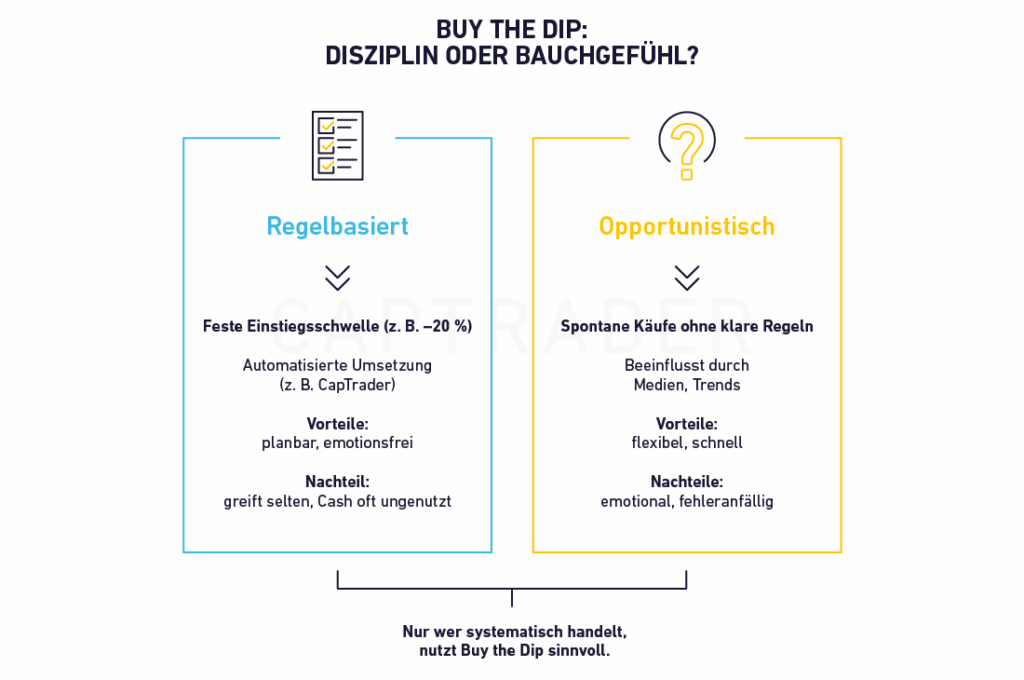
Two variants have emerged: the Rule-based, which relies on logic and structure, and the Opportunistic, which is strongly influenced by emotions. Both hold opportunities, but also great risks. Especially when behavior is not underpinned by sound knowledge.


The rule-based variant
"Buy the Dip" can be particularly profitably applied when clear rules define the scope of action. In the rule-based version, for example, it is stipulated that if there is a decline of 20 percent, 10 percent of the previously held cash reserve is automatically invested.
This mathematical approach reduces emotional decision-making by reducing the scope for action and enabling automation.
Good to know:
Users of CapTrader can implement such scenarios with precision: using limit-based orders, rebalancing functions, and intraday execution, including across international markets.
Nevertheless, this approach has a crucial weakness: it depends on the occurrence of rare events. Markets often only correct slightly or even rise without ever producing a significant dip.
In these phases, the investment reserve remains ineffective. This means a significant portion of the capital is not participating in market growth, which leads to massive losses in returns over the years.
To avoid losing sight of the big picture, investors should use a clear system based on proven technical tools. You can find a deeper introduction to these structuring approaches in the article about Trading signals.
The opportunistic variant
Many private investors make spontaneous decisions when buying the dip. These are driven by emotions and gut feelings. However, this is precisely where there is a high potential for wrong decisions.
- Spontaneous decisionsInvestors react impulsively to market events without sound analysis.
- No clear rulesThere is a lack of fixed entry thresholds, risk management, and differentiation between correction and crash.
- Misjudgment due to gut feelingShort-term setbacks are overestimated, although they rarely represent real opportunities.
- Confirmation BiasInvestors retrospectively confirm themselves and systematically overlook their mistakes.
- Psychological risksEmotional reactions lead to excessive activity, timing errors, and long-term losses.
These psychological misconceptions accompany many investors for years. They lead to impulsive transactions and unnecessary losses. Our expert article explains why this behavior is so widespread. Stock market psychology.
What do studies say about the "buy the dip" strategy?
Several independent analyses have examined whether targeted re-buying during price declines yields better long-term results than a continuous buy-and-hold strategy.
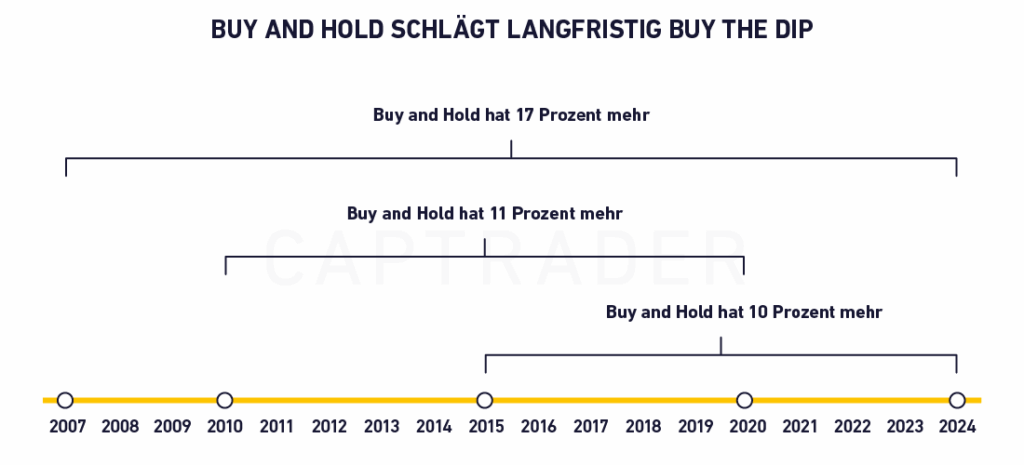
- Performance comparisonBuy and Hold achieved a higher total return than Buy the Dip in all 14 periods examined (2007 to 2024).
- Timing issuesStudies show that attempts to systematically time dips regularly fail. Often, investments are made too early or too late.
- Capital utilizationWith "Buy the Dip," a portion of the assets remains unused on the sidelines while the market, on average, continues to rise.
Buy and Hold outperforms Buy the Dip in almost all tested time periods. The following table presents different time periods with their respective performance.
| Period | Buy and Hold Returns | Buy the Dip Yield | Difference in favor of Buy and Hold |
| 2007 to 2024 | One hundred percent | 83 percent | 17 percent |
| 2010 to 2020 | 85 percent | 74 percent | 11 percent |
| 2015 to 2024 | 65 percent | 55 percent | 10 Prozent |
Results of the Kommer Analysis
The analysis of Gerd Kommer shows with impressive clarity that buy and hold performed better than buy the dip over almost all examined time periods.
Different models were tested: with 10, 20, and even 30 percent cash share, as well as varying entry thresholds during market downturns.
In no case could Buy the Dip outperform Buy and Hold. Neither absolutely nor risk-adjusted. Even in scenarios with slightly reduced volatility, the return was consistently lower.
The reason is obvious: while buy and hold remains continuously invested and benefits from the entire uptrend, buy the dip often waits in vain for the next pullback.
The sequence is a structural underperformance that accumulates over years, especially when markets are in a stable upward trend, as between 2009 and 2021.
Scientific confirmation
Komm is not alone in his assessment. Scientific studies also support his conclusions. Two works are particularly noteworthy: the first is by Park (2022), the second by Bonini et al. (2024).
Both analyze long-term investment strategies based on historical market data. The performance difference between buy and hold and buy the dip was systematically investigated.
The result is clear: In stable market phases, "buy the dip" leads to significant losses in returns. The most common mistake lies in trying to time the market, that is, in trying to predict favorable entry points. However, according to studies, precisely this market timing rarely works reliably.
The cause of the reduced performance
Buy and hold is usually more successful. This is mainly because buying the dip comes with structural disadvantages:
- Idle capitalA portion of the assets remains unused because it is „waiting“ for the next pullback.
- Missed Market DevelopmentWhile capital rests, the market generally continues to rise. Often by several percentage points per year.
- Too late a reactionEven if a pullback occurs, the recovery is often faster than an investor can react.
- Structural return disadvantageThis delay results in a permanent loss of performance. A backlog that is difficult to catch up on.
- Market development of recent yearsEspecially between 2013 and 2023, many upturns were dynamic. Those who hesitated missed great opportunities.
Those who want to understand more deeply how stock markets behave in difficult phases and why many investors make wrong decisions at such times should engage with the topic. Stock market crash deal with.
The Illusion of a Cheap Entry
Many investors consider "buy the dip" a simple and clever strategy. In theory, it sounds convincing: buying when prices are falling seems logical, as stocks are cheaper then. However, this logic is based on the assumption that one can identify the bottom.
In reality, however, hardly anyone succeeds. The reasons for this are:
- Complexity of the stock marketMovements are unpredictable and depend on many factors.
- Risks of premature entryInvestors buy too early and see their investment continue to slip into the red.
- Risks of late entryHe who waits too long misses the best time.
- Emotional behavior as a weaknessOften leads to bad decisions and below-average returns.
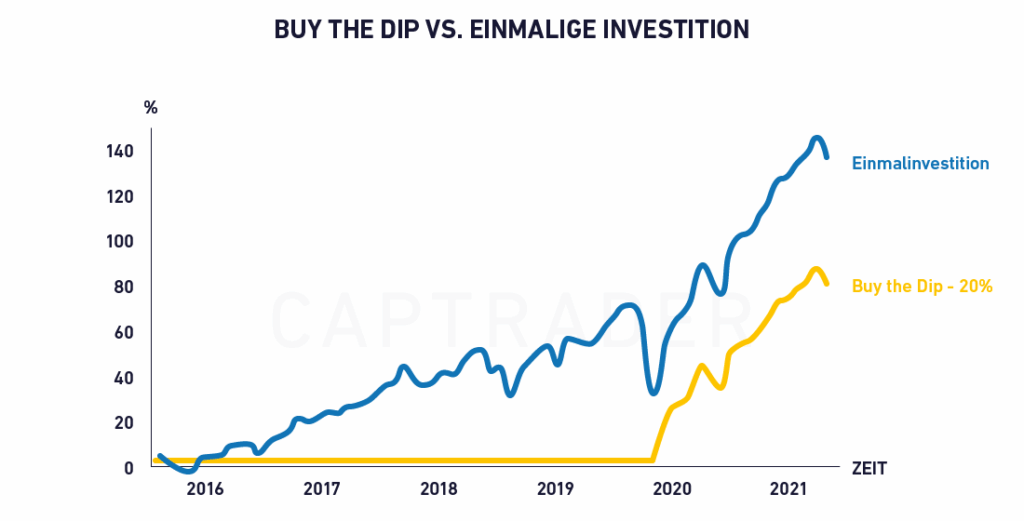
The following chart shows the yield difference between the strategies Buy and Hold versus. Buy the Dip. The comparison period until December 2021 clearly shows that investing in the market immediately would have led to a significantly better result than waiting for an ideal entry point.
In this example, the performance of Buy and Hold is 20 percent better than the Buy the Dip approach.
Good to know:
Many investors underestimate how much uncertainty and psychological pressure are associated with this strategy. Instead of acting rationally, they react impulsively.
Buy the dip makes sense when: * **You have a long-term investment strategy:** If you believe in the long-term growth potential of an asset, a temporary price drop can be a good opportunity to buy more at a lower cost basis. * **The underlying fundamentals of the asset remain strong:** The dip should be caused by market sentiment or temporary factors, not by a fundamental flaw or decline in the asset's value. * **You have done your research:** Understand why the price has dropped and ensure it's not a sign of a more serious problem. * **You have risk management in place:** Only invest what you can afford to lose and consider setting stop-loss orders to limit potential downside. * **You have cash available:** Buying the dip requires having liquid funds ready to invest.
Buy the dip is not a one-size-fits-all solution for every market downturn. In most cases, the strategy is neither necessary nor helpful. It's different in the case of sharp, extraordinary setbacks. For example, in geopolitical crises, financial shocks, or sudden interest rate hikes.
- Clear market picture needed: "Buy the Dip" only works during clearly identifiable and deep pullbacks.
- Flexible working hours requiredThose who can trade quickly outside of stock exchange hours gain an advantage.
- Technique and discipline are crucialWithout analysis tools and a structured approach, the strategy is difficult to implement successfully.
In these moments, acting counter-cyclically can actually be worthwhile. However, two conditions must be met for this: firstly, a time advantage over the masses. And secondly, the ability to objectively assess the situation.
Those prepared for both factors can tactically deploy "buy the dip." With the right tools, the suitable broker, and a clear strategy.


Strategic Action During Crashes
Buying the dip can be a sensible reaction to market corrections in exceptional cases. For example, in the event of a price drop of over twenty percent within a few days. However, the prerequisite is that investors are able to act quickly and thoughtfully.
Important prerequisites for a strategic approach:
- Significant pullback requiredThe strategy only works with price drops of over 20 percent within a short period of time.
- Planned instead of impulsive actionSuccess requires clear decisions and not reacting instinctively.
- Clear Rules Are NeededEntry thresholds and frameworks for action must be defined in advance.
- Technical know-how importantMarket mechanisms, indicators, and signals must be understood and interpreted correctly.

In such moments, time is often money. Those who react early to a sudden interest rate turnaround in the US can enter at a lower cost than investors who have to wait until Monday morning.
Without clear rules and a technical understanding, even the best entry point won't be used effectively. To learn how to analyze short-term price movements in a targeted way and build on them, read the article on Swing Trading.
Disciplined implementation with analysis
The theory behind the "buy the dip" strategy sounds simple. However, implementing it requires precise timing, technical expertise, and analytical discipline. Without a solid understanding of market mechanisms, any attempt will quickly fall flat.
Anyone who seriously wants to work with this strategy needs to know how trends develop, how support zones work, and which signals are actually reliable. This is where tools like Chart patterns, Volume analysis and Momentum Indicators into play. These are tools that have proven their worth in professional analysis.
It is particularly important to use the right order types. Those who trade with a Market Order buying blind risks bad prices in volatile phases. A Limit order Conversely, it protects against excessive entry prices when volatility is high.
Knowledge of these differences and the ability to apply them appropriately are crucial for the success of any buy-the-dip strategy. Those who first familiarize themselves with the basics of market mechanics will benefit in the long run. A good starting point is our concise guide to Trading for beginners.
Recognizing Risks and Cognitive Biases
To many investors, “buy the dip” seems like a strategic approach. In reality, it often leads to idle capital, missed opportunities, and poor decisions. The situation becomes particularly critical when emotional factors dominate decision-making or when capital remains unproductive for too long.
- Return disadvantage due to cashUninvested capital generates significantly lower returns in the long run than permanently invested funds.
- Emotions as Profit KillersSpontaneous reactions often prevent rational and strategic investment decisions.
- Media as a Trigger: News and market trends often lead many investors to act impulsively. This usually has negative consequences.
Good to know:
To effectively use "buy the dip," investors need to be aware of and avoid these psychological and structural pitfalls.
The opportunity cost of the investment reserve
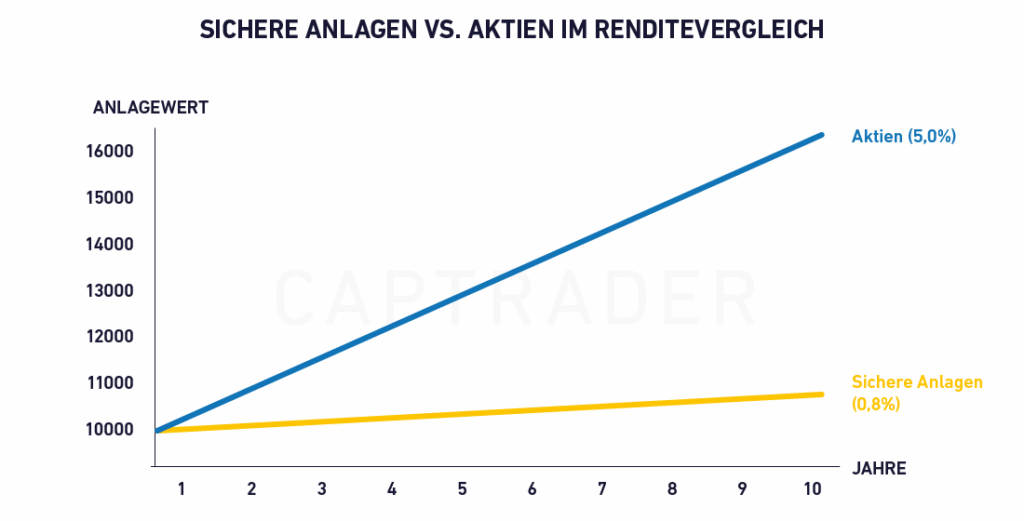
Investors who consciously withhold capital to wait for a pullback accept significantly lower interest rates. Between 2007 and 2024 lay the average Yield secure facilities in Germany at only 0.8 percent per year.
In the same period achieved broad scattered Equity portfolios on average over 5 percent. This difference may seem negligible in the short term, but it adds up massively in the long run.
A decade with 3 to 4 percent less per year quickly means a double-digit return disadvantage. This is fatal, especially in times of low interest rates and high inflation. Because then cash also loses purchasing power.
As a result, "buy the dip" can hinder returns if it is used too infrequently. Those who keep their equity ratio high for too long fail to benefit from the power of compound interest and miss out on dividends, capital gains, and reinvestments.
Emotional Influences and Poor Decisions
The biggest losses aren't caused by the wrong stocks. They're caused by the wrong behavior. Many investors let their emotions guide their investment decisions.
Fear of further losses, euphoria at apparent bargains, panic at bad news: all these reactions can block rational action. Especially when trying to buy the dip, many tend to buy without thinking. Or, out of sheer uncertainty, they refrain from acting altogether.
People often overestimate the potential of a pullback, even though it is statistically irrelevant. At the same time, they hesitate during real crises, even though that is precisely when entering the market would be particularly valuable. This inconsistency is dangerous and leads to below-average results in the long run.
A systematic approach to information is therefore essential. You can learn how to make sense of news, stock market reports, and rumors in our expert article on Newstrading.
CapTrader can do that:
CapTrader offers direct access to over 160 exchanges in 36 countries, including Germany, USA, Switzerland, UK, Japan, and Australia. Orders are placed directly on international exchanges such as Nasdaq, London, Tokyo, or Frankfurt, resulting in lower spreads and reduced costs.


Conclusion: Buying the dip is not a guarantee of better returns
"Buy the dip" is a popular but overrated investment strategy. Those who selectively buy more during price drops risk leaving capital unused for years. And thus missing out on the average market return.
Studies, analyses, and backtests show: A simple buy and hold strategy, where capital remains permanently invested, outperforms buy the dip in almost all tested scenarios.
The "Buy the Dip" strategy can be sensible only in exceptional situations (e.g., clear crashes). Prerequisites include discipline, technical knowledge, and the right infrastructure, for example, through CapTrader.
However, without a clear strategy and thorough market analysis, “buy the dip” often leads to emotional mistakes and below-average results. Investors should therefore carefully consider whether and when to use “buy the dip” strategically—or whether they would be better off relying on proven strategies.
