Dear traders, dear stock market friends.
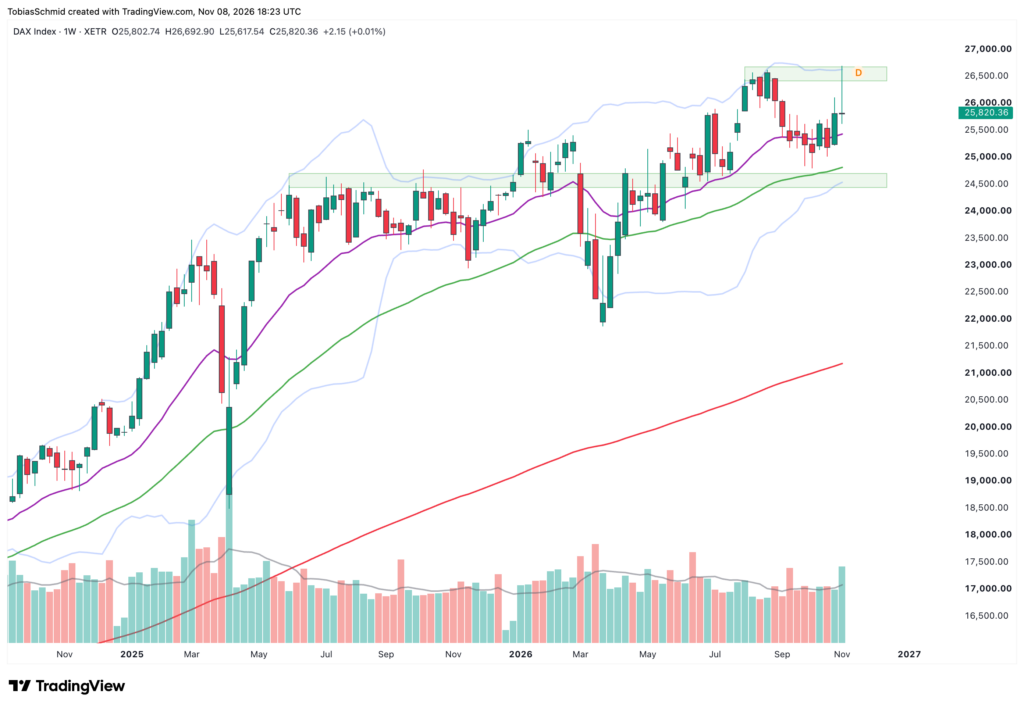
The DAX ended an unusually volatile trading week virtually unchanged. On Thursday, the index reached a new all-time high at 26,693 points. Just one day later, a 1.9 percent sell-off followed and the DAX closed the week at 25,820 points. Compared to the previous Friday, that represents a gain of just 0.01 percent.
Initially, the German stock market was able to hold up significantly better than the US technology stocks that had recently come under strong pressure. It was not until Friday that the bad mood reached Europe as well, and it almost reversed the entire weekly gain for the DAX.
Rotation from US tech drives the DAX to a new record high
The strongest movement occurred on Wednesday. The DAX jumped up by 2.2 percent, thus laying the foundation for the new all-time high on Thursday.
Following the US midterm elections, in which the Democrats won control of both chambers of Congress, European stocks were among the winners. Particularly banks saw strong gains. At the same time, technology and AI stocks continued to come under pressure. Investors were therefore increasingly looking for alternatives outside the recently highly valued US tech stocks.
Additional support came from the oil price, which declined significantly over the week. There was also at least a small positive boost from Germany: Industrial production rose by 0.7 percent in September, which was stronger than expected. However, the strong August figure was revised down significantly.
Heidelberg Materials, Bayer and Fresenius impress; Rheinmetall falls off the list
There were sometimes very different developments among the individual DAX stocks over the past week.
Heidelberg Materials leads the list of winners with a weekly increase of around 15.5 percent. Revenue rose by 10 percent to 6.4 billion euros in the third quarter, while operating profit increased by 9 percent. In addition, the company announced further cost savings of 300 million euros by the end of 2028.
Bayer and Fresenius were also among the big winners. Bayer gained nearly 10 percent and raised its forecasts for EBITDA, free cash flow, and debt, among other things. Fresenius added around 9.3 percent after the healthcare group once again raised its annual targets.
The situation at Rheinmetall was quite different. The stock lost more than 20 percent over the course of the week. The company lowered its forecast for 2026 for the second time in three months. Among other things, sales from the Boxer program are being postponed to next year. At the same time, weaker order intake and negative operating free cash flow created additional uncertainty.
Infineon also lost around 9.5 percent and Siemens Energy nearly 7 percent. Both stocks were dragged down by the continued weak sentiment surrounding technology and AI investments.
On Friday, the sell-off also reaches the DAX
Until Thursday, the DAX was largely able to escape the weakness in the US technology markets. On Friday, that ended.
The global risk-off move spread to Europe, and the DAX lost 1.92 percent. This made it even weaker than many other European indices.
There was additional pressure on insurers. JPMorgan downgraded several German reinsurers. Hannover Rück subsequently lost 4.3 percent, Munich Re 4.4 percent. The European insurance sector as a whole fell by 2.6 percent.
In just over a trading day, the new all-time high of 26,693 points fell to a low on Friday of around 25,618 points.
Chart technical outlook for the DAX: These brands are now important
Chart-technically, the picture remains positive despite the sharp rebound.
A first short-term support lies in the region of around 25,600 points. This is also where the daily EMA 50 is currently located. It was exactly in this area that the sell-off initially stopped on Friday.
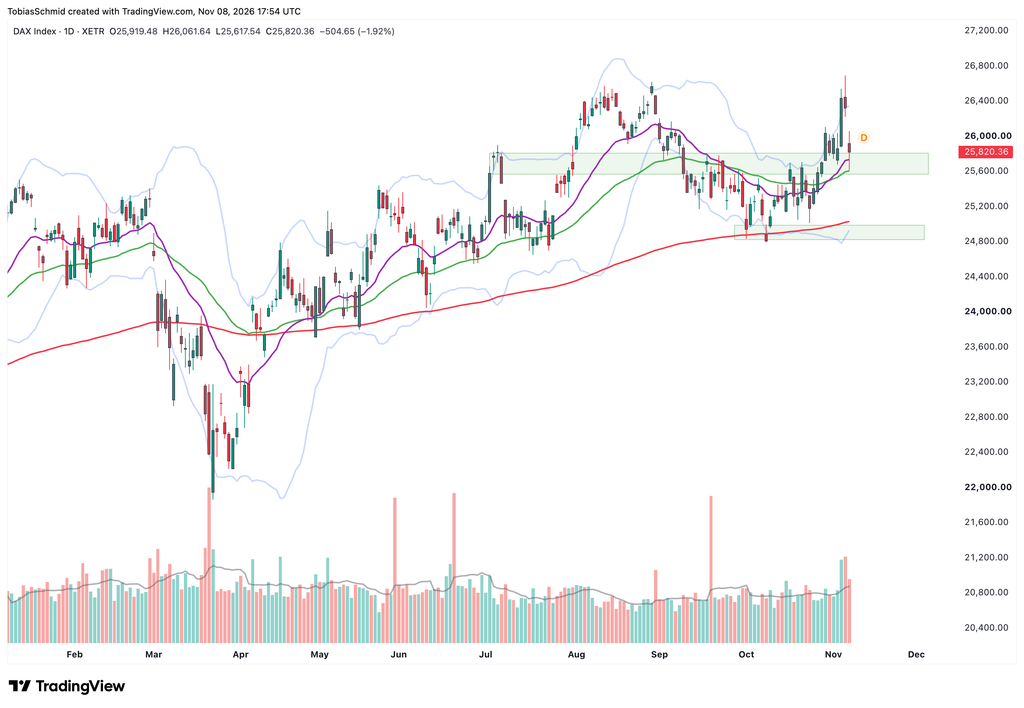
Should this support not hold, the correction could extend into the area of the EMA 200.
In my view, however, the long-term chart picture would only really become distorted if there was a significant break below the local correction low of the current uptrend at around 24,800 to 24,850 points. This area has already served as an important support in early October.
As long as the DAX remains above this zone, a stronger correction would initially still be compatible with the broader upward trend.
On the upside, of course, the new record high of around 26,700 points remains the decisive mark. A further increase above this would confirm the recently failed attempt to break through.
Infineon, Siemens Energy and US inflation in focus
There are also numerous important dates on the agenda for the new trading week.
- Infineon will already publish the figures for the fourth quarter and the full year 2026 on Tuesday. After the price decline last week, the outlook and statements regarding demand from the automotive, industrial, and AI infrastructure sectors are likely to be of particular interest.
- On Wednesday, Siemens Energy will follow with its figures for the past financial year.
- On Thursday, among others, Siemens, Allianz and Munich Re will report.
- In addition to the company figures, inflation data is once again in the spotlight. On Tuesday, consumer prices for October will be released in the USA. In September, inflation was still at 3.7 percent. Especially after the recent high energy prices, the market will be closely watching to see whether price pressure will weaken again.
- On Wednesday, the final German inflation figures will be released. According to the preliminary calculation, the German inflation rate in October was 2.8 percent, which was below the 3.3 percent recorded in September.
For the DAX, what is of particular interest is whether the rotation into European and less technology-dependent stocks will continue. The rebound from Friday initially halted the new breakout. As long as support at 25,600 points or, in the longer term, the correction low at 24,800 to 24,850 points holds, the overall upward trend remains intact.
Author: Tobias Schmid
Date: 09.11.2026