Dear traders, dear stock market friends.
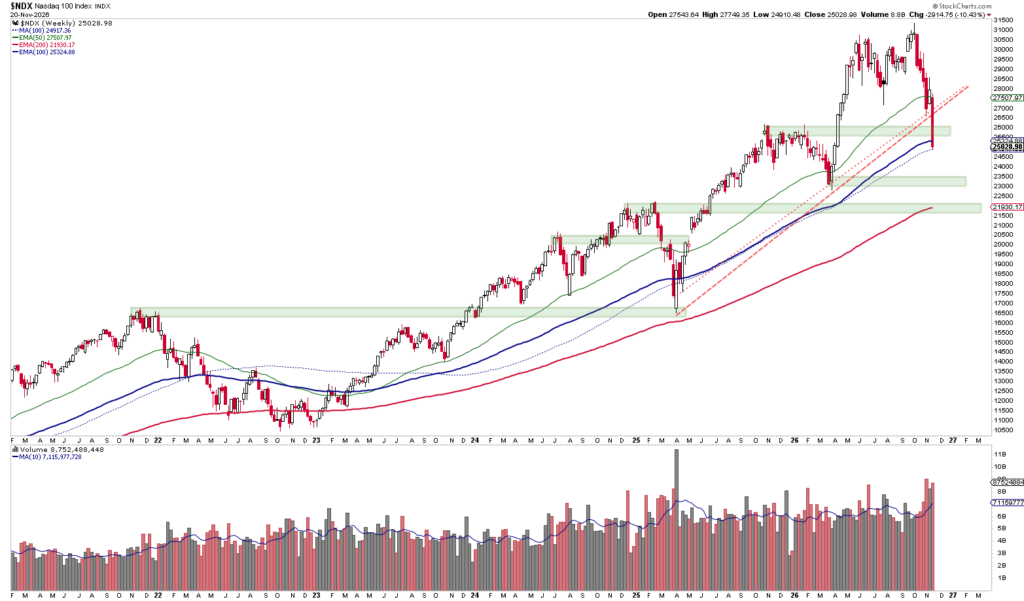
What a week. The Nasdaq 100 lost 10.4 percent in just five trading days and ended the last trading week at 25,029 points. The index closed down 5.6 percent on Friday alone. It was the worst trading week since the Corona crash in March 2020.
Since the record high in early October, the Nasdaq 100 has lost about 20 percent. The technology index is thus directly at the classic boundary to the bear market.
What is surprising is especially the speed of the sell-off. At the same time, the sharp decline in the price has significantly reduced the previously high valuation. This raises the question of whether the now significantly more favorable valuation level already offers attractive entry points or whether further fundamental factors and possible profit revisions could trigger an additional downward movement.
Worst week for the Nasdaq 100 since March 2020
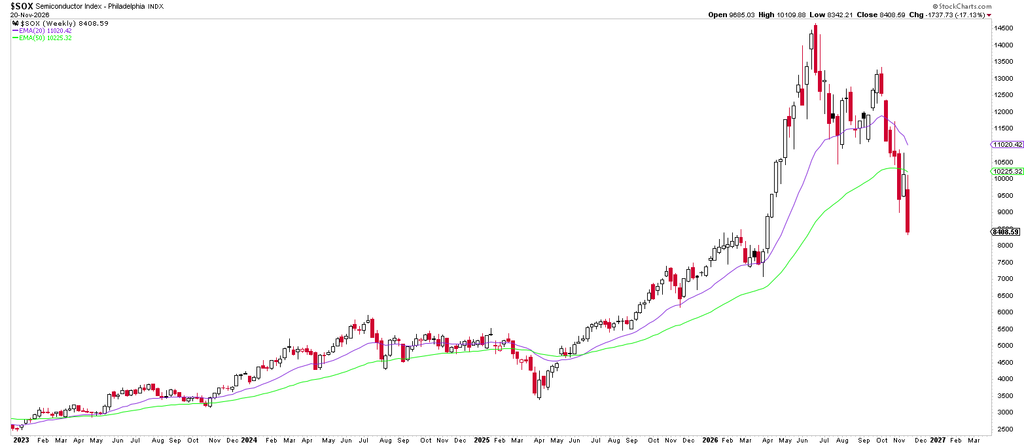
The semiconductor sector was hit particularly hard during the sell-off; the Philadelphia Semiconductor Index lost around 17 percent last week. This was the worst week since September 2001. On Friday alone, it fell by more than 10 percent.
The market breadth also showed real selling pressure on Friday. On the Nasdaq, 928 rising stocks faced almost 4,000 declining ones. At the same time, 826 new 52-week lows were recorded. The VIX rose to the highest closing level since April 2025.
This week’s performance differs significantly from previous tech corrections. This time, not only were some overvalued AI stocks sold; the risk reduction extended to practically the entire technology sector.
Why the AI trade is being sold so brutally
The main reason for the panic selling remains the growing skepticism towards the enormous investments in AI infrastructure. No one seriously disputes that demand for computing power will continue to grow. The question now is rather whether the billions of dollars invested will quickly produce corresponding profits and cash flows.
Nvidia highlights this problem particularly clearly. The company once again delivered strong results in the operating results. Nevertheless, the share price fell by around 23 percent over the course of the week. On Friday, there was a 14 percent drop after it was announced that the US Securities and Exchange Commission (SEC) was investigating possible accounting issues. Although this is not yet concrete evidence of actual misconduct, the news hit a market that was already extremely nervous anyway.
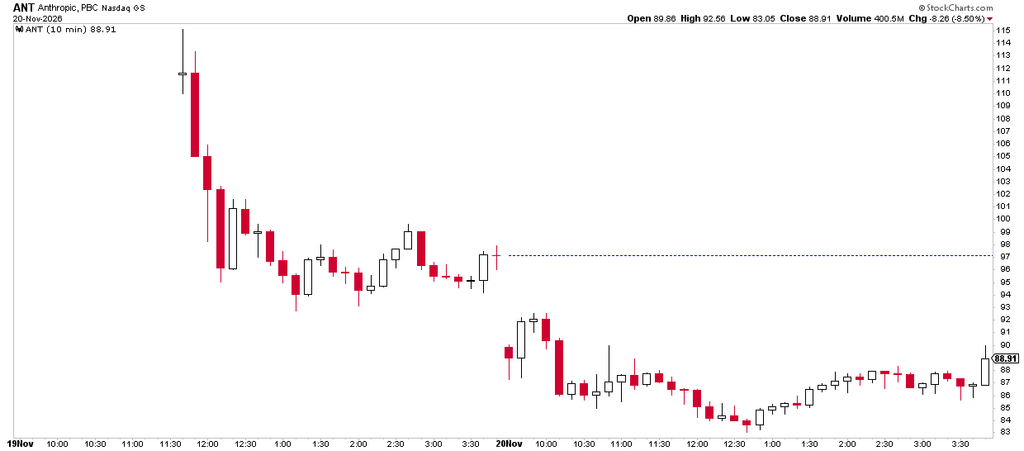
Even the IPO of Anthropic failed to turn the mood around. In fact, one of the largest IPOs in history could have strengthened confidence in the AI boom. Instead, the stock lost significantly again on its second trading day.
To this is added the Fed. After the most persistent inflation data recently, the market now almost completely expects another interest rate hike in December. This means additional headwinds for highly valued growth stocks in particular.
Forward KGV significantly decreased
However, due to the sharply falling prices, the valuation levels have already declined significantly again. The Nasdaq 100 forward KGV currently stands at only around 17-19 (depending on the data provider/calculation). The average over the past ten years was 23.1.
However, a forward P/E ratio of 17 is only favorable if the expected profits are actually achieved. If analysts begin to significantly lower their earnings estimates for Nvidia, AMD, Broadcom, Microsoft, Meta, or other large index members, the seemingly low valuation can quickly become relatively insignificant.
So far, the sell-off has mainly been a correction in valuation. It would be more problematic if it were also accompanied by a profit correction.
Surrender or the risk of a new downward wave?
Charttechnically, the Nasdaq 100 is now in a very interesting price zone. On Friday, the index fell to 24,910 points and closed practically exactly at the psychologically important mark of 25,000 points. At the same time, the 100-week average runs roughly in this range.
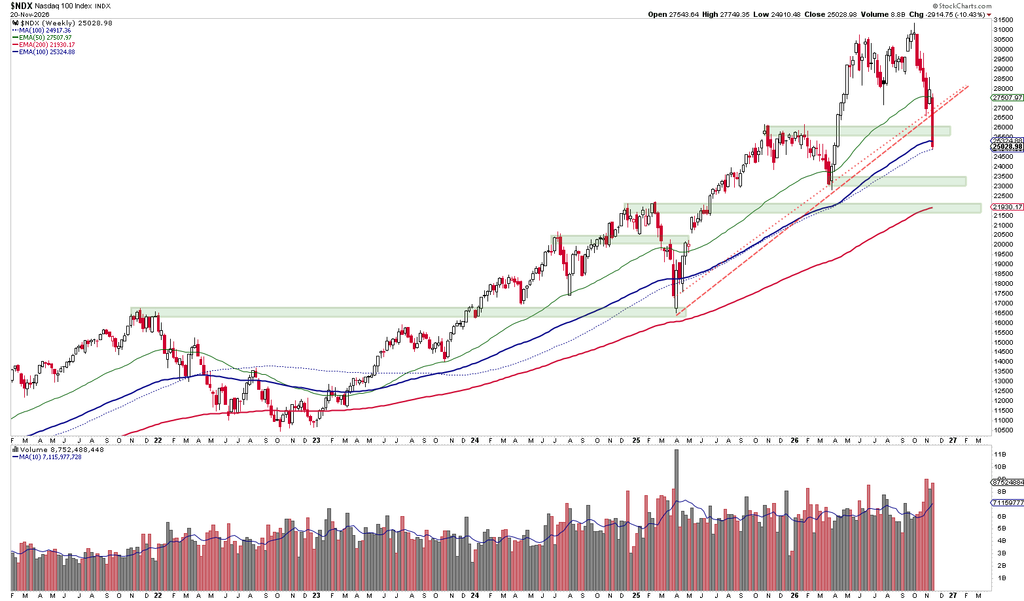
After a week-long loss of more than 10 percent, the short-term conditions are now massively overbought. A sharp counter-movement would therefore hardly be surprising.
The crucial question is first of all whether the Nasdaq 100 can defend the 25,000 point zone. A sustained breach of this level would indicate that even after the extreme sell-off, there is still insufficient buying interest.
However, even more important is the fundamental development. If it turns out in the coming weeks that the hyperscale companies significantly reduce their investment plans or that profit expectations in the semiconductor sector drop significantly, a further downward movement is still possible despite the now more favorable valuation.
Conversely, a stabilization of earnings estimates, combined with somewhat less pressure from the Fed, could be enough to trigger a strong recovery after this sell-off.
PCE, Dell and semiconductor figures in focus
The upcoming Thanksgiving week is shortened, but it still provides some important dates.
On Tuesday, Analog Devices will report before the stock market opens. After the stock market closes, companies such as Dell Technologies, HP, and Workday will follow. In particular, the figures from Dell are likely to be closely watched in light of the business with AI servers.
On Wednesday, several important US economic data will be released simultaneously. Among other things, the PCE inflation data for October and the second estimate of the US GDP for the third quarter will be published. In the evening, the Fed will also release its Beige Book.
On Thursday, US stock markets remain closed due to Thanksgiving; trading ends earlier on Friday.
Author: Tobias Schmid
Date: 23.11.2026