Your Broker for worldwide trading

S&P 500 between fear and TACO opportunity

The candlestick chart of the S&P 500 Index shows a 21-day trading range followed by a sharp decline labeled "1 trading day" - a move that is often driven by fear and offers a potential TACO opportunity. Volume bars are shown below.

Dear traders, dear stock market friends.

After the S&P 500 initially continued to rise in the past trading week and reached new all-time highs, this was followed by a sharp sell-off on Friday. The reason for the slump was a topic that had almost been forgotten: the trade dispute between the USA and China.

130 % Tariffs for Chinese imports?

The latest market turbulence was triggered by an announcement made by President Donald Trump on social media late on Friday afternoon. In his post, Trump announced that the United States would impose an additional 100 percent tariff on Chinese goods from November 1, 2025, on top of existing tariffs. This would raise the total tariffs on Chinese imports to around 130 percent.

Tariffs are a reaction to China's export controls

Trump justified this step with China's "extraordinarily aggressive" trade position, which had been communicated in an "extremely hostile letter to the world". In this letter, China announced that it would impose far-reaching export controls on practically all of its products from November 1, 2025, which Trump said was "absolutely outrageous in international trade" and "a moral disgrace in dealing with other nations".

Rare earths as a geopolitical weapon

However, the background to the renewed escalation in the tariff dispute goes beyond the immediate announcement on Friday. On Thursday, October 9, China's Ministry of Commerce actually announced new export restrictions on rare earths, which were to come into force on December 1, 2025. China controls more than 90 percent of the world's rare earth processing and rare earth magnet production. These materials are essential for many high-tech applications, from smartphones and electric vehicles to wind turbines and military equipment.

The export controls announced by China affect seven medium and heavy rare earths, including samarium, gadolinium, terbium, dysprosium, lutetium, scandium and yttrium.

China is applying the Foreign Direct Product Rule, a mechanism originally developed and used by the US to cut off Chinese technology companies from American semiconductor technology. Under this new Chinese regulation, foreign companies must obtain approval from the Chinese government to export magnets that contain even traces of Chinese rare earths or are manufactured using Chinese technology, even if these products are manufactured outside China. The threshold is a content of only 0.1 percent or more of rare earths of Chinese origin.

Rare earths are crucial for the US military

The strategic importance of these materials is particularly critical to the U.S. defense industry. Rare earths are essential components of many military systems, including F-35 fighter jets, Virginia- and Columbia-class submarines, Tomahawk missiles, radar systems, Predator drones and the Joint Direct Attack Munition series of smart bombs. For example, an F-35 fighter jet contains over 900 pounds of rare earths, while an Arleigh Burke-class destroyer requires about 5,200 pounds and a Virginia-class submarine uses about 9,200 pounds. 

The United States is therefore particularly vulnerable to disruptions in the supply chain of heavy rare earths. A refinery in Vietnam that had served as an alternative source has been closed for over a year due to a tax dispute, effectively giving China a monopoly on supply.

Mutual dependencies

China's use of rare earths as a geopolitical weapon is nothing new. However, the announcement on October 9 went much further and signaled China's willingness to use its dominant position in critical supply chains even more aggressively.

Trump also announced that the United States would impose export controls on all critical software from November 1. 

The reciprocal nature of these restrictions - American semiconductor technology versus Chinese rare earths and critical minerals - is on the one hand a sign of mutual dependencies and vulnerabilities, but on the other hand also fuels the hope that an agreement will be reached in the medium term.

Real danger or TACO trade?

After Trump's latest tariff announcement, the key question is: will the tariffs actually be implemented this time? Or will they be rolled back shortly, as is so often the case? It is precisely this recurring pattern that has led to the term TACO trade („Trump Always Chickens Out“) over the past six months. The pattern was as follows:

  • Trump announces new tariffs.
  • The market reacts in panic and collapses briefly.
  • Trump announces that the measures will be delayed or suspended.
  • The market recovers quickly.

The best-known example was „Liberation Day“ on April 2, 2025: Trump's 10% tariff plan triggered the biggest two-day loss in stock market history. Shortly afterwards, a 90-day tariff freeze was announced and a record rally followed. The losses were recouped within weeks. Trump's renewed threats have therefore been viewed increasingly calmly by investors in recent months and interpreted as a buying opportunity.

However, analysts such as Capital Economics and banks such as JPMorgan or UBS warn against complacency: the markets believed in an endless game in which Trump threatens, prices fall, he retreats and everything starts all over again. However, we must never forget that the situation could be different this time. 

The current conflict concerns China's export controls on rare earths and is a strategically sensitive issue with long-term consequences for national security and technology, which could make a rapid de-escalation more difficult. At the same time, the timetable (the new tariffs are not due to take effect until November 1) still leaves some room for negotiations. The upcoming APEC meeting between Trump and Xi Jinping offers a potential stage for détente.

As a trader or investor, you therefore currently have to weigh up two scenarios:

  • Either another classic TACO trade follows with a later all-clear,
  • or Trump follows through on his threat this time.

Excessive optimism harbors the danger of underestimating a real risk of escalation. Excessive fear, on the other hand, could lead to missed opportunities.

Trump already rows back at the weekend

After writing this analysis, there were already new headlines regarding the trade dispute on Sunday evening. Donald Trump has already rowed back significantly in another social media post, suggesting that the stock markets could stage a recovery on Monday.
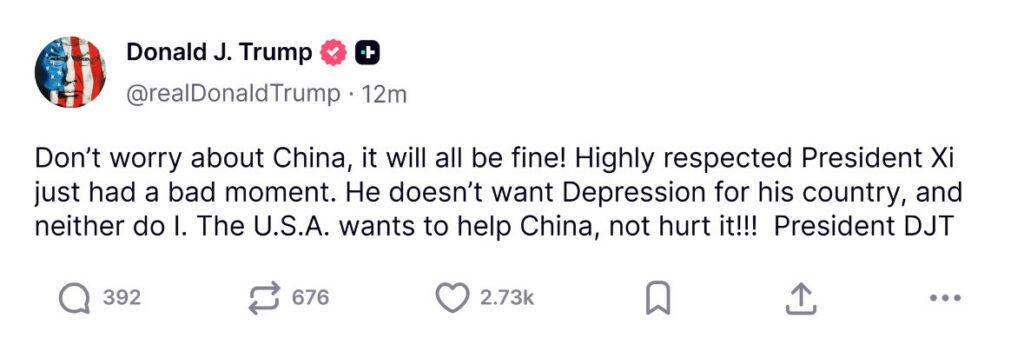
A tweet from Donald J. Trump is about China, President Xi and the S&P 500, stating that the US wants to help China and "everything will be fine" to ease economic fears.

Ongoing shutdown of the US government could be an additional burden

The US government shutdown, which began on October 1, 2025, remains in force at the start of the new week. The cause is a deadlocked political dispute between Republicans and Democrats over government funding and issues surrounding healthcare reforms as part of the „One Big Beautiful Bill Act“. Despite several votes in the Senate, no agreement has yet been reached, meaning that large parts of the administration remain paralyzed.

Historically, the stock markets usually react calmly to short-term shutdowns. In the past, there have rarely been major or sustained price falls, as many core government functions continue and investors often view such events as temporary political maneuvers.

However, the longer the shutdown lasts, the greater the uncertainty: a prolonged shutdown can undermine confidence in the US's ability to act politically, weigh on consumer sentiment and indirectly affect the markets, particularly via second-round effects such as delayed economic reports or falling government spending.

Investors therefore currently still see the standstill as a temporary risk, but the longer the blockade lasts, the greater the risk that it will become a negative factor for the market environment, especially in conjunction with the recent customs and trade conflicts, which are already causing nervousness.

Weakest trading day for the S&P 500 since April

With a drop of 2.7 percent, the S&P 500 experienced its worst trading day since April 10 on Friday. The gains of the previous 21 trading days were neutralized in just one trading day.
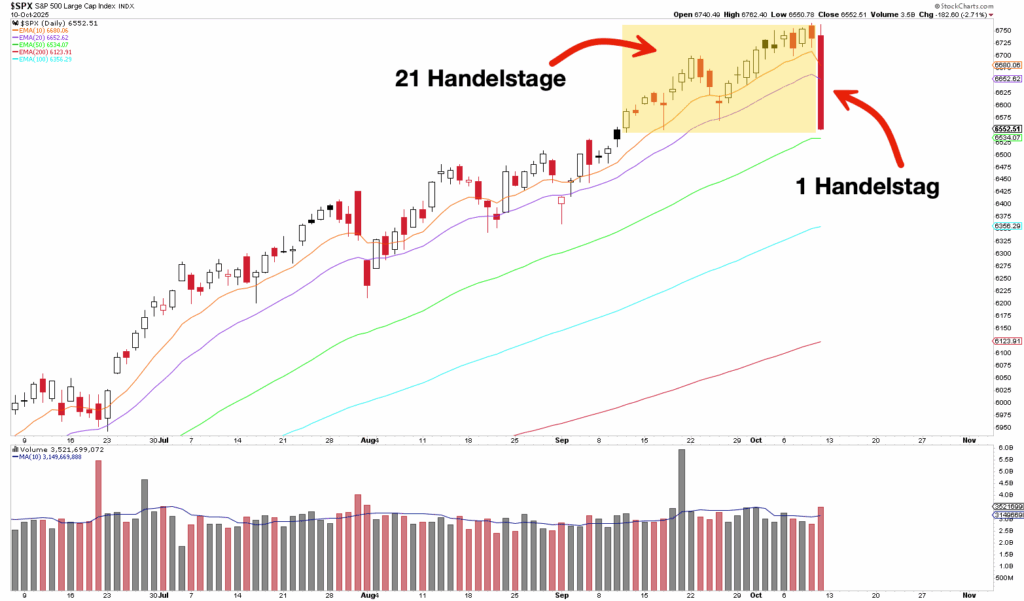
Candlestick chart with 21 trading days of sideways movement followed by a sharp price drop on one trading day; moving averages and volume bars are also displayed in this automatically saved draft.
S&P 500 daily chart

In the short term, the further development of the S&P 500 is likely to depend on the further course of the trade dispute. If there are rapid signals of a de-escalation, we should see an immediate recovery on the stock market. If the situation escalates in the short term, a continuation of the correction would be likely. The next correction target is in the area of the weekly EMA-20 at around 6400 points. Should the correction continue, a very important technical support level would be at 6100 - 6200 points. On the one hand, this is where the last all-time highs and local highs of the current primary uptrend are located; on the other hand, both the weekly EMA-50 and the daily EMA-200 are likely to rise a few more points in the coming days or weeks and reinforce this support area.
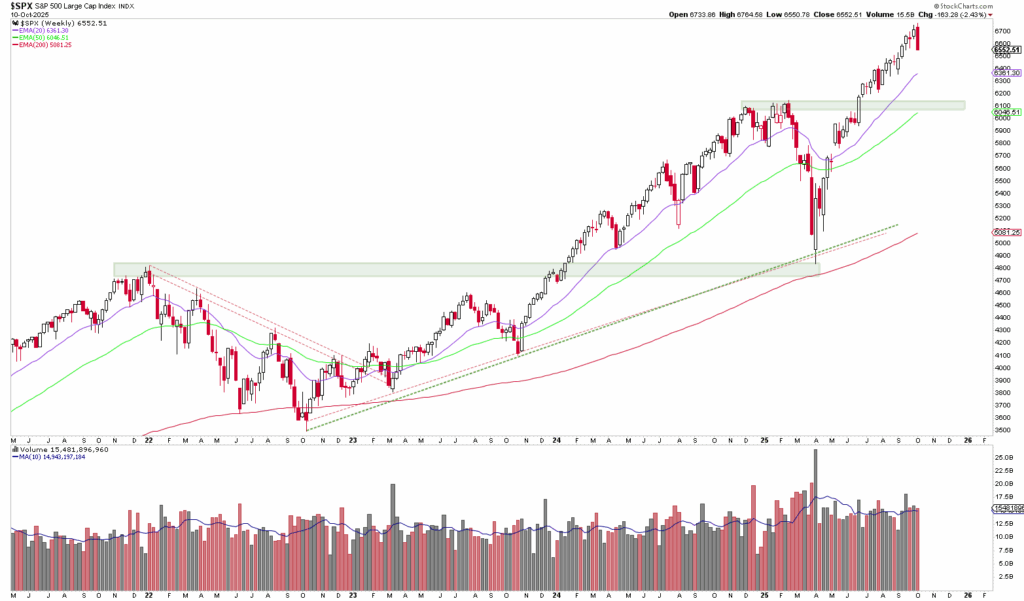
Line chart of the S&P 500 Index from 2021 to mid-2024 with moving averages and volume bars below; an automatically saved draft captures the upward price trend and consolidation phases.
S&P 500 Index weekly chart

VIX rises above 20 points

In line with the slump in the S&P 500, the VIX volatility index rose to 21.66 points at the close on Friday, its highest level since the end of May. 
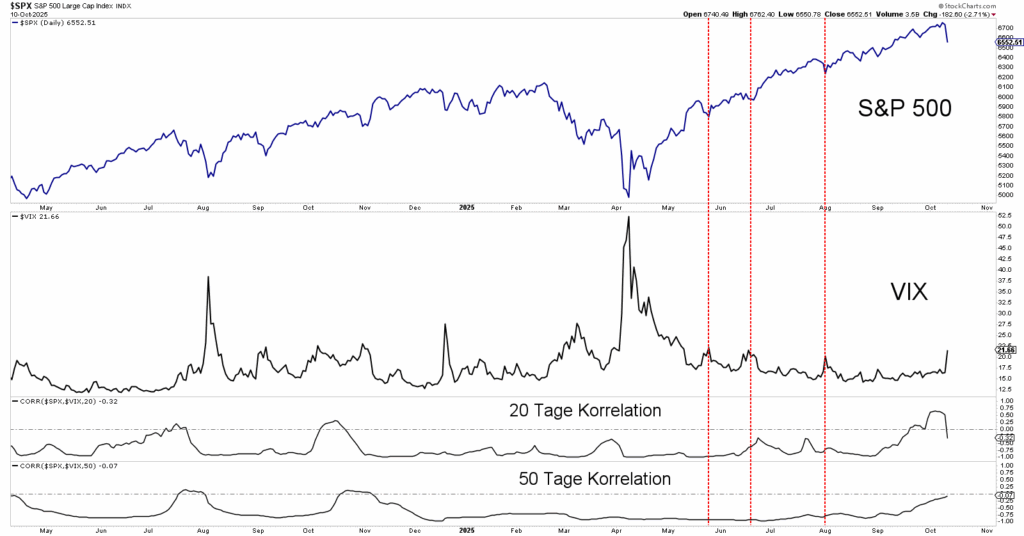
Line chart of the S&P 500 Index, the VIX and the 20- and 50-day correlations over time, with three vertical dashed red lines for specific dates. The labels are in German. This is an automatically saved draft.
S&P 500 and VIX

A rise in the VIX above the 20-point mark has always been a favorable entry point over the past 6 months. In addition, option prices have risen due to the increased volatility level, which opens up new opportunities for short trades. 

Author: Tobias Schmid
Date: 13.10.2025

A man with slicked-back hair and a trimmed beard, wearing a navy blue suit jacket and a white shirt, looks into the camera with a slight smile. Industrial background.
Tobias Schmid

Tobias Schmid has been a trader and analyst since 2008 and specializes in trading futures options and equity options. His strategies and analysis methods are based on a combination of technical analysis, intermarket analysis and sentiment analysis. Tobias Schmid is also the founder of Fomo Financea financial website for active traders, investors and options traders.

Mandatory information and disclaimer

This is a marketing communication within the meaning of Section 63 (6) of the German Securities Trading Act and does not contain investment strategy recommendations, investment recommendations or financial analyses in accordance with Section 85 of the German Securities Trading Act and Article 20 of the Market Abuse Regulation. It therefore does not fulfill the legal requirements to guarantee the objectivity of investment strategy recommendations/investment recommendations/financial analyses. CapTrader GmbH or its employees are therefore not legally prohibited from trading or providing services in the securities products mentioned therein prior to publication of the information.

Past performance, simulations or forecasts are not a reliable indicator of future performance. Mandatory information and limitation of liability for CapTrader and any third-party content providers can be found at https://www.captrader.com/marketingmitteilung/angaben
Please note that investing in financial instruments involves high risks and take note of our disclaimer and the mandatory legal information at the locations indicated.

  1. Mandatory information

Responsible: CapTrader GmbH, Elberfelder Straße 2, 40213 Düsseldorf; Commercial Register Number: HRB 86537 Düsseldorf Local Court; VAT ID DE323771603; Managing Directors Andreas Weiß, Christian Weiß, Michael Heyder; Tel: +49 211-740786-00, Fax: +49 211-740786-90.

Zuständige Aufsichtsbehörde: Bundesanstalt für Finanzdienstleistungsaufsicht, Graurheindorfer Straße 108, D – 53117 Bonn und Marie-Curie-Str. 24-28 D – 60439 Frankfurt am Main, Tel: 0228 4108 – 0 Fax: 0228 4108 1550 E-Mail: poststelle@bafin.de; Institutsnummer 10156708

Conflicts of interest CapTrader in marketing communications: CapTrader GmbH confirms that it does not hold any positions in the mentioned financial instruments beyond the positions mentioned in the marketing communication itself, if applicable. There are also no other conflicts of interest within the meaning of CapTrader GmbH's Financial Analysis and Marketing Communication Policy.

Conflicts of interest and mandatory disclosures by the third-party content provider for marketing communications with financial instrument recommendations: See under https://www.captrader.com/marketingmitteilung/angaben  to creators of third-party content

The copyright to the marketing communication is reserved. Reprinting and distribution is only permitted with our consent.

  1. Disclaimer

By accepting the content, the recipient accepts the binding nature of the limitation of liability.

a) Disclaimer for third-party content

CapTrader GmbH offers authors - such as editors, guest commentators, agencies and companies - the opportunity to publish comments, analyses, news and company announcements. Their opinions do not necessarily reflect the opinions and views of CapTrader GmbH and its employees. CapTrader GmbH assumes neither liability nor guarantee for this content. This applies in particular to incomplete or incorrectly reproduced reports, incorrect price information and editorial errors. Liability claims relating to material or immaterial damage caused by the use or non-use of the published information or by the use of incorrect or incomplete information are fundamentally excluded.

b) Exclusion of liability for CapTrader's own content

CapTrader has taken its own information in this marketing communication from sources believed to be reliable, but has not verified all such information itself. Accordingly, CapTrader makes no warranties or representations as to the accuracy, completeness or correctness of the information or opinions contained herein. Subsequent changes cannot be taken into account. The marketing communication does not constitute an offer or solicitation to buy shares of the issuer and is in no way a substitute for advice appropriate to the investor and the property. We cannot verify whether the information in the marketing communication is in line with your personal investment strategies and objectives. We recommend that you consult an investment advisor for advice that is appropriate to the investor and the property. The marketing communication cannot and should not replace a securities prospectus and/or expert investment advice required for an investment. It can therefore never be the sole basis for an investment decision. By accepting the marketing communication, the recipient accepts the binding nature of the above limitation of liability.

CapTrader provides the information despite careful procurement and provision only without guarantee for the correctness / completeness, timeliness or accuracy and availability of the stock exchange and economic information, prices, rates, indices, general market data, valuations, assessments and other accessible content held and displayed for retrieval. This also applies to third-party content. Historical observations and forecasts are not a reliable indicator of future developments. The facts presented in particular in connection with product information are for illustrative purposes only and do not permit any statements to be made about future profits or losses. Any conditions stated are to be understood as non-binding indications and are dependent on market developments on the day of conclusion.

CapTrader accepts no liability for any direct or indirect damage caused by and/or related to the distribution and/or use of this marketing communication.

The information, opinions and statements correspond to the status at the time of preparation of the marketing communication. They may be outdated due to future developments without the publication being changed.

CapTrader is not obliged to update, amend or supplement the information in this marketing communication if a circumstance mentioned in this publication or a statement, estimate or forecast contained therein changes or becomes inaccurate. The presentation of the performance of financial instruments over previous periods does not provide a reliable indication of their future performance. No guarantee can therefore be given for the future price, value or income of any financial instrument mentioned in this publication.

Despite careful control of the content, we assume no liability for the content of external links. The operators of the linked pages are solely responsible for their content.

Distribution: This publication may only be distributed in accordance with the laws of the respective countries, and persons in possession of this publication should inform themselves about the applicable local regulations. The information contained herein is not intended for natural or legal persons who, due to their place of residence or business, are subject to a foreign legal system that imposes restrictions on the distribution of such information. The contents are therefore exclusively in German. In particular, this publication contains neither an offer nor an invitation to purchase securities to citizens of the USA, Great Britain and Australia.

Taxes: The tax treatment of financial instruments depends on the personal circumstances of the respective investor and may be subject to future changes, which may also have a retroactive effect.

Historical observations and forecasts are not a reliable indicator of future developments. The facts presented in particular in connection with product information are for illustrative purposes only and do not permit any statements to be made about future profits or losses. Any conditions stated are to be understood as non-binding indications and are dependent on market developments on the day of conclusion.

CapTrader accepts no liability for direct or indirect damage caused by and/or in connection with the distribution and/or use.

The information, opinions and statements correspond to the status at the time of preparation of the marketing communication. They may be outdated due to future developments without the publication being changed.

CapTrader is not obliged to update, amend or supplement the information if a circumstance mentioned in this publication or a statement, estimate or forecast contained therein changes or becomes inaccurate. The presentation of the performance of financial instruments over previous periods does not provide a reliable indication of their future performance. No guarantee can therefore be given for the future price, value or income of any financial instrument mentioned in this publication.

Despite careful control of the content, we assume no liability for the content of external links. The operators of the linked pages are solely responsible for their content.

Distribution: This publication may only be distributed in accordance with the laws of the respective countries, and persons in possession of this publication should inform themselves about the applicable local regulations. The information contained herein is not intended for natural or legal persons who, due to their place of residence or business, are subject to a foreign legal system that imposes restrictions on the distribution of such information. The contents are therefore exclusively in German. In particular, this publication contains neither an offer nor an invitation to purchase securities to citizens of the USA, Great Britain and Australia.

Taxes: The tax treatment of financial instruments depends on the personal circumstances of the respective investor and may be subject to future changes, which may also have a retroactive effect.

Email:

info@captrader.com

Send e-mail

Phone:

Hotline (Germany)
0800-8723370

Hotline (International)
00800-08723370

Further contact options