Dear traders, dear stock market friends.
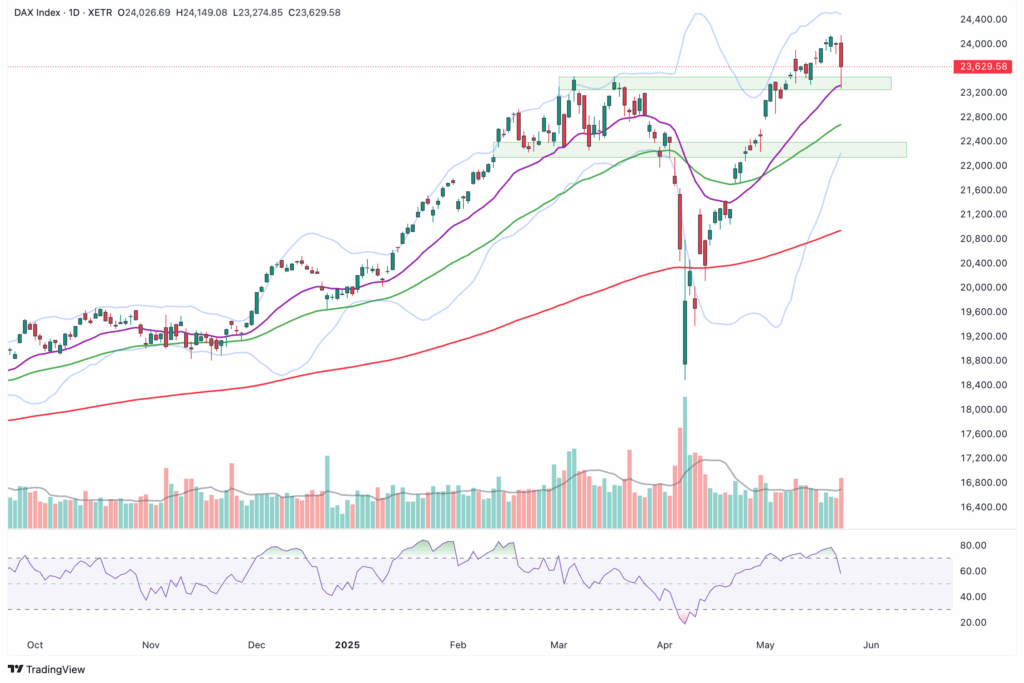
Last Wednesday, May 21, the DAX reached a new all-time high with a closing price of 24,122 points, before taking a breather on Thursday and coming under further downward pressure on Friday after new tariff threats from Donald Trump against the EU were reported.
Fundamental tailwind for DAX continues
The DAX recovered quickly after the slump in April. Since the low of 18,490 points on April 7, the leading German index has risen by 5,632 points or more than 30 % percent. Since the beginning of the year, the DAX is up 21%. There were many reasons for the positive sentiment:
1. prospect of a turnaround in monetary policy
Since the beginning of April, there have been increasing signals that the ECB could cut the key interest rate as early as June. Several Council members - above all Klaas Knot and Fabio Panetta - are openly talking about a "cautious pivot". The combination of falling producer and consumer prices and stagnating core inflation gives the central bank room for maneuver. As soon as the markets sense interest rate fantasy, the valuation comparison clearly favors equities, which has noticeably increased demand for DAX stocks.
2. unexpectedly strong reporting season
In recent weeks, we have seen some strong quarterly results from DAX companies, which have led to positive share price reactions and a buying mood:
- SAP impressed with cloud sales (+27 %) and the strongest increase in operating profit since 2018.
- Siemens reported double-digit order growth and a record order backlog, making investors confident that the industrial group will continue to grow robustly in 2025.
- The trend across Europe is also encouraging: a total of around 60 % of the companies reporting in the STOXX 600 exceeded earnings estimates - and the trend is rising. For the DAX, this means valuation premiums without a simultaneous overstretching of the P/E ratio.
3. brightening economic indicators
At the same time, the macroeconomic environment in the eurozone brightened surprisingly:
- The German ifo Business Climate has risen for five months in a row and is now at an eleven-month high.
- The ZEW index jumped from -14.0 to +25.2 points in May - the largest monthly increase since 2020.
- In April, the Purchasing Managers' Index for the manufacturing industry recorded the strongest increase in output for over three years.
This data dispels fears of recession and confirms the hope that Germany and the eurozone will return to growth mode in the second half of the year.
4. fiscal programs to support the economy
The €500 billion package for infrastructure, digitalization and climate change adopted by the Bundestag provides planning security for construction, industrial and technology assets. At the same time, there are signs that the debt brake will be interpreted more flexibly in future - a further stimulus for the investment climate.
5 "Tariff rush" boosts exports
In the run-up to the threat of US tariffs from June, many American customers ordered German cars, machinery and chemicals ahead of schedule. This pull-forward effect was not only reflected in the positive GDP contribution of exports, but also filled the order books of many cyclical companies.
6. capital flows and relative valuation
With Bund yields around 2.6 %, German government bonds remain well below the 4.5 % for US Treasuries. At the same time, despite record highs, the DAX is still trading at a significant P/E discount to the US megacaps. This makes German blue chips an attractive alternative for international funds - rotations from overweighted US technology stocks into European large caps reinforce the upward trend.
Return of the customs risk
The positive stock market trend until Thursday last week came to an abrupt halt when US President Donald Trump announced new punitive tariffs on Friday lunchtime: 50 % on all EU imports from June 1. The news caused the DAX to plummet by around three percent in less than half an hour and ended a run of six weeks of gains.  
Is the market taking Trump's threats seriously?
It remains to be seen whether Trump will make good on his threat or - as previously with the China tariffs - quickly row back. If you read between the lines, you can assume or at least hope that an agreement can be reached this time too. It seems that the market is also not too worried about the threat of new tariffs, at least for the time being. Trump's announcement did lead to a brief period of downward pressure, but both the US indices and the DAX were already up a few points again over the course of Friday and closing prices were well above the day's lows.
Stress on the bond market
In parallel to the headlines from Washington, a completely different topic is weighing on investors: rising government bond yields. Since Moody's gave the US credit rating a second negative outlook, "government debt fever" has returned. Ten-year Treasuries are once again yielding well over 4.5 %, while German Bunds are stable at over 2.6 %. The combination of higher coupons and lavish budget deficits is forcing investors to reassess the relationship between risk and return. 
Problem child Japan
Another hotspot is Japan: consumer prices are now at % 3.6, while the key interest rate has only been tentatively raised from % 0.25 to % 0.50. The rise in yields on Japanese ten-year bonds from below 1 % to 1.55 % since the fall shows that the era of unlimited cheap money is coming to an end. With government debt amounting to almost 1 % of GDP, even a moderate rise in interest rates could make debt servicing noticeably more expensive - with possible spill-over effects on global funding markets. 
As explained above, the current bull market is not driven by a single story, but by a combination of monetary policy hope, solid corporate profits, economic tailwinds and fiscal pillars of support. However, the trend is also based on the hope that Trump's tariff threats will indeed soon be off the table. If, contrary to expectations, there is a drastic long-term increase in tariffs, sentiment could quickly change again. The risk of a further rise in yields on the bond market is also currently still being given little consideration on the stock market. Should there be further distortions here, this could also weigh on the stock market.
Weekly Outlook
At the start of the week, the Memorial Day holiday in the US will result in lower trading volumes. On Friday, two key inflation indicators - the flash estimate of German May consumer prices and the US PCE deflator - are due. In between, the focus will shift to Conference Board consumer confidence, the minutes of the latest Fed meeting and Nvidia's quarterly figures. In Germany, the Ascension Day holiday is likely to further dampen liquidity, which could potentially lead to greater price fluctuations.
Author Tobias Schmid
Date: 26.05.2025