Your Broker for worldwide trading

Tech Sell-off After New Highs in the Nasdaq 100

Dear traders, dear stock market friends.

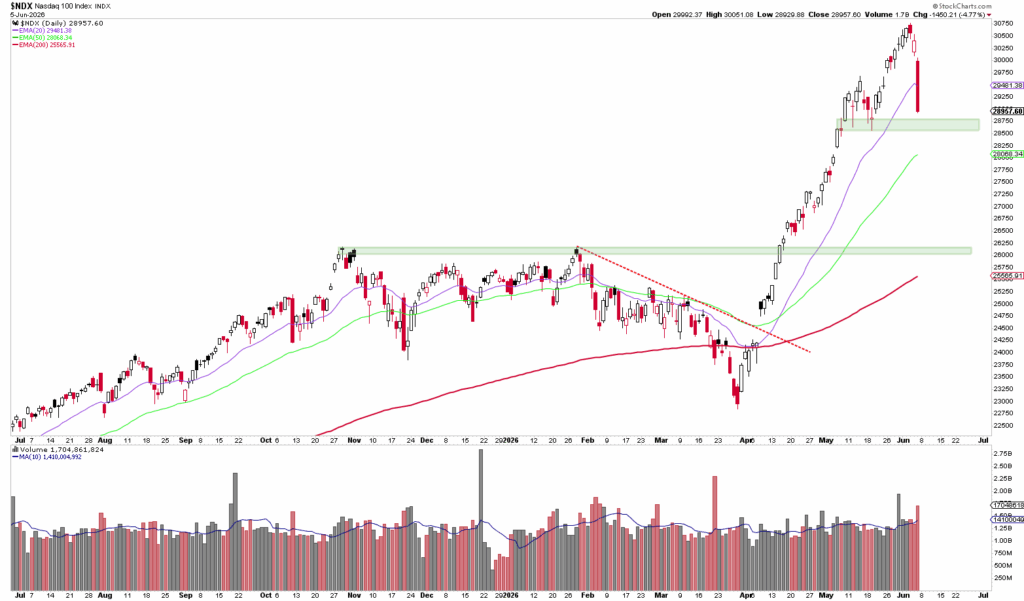
The Nasdaq 100 experienced a full-blown mini-crash on Friday. The tech index plummeted 4.77% in a single trading day, giving back a large portion of the gains it had made in recent weeks.

As strong as this setback appears at first glance, it was not entirely surprising. The Nasdaq 100 had previously undergone an exceptionally strong rally. Many large technology and AI stocks had risen significantly in a short period, sentiment was extremely optimistic, and the market appeared increasingly overheated. After such a move, a single trigger is often enough to initiate profit-taking.

That's exactly what we saw on Friday. The strong US jobs report led to rising interest rate expectations, bond yields rose, and investors primarily reduced positions in highly valued technology and growth stocks. AI and semiconductor stocks, in particular, came under pressure. What was a long overdue correction thus turned into a real sell-off.

Largest daily loss in the Nasdaq 100 since April 2025

The Nasdaq 100 fell 4.77% on Friday, marking its biggest one-day loss since April 2025. On the screen, it looked like a classic mini-crash: many of the previous winners were sold off simultaneously, support levels were broken, and the downward trend accelerated as the day progressed.

However, contextualization is also important. In the weeks prior, the market had experienced a massive rally. The broad US stock market was coming off a nine-week winning streak, with the Nasdaq benefiting particularly strongly from the euphoria surrounding artificial intelligence, semiconductors, and large tech stocks. Many stocks had seen strong short-term gains, some significantly above their moving averages. This is often a sign that the market is becoming susceptible to profit-taking.

The pullback on Friday was therefore less of an isolated event and more of a reaction by an overheated market to a clear negative factor. Investors took profits, particularly in the stocks that had previously risen the most. The trigger for the sell-off was the new US labor market data. 

Strong US jobs data shift interest rate expectations

On Friday, the latest nonfarm payrolls figures for May were released in the U.S. The market had expected around 80,000 new jobs. In fact, however, 172,000 new jobs were created. This means the jobs report was more than twice as strong as forecast. At the same time, the unemployment rate remained stable at 4.3%.

At first glance, a strong job market sounds positive. Companies continue to hire, the economy appears robust, and a recession seems less likely. However, for the stock market, this very strength was the problem on Friday.

Because a very robust labor market gives the US central bank less room for interest rate cuts. If employment and the economy remain stable while inflation remains high, from the markets' perspective, the risk increases that the Fed will have to remain restrictive for longer or even discuss interest rate hikes again.

That very reassessment took place on Friday. According to the FedWatch tool, the probability of another interest rate hike this year rose to over 70% (%). At the same time, hopes for imminent interest rate cuts vanished almost entirely. 
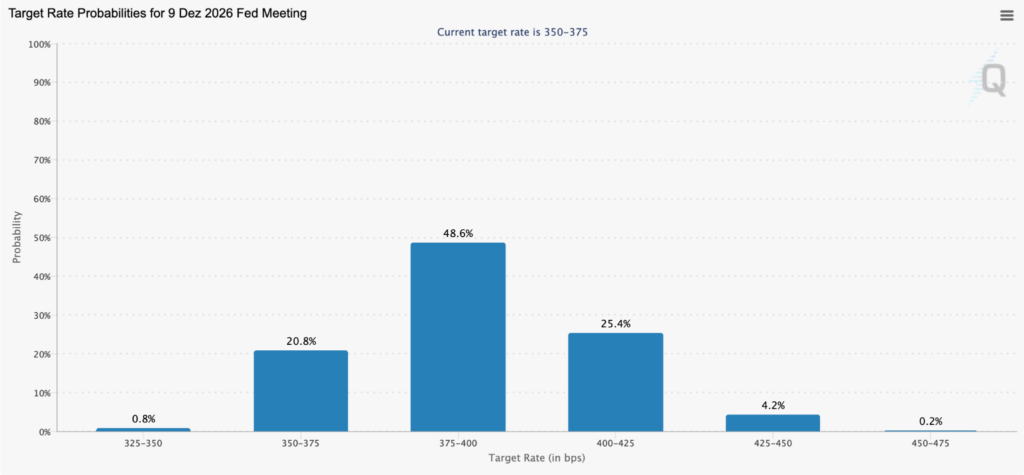
FedWatch Tool: Probabilities for Fed Meeting on December 9

The next Fed meeting on June 16 and 17, 2026, will therefore be particularly exciting. It is the first FOMC meeting under new Fed Chair Kevin Warsh. Markets will be watching very closely to see how Warsh assesses the combination of a strong labor market, persistent inflation, and rising interest rate expectations.

Above all, the press conference following the interest rate decision is likely to be the focus. It will be crucial whether Warsh leaves the door open for later interest rate hikes, whether he emphasizes concerns about persistently high inflation, or whether he attempts to calm the markets with more balanced communication.

Rising bond yields hit growth and AI stocks particularly hard

Rising interest rate expectations also led to rising bond yields on Friday. This is precisely what is particularly problematic for growth and technology stocks.

The reason is relatively simple: many technology and AI companies are valued on the stock market not only by their current profits but primarily by their expected future profits. The further into the future these profits lie, the more sensitive valuations become to changes in interest rates.

When interest rates rise, the discount factor also rises. From today's perspective, future profits are then worth less. This particularly affects those companies whose very high future growth rates are already priced into their stock price. This is precisely why highly valued tech stocks often react disproportionately strongly when yields in the bond market rise.

A second effect is added: When safe government bonds offer higher returns again, risky stocks become relatively less attractive. Investors then demand a higher risk premium. This can lead to particularly expensive stocks being sold, even if little has changed in the long-term growth story initially.

Another point comes into play with AI stocks. Many companies are currently investing heavily in data centers, chips, infrastructure, and artificial intelligence. These investments are capital-intensive. Rising interest rates increase financing costs and make future investment projects less attractive. Therefore, the increase in yields particularly affected the stocks that had previously benefited most from the AI hype.

Important inflation data this week

Following the strong jobs report, inflation will come into even sharper focus in the new trading week. This is because the crucial question now is: Will inflation remain high while the labor market stays strong?

If so, the Fed would have significantly less reason to cut interest rates. On the contrary, hot inflation data could further fuel the discussion about a possible interest rate hike later in the year.

Therefore, several important US data releases are on the agenda next week.

  • On Monday, June 8, the New York Fed's survey of consumer inflation expectations will be released. This data is important because the Fed watches very closely whether higher inflation expectations are becoming entrenched among the public.
  • On Wednesday, June 10th, US consumer prices for May will be released. The Consumer Price Index, or CPI, is one of the most important inflation reports there is. Of particular relevance is not only overall inflation but also core inflation, excluding energy and food. If this turns out to be higher than expected, it could reignite concerns about interest rates.
  • On Thursday, June 11th, the US producer price index will be released. The Producer Price Index, or PPI for short, shows how prices are developing at the producer level. Rising producer prices can later translate into consumer prices and are therefore an important early indicator of inflationary pressure.
  • Also on Thursday, the weekly initial jobless claims will be released. These figures will also be closely watched after the strong jobs report.
  • On Friday, the preliminary University of Michigan consumer sentiment index will also be in focus, particularly its inflation expectations.

For the Nasdaq 100, this means: The coming week could be volatile again. If CPI and PPI turn out hotter than expected, pressure on technology stocks is likely to continue. If, on the other hand, the data comes in more moderately, the market could stabilize after the sharp pullback.

Author: Tobias Schmid
Date: 06/08/2026

A man with slicked-back hair and a trimmed beard, wearing a navy blue suit jacket and a white shirt, looks into the camera with a slight smile. Industrial background.
Tobias Schmid

Tobias Schmid has been a trader and analyst since 2008 and specializes in trading futures options and equity options. His strategies and analysis methods are based on a combination of technical analysis, intermarket analysis and sentiment analysis. Tobias Schmid is also the founder of Fomo Financea financial website for active traders, investors and options traders.

Mandatory information and disclaimer

This is a marketing communication within the meaning of Section 63 (6) of the German Securities Trading Act and does not contain investment strategy recommendations, investment recommendations or financial analyses in accordance with Section 85 of the German Securities Trading Act and Article 20 of the Market Abuse Regulation. It therefore does not fulfill the legal requirements to guarantee the objectivity of investment strategy recommendations/investment recommendations/financial analyses. CapTrader GmbH or its employees are therefore not legally prohibited from trading or providing services in the securities products mentioned therein prior to publication of the information.

Past performance, simulations or forecasts are not a reliable indicator of future performance. Mandatory information and limitation of liability for CapTrader and any third-party content providers can be found at https://www.captrader.com/marketingmitteilung/angaben
Please note that investing in financial instruments involves high risks and take note of our disclaimer and the mandatory legal information at the locations indicated.

  1. Mandatory information

Responsible: CapTrader GmbH, Elberfelder Straße 2, 40213 Düsseldorf; Commercial Register Number: HRB 86537 Düsseldorf Local Court; VAT ID DE323771603; Managing Directors Andreas Weiß, Christian Weiß, Michael Heyder; Tel: +49 211-740786-00, Fax: +49 211-740786-90.

Zuständige Aufsichtsbehörde: Bundesanstalt für Finanzdienstleistungsaufsicht, Graurheindorfer Straße 108, D – 53117 Bonn und Marie-Curie-Str. 24-28 D – 60439 Frankfurt am Main, Tel: 0228 4108 – 0 Fax: 0228 4108 1550 E-Mail: poststelle@bafin.de; Institutsnummer 10156708

Conflicts of interest CapTrader in marketing communications: CapTrader GmbH confirms that it does not hold any positions in the mentioned financial instruments beyond the positions mentioned in the marketing communication itself, if applicable. There are also no other conflicts of interest within the meaning of CapTrader GmbH's Financial Analysis and Marketing Communication Policy.

Conflicts of interest and mandatory disclosures by the third-party content provider for marketing communications with financial instrument recommendations: See under https://www.captrader.com/marketingmitteilung/angaben  to creators of third-party content

The copyright to the marketing communication is reserved. Reprinting and distribution is only permitted with our consent.

  1. Disclaimer

By accepting the content, the recipient accepts the binding nature of the limitation of liability.

a) Disclaimer for third-party content

CapTrader GmbH offers authors - such as editors, guest commentators, agencies and companies - the opportunity to publish comments, analyses, news and company announcements. Their opinions do not necessarily reflect the opinions and views of CapTrader GmbH and its employees. CapTrader GmbH assumes neither liability nor guarantee for this content. This applies in particular to incomplete or incorrectly reproduced reports, incorrect price information and editorial errors. Liability claims relating to material or immaterial damage caused by the use or non-use of the published information or by the use of incorrect or incomplete information are fundamentally excluded.

b) Exclusion of liability for CapTrader's own content

CapTrader has taken its own information in this marketing communication from sources believed to be reliable, but has not verified all such information itself. Accordingly, CapTrader makes no warranties or representations as to the accuracy, completeness or correctness of the information or opinions contained herein. Subsequent changes cannot be taken into account. The marketing communication does not constitute an offer or solicitation to buy shares of the issuer and is in no way a substitute for advice appropriate to the investor and the property. We cannot verify whether the information in the marketing communication is in line with your personal investment strategies and objectives. We recommend that you consult an investment advisor for advice that is appropriate to the investor and the property. The marketing communication cannot and should not replace a securities prospectus and/or expert investment advice required for an investment. It can therefore never be the sole basis for an investment decision. By accepting the marketing communication, the recipient accepts the binding nature of the above limitation of liability.

CapTrader provides the information despite careful procurement and provision only without guarantee for the correctness / completeness, timeliness or accuracy and availability of the stock exchange and economic information, prices, rates, indices, general market data, valuations, assessments and other accessible content held and displayed for retrieval. This also applies to third-party content. Historical observations and forecasts are not a reliable indicator of future developments. The facts presented in particular in connection with product information are for illustrative purposes only and do not permit any statements to be made about future profits or losses. Any conditions stated are to be understood as non-binding indications and are dependent on market developments on the day of conclusion.

CapTrader accepts no liability for any direct or indirect damage caused by and/or related to the distribution and/or use of this marketing communication.

The information, opinions and statements correspond to the status at the time of preparation of the marketing communication. They may be outdated due to future developments without the publication being changed.

CapTrader is not obliged to update, amend or supplement the information in this marketing communication if a circumstance mentioned in this publication or a statement, estimate or forecast contained therein changes or becomes inaccurate. The presentation of the performance of financial instruments over previous periods does not provide a reliable indication of their future performance. No guarantee can therefore be given for the future price, value or income of any financial instrument mentioned in this publication.

Despite careful control of the content, we assume no liability for the content of external links. The operators of the linked pages are solely responsible for their content.

Distribution: This publication may only be distributed in accordance with the laws of the respective countries, and persons in possession of this publication should inform themselves about the applicable local regulations. The information contained herein is not intended for natural or legal persons who, due to their place of residence or business, are subject to a foreign legal system that imposes restrictions on the distribution of such information. The contents are therefore exclusively in German. In particular, this publication contains neither an offer nor an invitation to purchase securities to citizens of the USA, Great Britain and Australia.

Taxes: The tax treatment of financial instruments depends on the personal circumstances of the respective investor and may be subject to future changes, which may also have a retroactive effect.

Historical observations and forecasts are not a reliable indicator of future developments. The facts presented in particular in connection with product information are for illustrative purposes only and do not permit any statements to be made about future profits or losses. Any conditions stated are to be understood as non-binding indications and are dependent on market developments on the day of conclusion.

CapTrader accepts no liability for direct or indirect damage caused by and/or in connection with the distribution and/or use.

The information, opinions and statements correspond to the status at the time of preparation of the marketing communication. They may be outdated due to future developments without the publication being changed.

CapTrader is not obliged to update, amend or supplement the information if a circumstance mentioned in this publication or a statement, estimate or forecast contained therein changes or becomes inaccurate. The presentation of the performance of financial instruments over previous periods does not provide a reliable indication of their future performance. No guarantee can therefore be given for the future price, value or income of any financial instrument mentioned in this publication.

Despite careful control of the content, we assume no liability for the content of external links. The operators of the linked pages are solely responsible for their content.

Distribution: This publication may only be distributed in accordance with the laws of the respective countries, and persons in possession of this publication should inform themselves about the applicable local regulations. The information contained herein is not intended for natural or legal persons who, due to their place of residence or business, are subject to a foreign legal system that imposes restrictions on the distribution of such information. The contents are therefore exclusively in German. In particular, this publication contains neither an offer nor an invitation to purchase securities to citizens of the USA, Great Britain and Australia.

Taxes: The tax treatment of financial instruments depends on the personal circumstances of the respective investor and may be subject to future changes, which may also have a retroactive effect.

Email:

info@captrader.com

Send e-mail

Phone:

Hotline (Germany)
0800-8723370

Hotline (International)
00800-08723370

Further contact options