


Bulls and bears call the shots on the stock market: they stand for the constant ups and downs of the markets. But where do the terms come from, what do they stand for and how can traders use both phases to their advantage? We have the answers!

The most important in a nutshell
- On the stock market, bulls and bears stand for rising (bull) and falling (bear) prices
- Bull markets are ideal for investors and private investors as they enable easy profits
- Bear markets can cause losses if the right protection is lacking
- Traders can use various methods to make profits even in bear phases
What do bulls and bears mean on the stock market?
Stock exchange trading is a world of its own, with unwritten rules and its own Stock market psychology. The market participants have even developed their own language! It contains terms such as “triple Witches' Sabbath" or "Short sale”, which often seem bizarre to outsiders.
One phrase that is frequently used but always causes confusion is the bull and bear on the stock market. The two animals each represent a market direction and the corresponding sentiment of market participants:
- Bull, bull market: Prices are rising, investments are increasing in value and traders and investors are optimistic.
- Bear, bear market: Prices are falling, investments are losing value and market participants are pessimistic
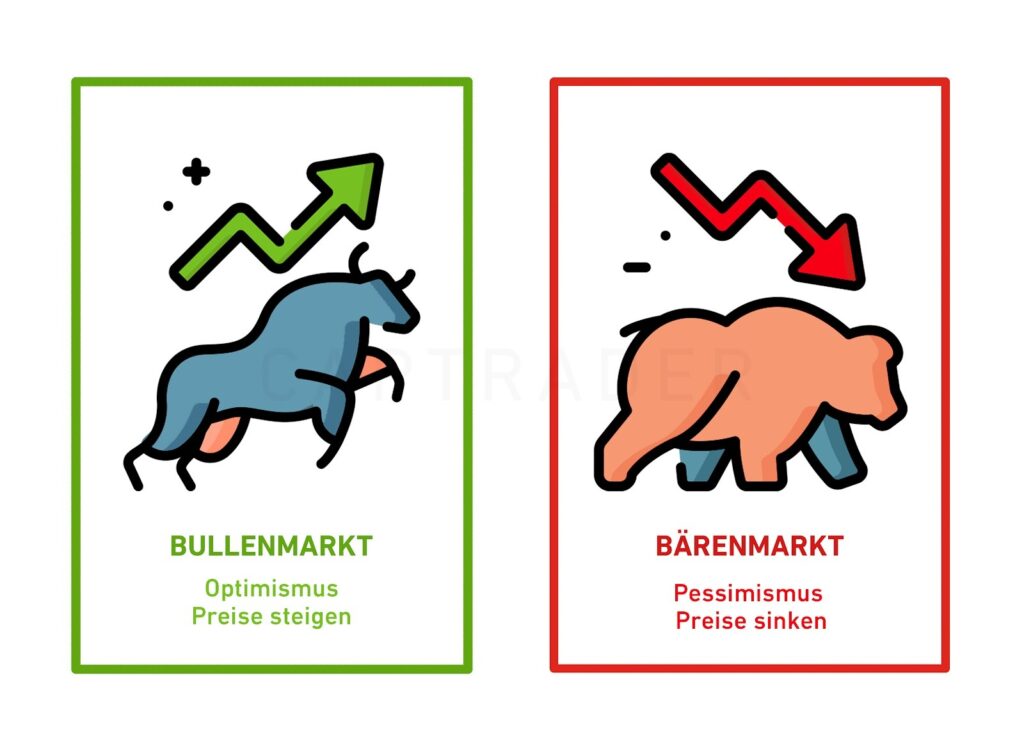
In order not to forget the meaning of bull and bear, there is a simple mnemonic: In nature, the Bull with his horns, divides up its opponents (= the markets) and throws it upwards. The Bear on the other hand, uses its enormous paws and its weight to opponent to the ground.


Origin of bull and bear on the stock market
It is not clear where the terms bull and bear on the stock market come from. Several theories are circulating, but the exact origin will probably never be conclusively clarified.
- According to a popular legend, exhibition fights between bulls and bears took place near the London Stock Exchange in the 17th century. The reading for the markets (bull forks up, bear presses down) could have been derived from this.
- The origin could also go back to the Spanish writer Don Joseph de la Vega. His book “The Confusion of Confusions” from 1688 is considered a standard work of stock market literature. It also mentions the bull and the bear in the context of the stock market
- Another theory traces the terms back to North American trappers. Intermediaries sometimes sold skins (or the rights to skins) before they were delivered. The traders were known as “bearskin jobbers”, from which the short form “bears” developed. Later, the term bear was equated with a downward trend on the market.
However, it is also possible that the dealers were just looking for a catchy name for both trends. The two animals are then an obvious choice due to their respective fighting styles.
Differentiation from other market phases
The two animals are not the only terms used to describe markets, but merely denote two specific market phases. They are thus part of a series of terms:
- Stock market crash: A rapid, sharp fall in prices. It usually lasts only a few trading days. Warning signals, such as a strong overvaluation of shares, usually precede it.
- Flash Crash: This extreme form of crash sometimes only lasts a few minutes. Prices fall very quickly and sharply, but usually recover within a very short time.
- Bear market: The bear stands for a longer downward trend, which can last several months or even years in the event of a recession, for example.
- Neutral market/sideways market: If the stock market does not show a specific direction, this is referred to as a neutral or sideways market.
- Bull market: Analogous to the bear, the bull symbolizes a sustained upward movement that can also last a very long time.
- Rally: Also known as a “run-up”; a short-lived, strong upward movement in the markets. It forms the positive counterpart to the Stock market crash .
Good to know: Short-term developments (crashes, flash crashes, rallies...) can also occur within a longer trend such as bulls and bears. For example, a short-term price increase during a longer downward phase is referred to as a “bear rally”.

The exact distinction between market phases is particularly important for long-term strategies. For example, if you want to Equity portfolio pursues a buy-and-hold strategy or reacts to a current Share trend If you want to jump on the bandwagon, you should pay attention to the mood on the stock markets.
People who pursue short-term strategies and, for example Scalping operate or Earn money with day trading, are less interested in bulls, bears and the like. They focus on very short-term trends, which they can identify through the Chart analysis discover.


Practical significance of bull and bear on the stock market
The terms bull and bear market have long since become part of everyday financial jargon. But the two animals stand for more than just the direction of prices: depending on whether bull or bear prevails on the stock market, a different course of action is required in each case!
Bull markets are considered easy and beginner-friendly, while the bear stands for bad times and losses. But that doesn't have to be the case! We want to take a closer look at both market phases:
Profit from bull markets
Bull markets are much more common than bear markets. This is because stock markets go up in the long term! Profiting from rising prices is very simple, because all you have to do is own an asset (e.g. a share). If the value increases, you then sell the asset for a higher price.
If the bull rules, it is enough to sit back and wait. However, active traders and smart investors can further optimize their success in such markets:
- If prices rise, we can increase our positions and thus increase our profits. The simplest method is to invest additional capital at the start of a bull market and buy more shares, for example.
- If you don't have the money to increase your investment, you can Trade optionsWith the long call, we can profit from rising prices without having to buy the asset in question.
- It is possible to borrow additional capital from a broker and thus open a larger position. This “margin trading” increases profits, but also losses, many times over. It is only possible with professional brokers such as CapTrader.
If you expect the bull market to end soon, it is crucial to exit in good time: you should sell near the peak in order to turn the price increases into real profits. Because only when the money is in cash in your share portfolio have you really been successful!
As always on the stock market, the right forecast is crucial. Those who can accurately predict the beginning and end of bull and bear markets have the chance to make handsome profits. Conversely, losses often occur when market participants are unable to correctly identify the individual phases or when there is a rapid change.
How to survive bear markets
Prices fall and investments in shares and co. lose value. Bear markets are a nightmare scenario for most private investors. However, falling prices do not necessarily mean automatic losses!
We can protect ourselves against negative developments by hedging. This term covers various measures:
- Stop-loss and other order forms ensure an automatic sale if our assets fall below a certain value. This simple method allows us to convert our investment into cash and avoid downturns.
- If you predict a bear market in good time, you can also sell your shares, ETFs etc. manually. Because if you're not invested, you can't lose anything! The capital freed up in this way can then be reinvested at the low point of the markets.
- We can open positions that offset any losses. For example, a long put option can generate high profits if prices fall and thus compensate for them.
- Diversification, i.e. spreading our capital across different assets, can also help. Especially if only individual regions or sectors are affected by a downward trend, a broadly diversified portfolio reduces our risk. However, if the bear has hit the entire economy and all stock market sectors, diversification will no longer help us.
- Crisis-resistant assets also offer protection against bear markets. These include some safe stocks (e.g. from the non-cyclical consumer goods category) or real estate.
Protection is possible with these methods. But traders don't just have to take cover in such phases and wait until the downward trend is over! On the stock markets, we can profit from both bulls and bears:
- With a Short sale we make a profit when prices fall. However, if prices rise instead, there is a risk of a loss. This special form of stock market trading is only available to you with professional brokers such as CapTrader.
- You can also use options to generate income when prices fall. There are several options available to you, from individual long put options to complex strategies.
- Also Futures, Warrants or Certificates are suitable for profiting during a bear market. These products each have their own advantages and disadvantages.
Meaning of bull and bear arises from trader emotion
Many traders attach great importance to bulls and bears - too much, as the Stock market psychology would probably say. The significant effects of these market phases are largely based on the emotional (over)reaction of traders!
Keeping a cool head is therefore the be-all and end-all:
- During a bear market, many traders panic and try to prevent further losses by selling quickly. However, this turns book losses into real losses! If you are not dependent on your capital in the short term, it is therefore better to wait for the markets to recover.
- Those who have already hedged their positions in good time, for example, do not have to worry about a bearish development. Such hedging is therefore ideal for people who tend to react emotionally!
- Even in bull markets, our emotions can be our downfall: Greed quickly sets in and traders take high risks to profit from the apparent “gold rush”. In many cases, this leads to an expensive purchase price, which in turn reduces potential profits. Because every price rally comes to an end!
Traders and investors should therefore consciously take a step back in very emotional phases and look at the bigger picture: Bull markets do not last forever, but in the long term, stock markets always go up.
Both animals should therefore be viewed soberly and objectively. This will help you avoid costly mistakes.
If this “emotional self-control” does not work, more tangible control mechanisms could be a possible remedy: Stop orders, trailing stop-loss orders and similar methods are ideal here.
“Invest and forget” is also a possible solution: through a Share savings plan you can, for example, invest automatically over long periods of time. You don't have to check current prices, keep an eye on bulls and bears or make a Trading app on your cell phone. Your assets grow without you having to worry.


Conclusion: Bull and bear are highly significant for markets
Bull and bear refer to two different market phases on the stock markets. The bull stands for rising markets (the animal picks up its opponents and throws them into the air → uptrend), the bear for falling markets (it pushes down its opponents with its paws → downtrend).
Although the origin of the terms is not entirely clear, their meaning is unambiguous:
- A bull market stands for optimism and gains. Those who own shares and other assets record profits during this phase, even without having to do anything. However, caution is advised if traders become too greedy, as every bull phase comes to an end.
- A bear market, on the other hand, is considered a “bad time” and is associated with pessimistic traders. But that doesn't have to be the case! We can avoid losses through appropriate hedging and diversification. At the same time, we can Short sale or Trade options benefit from falling share prices.
Attentive market participants can therefore make profits with bulls and bears. It is important to correctly recognize the respective phase, its beginning and end and to act appropriately: A cool head is the be-all and end-all for successful financial transactions! Those who succumb to greed or panic, on the other hand, will inevitably generate losses.
Within larger movements, we can also use techniques such as the Chart analysis discover profitable trades.
