


For many investors, crypto stocks offer an exciting way to profit from the development of the blockchain and crypto economy without having to hold cryptocurrencies directly. The industry benefits from strong megatrends such as the tokenization of real-world assets, DeFi applications, digital payment solutions, and the increasing use of blockchain in the traditional financial world.
In this article, we show which crypto stocks could be attractive in 2026. You will also learn which opportunities and risks should be considered when putting together your portfolio.

The most important facts in brief:
- The blockchain sector is being driven by increasing regulatory clarity, the tokenization of real-world assets (real estate, securities), and the expansion of stablecoins for global payments.
- Experts expect the global blockchain market to grow to over $577 billion by 2034, representing an annual growth rate of approximately 36.5 %.
- A distinction is made between pure players (e.g., Coinbase, Riot Platforms) and technology companies with a blockchain division (e.g., NVIDIA, AMD).
What are crypto stocks?
Crypto stocks are much more than just a driver of current Share trends, they are normal stocks of companies whose business is closely linked to the world of cryptocurrencies and blockchain technology.
Anyone who invests in such stocks is not buying Bitcoin or Ethereum directly, but rather stakes in companies that can benefit from the development of these digital markets: for example, through services, technology, or infrastructure.
- Cryptocurrencies are digital currencies that operate without a central authority and are usually stored on a blockchain. Well-known examples are Bitcoin, Ethereum, and Solana. They are used to make payments, hold wealth, or participate in special applications (e.g., DeFi, NFTs).
- Blockchain is a type of digital ledger in which transactions are stored chronologically and securely. You can think of it as a shared, tamper-proof log that is verified by many participants simultaneously and is not controlled by a single entity.
Despite high volatility, the crypto sector remains an interesting building block in a portfolio because it not only involves „pure“ cryptocurrencies, but increasingly incorporates traditional companies such as exchanges, payment providers, banks, or technology corporations. Crypto stocks can, for example, be related to themes like the tokenization of real-world assets or DeFi applications.
- Tokenization of real-world assets This means that real-world assets such as real estate, stocks, or commodities are converted into digital shares („tokens“) on a blockchain. This makes it easier to trade them, divide them, or incorporate them into portfolios.
- DeFi stands for „decentralized finance“ (Decentralized Finance). These are programs and platforms where lending, saving, trading, and other financial transactions take place without traditional banks, but using cryptocurrencies.
Those who hold crypto stocks thus benefit indirectly from the development of these technologies while continuing to invest in regular equities rather than directly in volatile cryptocurrencies.
Structure of the crypto value chain
Crypto stocks can be divided into various segments of the so-called value chain. This is a business term that means: all the steps and industries that work together to create a product or service and bring it to the market.
In the crypto sector, this chain encompasses all the areas necessary for cryptocurrencies to exist, be securely stored, traded, or used. Depending on the segment, companies react differently to market cycles, regulatory decisions, and the general sentiment within the crypto community.
Typical segments are:
- Crypto exchanges and trading platformsThese are companies that operate digital platforms where cryptocurrencies are bought, sold, and managed, similar to a traditional stock exchange, only for digital assets. Examples include major trading platforms where investors and traders place orders and manage wallets.
- Mining companies: Mining is the process of using computer processing power to verify transactions and add new blocks to the blockchain. This requires specialized computers and chips. Mining companies operate large data centers („mining farms") that „mine“ cryptocurrencies.
- Hardware manufacturerThey supply chips or complete mining rigs. Both benefit from high crypto prices and strong network revenue, but suffer during price drops because mining can then become more expensive than the revenue generated.
- Blockchain technology and infrastructure companyCompanies that build blockchains, protocols, and Layer-2 systems, and provide server infrastructure and software to keep crypto networks running stable and fast. They benefit when more projects and applications build on their technology and data traffic increases.
- Financial service providers and payment players: Banks, payment providers, or fintechs that offer crypto wallets, crypto cards, and custody solutions, connecting crypto to the traditional financial system. They win when more and more investors want to use crypto services without fully slipping into the pure crypto world.
- Service providers and consulting firmsSpecialized companies that provide security, audits of smart contracts on blockchains, and compliance consulting for businesses in the crypto sector. They are becoming increasingly important because regulations, security requirements, and technical complexity in the crypto environment are continuously growing.
Some crypto stocks are active in several of these areas. For example, they can simultaneously operate mining data centers, run their own crypto exchanges, and develop blockchain software. As a result, they spread their risk across various sources of revenue and can partially offset individual fluctuations in one business segment through other segments.
Learn more about Bitcoin and how to trade crypto with CapTrader in our report on the subject Bitcoin Halving and trading ETFs like Bitcoin.


The market potential of crypto stocks in 2026
The demand for crypto and blockchain services could increase significantly by 2035 as several megatrends such as digitalization, financial innovation, and efficiency gains complement one another.
Numerous studies show that the use of blockchain technology in areas such as payment transactions, securities settlement, supply chains, and asset management is continuously increasing. Not only among start-ups, but also among banks, platforms, and governments.
At the same time, the crypto sector combines traditional financial services with modern technology: payments can be faster, cheaper, and automated, for example via stablecoins (crypto assets tied to fiat currencies) or DeFi platforms, which enable lending, saving, and exchanging without traditional banks.
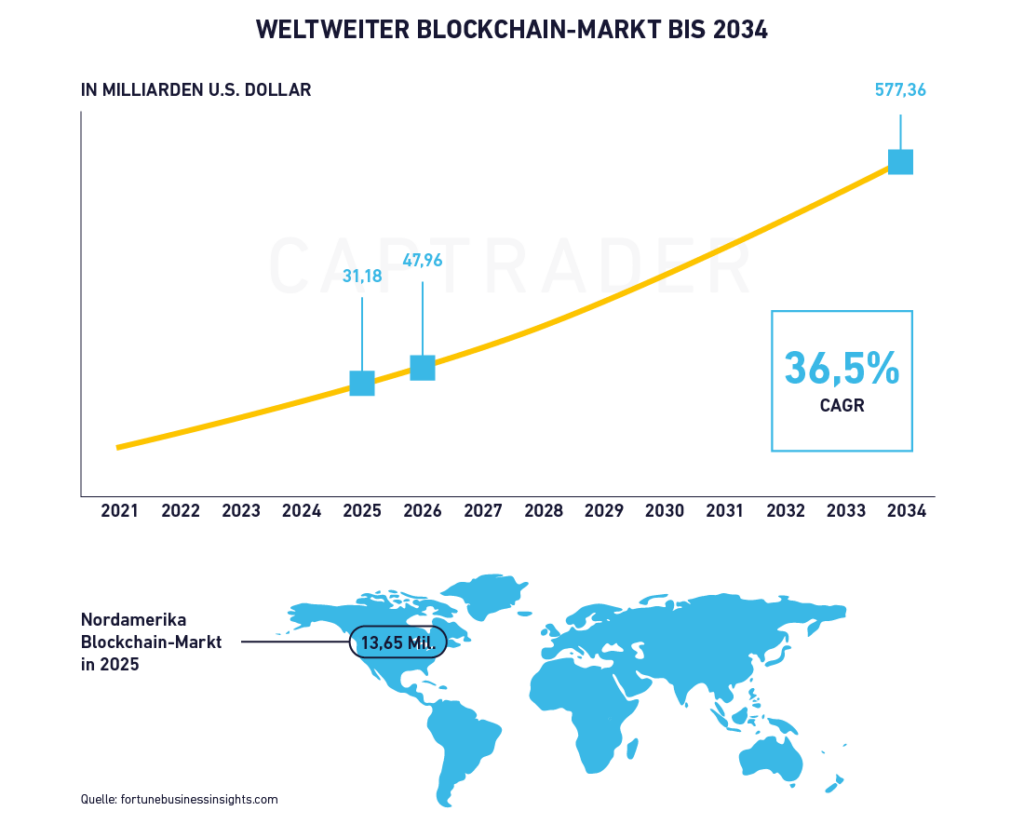
The chart shows that the blockchain market is expected to grow significantly in the coming years. According to the chart, the global market volume will rise from $31.18 billion in 2025 to $47.96 billion in 2026 and is projected to reach as much as $577.36 billion by 2034. The reported annual growth rate of 36.5% underscores that, according to this forecast, blockchain remains a highly dynamic growth market.
Tokenization
Tokenization is expected to gain significant importance by 2035, as a growing number of real-world assets are represented digitally on a blockchain. These include real estate, funds, bonds, and other investments, which thereby become easier to trade, divide, and integrate into portfolios.
Numerous studies view this as an important growth driver for the entire blockchain market. Banks, asset managers, and trading platforms in particular stand to benefit because they can develop new business models around tokenized assets and thereby tap into additional sources of fees and revenue.
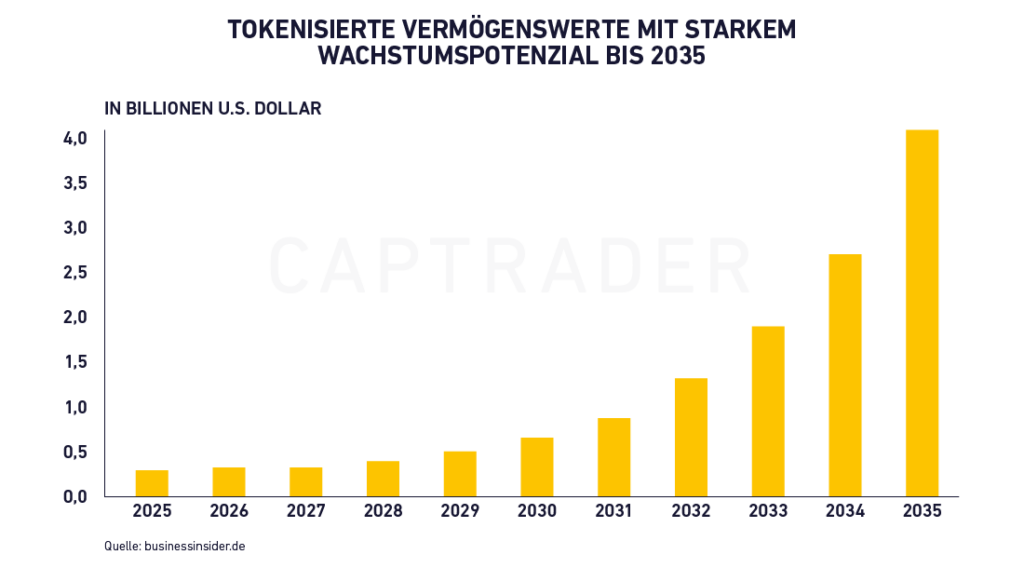
The chart shows a rapidly growing forecast for the global market value of tokenized real estate assets: from around $0.3 trillion US dollars in 2025 to $4.0 trillion US dollars in 2035.
Furthermore, additional Forecasts indicating that the market for tokenized assets is likely to expand significantly in the coming years. Particularly in the areas of real estate and securities, it is expected that tokenization will no longer remain just a niche topic, but will increasingly establish itself as an integral part of modern financial infrastructure.
Stablecoins, payments, and platforms
Stablecoins and blockchain-based payment solutions are also likely to grow strongly by 2035. Stablecoins are digital currencies that are pegged to traditional currencies such as the euro or the US dollar and therefore fluctuate less than Bitcoin or other freely traded cryptocurrencies.
They are increasingly being used for cross-border payments, liquidity management, and automated transactions. At the same time, a growing number of platforms and infrastructure solutions are emerging around these applications to enable fast, affordable, and transparent payment processes. This is an area that can particularly benefit crypto stocks with a focus on financial services.
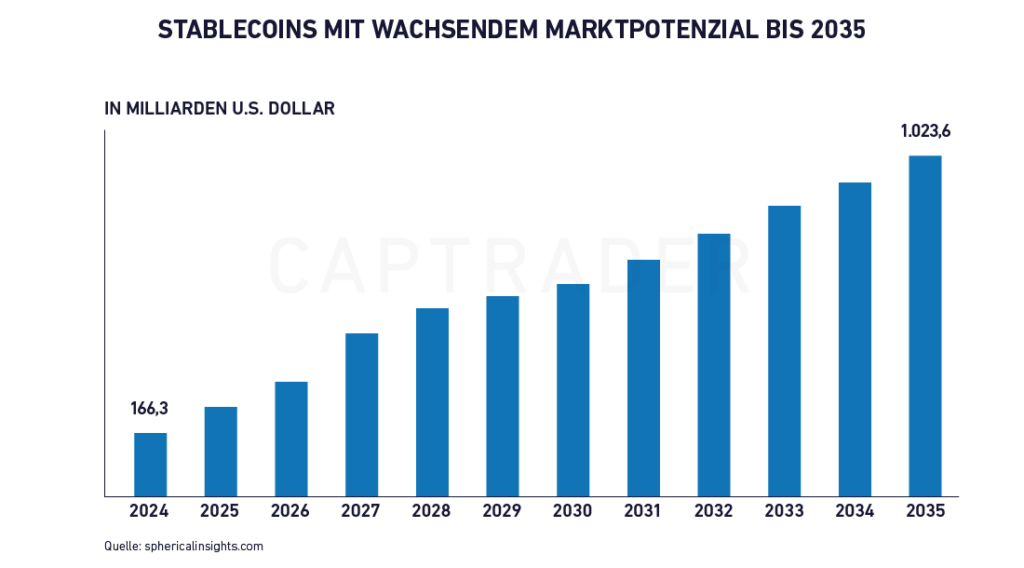
The stablecoin market was estimated at $166.3 billion in 2024 and is projected to grow to $1,023.6 billion by 2035, representing a compound annual growth rate (CAGR) of 17.96 %. Key drivers include rising demand for price-stable digital assets, cross-border payments, growing institutional interest in blockchain-based financial solutions, and the increasing adoption of DeFi.
An overview of the best-known and largest crypto stocks
The following list gives you an overview of a selection of stocks from companies that directly or indirectly profit from the crypto market. The selection is sorted by market capitalization and is based on the status as of April 2026.
| Company | ISIN | Country | Market capitalization in US dollars¹ |
| NVIDIA | US67066G1040 | USA | 4.909 billion |
| AMD | US0079031078 | USA | 448 billion |
| Robinhood | US7707001027 | USA | 82 billion |
| Strategy Inc. | US5949724083 | USA | 59 billion |
| Coinbase Global | US19260Q1076 | USA | 56 billion |
| Block Inc. | US8522341036 | USA | 44 billion |
| Riot Platforms | US7672921050 | USA | 7 billion |
| Galaxy Digital | KYG370921069 | Cayman Islands/United States | 5 billion |
| MARA Holdings | US5657881067 | USA | 4 billion |
| CleanSpark | US18452B2097 | USA | 3 billion |
To be able to trade crypto stocks, you need a brokerage account. Open your account with CapTrader and benefit from access to more than 170 international exchanges. In addition, trading fees are low: For US stocks, you pay 1 cent per share, with a minimum of 2.00 US dollars per order.


1. Coinbase Global (COIN)
Coinbase was founded in 2012 and has become largest crypto exchange in the US and has developed into one of the world's largest trading platforms for digital assets. The company is a direct beneficiary of the broader adoption of cryptocurrencies and the associated trading activity.
- Coinbase offers a wide range of products and services in over 100 countries.
- The annual trading volume is currently 1.2 trillion US dollars (as of April 2026).
- In addition to retail customers, Coinbase also addresses institutional investors with specialized solutions.
| Tax year | estimated revenue (in millions USD)¹ | Change compared to previous year¹ |
| 2025 | 7.181 | 9,4 % |
| 2026 | 6.976 | -2,86 % |
| 2027 | 8.394 | 20,33 % |
The special feature: Coinbase impresses in particular with its high operating margins, which the company generates from its core activities.
This strong profitability is underpinned by a very solid financial position, which affords Coinbase significant room for future investments. Accordingly, the company has Resources for continued growth and to evolve.
Analysts have also significantly upgraded their assessments of the company over the past 12 months, indicating increased confidence in Coinbase's future development.
2. Riot Platforms (RIOT)
The company Riot Platforms was originally founded in 2000 as a biotechnology company. Since 2017, however, it has focused on Bitcoin mining and the blockchain infrastructure, to tap the potential of the growing business area.
- Riot now operates one of the largest mining facilities in the U.S.
- Riot's revenue is heavily dependent on the price of Bitcoin, which leads to high volatility, as the chart below shows.
- At the same time, the business model holds long-term growth potential, making Riot an exciting crypto stock for investors.
| Tax year | estimated revenue (in millions USD)¹ | Change compared to previous year¹ |
| 2025 | 647,4 | 71,89 % |
| 2026 | 605,7 | -6,45 % |
| 2027 | 786,7 | 29,88 % |
The special feature: Riot has evolved from a pure Bitcoin miner into a more broadly positioned digital infrastructure platform further developed. This includes the establishment of large mining sites in the USA (Texas and Kentucky) and the development of proprietary data centers for high computing power.
Riot is one of the few publicly traded larger miners with professional infrastructure, which is why the company in the pure-play blockchain stock segment is particularly relevant for many investors.
3. MARA Holdings (MARA)
MARA Holdings, formerly Marathon Digital Holdings, is a pure-play blockchain company focusing on the Bitcoin mining and the expansion of blockchain infrastructure focused. The company operates large mining locations worldwide.
- MARA holds self-mined Bitcoin over longer periods, making it one of the largest mining companies on the stock exchange.
- MARA regularly expands its mining capacity, thereby increasing the amount of Bitcoin produced.
| Tax year | estimated revenue (in millions USD)¹ | Change compared to previous year¹ |
| 2025 | 907,1 | 38,2 % |
| 2026 | 795,8 | -12,27 % |
| 2027 | 976,7 | 22,73 % |
The special feature: MARA is gradually building up its infrastructure and has recently also taken steps, Making parts of its data centers usable for AI and high-performance computing. With this, the company aims to broaden its position, which offers you as an investor more diversification with this crypto stock.
Advanced Micro Devices (AMD)
Advanced Micro Devices (AMD) was founded in 1969 in Silicon Valley, California, and is a leading semiconductor company that specializes in High-performance processors and graphics solutions specialized.
- AMD has evolved into a strong competitor to Intel and NVIDIA, gaining significant market share in the AI sector in recent years.
- Revenue is broken down geographically as follows: the United States (32.8 %), China (22.4 %), Taiwan (15 %), Singapore (12.4 %), and other regions (17.4 %).
- The increasing demand for computing power for AI models, data centers, and gaming offers long-term growth potential for AMD.
| Tax year | estimated revenue (in millions USD)¹ | Change compared to previous year¹ |
| 2025 | 34.639 | 34,34 % |
| 2026 | 46.723 | 34,88 % |
| 2027 | 68.000 | 45,54 % |
The special feature: AMD stands out in the AI sector with its open approach and strong hardware innovation.
Through its close collaboration with cloud providers, the company is positioning itself as the most important alternative in the rapidly growing AI market. It is a realistic challenger to market leader NVIDIA and thereby positions itself as No. 2 on the market. This catch-up potential should also continue to drive stock prices up in the future.
5. Block Inc.
Formerly operating as Square, Block is a US technology company that focuses on Financial services and digital payments specializes in. It is known for its mobile payment platform Square for merchants as well as Cash App for private customers.
Block is not considered a pure crypto player, but it does offer investors a way to benefit from the blockchain ecosystem.
- Under the leadership of Jack Dorsey, Block developed a strong interest in Bitcoin and blockchain, gradually aligning its business model in that direction.
- The company thus benefits both from the trend toward digital payments and from the increasing use of blockchain-based financial solutions.
| Tax year | estimated revenue (in millions USD)¹ | Change compared to previous year¹ |
| 2025 | 24.194 | 0,3 % |
| 2026 | 26.452 | 9,33 % |
| 2027 | 29.378 | 11,06 % |
The special feature: Block combines digital payments, blockchain, and innovation, thereby creating diverse revenue streams, high diversification, and long-term growth potential for investors.
Due to this special arrangement, Block is a Hybrid of a technology and crypto company, which deserves the interest of investors.
CapTrader can do that:
At CapTrader, the trading fees are extremely low: you can trade US shares from as little as $ 0.01 per share (order minimum $ 2.00) and German shares from as little as 0.1 % of the order volume (order minimum €2.00), options from €2.00, futures from €1.00, ETFs from €2.00 and much more!
Risk factors in crypto stocks
Blockchain stocks offer opportunities, but they are often significantly more volatile than traditional equities. This is mainly because they depend heavily on sentiment in the crypto market, regulatory decisions, and technological developments.
Therefore, anyone investing in this sector should not only look at growth and price potential, but also understand the key risk factors. Especially with crypto stocks, it is important to distinguish between a real business model and mere market hype.
- Crypto stocks often react strongly to the price development of Bitcoin and the overall market.
- Many companies are already highly valued and are pricing in a lot of future growth.
- Regulatory interventions can transform entire business models.
- Technological changes can quickly put existing providers under pressure.
Therefore, one should always view the sector with a clear eye on opportunities and risks. The better the business model and the broader the positioning, the more robust a crypto stock can be.
1. Volatility and Valuation Risks
A key risk of crypto stocks is their high volatility. Many equities rise and fall significantly more than the overall market because investors view them as a direct lever on the crypto sector. While this can be attractive during strong market phases, it often leads to severe declines during weaker phases.
In addition, many crypto stocks are valued with very high expectations. If user growth, trading volume, or revenue fall short of projections, the share price can come under heavy pressure despite solid operational performance.
- Strong price fluctuations even without direct company news.
- High dependence on market sentiment in the crypto sector.
- Valuation risk from inflated future expectations.
- Setbacks are often more severe than with traditional stocks.
Precisely for this reason, investors should not focus solely on short-term price movements. The decisive factor is whether a company remains stable even when the crypto market itself is experiencing a temporary downturn.
2. Business Model and Earnings Situation
Not every crypto stock makes money in the same way. Some companies live off trading fees, others off mining, custody, software, infrastructure, or services related to blockchain and digital assets. These differences make the earnings situation very diverse and, at times, vulnerable to individual market phases.
Business models that rely on just a single source of revenue are particularly risky. Declining trading volumes, weaker crypto prices, or waning interest in certain applications can then quickly impact revenue and profit.
- Some companies depend heavily on trading volume.
- Others make money with mining or computing power.
- Software and infrastructure companies are often more broadly positioned.
- One-sided business models are more sensitive to market fluctuations.
A close look at the revenue sources is therefore important. The better a company has multiple pillars of support, the lower the risk of a slump in a single division usually is.
3. Regulation and Legal Uncertainty
The crypto industry is heavily dependent on political and legal frameworks. New rules on trading, custody, taxation, money laundering, or stablecoins can significantly impact the business models of individual companies.
For investors, this means that a company can be well-positioned operationally and still lose its appeal due to regulatory changes. Providers with international operations are particularly affected because they have to adapt to different regulations.
- New regulations can make products and services more expensive.
- Stricter rules for exchanges and custodians can weigh on margins.
- Stablecoin regulation can transform entire sectors.
- Companies operating globally are affected particularly strongly.
Therefore, the legal situation is a central point in the analysis. Anyone examining blockchain stocks should also always pay attention to how dependent the business model is on political decisions.
4. Technological Change and Competition
The crypto sector is developing very rapidly. New blockchains, different consensus mechanisms, layer-2 solutions, and changing user habits can cause existing business models to lose relevance. That makes the industry exciting, but also risky.
Added to this is intense competition. New providers can quickly gain market share with lower fees, better applications, or higher security, putting even established companies under pressure.
- Technological trends often change very quickly.
- Old business models can rapidly lose relevance.
- Competition is international and often very aggressive.
- Innovation is important, but also expensive and risky.
Anyone looking to invest here should therefore pay attention to whether a company is truly keeping pace technologically. Only those who continuously evolve can survive in this environment in the long term.
Conclusion: Are crypto stocks worth it in 2026?
Crypto stocks can be worthwhile in 2026 and in the future because they have made the leap from mere speculation to essential financial infrastructure, offering investors regulated access to massive growth areas.
This optimism is primarily driven by the ongoing tokenization of real-world assets and the emergence of stablecoins, which, according to forecasts, will drive annual market growth of over 35 % through 2035.
Since institutional acceptance and clear regulatory frameworks are reducing the previously extreme uncertainty, these securities now enable targeted participation in the digital transformation of global payments, provided one accepts the remaining volatility as part of a long-term strategy.
If you are interested in long-term portfolio building, the Core-satellite strategy be an exciting opportunity. Here, established Blue chip stocks with solid Dividendenhistorie the stable core of your portfolio, while growth-oriented themes like selected Blockchain stocks when smaller satellites are added to specifically increase the return potential.
This flexible concept can be applied just as successfully to industries such as Tech stocks, green Energy stocks or Oil stocks apply.
List of sources:
(1) Source: Marketscreener, 04/21/2026
