Wine is not only regarded as a luxury food, but increasingly also as an interesting investment. In times of volatile markets and many uncertainties, investors are looking for alternative ways to protect their capital and increase it in the long term. High-quality wines offer a promising opportunity to diversify your own portfolio and benefit from a growing market at the same time. But what makes wine an attractive investment and what should prospective investors look out for? In this article, Alexander Eichhorn explains why wine is becoming increasingly popular as an investment, which wines are particularly suitable and which strategies are promising when building a wine portfolio.
A comparison of alternative forms of investment
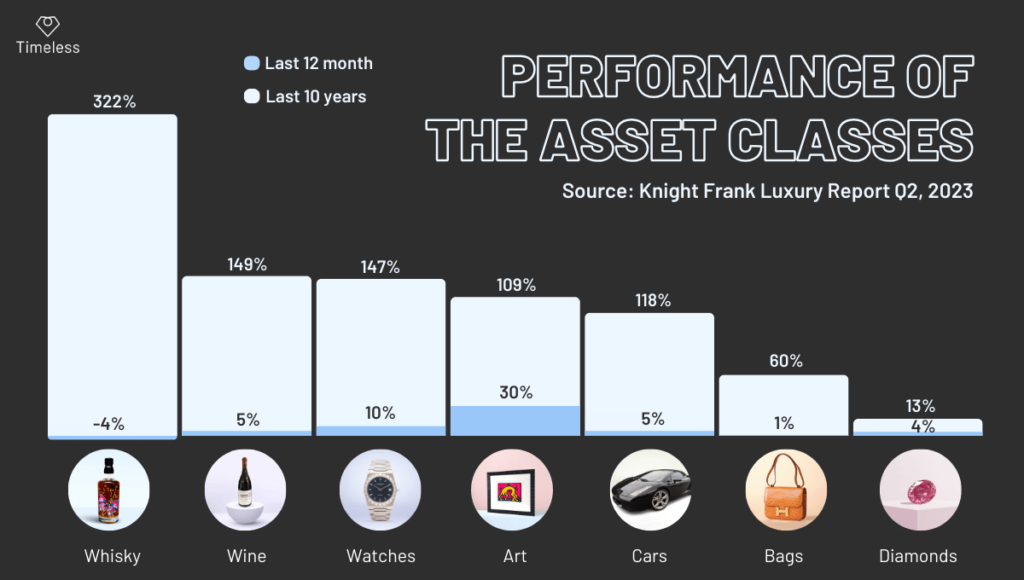
Indices such as the Object of Desire Index from Coutts Private Bank and the Knight Frank Luxury Investment Index (KFLII) show the performance of the most important alternative asset classes and thus enable a comparison with equity or commodity indices. It becomes clear that whisky investments have performed particularly strongly in the last ten years, especially due to the high demand from Asia.
Wine vs. whisky investments
Although the performance of investment whiskies has been significantly higher than that of wine in recent years, wine does offer some advantages as an investment:
- Diversification
Whiskies are often extremely expensive, and valuable bottles can already be in the five-figure range. As a result, a broad diversification into different whiskies is hardly possible in many portfolios.
- High counterfeiting rate
As whisky prices have risen, the number of counterfeits has also increased. Investors should therefore only buy from reputable auction houses.
- Market exaggerations
Whisky prices have risen rapidly in recent years, similar to cryptocurrencies. Whether these price rises are sustainable or just hype remains questionable. Despite the high returns on whisky in recent years, wine also offers attractive investment opportunities and can achieve a comparable performance.


Wine as a low-volatility investment
As an investment, wine is also considered a stable store of value, especially in times of economic crisis, as it has a low correlation to the stock markets. A comparison of the risk-return profiles of the Wine Index with common share indices shows the strengths of wine investments.
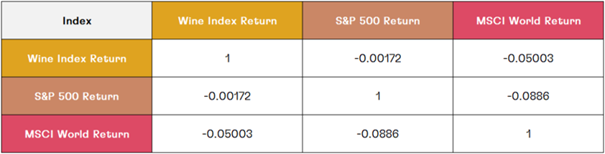
Investors should not view wine as a capital investment in competition with the stock market. Wine investments are characterized by low volatility and a high safety factor. Like other tangible assets with limited availability, wine has an intrinsic value that prevents its value from falling to zero - unlike shares. Even if the expected increase in value fails to materialize, a residual value remains. Wine investments are often among the so-called "passion investments", which offer not only material but also emotional value in the form of enjoyment and pleasure.
Just like works of art, antiques or vintage cars, valuable wines are excellent status symbols and fit in perfectly with a luxurious lifestyle. But wines have a decisive advantage: they are consumed. When valuable bottles are opened, the value of the remaining bottles increases as they become increasingly sought-after due to their rarity and maturity. An increase in value is therefore almost inevitable. Some people store wine for the birth of their child in order to enjoy it later on special occasions such as weddings - provided the wine is of high quality and long-lasting.
With the growing number of super-rich people, particularly in Asia, and their preference for luxurious lifestyles, demand for valuable wines is likely to remain stable in the future, which suggests that prices will continue to rise.
Investing in wine - the returns
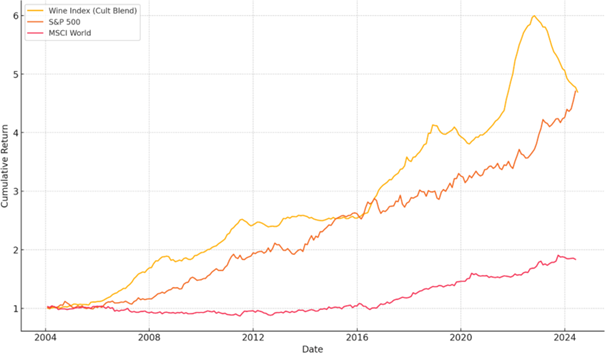
In addition to capital and inflation protection, wine as a capital investment is also a lucrative investment. In recent years, the return on the largest wine index has been comparable to the performance of the major share indices. The great advantage of investing in wine is its crisis protection: during the 2008/09 financial crisis, there was only a drawdown of around 10 % and in the 2020 coronavirus crisis there was a correction of around 4 % in the wine index. The major share indices fell many times over during these crashes.
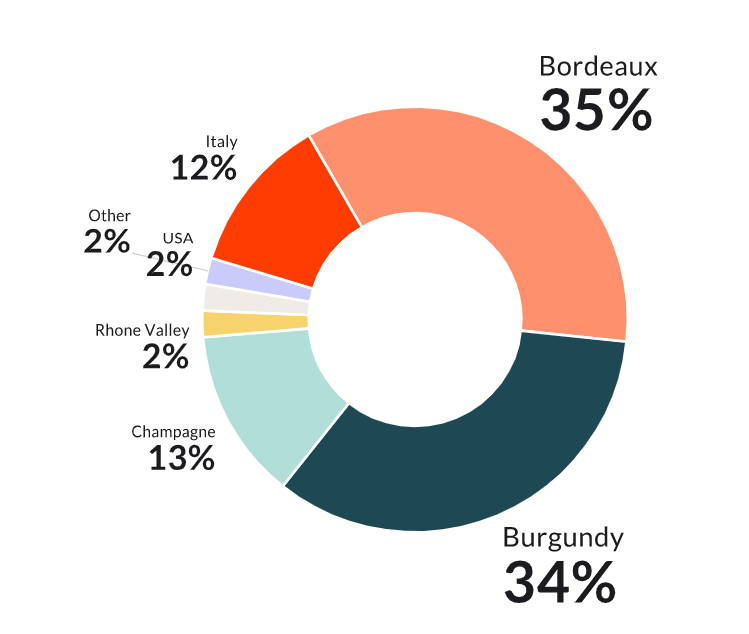
When investors look at the performance of individual wine regions, they realize that all major wine regions have increased in value. In recent years, however, wines from Burgundy and Champagne have particularly stood out.
Recognizing valuable wines - When does a wine become valuable?
Only around 200 wineries worldwide fulfill the criteria for "Investment-Grade Wines" (IGWs). The characteristics that characterize a wine as valuable are:
- Origin from renowned wineries: Wines from well-known and respected wineries are often the best candidates for a capital investment.
- Longevity: A wine should be aged for at least 10 years to be considered valuable.
- Increase in value: The wine should increase in value over a period of 10 years or longer.
- Tradability: The wine must be tradable as an asset.
- Positive reviews: Recognition from renowned wine critics is an important indicator of value and quality.
- Quality assurance: The winery should establish its own standards for quality assurance.
Within established wine-growing regions, producers who adhere to the highest standards through self-imposed restrictions, such as yield limits, in addition to the basic quality criteria stand out. Less densely planted vineyards and old vines with deep roots produce fewer but higher quality wines. Top wineries may refrain from producing if the vintage does not reach the desired standard, which makes it easier to invest, as production cannot simply be increased by increasing the area under vines.


The older, the better?
Older vintages generally offer more security than new ones, as their quality and development have already been assessed. However, prices for older vintages rise more slowly and often reach a plateau when the drinking maturity window closes. Investors should therefore keep an eye on the drinking window to get the most out of their investment.
The suitability of a wine for investment depends on its shelf life. Wines with a long lifespan are more valuable. If a wine is no longer enjoyable to drink in 15 to 20 years, it is not suitable as an investment. Particularly valuable wines from Bordeaux and Burgundy usually reach their drinking maturity after 15 to 20 years. Top dessert wines and champagnes can be stored for 50 to 60 years, while fortified wines such as Madeira, port, sherry or Malaga often remain drinkable for over 200 years.
Wine critics as a benchmark
Despite their controversy, ratings from renowned wine critics are an important indicator for wine investments. Wines with high ratings, for example from Robert Parker, are generally good investment properties. A score of 95 or more from Parker can increase the return on a wine investment by up to 5.5 %. For example, the 2005 Château Latour, which received 100 points from Parker in 2008, is traded for around 1,500 euros, while the 1998 with 90 points is only worth around 500 euros.
Other important wine critics such as James Suckling, Jancis Robinson and especially Michael Broadbent, whose ratings for old and rare wines are particularly valuable, should also be taken into account. Investors should therefore carefully check the ratings of the most important wine critics in order to have the best chance of making a profitable wine investment.
Which wine to invest in?
From this rather comprehensive catalog of qualitative and quantitative criteria, it can be deduced that very few wines are suitable as an investment: Less than 1 % of global production. The Bordeaux and Burgundy regions account for by far the largest proportion of the approximately 200 investment wines, but Egon Müller's Moselle wines from the Auslese level upwards are also included.
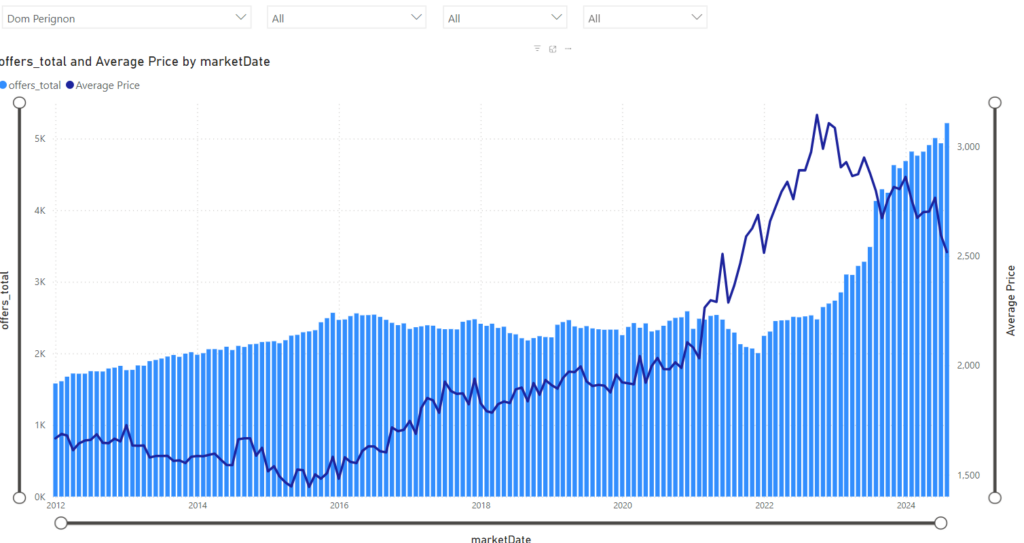
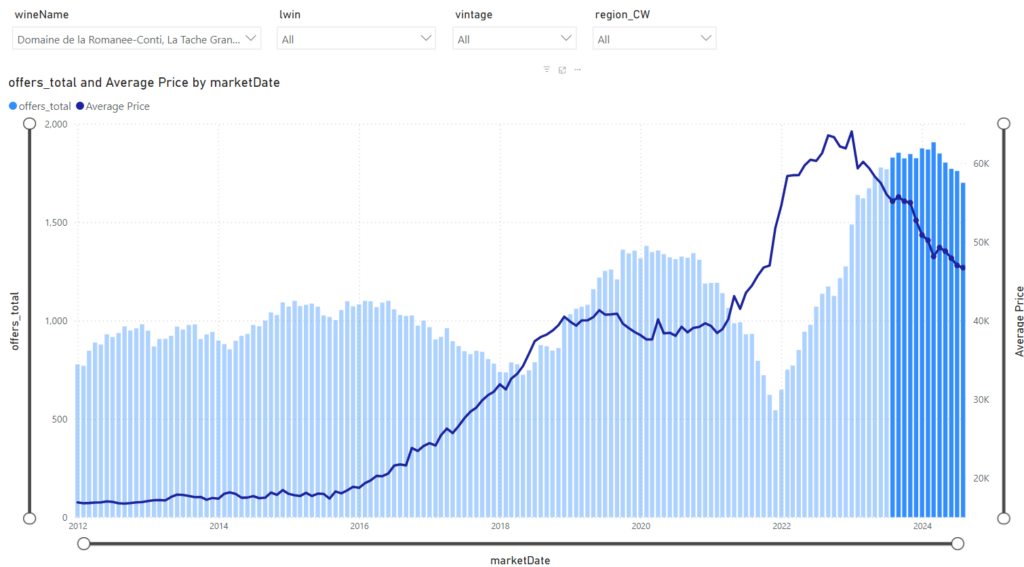
The price development of two well-known investments is shown below:
Dom Perigon (Champagne; all vintages):
Domaine de la Romanee-Conti "La Tache" (Burgundy; all vintages):
Other well-known investments are
Bordeaux region:
- Château Lafite Rothschild (Pauillac)
- Château Margaux (Margaux)
- Château Latour (Pauillac)
- Château Haut-Brion (Pessac-Leognan)
- Château Mouton-Rothschild (Pauillac)
Burgundy region:
- Bonneau du Martray
- Domaine Armand Rousseau
- Domaine Coche-Dury
- Domaine Comte de Vogue
- Domaine de la Romanee-Conti
- Domaine des Comtes Lafon
- Domaine des Lambrays
- Domaine du Comte Liger-Belair
- Domaine Dujac
- Domaine Emmanuel Rouget
- Domaine Fourrier
- Domaine Georges Roumier
- Domaine Henri Jayer
- Domaine Jacques-Frederic Mugnier
- Domaine Leflaive
- Domaine Leroy
- Domaine Meo-Camuzet
- Domaine Rene Engel
- Maison Joseph Drouhin
- Mommessin
- Ponsot
Champagne region:
- Bollinger
- Dom Perignon
- Jug
- Louis Roederer
- Philipponnate
- Pole Roger
- Ruinart
- Salon
- Taittinger
Italy:
- Brunello
- Piedmont
- Super Tuscan
USA:
- Opus One
- Screaming Eagle
- Scarecrow
Egon Müller's winery is the only investment winery in Germany.
Advantages and disadvantages of wine as an investment
Advantages of wine investments:
- Potentially high returns: Rare and high-quality wines can increase considerably in value over time.
- Long-term investment: Wine can be stored over a long period of time and retains its value or even increases in value.
- Combining finance and passion: wine investments offer the opportunity to invest in a product that you can both enjoy and collect.
- Portfolio diversification: wine investments can be used to
- isis minimization by diversifying the portfolio.
- Crisis-proof: Investment wines are particularly stable in times of crisis and offer additional security.
- Tax exemption: Profits can be realized tax-free for private investors after a holding period of one year.
Disadvantages of wine investments:
- High costs: The purchase of rare and high-quality wines is often associated with high costs, with additional expenses for storage and insurance.
- Necessary specialist knowledge: A sound understanding of the wine market, the different wines and optimal storage conditions is essential.
- Not a regular source of income: Wine investments do not offer regular income, but are designed for long-term increases in value.
- Unregulated market: As there are no fixed rules or standards for trading wine as an investment, there is a higher risk.
Our wine investment strategy
CapTrader and Eichhorn Coaching are an official partner of the London Wine Exchange. This partnership offers many advantages for investors:
- Storage in bonded warehouse (VAT & duty free)
- Actual ownership, no fund assets or similar
- Fire & theft insurance
- Daily updated insight into the portfolio
Expert advice and processing by our exclusive partner ensure that a wine investment is a complete success.
Tax advantage for wine as an investment
For some, wine is a capital investment, but for the tax authorities it remains a consumer good. As valuable wines have so far received little attention from the tax authorities, they could possibly be disregarded in future property levies. While paintings and classic cars are difficult to hide, wine as a consumer good remains an asset class that remains relatively inconspicuous.
Another advantage from a tax perspective: profits from wine investments have so far been completely tax-free in Germany. As long as the speculation period of one year is observed, neither capital gains tax nor income tax is payable. However, it is important that trading in wine is not carried out so regularly that the tax authorities could assume that it is a commercial trade.
If you want to invest in wine and realize profits later, it is best to sell the entire collection "en bloc" or within a short period of time so as not to be classified as a commercial trader.
Conclusion on investing in wine
Investing in high-quality wines proves to be extremely profitable and at the same time offers protection for your assets. Wines from the most important vintages of the most renowned wineries have established themselves over decades as a lucrative and secure tangible asset. Anyone investing in wine should pay particular attention to thorough research and buying from trustworthy sources. If you trust the major wine critics, pay attention to proper storage and concentrate on outstanding vintages, you can benefit from a high-yielding tangible asset that protects your wealth.
*This article contains so-called affiliate links. If you buy a product via such a link, we will receive a small commission. There are no additional costs for you. Our recommendations are based exclusively on our own evaluation and research.