


Many investors view water stocks as an attractive opportunity to profit from the growth of the global water market. This sector is gaining momentum in particular due to rising water prices, increasing demand for clean drinking water, water supply costs, infrastructure development, and the market position of the companies.
As an investor, you should know that drinking water stocks are heavily influenced by fluctuations in water resource prices, as well as climatic conditions and operational challenges. In this article, you will learn which water treatment stocks are currently stably positioned and what potentials and risks the sector holds.

The most important facts in brief:
- Water is an indispensable resource; global water demand is expected to rise by about 55 % by 2050, particularly in the industrial, energy, and residential sectors.
- Worldwide, there is a massive backlog in the demand for utility grids, wastewater treatment plants, and smart water technology, requiring billions in investments.
- Water stocks and water treatment stocks combine defensive demand with structural growth and, with good selection, can deliver stable cash flows and dividends
What are water stocks and water utility stocks?
Water stocks and water supply stocks encompass companies along the entire water value chain. These include firms that develop water sources, build and operate water supply infrastructure, treat and distribute drinking water, or provide technologies for water purification and management.
The sector remains relevant in the long term, as it secures the global drinking water supply and benefits from megatrends such as population growth, urbanization, rising demand for clean water, climate change, and limited water resources.
At the same time, water stocks react to factors such as water availability, infrastructure development, energy costs, regulatory developments, and geopolitical tensions surrounding water resources.
Water stocks can be divided into several key areas that react differently to market cycles:
- Water utilities and drinking water suppliersCompanies that treat, distribute, and sell drinking water. They are at the end of the value chain and benefit from stable demand since water is a basic need. At the same time, rising energy prices for water treatment can put pressure on margins, while strong brands and regional unique selling points often enable pricing power.
- Water infrastructure and pipeline manufacturerThese companies produce essential components for water networks such as pipes, pumps, valves, and storage facilities. They are a central lever for infrastructure development in growing cities and emerging markets. Their profits generally rise during phases of high infrastructure investment, as governments and municipalities invest heavily in water networks. However, the business is cyclical and heavily dependent on energy prices and public budgets.
- Water purification technology and filtrationCompanies in this sector develop filtration systems, UV purification, membrane technologies, desalination solutions, and innovative water purification solutions. They benefit from the increasing demand for clean drinking water and industrial water reuse (the reuse of treated wastewater). At the same time, regulatory issues regarding water quality and high research costs play a major role.
- Water technology and irrigation systemsManufacturer of precision irrigation, smart water solutions, automation, and water management systems for industry and agriculture. You benefit from investments in efficiency, automation, and sustainable water use. The business is cyclical, as major infrastructure investments are made during boom periods.
- water extraction companyCompanies that develop their own water sources, extract groundwater, use surface water, and hold water rights. Their results depend directly on water availability, climatic conditions, and market prices for water, and are correspondingly volatile.
- Water resources and infrastructure investorsCompanies that own and lease, or operate themselves, water rights, watersheds, and water infrastructure. They benefit from rising water prices and stable consumption volumes. This sector is often considered a defensive entry point into the water sector.
- water distribution and logistics companyThese companies store, transport, warehouse, and distribute water globally or regionally. They benefit from trading volumes and price fluctuations and are a central component of global and regional water supply chains.
- Water digitalization and IoT platformsThis includes providers of software, data analysis, smart metering, monitoring systems, and other solutions for increasing efficiency in water management. This sector is growing strongly due to trends such as digitalization, automation, and sustainable water use.
- Water project development and source tappingCompanies that are developing new water sources or innovative water projects. They offer high growth potential, but are associated with increased risk because projects require long-term planning and depend on regulatory approvals.
Some water utilities cover multiple stages of the value chain. This allows them to better balance fluctuations in submarkets and ensure stable earnings through diversification across the entire water segment.


The market potential of water stocks and drinking water stocks in 2026
Water is an indispensable resource worldwide for agriculture, industry, energy generation, and private households, and long-term demand continues to grow.
International organizations such as the OECD, UN, and UNESCO expect global water demand to rise significantly by 2050, driven primarily by population growth, urbanization, increasing prosperity, and the associated higher production of food, industry, and energy.
While agriculture remains the largest water consumer, the sectors of manufacturing, households, and power generation are expected to grow significantly, according to the OECD.
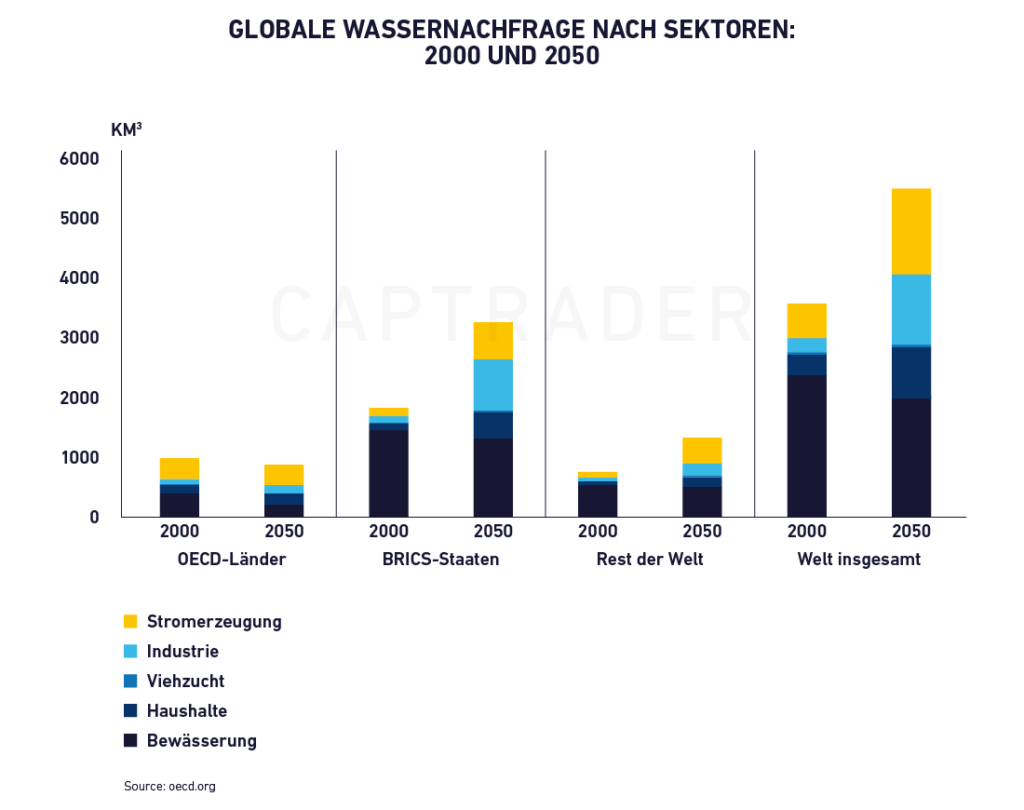
The chart shows water demand for OECD countries, BRICS countries, the rest of the world, and the world as a whole in the years 2000 and 2050, breaking down the bars by sector (irrigation, domestic, livestock, manufacturing, electricity generation).
The world bar chart shows that total water demand in the baseline scenario will roughly double by 2050, and the OECD derives from this the often-cited¹ figure of an increase in global water demand of about 55 %. At the same time, it becomes clear that the share attributable to industry and energy in this growth is increasing particularly sharply.
High investment needs in water infrastructure
For water to reach consumers safely, functioning pipeline networks, sewage treatment plants, and supply infrastructure are needed. There is a strong need to catch up in precisely these areas worldwide.
Many networks are outdated, lose large amounts of water through leaks, and are neither designed for growing cities nor for more frequent extreme events. At the same time, wastewater treatment and network expansion must be accelerated to limit health and environmental risks.
The 2024 UN World Water Development Report emphasizes that this backlog in renovation and expansion can only be resolved through heavy investments in physical infrastructure and modern technology (e.g., monitoring systems, efficient treatment, climate-resilient facilities).
- Outdated utility networks increase losses due to leaks and supply failures.
- New and modernized wastewater treatment plants are needed to safely treat growing volumes of wastewater and new pollutants.
- The expansion of utility networks in rapidly growing cities requires high initial investments in pipes, storage facilities, pumps, and control technology.
- Climate risk (drought, flooding) makes additional protective investments economically viable, because otherwise damages would be significantly higher.
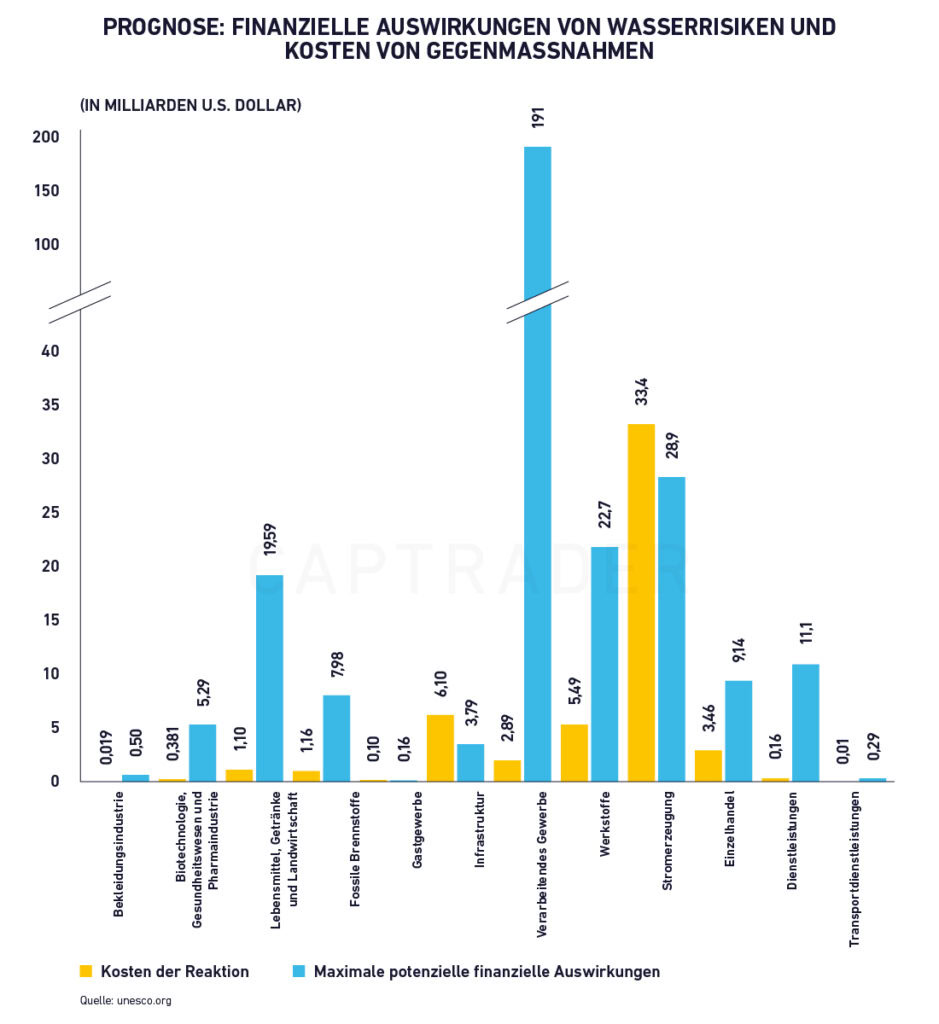
The graphic makes it clear why investments in water infrastructure are worthwhile: for various industries, the costs of countermeasures (turquoise) are compared with the maximum possible financial damages from water risks (yellow).
Water risk-related damages were estimated at around 301 billion US dollars, while the necessary countermeasures would have cost only about 55 billion US dollars.
Thus, the graphic clearly shows that investments in transmission grids, wastewater treatment plants, and supply infrastructure are not only technically necessary, but also economically sensible because they are significantly cheaper than the costs of unmitigated water risks.
Growth in future sectors of the water industry
The market size for smart water management solutions is expected to grow from approximately $23 billion in 2026 to over $40 billion in 2030, representing a compound annual growth rate (CAGR) of 15.3 %.
Globally, this development is being driven by water scarcity, climate risks, stricter regulations, and investments in modern infrastructure that require efficient, digitally controlled systems.
The focus is on future sectors such as water treatment, membrane filtration, and desalination, which enable a secure supply of clean water even in resource-scarce regions.
In addition, digital monitoring and smart measuring systems are gaining importance, such as sensors in pipe networks, smart water meters, and analysis platforms that detect leaks early, monitor water quality in real time, and automate and optimize operations.
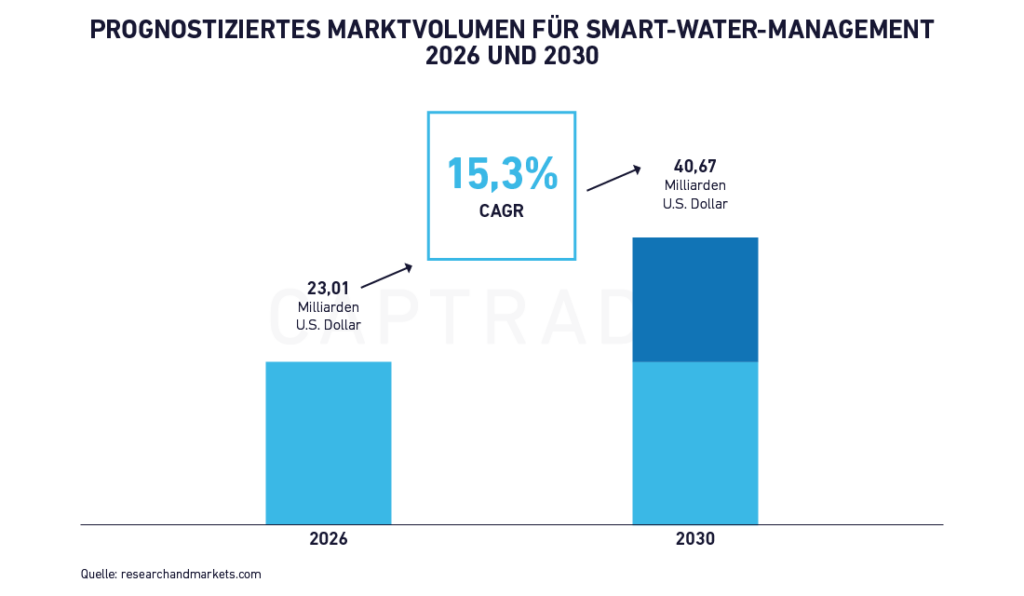
The graphic illustrates this development by comparing the global market volume for 2026 and 2030, thereby making the strong expansion of the market for smart water solutions visible.
Thus, new opportunities are opening up along the entire value chain for specialized providers that combine physical technology with software, data analytics, and services to deliver comprehensive smart water solutions.
Investing in Water: The Best Water Stocks and Drinking Water Stocks
The following overview focuses on some of the world's most significant publicly traded water companies whose core business lies in drinking water supply, wastewater treatment, water infrastructure, and water technology.
They serve as guidance for you as an investor who wants to specifically profit from long-term investments in the global water market.
The selection is based on market capitalization (as of June 2026), making it clearly recognizable which water and water treatment stocks dominate the sector.
| Company | ISIN | Country | Market capitalization in US dollars² |
| Xylem Inc. | US98419M1009 | USA | 27 billion |
| American Water Works Company Inc. | US0304201033 | USA | 24 billion |
| Veralto Corporation | US92338C1036 | USA | 21 billion |
| Sabesp | BRSBSPACNOR5 | Brazil | 18 billion |
| United Utilities Group PLC | GB00B39J2M42 | Great Britain | 13 billion |
| Pentair PLC | IE00BLS09M33 | USA / Ireland | 12 billion |
| Severn Trent PLC | GB00B1FH8J72 | Great Britain | 11 billion |
| Essential Utilities Inc. | US29670G1022 | USA | 10 billion |
| Primo Brands Corporation | US7416231022 | USA | 9 billion |
| American States Water Company | US0298991011 | USA | 3 billion |
If you want to research other interesting stocks, it is worth taking a look at our article about dividendenstarke Aktien.
To trade water stocks or water treatment stocks, you need a brokerage account. With CapTrader, you can open an account and trade stocks directly on more than 170 international exchanges. The trading fees are particularly low: for US stocks, you pay 1 cent per share, with a minimum of $2.00 per order.


1. Xylem Inc.
Xylem (ISIN: US98419M1009) is a blue-chip stock and ranks among the world's leading manufacturers of smart water technology. This company is considered a relevant water stock because its products contribute significantly to the efficient movement, treatment, and analysis of water, as well as to the modernization of global infrastructure.
The company controls production facilities and research centers worldwide with a focus on smart pumps, filter technologies, and digital software solutions for leak detection for global markets.
| Tax year | estimated revenue (in million USD)² | Change compared to previous year² |
| 2025 | 9.035 | 5,52 % |
| 2026 | 9.252 | 2,4 % |
| 2027 | 9.613 | 3,9 % |
Instead of pure hardware delivery, Xylem focuses on digital "smart water" solutions, the integration of software for resource efficiency, and strategic acquisitions for robust cash flows.
2. Veralto Corporation
Veralto (ISIN: US92338C1036) is one of the world's leading specialists in water analytics and disinfection and is considered a relevant water stock because its products play a crucial role in monitoring water quality, complying with environmental regulations, and ensuring safe drinking water.
The company controls renowned brands like Hach and Trojan Technologies with a focus on precision instruments, chemical test reagents, and UV purification systems for global markets.
| Tax year | estimated revenue (in million USD)² | Change compared to previous year² |
| 2025 | 5.503 | 5,97 % |
| 2026 | 5.871 | 6,69 % |
| 2027 | 6.176 | 5,18 % |
Instead of pure one-off sales, Veralto relies on a highly profitable "razor-and-blade model" featuring consumables, strict regulatory standards, and continuous service revenues for robust cash flows.
3. American Water Works Company Inc.
American Water Works (ISIN: US0304201033) is one of the largest publicly traded water utilities in North America and is considered a prominent water stock, as its services make a significant contribution to the safe supply of drinking water and the reliable wastewater management for millions of people.
The company controls regulated utility networks and treatment facilities across numerous US states, with a focus on municipal infrastructure and grid security for regional markets.
| Tax year | estimated revenue (in million USD)² | Change compared to previous year² |
| 2025 | 5.140 | 9,74 % |
| 2026 | 5.409 | 5,23 % |
| 2027 | 5.725 | 5,85 % |
Instead of dynamic growth leaps, American Water Works relies on state-approved price adjustments, continuous modernization of the pipeline network, and crisis-resistant, predictable earnings for robust cash flows. The company has increased its dividend for 18 consecutive years and is well on its way to becoming a Dividend aristocrats.
4. Sabesp (Sanitation Company of the State of São Paulo)
Sabesp (ISIN: BRSBSPACNOR5) is one of the largest water and wastewater utilities in Latin America and is considered a significant water stock, as its projects contribute significantly to the expansion of basic sanitation and the development of new customer bases in emerging markets.
The company controls massive pipeline networks, reservoirs, and sewage treatment plants in Brazil, focusing on the water supply of the state of São Paulo for the South American market.
| Tax year | estimated revenue (in million USD)² | Change compared to previous year² |
| 2025 | 4.320 | -38,55 % |
| 2026 | 4.887 | 13,12 % |
| 2027 | 5.794 | 18,55 % |
Instead of pure state administration, following its privatization Sabesp is increasingly focusing on efficiency gains, reducing water loss, and massive investments in network expansion for robust cash flows.
5. Primo Brands Corporation
Primo Brands (ISIN: US7416231022) is one of the leading providers of drinking water solutions outside the traditional municipal water supply network and is considered a relevant water stock, as its products make a significant contribution to supplying healthy, filtered drinking water to homes and offices.
The company controls a dense distribution network and bottling plants in North America, focusing on bulk containers, water coolers, and premium bottled water for consumer markets.
| Tax year | estimated revenue (in million USD)² | Change compared to previous year² |
| 2025 | 6.664 | -2,15 % |
| 2026 | 6.779 | 1,72 % |
| 2027 | 7.013 | 3,47 % |
Instead of municipal regulation, Primo Brands relies on the lifestyle trend toward healthy hydration, a scalable subscription model for water jugs, and synergies from major mergers for robust cash flows.
Risk factors in water stocks: A practical analysis for investors
Water stocks and water treatment stocks are often considered defensive because water is an indispensable commodity and many business models benefit from stable demand.
Behind this stability, however, lie industry-specific risks that differ significantly from classic industrial or consumer stocks and must not be underestimated during analysis.
1. Regulatory and tariff risks
Water prices, permitted returns, and investment budgets are determined by authorities, municipalities, or independent bodies in many countries. Analyses by S&P Global show that new environmental regulations, stricter quality standards, and limited scope for tariff increases can noticeably pressure the margins and credit ratings of water utilities.
Of particular relevance are:
- Dependency on approval for fee increases in a high-cost environment
- potential cuts to allowable returns in new decision periods
- additional investments due to new quality and environmental standards, such as for pollutants like PFAS
For investors, the specific regulatory framework in which a utility operates is therefore a decisive risk factor, because it determines how well rising costs and Inflation can be absorbed by prices.
2. Climate and Water Availability Risks
Climate change and increasing water stress are among the central risks in the water sector, according to the OECD and other international organizations.
More frequent droughts, altered precipitation patterns, and extreme events such as floods directly impact the availability, quality, and spatial distribution of water resources.
Of particular relevance are:
- prolonged dry spells and falling groundwater levels in already stressed regions
- Floods and storm events that damage pipeline networks, treatment plants, and wastewater treatment facilities
- growing use conflict between households, industry, energy production, and agriculture over limited resources
OECD and World Bank analyses make it clear that these water and climate risks can directly impact the cash flow stability and future capital requirements of water utilities.
3. Capital intensity, investment pressure and financing risks
Water infrastructure is extremely capital-intensive, with long service lives and a permanently high need for maintenance. The OECD, the World Bank, and other institutions speak of a significant investment gap that is made even larger by modernization, climate adaptation, and more demanding quality standards.
Furthermore, one should keep in mind that high investment programs, rising interest rates, and distributions can limit the financial flexibility of many utilities.
Of particular relevance are:
- permanently high investment volumes for the renewal, expansion, and resilience of the grids
- rising debt and interest burden with limited yield potential per invested unit of capital
- Risk of project delays or cutbacks if financing solutions or public support fail to materialize
For you as an investor, the debt-to-equity ratio, cash flow coverage of capital expenditures, access to long-term financing, and the interaction with the respective regulatory requirements are key metrics to realistically assess this risk.
CapTrader can do that:
At CapTrader, the trading fees are extremely low: you can trade US shares from as little as $ 0.01 per share (order minimum $ 2.00) and German shares from as little as 0.1 % of the order volume (order minimum €2.00), options from €2.00, futures from €1.00, ETFs from €2.00 and much more!
Conclusion: Are water stocks worth it in 2026?
Water stocks and drinking water stocks combine defensive basic demand with structural growth, as global water demand, urbanization, and the expansion of water infrastructure are increasing significantly in the long term.
OECD, World Bank, and the UN expect sharply rising water consumption by 2050 as well as investments ranging from billions to trillions in networks, wastewater treatment plants, and smart water technologies.
For investors, solid water companies with stable cash flows, regulated business models, and a clear market position can be a robust core component in their portfolio, combining earnings opportunities with a certain degree of protection against inflation.
At the same time, key risks such as strict regulation, climate and water stress, and high capital intensity must be deliberately managed in stock selection.
Did this overview of water stocks help you? Discover our analyses of other exciting industries, such as medical technology stocks, robotics stocks, solar stocks, steel stocks or Restaurant stocks.
List of sources:
(1) Source: OECD as of June 20, 2026
(2) Source: Marketscreener from 06/20/2026
