


When creating an order, traders can select different types of so-called order validity. These options can help to build up an order as efficiently as possible and reduce potential risks. In this article, you will learn what exactly an order validity is, what types there are and how exactly they work.
What is order validity?
When an order is created, investors can select different information and customize their order and adapt it to their own strategy. This includes the following data, for example:
- Exact designation of the security to be traded (ISIN or security identification number)
- Purchase or sale or
- Name of the stock exchange
- Number of units of the security
Another option is "order validity". The so-called order validity is an addition that is specified when an order is created. This addition defines the period for which an order should be valid. There are various options that are suitable for different investment strategies and can reduce potential risks by limiting them over time.
Day Order
The best-known order validity is the "day order" (selectable in the platforms as DAY). It is important that a day order only active for the current trading day remains. If it is not executed by the end of the trading day, it is automatically deleted.
This setting is the default setting, which often leads to undesired effects and can be avoided:
- If an investor wishes to acquire a share at a lower price and sets a Limitit may be that the probability of execution on the same day is very low
- With such a setting (DAY), the investor must place the expired order again the next day
GTC
An alternative is the setting "GTC", short for "Good to Cancel". If you execute an order with this setting, it will remain active until it is executed based on the desired price. Alternatively, you can cancel the order. Sometimes an unexecuted order can remain for months if the corresponding price has not been reached.
This order is particularly suitable for investors who are waiting for a certain price but do not want to place a new order every day. A GTC is automatically canceled in the event of corporate actions, otherwise it remains valid until the last trading day of the next quarter.
At the Open
The "At the Open" or "OPG order validity" can be executed at the opening price or is not executed at all executed. If the stock exchange opens and the selected security starts at the desired price, the order is executed. If the price is too high, the order is canceled immediately.
This order is particularly suitable for clients whose strategy emphasizes the opening price. Compared to the normal market, the biggest advantage is that Control over the timing the execution and the course.
IOC Order
Further order validities can be found in the TWS. One example is the "IOC Order" or "Immediate-Or-Cancel". Orders are placed here Immediately executedeither completely or only partially.
A concrete example of partial execution is the number of shares. If an investor wants to buy 1000 shares, but only 700 are available, this order is executed immediately. The order for the remaining 300 shares is automatically canceled.
If there is a partial execution, the parts not executed canceled. This is particularly suitable for traders who want immediate execution and do not have time for continuous market monitoring.
The advantages of the IOC order are
- Time saving: The order is executed immediately or deleted automatically
- Reduced riskPartial executions are automatically deleted. There is no risk of remaining orders or parts thereof being executed at unexpected prices or times
- Efficiency: Increased efficiency is possible here, especially with high trading volumes or volatile markets
GTD order
Another option is the "GTD order" or "Good Till Date" order validity. The validity of an order can be selected by the user, whereby a Upper limit applies. As with the GTC-Oder, an order can exist until the last trading day of the next quarter at the latest.
With the GTD order, you can specify that an order should remain active for seconds, minutes or a certain number of hours. It is also possible to specify a combination of time and date. It is also possible to create an order that is only to be activated in the future.
Order validity with CapTrader
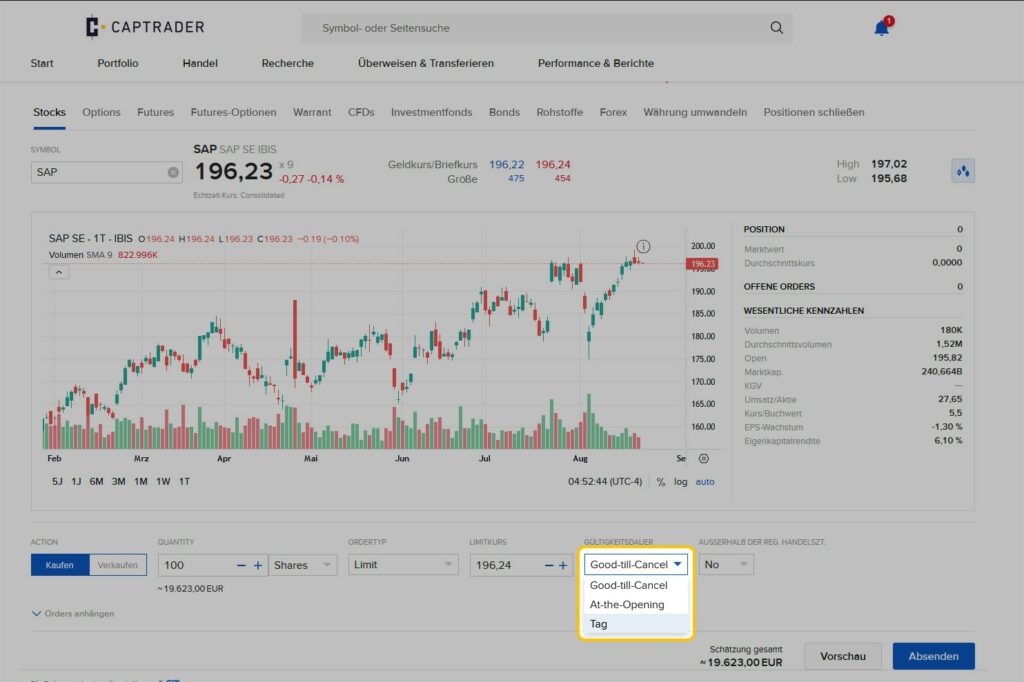
With CapTrader, you can of course use the various order validities in every trading platform (Trader Workstation, Client Portal, Trading App) when placing the order.
Here you can see the order placement in the account management:
Conclusion: More efficient strategies with suitable order validity
In addition to details such as the desired number of units of a security or the desired purchase amount, the so-called order validity can also be selected when creating an order. This addition specifies, Until when an order should remain active.
The option enables investors to protect against certain risks. Cancellation at a desired time can prevent a purchase from being made at an unfavorable and surprising time. There are various options for this.
A Day Order is valid for the current trading day and is either executed until the end or automatically canceled. A GTC remains active until the order is executed at the desired price or the last trading day of the next quarter occurs, when it is automatically canceled.
The OPG order validity focuses on the opening price and is either executed immediately or canceled. IOC Orders are executed immediately. Partial executions may occur, with the remainder being canceled to avoid possible risks.
With a GTD order traders can choose the validity themselves, taking into account an upper limit. You can find more information on this and specific examples of settings at CapTrader in the video below.