


How do Index CFDs?
Stock indices were developed to track the price development of the stock market of a country, region or industry. An index itself is only used for observation and analysis and cannot be traded directly. Similarly, commodity indices are used to track the movements of commodities or commodity futures.
In order to be able to trade an index, a financial product is required that tracks the performance of the underlying index. In addition to exchange-traded forward contracts such as futures and options, CFDs in particular have become established in Germany and Europe.
What are Index CFDs?
CFD stands for Contract For Difference. This is a non-exchange traded financial product that tracks the performance of the underlying asset. This means that with an index CFD you can take both long and short positions and profit from the price movements of the index. To trade an index CFD, you must deposit a security deposit, which covers possible losses.
CFDs vs. the underlying shares
Depending on your trading goals and trading style, CFDs offer you a number of advantages compared to trading stocks, but also certain disadvantages:
Advantages of CFDs
Disadvantages of CFDs
Index CFDs for Trade best price
As of: 12.10.2026
Contract interest is calculated daily for all open CFD positions held at the close of trading.
Starting August 1, 2018 an additional spread of 1% will be added to the rates below for clients classified as retail clients under MIFID.
| CFD Index Country | Symbol | Commission | Minimum | Debit Interest for Long Positions | Credit Interest for Short Positions |
|---|---|---|---|---|---|
| Germany 40 | IBDE40 | 0.01% | from 2.00 Euro | 4.982% | 0% |
| Euro 50 | IBEU50 | 0.02% | from 2.00 Euro | 4.982% | 0% |
| France 40 | IBFR40 | 0.02% | from 2.00 Euro | 4.982% | 0% |
| Spain 35 | IBES35 | 0.02% | from 2.00 Euro | 4.982% | 0% |
| Netherlands 25 | IBNL25 | 0.02% | from 2.00 Euro | 4.982% | 0% |
| US 30 | IBUS30 | 0.01% | from 2.00 USD | 6.38% | 1.38% |
| US 500 | IBUS500 | 0.01% | from 2.00 USD | 6.38% | 1.38% |
| US Tech100 | IBUST100 | 0.02% | from 2.00 USD | 6.38% | 1.38% |
| Australia 200 | IBAU200 | 0.02% | from 2.00 AUD | 7.114% | 2.114% |
| Switzerland 20 | IBCH20 | 0.02% | from 2.00 CHF | 2.5% | -1.706% |
| UK 100 | IBGB100 | 0.01% | from 2.00 GBP | 6.205% | 1.205% |
| Hong Kong 500 | IBHK50 | 0.02% | from 2.00 HKD | 4.599% | 0% |
| Japan 225 | IBJP225 | 0.02% | from 2.00 JPY | 3.604% | -0.396% |
Favorable margin requirements for CFDs
CFDs are global products and are not associated with any particular country or region. The section below explains the margin requirements, but these may be subject to change depending on the regulations of regional regulators.
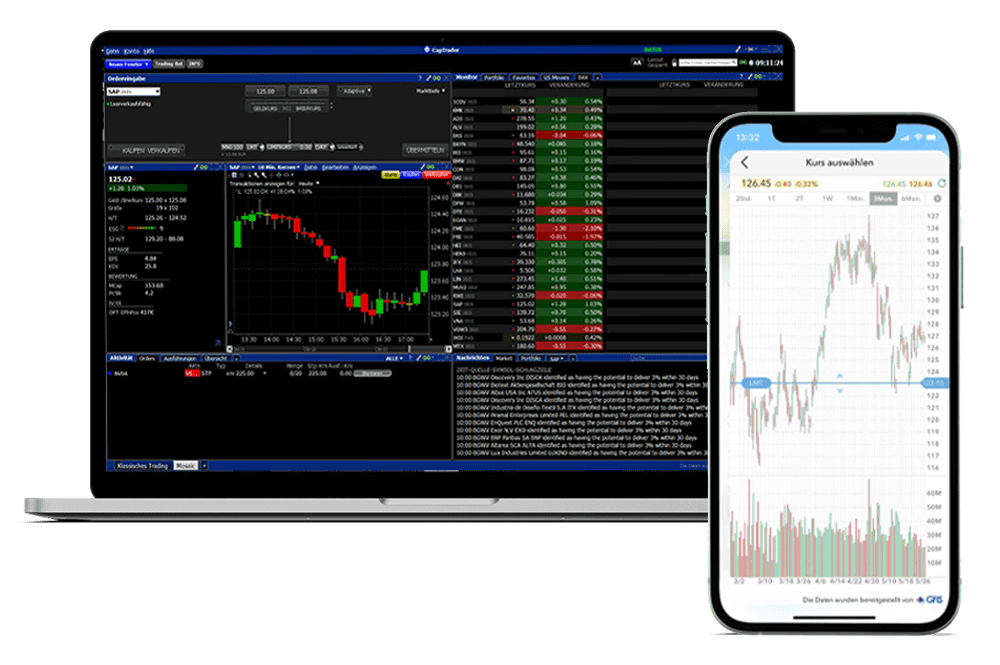
Powerful CFD trading tools
Our trading platforms offer a wide range of functions for CFD trading that meet the needs of different CFD traders. Whether you want to trade directly via the most powerful platform, the Trader Workstation (short: TWS), the FXTrader or flexibly via the CapTrader App, with our trading platforms you trade CFDs at any place and at any time as you want.
Trading platform stable even in turbulent stock market times
Free professional trading tools
Excellent trading app available for iOS & Android
CapTrader - Your CFD broker for traders who want more
Trade CFDs through CapTrader with Direct Market Access (DMA). As an established online broker, we guarantee very low fees, narrow spreads and favorable financing costs for contracts for difference, regardless of whether you want to speculate on rising or falling prices of the underlying.
CFDs (Contracts for Difference) are derivatives and are only suitable for very well-informed investors who are aware that the increased opportunities are also associated with increased risks. A derivative or derivative security is a security whose value or performance depends on the performance of one or more underlying assets. The performance of a CFD on the Apple share, for example, will always depend on the development of the price of the Apple share.

Open a securities account now and use Trade CFDs professionally
CapTrader's Index CFDs give you the opportunity to trade long and short positions for the world's major stock indices and commodities around the world.
CFD trading at favorable and transparent conditions at CapTrader.
Frequently asked questions about the Index CFD trading
For more information, please visit our Help Center
How do Index CFDs work?
A stock index (or any other price index) is basically not tradable. In order to be able to profit from the price movements of an index, you need a tradable financial productwhich tracks the index. For this purpose, various exchange-traded and non-exchange-traded instruments are available to you. A CFD is a contract for difference, where the broker guarantees to compensate you for the price difference between the buying and selling price.
What is the difference between an index and an index CFD?
A price index is only used to observe and analyze a market. An index CFD replicates the index and can be traded. At CapTrader, the price of an index CFD and the price of the underlying index are completely identical at any time. In the Trader Workstation you have the possibility to call up the prices and charts for each index, as well as for all index CFDs.
What is the difference between an index CFD and an index future?
An index future can be traded just like an index CFD. While a CFD is a non-exchange-traded product, futures are exchange-traded forward contracts. Index futures are thus subject to exchange supervision by the relevant regulatory authority. Furthermore, index futures have a limited term and therefore expire at a certain point in time.
Do I have to pay interest daily when trading CFDs?
For open long positions, daily interest will be charged to your securities account. For open short positions, interest is usually credited to your securities account on a daily basis, except in cases where there is a negative contract interest rate. If the contract interest rate is negative, your securities account will be debited with this interest.
What are the margin requirements for an index CFD?
The margin for CFDs consists of the specifications of the broker and the European Securities and Markets Authority (ESMA), whereby the higher requirements are applied in each case. As with other investment products, the margin changes according to the current risk assessment of the broker. Therefore, you will always be shown the current margin requirement before placing your order.
What is a DMA Broker?
Pure CFD brokers usually act as so-called market makers (MM brokers) and thereby determine the trading volume and the prices at which securities are bought (ask price) and sold (bid price) themselves. The disadvantage for the customer is that in practice it is not always transparent how the broker's pricing is carried out. Also, this type of pricing occasionally results in sharp price swings (the so-called spikes), which do not occur on the stock exchange where the underlying security of the CFD is traded.
CapTrader as a DMA broker (DMA=Direct Market Access), on the other hand, allows its clients to trade directly in the order book of the lead exchange. DMA trading with CFDs therefore means that you trade with the same tight spreads that the underlying (the stock, the index, etc.) has on the reference exchange. As a transparent and fair DMA broker, we do not charge markups or artificially widen spreads. This is therefore very advantageous for you as a customer in leveraged trading with contracts for difference, as even the smallest changes in the spread can have a strong impact on possible profits or losses due to the leverage.