


The Long Butterfly is a popular Option strategywhich traders like to use in trendless market phases or in sideways trends. Thus, due to the time value decline of the Options and/or a declining implied volatility profits are generated. The Broken Wing Butterfly is a variation of the Long Butterfly and allows for slightly directional market exposure by increasing risk on one side while decreasing risk on the opposite side. In this article you will learn how exactly a Broken Wing Butterfly works and when its use can be useful.
Definition Broken Wing Butterfly
A Broken Wing Butterfly is a Long Butterfly where the Out Of The Money Option is further away from the sold options than the In The Money Option. Just like the Long Butterfly, the Broken Wing Butterfly consists of four Call options or four Put options. Two options are sold - usually at-the-money or slightly out-of-the-money - and one option above the short strike and one option below the short strike are bought at the same time.
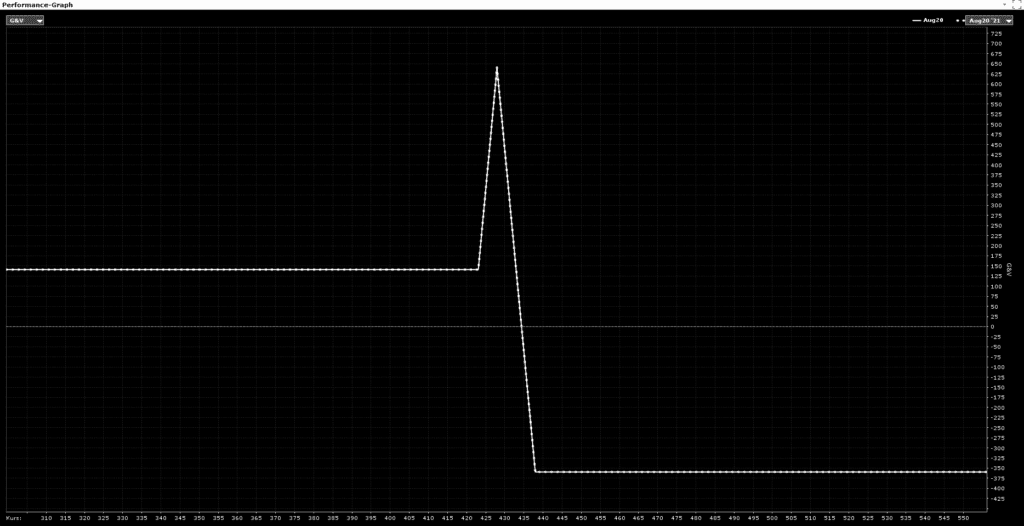
P&L diagram of a Broken Wing Butterfly
Looking at the P&L diagram, it becomes clear where the Broken Wing Butterfly gets its name from. In contrast to a Long Butterfly, where the "wings" are equidistant, in a Broken Wing Butterfly one wing or strike price is further away. This means that there is only a risk of loss on one side.
What to look for when trading a Broken Wing Butterfly
Due to the different spacing of the long strikes, the Broken Wing Butterfly is usually used with a neutral to moderately directional market view. Depending on the market view, you can adjust the spacing of the strikes. As a rule, the Out Of The Money Strike is traded further out of the money.
While a Long Butterfly is a debit spread and you have to pay a premium at the trade opening, the Broken Wing Butterfly can be set up as a debit spread or a credit spread, depending on your choice of strikes.
Maximum loss
The maximum loss occurs when the underlying rises above the strike price of the further out-of-the-money strike price (in the case of a call broken wing butterfly) or falls below the strike price of the further out-of-the-money strike price (in the case of a put broken wing butterfly).
The maximum loss is calculated by first determining the difference in the width of the spreads. Then the collected premium is subtracted, or the paid premium is added (if the trade was set up as a debit spread).
Maximum profit
The maximum possible profit arises if the underlying is quoted at the strike price of the sold options on the expiration date. In a broken wing butterfly with call options, the profit is calculated by subtracting the strike price of the ITM call from the strike price of the short options. Subsequently, the premium received is added or the premium paid is subtracted.
Max. Profit = Short Call - ITM Call + Net Credit
Or rather
Max. Profit = Short Call - ITM Call - Net Debit
If the Broken Wing Butterfly was set up with put options, the maximum profit is:
Max. Profit = ITM Put - Short Put + Net Credit
Or rather
Max. Profit = ITM Put - Short Put - Net Debit
Market assessment
The Broken Wing Butterfly is usually used when one has a neutral or moderately bearish or moderately bullish market view. The price level at which the two short options are located defines the "desired price" on the expiration date. This is where the biggest profit is made.
Compared to a long butterfly, the risk is only on one side. I.e. if you trade a call broken wing butterfly, the underlying can also fall below the strike price of the long call. If a premium was taken when the trade was opened, the trade will even end with a small profit. In the case of a put broken wing butterfly, the risk is only on the downside.