


Options are enjoying increasing popularity in German-speaking countries and are suitable as a financial instrument for the active private trader as well as for the long-term oriented investor. CapTrader offers you access to the world's most important futures and options exchanges, as well as attractive conditions for trading options. In this article you will learn, What options are and how they can be used.
What are options?
Options are futures contracts, or more precisely conditional forward contracts. This means that only one counterparty has a duty to perform, while the other has a right to choose.
There are purchase options - so-called. Call options (calls for short) - as well as put options - so-called Put options (puts for short).
Rights and obligations when trading options
As Option buyer you get the Lawto buy (in the case of a call option) or sell (in the case of a put option) a specific underlying asset (e.g. share, future, ETF) at a specific time (or by a specific time) at a previously agreed price. This is expressly a right and not an obligation. You pay a price for this right of choice: the so-called Option premium.
As the seller of an option, you receive from the option buyer the Option premium. In return, you are obliged to deliver the underlying to him (in the case of a call option) or to buy it from him (in the case of a put option), provided that the option buyer "redeems his option" (exercise of the option).
Options are standardized forward contracts
In general, therefore, an option is a right to buy or sell a certain thing at a later date at an agreed price.
While it is not uncommon in business to negotiate the contract details of an option individually, standardized option contracts are traded in the financial markets. That is, the Contract details are not negotiable, but are clearly determined by the stock exchange.
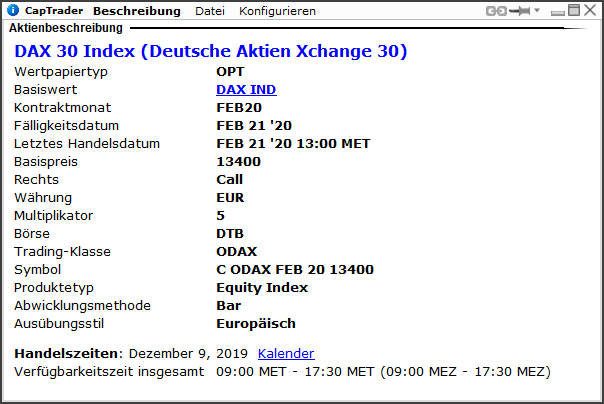
Contract details of an option
Contract details of an option include:
- The type of option/right (call or put)
- The underlying (the underlying)
- The strike price (also called exercise price or strike) of the option
- The quantity (e.g. 1 future, 100 shares, etc.)
- The expiration date of the option
- The last trading date
- The settlement method (cash or physical)
- The exercise method (European or American)
On which underlyings are options tradable?
Options are tradable on the following underlyings:
- Stocks
- Futures
- ETFs
- Indexes
The trade takes place thereby over Regulated futures or options exchanges. The most important futures and options exchanges include.
- CME (Chicago)
- CBOT (Chicago, part of the CME Group)
- NYMEX (New York City, part of the CME Group)
- COMEX (New York City, part of the CME Group)
- CBOE (Chicago)
- EUREX (near Frankfurt)
The difference between options, warrants and futures
Options, warrants and futures have some similarities, which is why they are often mentioned in the same sentence and sometimes confused by laymen.
Options and futures are exchange-traded futures contracts. This means that trading takes place on a regulated futures exchange and is subject to certain supervisory regulations. This ensures fair and transparent trading. The difference between options and futures is that options are conditional forward contracts, whereas futures are unconditional forward contracts. The counterparties to a futures contract are mutually obligated. When trading options, the option buyer has a Right to vote and can decide unilaterally whether or not to exercise the option.
Unlike options, are Warrants securitized options and are issued by financial institutions (banks) emits. Quiet market transactions are not possible with warrants. This means that warrants can only be purchased with the issuer being the counterparty of the warrant purchaser. Therefore, warrants are also subject to issuer risk. However, warrants are also versatile, as there are a large number of different variants that can be used to bet on various market scenarios.
How can options be used?
Forward contracts such as options (and also futures) were originally created with the intention of allowing commercial market participants to hedge against price fluctuations. secure. Initially, commodity futures for physical commodities were admitted to trading, followed later by futures and options on underlyings such as currencies, stock indices and bonds.
In addition to commercial market participants, the broadening range of tradable financial instruments also attracted professional and private Speculators on the parquet floor.
As private trader you can buy or sell options for speculative purposes on the one hand; on the other hand, they are suitable for Private investorsThe aim is to generate additional income or to "insure" against price setbacks or an imminent bear market.
Thereby options are extremely versatile and, in comparison to other financial instruments, it is not only possible to trade directionally, but also to bet on virtually any market scenario, including, for example, a sideways movement.
In addition to buying or selling a single call or put option, options with different strikes and/or maturities can be combined as desired. Furthermore, options can be combined with long or short positions in the underlying (e.g. long 100 shares + short call). This results in a Variety of different option strategies.
The most popular option strategies at a glance
Below we give you a brief overview of some of the most important strategies and how they can be used by private traders and retail investors:
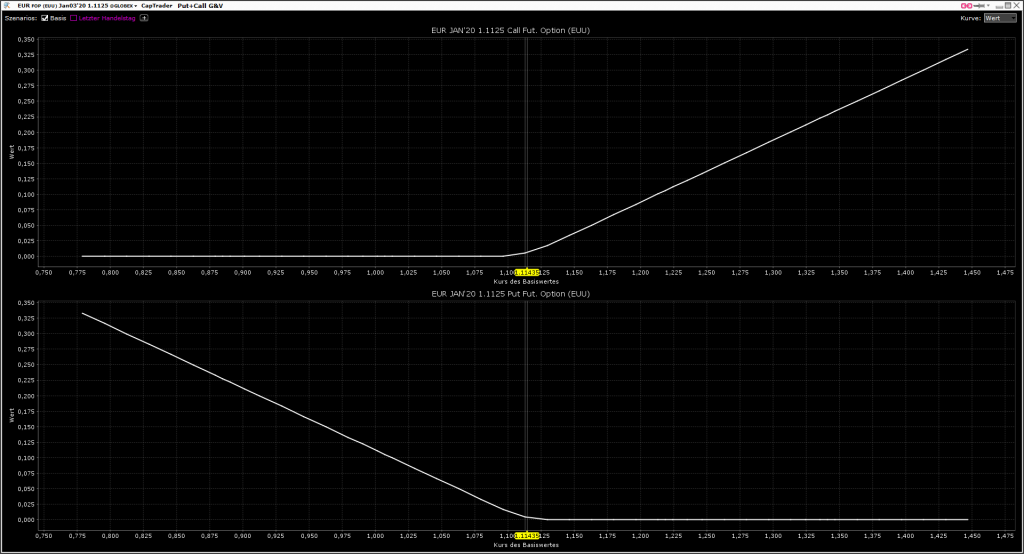
Long Call
The purchase of a call option is referred to as "Long Call". A long call is usually made on the basis of a bullish market opinion on strongly rising rates set.
Long Put
The purchase of a put option is referred to as "Long Put". A long put comes with a bearish market opinion and can be used for purely speculative purposes, or to hedge an existing long position (or even an entire equity portfolio) against falling prices.
Short Call
The sale of a call option is called "Short Call" and can be used with a neutral to bearish market opinion can be used. A short call can be used to speculate that the underlying will not be quoted above the strike price of the option on the expiration date.
Short Put
The sale of a put option is referred to as "Short Put". A short put usually occurs in the case of a neutral to bullish market opinion The option is used to speculate that the underlying will not be quoted below the strike price of the option on the expiration date.
Short Strangle
The combination of a short call and a short put with identical expiration dates is called a "Short Strangleis designated as the "strike price". The strike price of the call is above the current price of the underlying, the strike price of the put is below it. This means that a Sideways movement more precisely, that the underlying asset is quoted below the strike price of the short call and above the strike price of the short put on the expiration date.
Covered Call
A popular strategy among active private investors is the so-called "Covered Call"(also: "covered call writing"). This involves combining a short call with a long position in the underlying (almost always shares). The strike price of the short call is usually higher than the current share price. Thus a Supplementary income The only risk is that the underlying rises sharply and that the shares in the portfolio are "called away" when the option expires, i.e. they have to be sold.
Cash Secured Put
The "Cash Secured Put" is usually traded on shares and is nothing more than a short put. The only difference is that with a cash secured put, the option seller is willing to pay the Underlying to buyif the underlying is quoted below the strike price of the put option on the expiration date. (The buyer of the put option has the right to sell above the current market price and will do so; the option seller must therefore buy the underlying).
In the case of a purely speculative short put, on the other hand, the option seller has no interest in buying the underlying and will buy back the sold option beforehand and realize the loss.
The Cash Secured Put and the Covered Call can also be combined well in a stock portfolio. Put options are written to buy the shares; in principle similar to a limit buy order. The difference is that you also earn the option premium, regardless of whether you eventually buy the shares or not. If you have the shares in your securities account, you can write call options on them (covered call writing). If the underlying rises strongly and the shares in the portfolio are sold, Cash Secured Puts can be written again.