


Put options are frequently used by institutional market participants in particular to hedge against downside risks on the equity markets, and by commercial traders to insure against falling commodity prices, for example, which would pose a risk to their own business activities.
As a private investor, you have the option of using puts as a Fuse available in your equity portfolio as well as the speculative use for trading purposesThe purpose of these strategies is to speculate on falling prices of shares, futures, ETFs or indices, for example, or to generate income through option strategies.
What is a put option?
A put option (short: put) is a put option. Through the Purchase of a put option (long put), you receive the right to sell the underlying (e.g. share, future, ETF) at the strike price (also: exercise price or strike). Depending on the exercise style of the option (American-style option or European-style option), you can exercise this right during the entire term of the option or only on the expiration date.
Through the Sale of a put option (Short Put), you are the counterparty of the option seller and are obliged to comply with the option seller's demand if he exercises his right to sell the underlying. In this case you have to buy the underlying.
As the buyer of a put, you pay the option seller (who is also called the writer) the price of the option, the so-called Option premium. As a seller of a put option, you will be credited immediately.

Possible uses of puts
Through the Purchase of put options you can hedge individual stock positions or your entire stock portfolio against falling prices. Likewise, you can buy puts for purely speculative purposes.
With the Sale of put options On the one hand, you can speculate that the underlying will not fall below the strike of the option, thus making a profit by collecting the option premium; on the other hand, you can sell a put with the intention of buying the underlying if it falls below the strike of the option.
Long Put
Through the Purchase of a put option (Long Put), a profit is made if the price of the underlying falls after the purchase of the option. With a long put you can thus bet on falling prices of a stock, an ETF, a futures or an index. Should you have a long position of the underlying, the long put would act as a kind of insurance. The price decline of the underlying is partially or fully compensated by the profit of the purchased put option.

If the option is held until the expiration date, a gain only arises if the option is In The Money expires, i.e. when the price of the underlying is below the strike of the option.
If a put option expires In The Money, the profit can be calculated as follows:
Profit = (strike price of the option - price of the underlying) * multiplier of the option - option premium paid.
(You can find the multiplier of the option in the contract details of the option. In TWS, for example, double-click on any strike of an option in the option chain).
Example: Purchase of a put to hedge an equity position.
You have owned 100 shares in any company for 5 years. You bought the shares at a price of EUR 50 per share. In the meantime, the share price has risen to 75 EUR. You are uncertain about the price development of the share in the next 3 months and do not want to risk losing your profits in case of a stronger price decline. For this reason, you buy a put option with a strike price of 70 EUR and a remaining term of 90 days at a price of 200 EUR.
If the share continues to rise, you will profit from the price increase and the put will expire worthless. If the share actually falls below the strike, you have the right to sell your shares at a price of 70 EUR per share, thus hedging your profit of the shares. The total profit of your share position is therefore:
Selling price share - Purchase price share - Option premium
= 7000 EUR - 5000 EUR - 200 EUR = 1800 EUR
Short Put
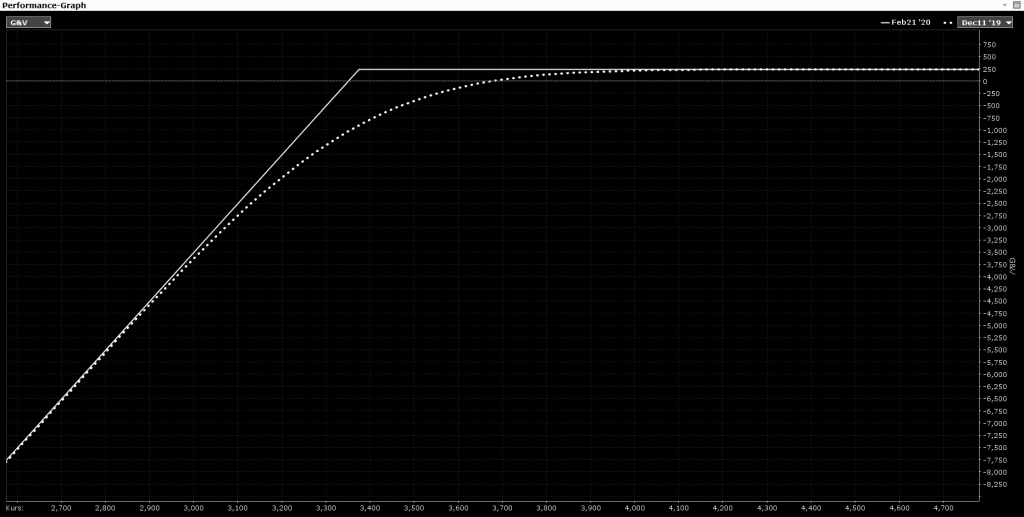
With the Sale of a put option (short put), you can speculate that the underlying will not be quoted below the strike of the option on the expiration date or during the term. If this is the case, the put option you sold expires worthless and the option premium collected at the beginning defines your profit.
However, if the underlying falls below the strike price, you, as the option buyer's counterparty, are obliged to buy the underlying from the option buyer at the strike price of the option.
Since the underlying can theoretically fall to zero, there is a risk of a large loss. For this reason, the short put should only be used if one is aware of the risk and if one is in a position, through appropriate Money and risk management limit the loss.
Cash Secured Put
In addition to the purely speculative use, put options can also be written with the intention of Underlying to buyif it quotes below the strike price on the expiration date of the option. In this case, you need to keep the cash for the purchase of the underlying free in your portfolio, which is why this strategy is also called a Cash Secured Put is called.