


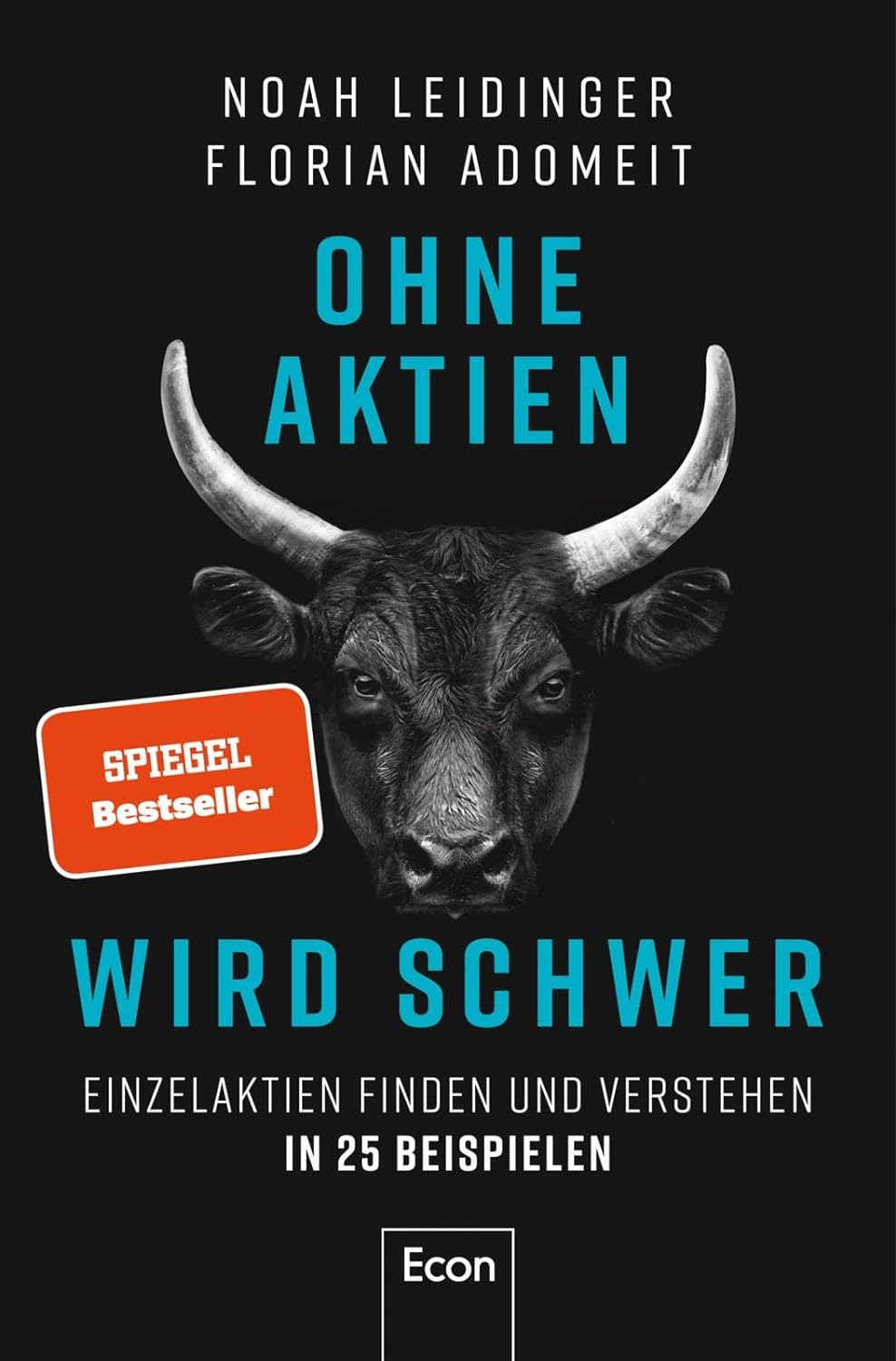
by Noah Leidinger and Florian Adomeit is one of the fresh, new books dealing with shares and investing. The authors run a successful stock market podcast with the same name and share their experiences, insights and opinions in a relaxed and straightforward manner.
I have included the latter at this point because I was ultimately not fully convinced by the content of the book. At the very least, this work cannot be labeled as scientifically sound and I don't find the way the authors themselves react to their sometimes questionable statements to be particularly reflective, but more on that later.
This introductory work, aimed at beginners, presents the usual problems. The authors emphasize the importance of shares as an investment instrument, as the title already clearly expresses. They explain how important it is to actively manage your own money and that shares are one of the best ways to do this. In doing so, they are obviously keen to challenge the widespread and empirically supported assumption that ETFs are the best method of wealth accumulation.
However, this critical questioning does not go beyond the well-known, easily invalidated points of criticism. Surprisingly unspecific, they attempt to build up a pseudo-construct of empiricism via emotions, personal experiences and individual observations, which cannot withstand even the slightest gust of wind. Fortunately, however, these parts only make up a small - rather framing - part of the book "Ohne Aktien wird schwer".
The main part of the book is devoted to the individual selection of individual stocks. The authors use a number of examples to help semi-professional and private stock pickers find the right securities. These include a close look at well-known companies such as Apple, McDonald's, Netflix and Porsche.
"So if you want a stable financial future, you have to make your own provisions. And Stocks are one of the best ways to do this. This is because shares are tangible assets with high expected returns and liquidity. In other words, especially in times of high inflation, it is worth investing in tangible assets. In other words, in real estate, commodities or shares, which have a value independent of the currency and financial system. Because even if shares are perhaps a little more abstract than real estate, they are still a share in a real company."
Noah Leidinger & Florian Adomeit
Stock picking should normally set alarm bells ringing for experienced stock market players, but despite the overwhelming scientific analyses that are at least worthy of consideration, a large number of investors obviously still take enormous pleasure in actively investing in the stock market. I have no fundamental problem with this, as long as people at least show the insight that it is largely emotionally based and not very rational. However, Noah Leidinger and Florian Adomeit largely lack this awareness. However, passive investing is probably not going to last very long on a podcast called "Ohne Aktien wird schwer". How Gerd Kommer has already explained in detail and aptly in Souverän Investieren, all the relevant information about the passive investment approach would be quickly told, whereas active investing provides the financial media with permanent content and also promises higher sales for the financial industry.
Who wants a passive investor who listens to 2-3 podcast episodes once and then uses the knowledge to adjust his portfolio once a year and doesn't listen to any more episodes, doesn't trade excessively via the broker and doesn't buy any "specialist" magazines or newsletters?
A few words about the authors at this point:
Noah Leidinger, born in 2002, started investing in the stock market at the age of 13 and invested his savings. He has been working as a freelance financial journalist since 2016 and has written numerous articles and stock analyses during this time. Since 2021, he has hosted the podcast "Ohne Aktien Wird Schwer". Since 2022, he has also been a portfolio manager and authorized signatory at the investment company OMR X.
Florian Adomeit, born in 1993, studied in Berlin and St. Gallen and worked for a long time as a research assistant and lecturer at the Free University of Berlin. At the same time, he worked in the consulting industry. In addition to his work as host of the podcasts "Beckers Bets" and "Alles Coin Nichts Muss", he is a member of the "Ohne Aktien Wird Schwer" team. Since 2022, he has been portfolio manager and authorized signatory at the investment company OMR X. In addition to his professional career, Florian Adomeit is continuing his studies and working on his doctorate at the FU Berlin.
"The fourth rule: only buy what you understand. BioNTech is already one of the most incredible business stories of this millennium. What was still a small research company in Mainz in 2019, making a loss of almost 200 million euros, was one of the most important companies in Germany two years later with a profit of more than 10 billion euros. The founders Ugur Sahin and Özlem Türeci became multiple billionaires in one fell swoop. And the other shareholders also made incredible returns, increasing their money thirty-fold in the meantime. Although the rise at BioNTech is particularly dramatic, very high returns are not at all unusual for young biotech companies. After all, when a drug is approved by the authorities, the company behind it often earns billions."
Noah Leidinger & Florian Adomeit

As an aside, it could be mentioned that BioNTech was one of those hype stocks that were praised to the skies by finfluencers and have since suffered a nasty downturn. But very few people talk about this openly. Just like Wirecard or all the NFTs and cryptocurrencies that are now worth so little that it is hardly worth liquidating the positions. But that's not what the financial media want. They just need to find a new horse, a new exciting idea. If you've seen Wolf of Wall Street, the last sentence should sound familiar.
However, if you don't care about any of this and even the most valid empirical studies go in left and out right, you will be very well served by this book, although books such as Unternehmensbewertung & Kennzahlenanalyse by Nicolas Schmidlin or Cool bleiben und Collecting dividends by Christian W. Röhl I liked them better. For experts, however, at best The Secrets of Securities Analysis by Benjamin Graham and David Dodd. This book is aimed very much at beginners and tries above all to present the approaches in a practical and understandable way.
In terms of content, the authors deal with various key figures such as profit, turnover, growth, debt, but also special features such as takeovers, dividends, share buybacks and voting rights. They explain how these factors can influence the valuation and price movements of shares in different ways. The different business models are also considered in terms of their impact on returns and current distributions. The authors conclude that there are different approaches to being successful with equities, including investing in innovative companies or those away from the headlines with long-standing business models.
What is missing in this context, however, is a detailed comparison of these approaches, especially in comparison to a completely passive approach or even a factor and tax-optimized investment. Of course, there are many roads to Rome in the stock market, but they promise different risk/return ratios and total returns and do not involve the same amount of work. However, such a rational and self-critical comparison would probably dismiss 80% of the contents of this book as an ultimately unnecessary gimmick.
"The high performers. Most professional investors do not manage to beat the market in the long term. This is often used as a killer argument against any investment in individual shares. Nevertheless, there are always investors who outperform the market in the long term. And they do so with a systematic and regular approach that does not look like mere luck. Warren Buffett is certainly the best-known example of this. He has built up a fortune with investments in companies such as Coca-Cola, Bank of America and Apple and is now one of the richest people in the world. And there is no lucky shot behind this, but many very smart investments."
Noah Leidinger & Florian Adomeit
Even these typical individual examples are not critically examined, although even Warren Buffett doubts today that he will be able to achieve this performance in the future. For one thing, the markets have become more efficient and for another, as a major investor he acts completely differently to private individuals. Moreover, measured against a passive benchmark that follows his value investing approach, he has not beaten the market in this way, especially in recent decades. It is this eternal myth that is being kept alive here.
"The extraordinary success of Warren Buffett and Jim Simons is of course not the norm. But it shows that it is fundamentally possible to beat the market."
Noah Leidinger & Florian Adomeit
No one has doubted that it is not fundamentally possible to beat the market. Looking at the world of mathematics, it is simply imperative that people will always manage to do so. But this has relatively little to do with systematics, patterns and the like, and more to do with luck. Nassim Taleb calls such people the fools of chance. But as Benjamin Graham has already expressed very nicely: we are very good at recognizing patterns, even if there are none. Rolf Dobelli rounded things off with the thesis that it is almost impossible to convince someone of the opposite if their income depends on not understanding it.
Especially considering the time, financial and intellectual effort that professional investors such as Warren Buffett invest in the stock market, it is absolutely naive to use this as a valid example for private investors. Of course, none of this effort is discussed. There is nothing in the book about a clear comparison including opportunity costs.
"Of course it's great if many of the new investors then simply set up an ETF savings plan and make long-term provisions for their future. But if some of them are also enthusiastic about learning about individual shares, this should not immediately be dismissed as stupidity. Because even if the return may suffer a little as a result, investors understand very well over time how the economy works. How do Visa & Mastercard actually earn money? What is the connection between turnover, profit and stock market value? How do you recognize a solid company and what are the warning signs? Which business models and sectors have future prospects, and which are already shrinking? In case of doubt, this economic knowledge brings such great advantages in your professional career that you could do without the returns altogether in return. Because at the end of the day, analyzing individual shares is all about understanding how much and in what form companies generate economic added value."
Noah Leidinger & Florian Adomeit
At this point, however, we are no longer investing, but have arrived at a kind of hobby. Not for me, because life offers so much more.
"The biggest advantage of ETFs is that you only have to think a little about where you invest. At the same time, however, this is also their biggest disadvantage. Passive ETFs invest independently of the personal needs of the respective investor. The whole thing is similar to a menu in a top restaurant that has been put together by the best chefs in the world. It may be that it tastes particularly good and everyone gets their fill. But what if you don't eat meat, want to avoid sugar or don't like carrots? If any of these things are on the menu, you're out of luck. It's the same with an ETF. If you invest in an MSCI World ETF, your money (as of 2022) is also invested in weapons manufacturers, tobacco companies or coal-fired power plants, for example. But what if you don't want that? Of course, you can then turn to ETFs that claim to invest as ethically and sustainably as possible. However, both are in the eye of the beholder. While some see nuclear energy as an environmental sin, others see it as the best possible alternative to coal power. For some investors, on the other hand, it is important that board positions are fairly distributed between the sexes, while others focus their investment strategy primarily on profitable companies or want high dividends. An investor's preferences are usually so individual that there is hardly an index that perfectly reflects them."
Noah Leidinger & Florian Adomeit
In my opinion, the authors misinterpret the meaning of Warren Buffett's statement that you should only invest in what you understand. Of course you should understand what shares, the stock market and the capital market are and how they work. But at the end of the day, I don't need to know every company in my ETF portfolio. The only coherent argument would be a strict focus on sustainability in the portfolio, which in turn can only be implemented 100% - if at all - via an active investment approach. But that only affects a small proportion of investors.
"Of course, we don't know ourselves whether we will outperform the market in the long term. Many studies speak against us, many practical examples speak for us. But even if not, we have done a lot of things right by investing in solid companies over the long term, at least from a historical perspective. And along the way, we have learned an enormous amount about the economy, business models and investing. This can then also be applied to investments in start-ups, for example - you can't yet invest in them via ETFs."
Noah Leidinger & Florian Adomeit
Frankly, I was at a loss for words at this conclusion. First of all, the second sentence shocks me - especially as one of the two authors is working on his doctorate. It almost seems as if they want to defame studies as a theoretical construct that has nothing to do with reality. Yet these studies are based on real-life examples and these real-life examples are part of the studies and yet they arrive at this clear result, which contradicts the authors' approach. How can academics cherry-pick individual examples in such a way to contradict well-founded empirical studies? To me, this borders on the absurd.
The addition of the start-ups is once again completely inappropriate. Irrespective of the fact that this is a completely different form of risk assessment, it simply seems like a desperate attempt to find something to come up with after admitting one's own inability.
However, private investors should probably leave investing in start-ups to business angels and venture capital investors, who have generally already made a profit before they start with such investments and have a complete team around them to be able to assess the risks of such an investment in an approximately valid manner.
I have to be honest, at this point I was on the verge of giving the book 0 stars because these almost naive statements shocked me.
Overall, Ohne Aktien wird schwer - if you leave out these passages - offers a thoroughly interesting introduction to different ways of analyzing and looking at the world of individual stocks. The language is adapted to the target group of beginners, but the one or other experienced investor will certainly also be presented with interesting aspects. Personally, I miss the depth in the analyses.
It is basically the typical Finfluencer book that excludes nothing, satisfies everyone, doesn't really offend anyone and offers more or less superficial strategies. You simply can't compare it with works by Benjamin Graham, Nicolas Schmidlin or Christian W. Röhl, all of whom shed much, much deeper light on certain aspects and are therefore, in my opinion, more valuable.