- Rio Tinto is part of an oligopoly in the iron ore market and plays a significant role in the global commodity trading value chain
- The world's second-largest mining group by market capitalization is involved in a market outside of iron ore that will benefit even more from the growing demand for critical raw materials for the energy and mobility transition in the future
- Thanks to a conservative acquisition policy, the company has kept its net debt at a very low level for years. The investment grade rating confirms Rio Tinto's excellent creditworthiness
- The globally positioned, extensive network of mines, refineries and mines provides reliable income from the existing business, which allows investment in new growth opportunities and shareholder-friendly capital allocation in the form of dividend payments and - in good economic phases - special distributions
- Click here for the DGI model portfolio and here to the overview of this series The dividend custody account.

Company profile and business model: who Rio Tinto is and what it does
Rio Tinto's roots go back deep into the history of the 19th century. Exactly 150 years have passed since the mines located on the Rio Tinto river in Spain were taken over by a predominantly British-European group of investors. Originally, the mine in Andalusia, which specialized in copper mining, had been owned by the Spanish crown since the late 1840s, but the financially strapped state could not afford to continue operating a loss-making plant.
On March 29, 1873, the company was The Rio Tinto Company Limited registered in London. Both the name of the town and the company name can be traced back to the mines that gave the town its name and the reddish-colored water of the Río Tinto river due to its iron and copper deposits. The concentrations of iron and copper in particular are so high on site that at the upper reaches at Minas de Riotinto raw materials have been extracted here for 3,000 years.
Over the next few decades, Rio Tinto built up the competitive advantage that still characterizes the company today: the Geographical diversification through successful exploration in Africa, Australia and Canada. In Australia, the subsidiary Rio Tinto Mining Company of Australia Ltd. was founded, which held a majority stake in the Mary Kathleen opencast uranium mine in Queensland from 1955. In later years, this marked the company's entry into iron ore mining in Western Australia. Pilbara region.
Rio Tinto's origins as a British-Australian dual group date back to 1962, when the Rio Tinto Company and the Consolidated Zinc Corporation were merged to form the Rio Tinto Group. The Rio Tinto-Zinc Corporation Limited (RTZ for short) merged. It was not until 1995 that joint Group management was established under the umbrella name of Rio Tinto Group The company was installed as a dual-listed company when the shareholders approved the merger.
Thanks to major acquisitions, Rio Tinto developed into the world's largest aluminum and bauxite producer in the 2000s. One of BHP Billiton notified Hostile takeover of Rio Tinto failed due to the drastic collapse in commodity prices in the wake of the financial crisis in 2008. Glencore and Rio Tinto was rejected by the Australian-British mining group.
During the turbulent years of the financial crisis, the Chinese commodities group Aluminum Corporation of China (Chinalco) took advantage of the opportunity to buy into Rio Tinto as a strategic investor. Rio Tinto had accumulated a mountain of external liabilities on its balance sheet as a result of previous acquisitions. The world's largest aluminum producer secured a nine percent stake in Rio Tinto, but a doubling of the stake failed for the time being due to intense public pressure and the Australian supervisory authorities. A Joint venture named Chinalco Rio Tinto Exploration Co. with the state-controlled company from China, with the aim of jointly exploring for copper deposits in mainland China, failed in 2017.

The business model Rio Tinto's core business consists of the extraction of iron ore, copper, aluminum, diamonds, gold, lithium and industrial minerals. Some of these raw materials are further processed or refined. For example, bauxite is processed into aluminum and iron ore into iron ore pellets in the company's own refineries. In terms of market capitalization, Rio Tinto is the second-largest commodities group in the world after the BHP Group.

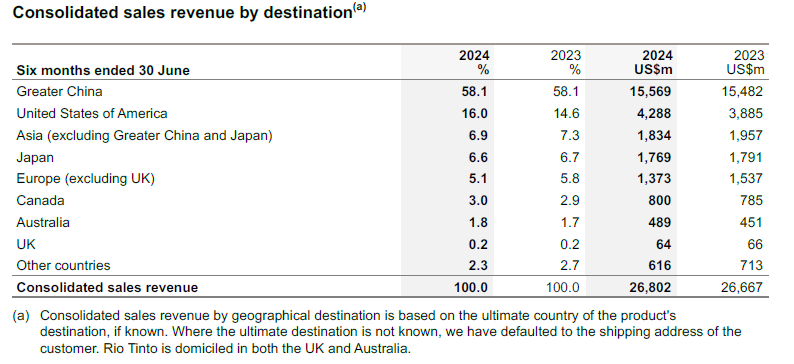
What Rio Tinto has in common with other industry players is a high proportion of total sales attributable to China is eliminated. Although this fell from 58% in 2020 to 54% today, this dependency can still be described as a cluster risk. Rio Tinto's focus on Asia is nothing new. A historical development has seen a concentration shift from the Japanese market, which was in a boom phase lasting almost two decades until the end of the 1980s, to mainland China.
The Strategy of Rio Tinto is strongly aligned with the growing demand for critical raw materials and minerals required to achieve the goals of "climate neutrality" and "emission-free future" in the course of the two megatrends of energy and (electric) mobility transition. This global, government-stimulated boom in demand could lead to a gradual reduction in Rio Tinto's enormous dependence on iron ore without having a lasting impact on the profitability of the business model.
Jakob Stausholm has been Chief Executive Officer of the Rio Tinto Group since January 2021. Following the debacle surrounding the demolition of sacred Australian Aboriginal sites, which resulted in the resignation of his predecessor, among other things, Stausholm, who was Chief Financial Officer at the time, was appointed Chief Executive Officer. Born in Denmark, he graduated with a master's degree in economics from the University of Copenhagen. Before joining Rio Tinto as Chief Financial Officer (CFO) in 2018, he worked for the oil multinational Shell for many years. From 2016 to 2018, Stausholm made a stopover at the shipping company A.P. Møller-Mærsk.
At the ownership structure of Rio Tinto, the organization listed in first position stands out among the institutional investors. With a share of approx. 14.6 percent of the "Aluminum Corporation of China", the Chinese People's Republic indirectly secures its influence over the company. The rest usually comes from the "usual suspects" of asset managers such as BlackRock and Vanguard.

Industry profile and competitive situation
The characteristics of Rio Tinto's business model make the Comparison with listed competitors with certain qualifications, whereby further differentiating factors such as the degree of internationalization, the weighting of the individual business segments or any special features in the supply of raw materials must be evaluated separately in a detailed analysis.
In an initial comparison, the choice fell on the competitor already mentioned several times in this analysis BHP Group as an adequate guide. An important limitation in this comparison is BHP's coal segment, from which Rio Tinto withdrew completely some time ago. The coal business accounts for just under a quarter of BHP's sales.
Whether this list is expanded to include other industry giants such as the company that focuses primarily on commodities trading Glencore Each investor can decide whether or not to expand the portfolio in a more detailed sector analysis.
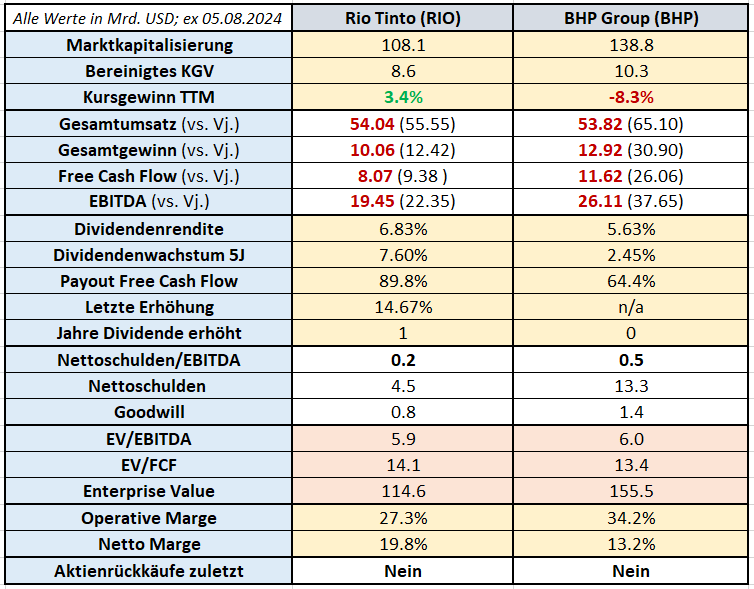
Notes on the values contained in the table:
- Green or red coloring of the figures indicates growth or decline compared to the previous year
- All values are stated in US dollars
The financial situation of Rio Tinto
After gaining an overview of the industry in general and taking a closer look at the company, its management and competition, we take a look at Rio Tinto's balance sheet and the key financial figures derived from it. The focus here is on the following aspects Growth, profitability and Financing.
To analyze the financial situation, we first look at the development of sales, profit and free cash flow. On average, the Turnover by 5.6 percent p.a. in the last five years.

Based on the key figure Earnings per share the cyclical nature of the commodities business becomes apparent. If we take the past financial year 2023 as an example, the Adjusted earnings per share The share price was 16.6 percent lower (GBP 5.70 vs. GBP 6.82). In the past financial year, Rio Tinto generated a Net profit from USD 10.1 billion (2022: USD 12.4 billion).
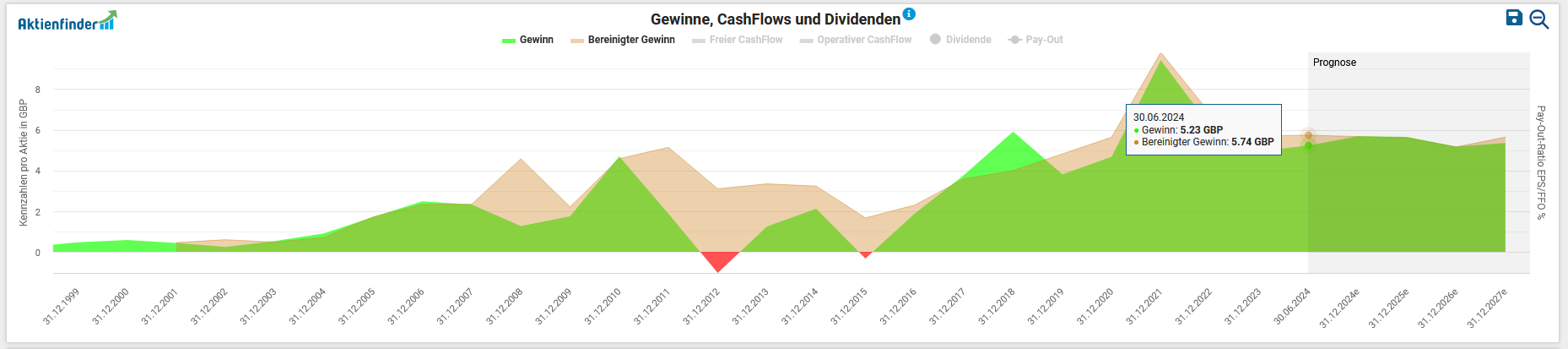
The amount available to the company Free Cash Flow can be used as part of the capital allocation policy to repay debt, expand via company acquisitions, pay out (increasing) dividends or buy back shares. In absolute figures - which I primarily like to use - the picture of operating and free cash flow and the extremely low capital expenditure (CapEx) for the period 2016 to 2023 is as follows:

A look at the Debt situation shows us that, based on the last financial year, Rio Tinto has a share of interest-bearing financial liabilities of USD 14.3 billion, which in turn is offset by cash and cash equivalents and securities totaling USD 9.8 billion. If we now divide the remaining net debt of USD 4.5 billion by the most recently generated EBITDA of USD 19.5 billion, the result is 0.2. This result is miles below the threshold value of 3, which is considered critical. Therefore, an in-depth examination of the maturity structure of the long-term liabilities and their interest conditions can be dispensed with. In 2023, Standard & Poor's confirmed the long-term Credit rating of the company with the Investment Grade A with a stable outlook.

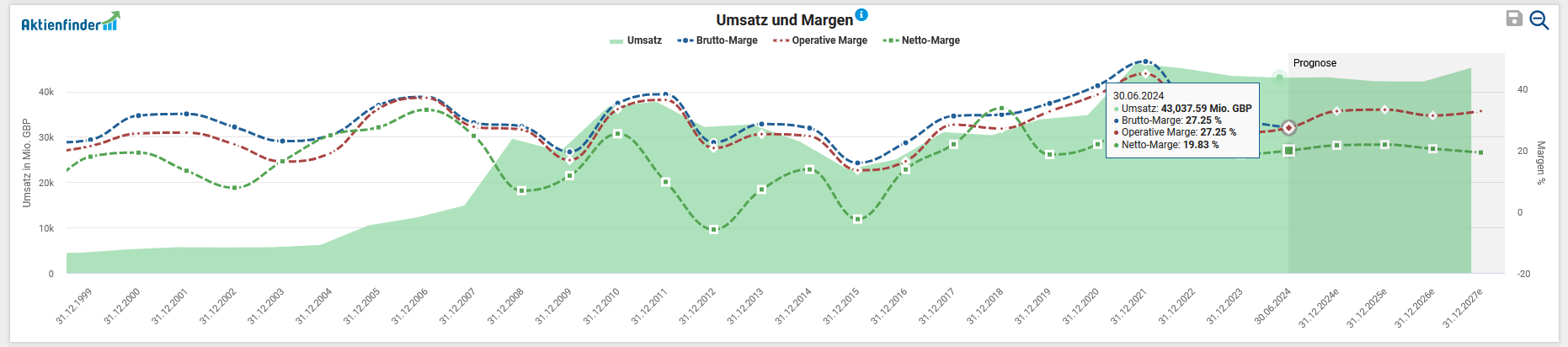
Finally, we look at the Profitability of Rio Tinto based on the development of gross, operating and net margins. The undulating trend is not surprising given that profitability correlates with the volatile development of commodity prices.
Opportunities & risks
In the course of the two Megatrends energy and (electric) mobility turnaround, with the aim of achieving "climate neutrality" or an "emission-free future" through the expansion of renewable energies, Rio Tinto is promoting part of the so-called Raw materials of the future lithium and copper. This global, government-stimulated boom in demand could lead to a gradual reduction in Rio Tinto's enormous dependence on iron ore without having a lasting impact on the profitability of the business model.
Rio Tinto's network of deposits, mines, refineries and mines stretches across the globe. These Infrastructure assets Together with tightly organized transport logistics, they represent a significant Competitive factor represent. In a trio with Brazil's Vale and the BHP Group, Rio Tinto occupies a leading position in the market. Oligopoly position in the iron ore market and plays a significant role in the global value chain of the raw materials trade. The capital-intensive basic investment, management and maintenance of the established infrastructure inhibits competition for this industry and represents a High market entry barrier for new competitors.
The Zyklik of the business model is undoubtedly directly linked to the general economic trend. The construction industry - particularly in emerging and developing countries - is pro-cyclical. If economic activity falls and spending on infrastructure and real estate projects declines, this has a negative impact on commodity prices. This circumstance is also reflected in the Fluctuations in marginsin Rio Tinto's operating profit and sales. The High dependency from steel production, whose products are used in infrastructure construction and expansion in particular, is obvious. It is not for nothing that Rio Tinto is referred to as a "proxy" for the iron ore market. The fluctuation range for a tonne of iron ore has been between USD 60 and USD 230 in the last three years.
In addition to the considerable China exposurethe main sales market of the Australian raw materials group, is attributable to the Reputational risks pointed out. The blasting in the Juukan Gorge, a 46,000-year-old indigenous Aboriginal cult site, to open up new iron ore deposits was just one of several serious missteps in Rio Tinto's recent past. Water and energy consumption remains a critical issue in the extraction of raw materials. This is why Rio Tinto Provisions in the billions for the renaturation of abandoned mines and extraction sites.
Current valuation of the Rio Tinto share
For the valuation of companies, I use the so-called Enterprise Value (EV) is used. In the case of a takeover, the EV indicates the amount required to purchase the assets required for operations and excludes the non-operating assets. I relate this key figure to operating profitability (before interest, taxes and investments (CAPEX)), expressed as EBITDA. The prevailing opinion is that a value of less than 10 indicates a „healthy valuation“ - as is always the case with generic Rules of thumb the company-specific context must be considered in the analysis by the careful investor himself. In the case of Rio Tinto we have seen a sideways valuation around the value of 6 since the beginning of 2023:

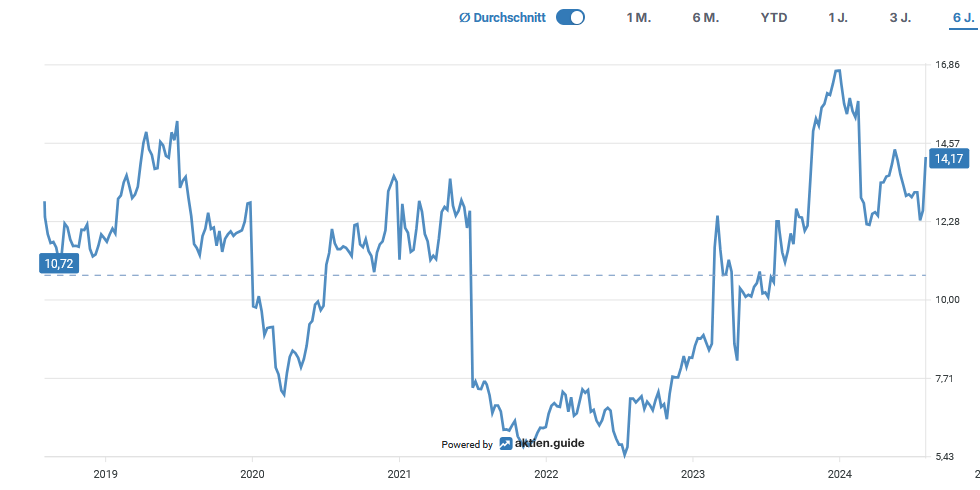
Another way of answering the valuation question is to compare the EV with the hardly manipulable Free Cash Flow (FCF) to be set. A high EV/FCF multiple indicates a high valuation, while a low result signals a cheap valuation. From the chart below, we can clearly see that the Rio Tinto share has a value of 14.2 for the EV/FCF-Ratio above the average level of 10.7 of the last six years.
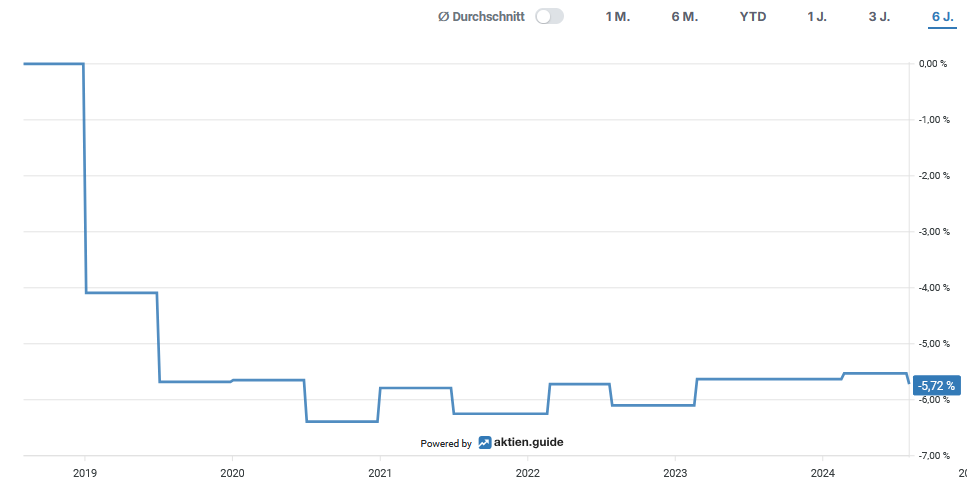
The Maximum decrease in the last six years amounted to approx. 23 percent just in the wake of the corona pandemic in 2020:
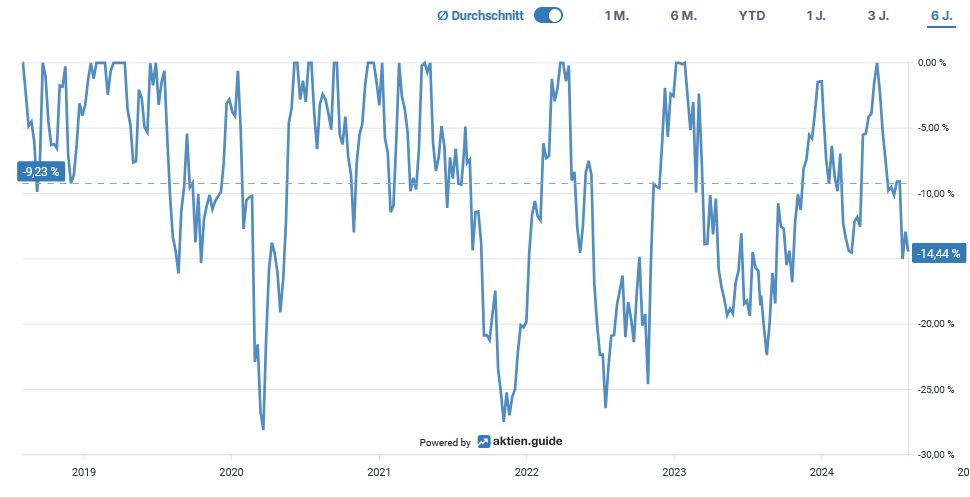
The Maximum decrease in the last six years amounted to approx. 28 percent just in the wake of the coronavirus pandemic in 2020 and again at the end of 2021:

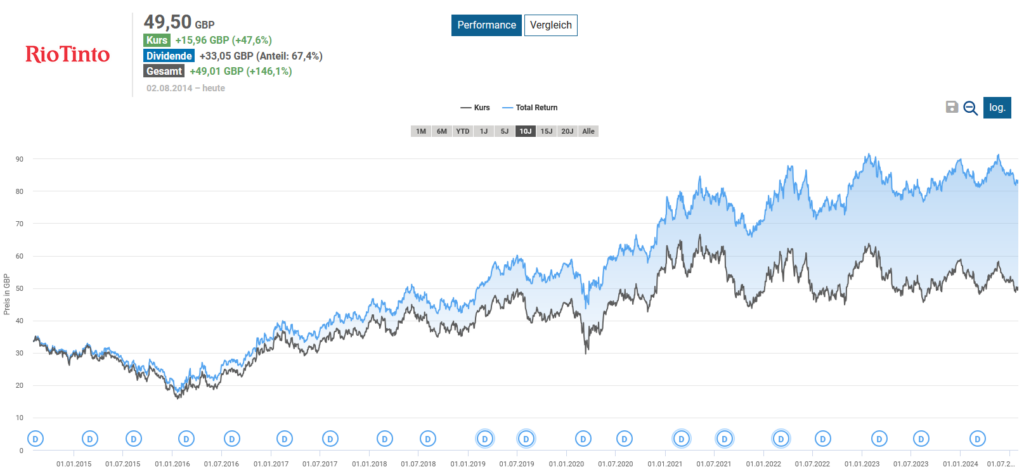
Over the past six years, an investment in Rio Tinto, measured in terms of Total Return, including dividends received, a Overall performance from 146.1 percent for the investor:
Capital allocation
Rio Tinto paid an annually increasing dividend to its shareholders for a period of five years, since the payout was last reduced by a third in 2016. This streak of dividend increases was broken again in July 2022. Since then, Rio Tinto has successively adjusted the dividend downwards before announcing another increase as part of the final dividend for the 2023 financial year:

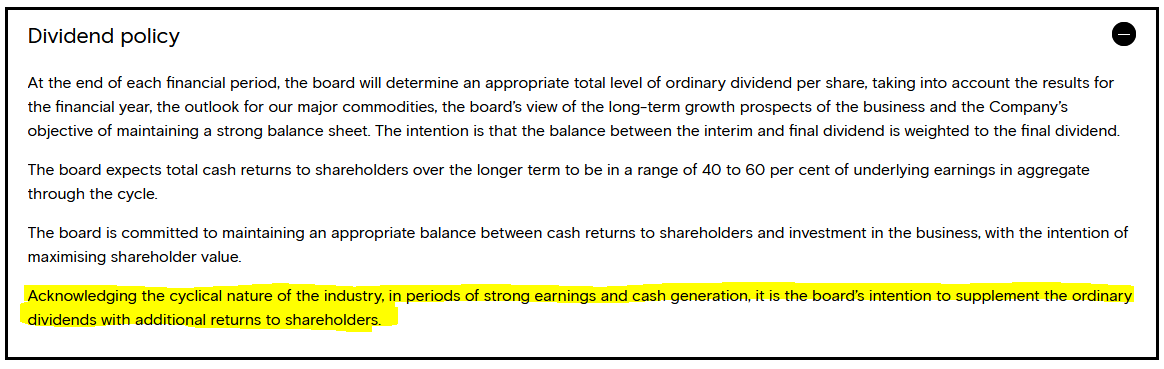
In line with the inherent cyclical nature of the business model, Rio Tinto pursues a variable dividend policy. This is communicated transparently by the company. Dividend cuts are therefore nothing unusual at Rio Tinto. This was also the case in 2009 and 2003, for example.
At peak times, when the global economy is booming, this even ensures double-digit returns thanks to generous special dividends. However, due to the cyclical nature of the commodities business, phases of dividend cuts must also be expected over the long term.
At the current share price of GBP 48.95, this results in a Dividend yield from 7.01 percent. The Five-year dividend growth rate amounts to 6.3 percent p.a. or 11.3 percent p.a. in the Ten-year period.
The most recent semi-annual dividends amounted to USD 1.77 and USD 2.58 per share and are paid out in April and September.
If we take the average value of the Free Cash Flow of the last three years as the basis for determining the Payout ratio we end up with a moderate result of 76 percent for Rio Tinto's payout ratio. As already mentioned, the scope for dividend increases in the coming years will depend on the economic development in the Asia-Pacific region.
The Number of shares outstanding decreased on average by approx. one percent per year in the past six years. Rio Tinto has hardly bought back any shares in the last five years. This component of capital allocation is therefore not actively used by management.
Conclusion: Considerations for my decision to invest in Rio Tinto
The underlying cyclical nature of Rio Tinto's business model can be a stomach-churning experience. If you don't want volatility in your portfolio, you should steer clear of mining companies that are closely linked to the development of commodity prices. On the other hand, the availability of raw materials forms the basis for economic prosperity. If this well-known conviction is shared, the shares of the second-largest mining group are characterized by a balanced risk/return profile.
Based on a solid balance sheet with low debt and a conservative acquisition strategy pursued by management, Rio Tinto generates high cash flows, which are passed on to shareholders in the form of variable dividends. In the past, this distribution policy has even resulted in double-digit returns during economic upturns thanks to generous special dividends. Due to the cyclical nature of the commodities business, phases of dividend adjustments must be expected, even for long-term holdings.