- American Water Works is characterized by stable profits and cash flows thanks to a non-cyclical business model in the water supply sector. Water is simply an indispensable, irreplaceable commodity
- Water supply in the United States is a regional monopoly within a highly fragmented market. Once contracts have been awarded, there is no competition in the individual areas at municipal level
- The regulatory requirements, in particular the lengthy procedures for setting consumer prices, reinforce the moat character of this specific business model with high barriers to market entry
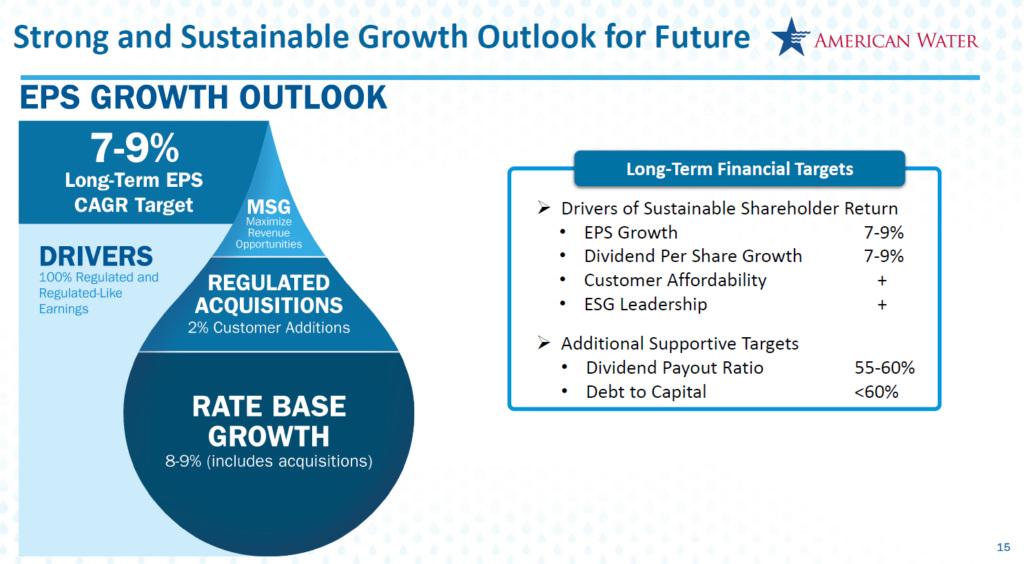
- American Water Works prioritizes the dividend growth factor in the company's own capital allocation policy as part of the investment plan, with a target of seven to nine percent p.a.
- Click here for the DGI model portfolio and here to the overview of this series The dividend custody account
Company profile and business model: Who is America Water Works and what does it do?
American Water Works (ticker symbol: AWK) is by far the largest listed utility in the water supply and wastewater treatment sector. The company has been in existence since 1886, when the American Water Works & Guarantee Company was established under the Pennsylvania Partnership Act. At that time, the use of a partnership gave the new company the right to hold shares in the water and gas companies it had established and acquired, while corporations in the utility sector could not own shares in other companies.
Following the amendment of corporate law in the US state of New Jersey to the effect that Corporations now held shares directly, the headquarters were moved from Pennsylvania to the east coast. In 1913, the up-and-coming water supplier had to declare bankruptcy because the company had miscalculated its investments in irrigation systems in the west of the country. After a successful reorganization, the company operated under the name American Water Works and Electric Company.
This was followed by decades of acquisitions of mostly smaller, regionally based water suppliers and partial portfolio streamlining. Ownership changed again. From 2003 until the IPO in 2008, the German RWE der Sole owner from AWK. The motivation behind the deal was to combine the water supply activities in the UK (Thames Water), Germany and the United States in a "global leader in the provision of water services" together.
The reality of the situation is unlikely to have lived up to the expectations associated with the USD 7.5 billion transaction. The exit strategy envisaged an IPO of AWK on the New York Stock Exchange. Initially, the German parent company still held 60.5 percent before RWE management acquired the remaining shares by the end of 2009. sold.
At the beginning of 2024, the company employed around 6,500 people who provide the entire portfolio of services to over 14 million people in 24 different US states. AWK focuses entirely on the fragmented US domestic market, which is largely dominated by the public sector.

Im Zentrum des Geschäftsmodells The company focuses on the value chain typical of the industry, from the extraction and treatment of water to its distribution. In this business segment, which is managed as "Regulated Businesses", AWK operates in 14 US states and 1,600 municipalities. This also includes the collection and treatment of wastewater. Under company law, these local services are handled by various subsidiaries focused on specific regions and managed by the holding company.
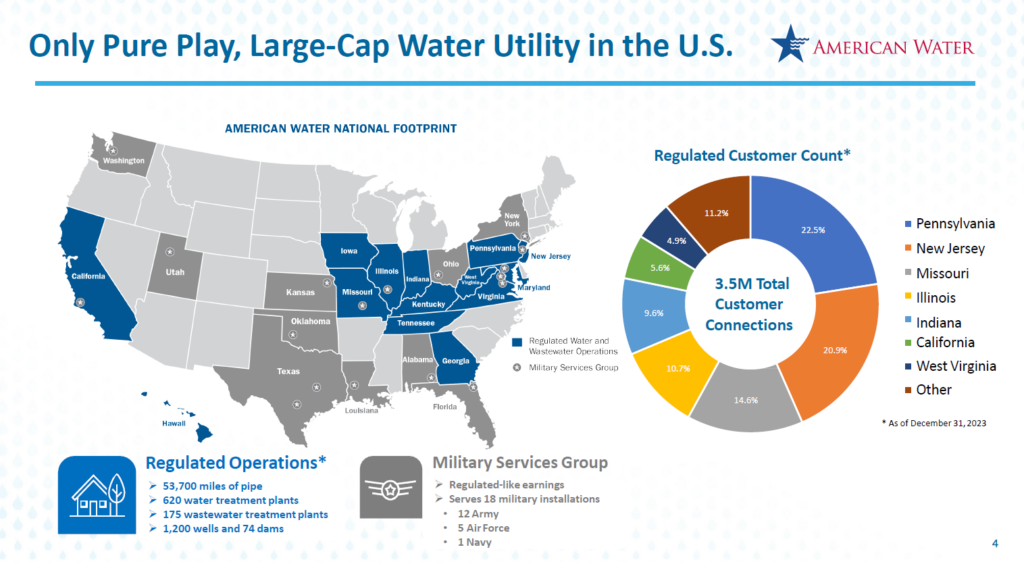
American Water Works offers its services to private households as well as commercial and industrial customers. The company is also active in the field of water and wastewater services for public institutions.

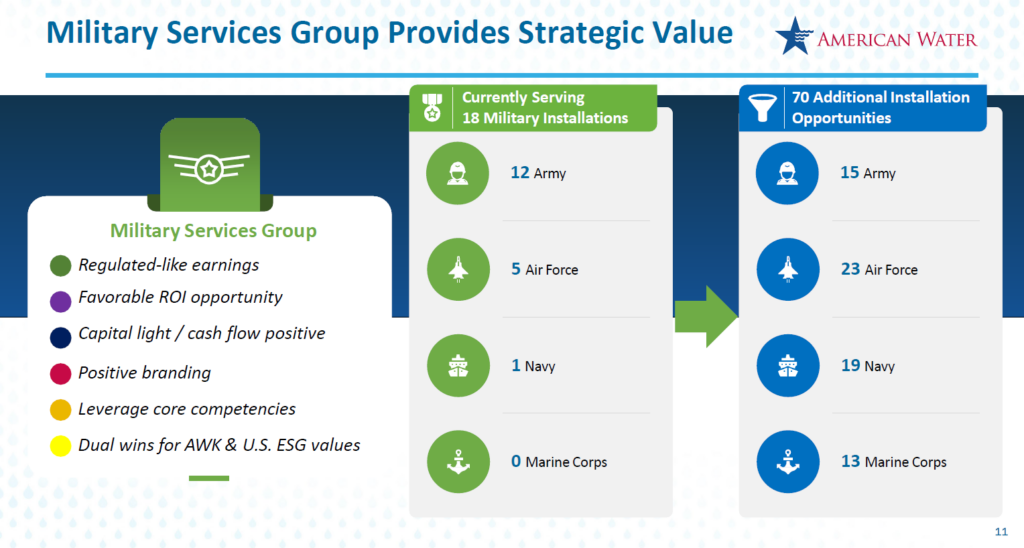
Another business area of American Water Works is the operation and maintenance of water treatment plants and wastewater systems for the US military. The contracts for the current 18 military bases are generally concluded with the public client for 50 years. The share of this segment is low and accounts for only eight percent of revenue. The average remaining term of the contracts is 40 years. Most of these contracts are subject to an annual right of early termination.
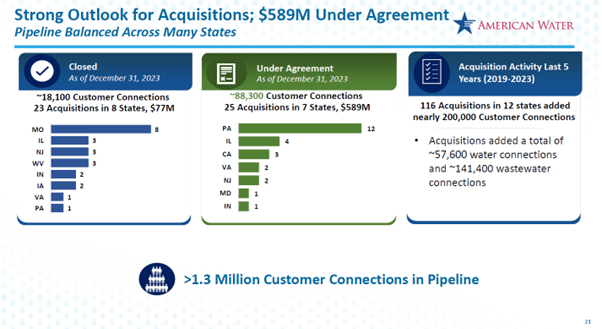
The Corporate strategy is characterized by decades of continuity in the acquisition and subsequent integration of smaller water utilities in the USA. Without exaggeration, AWK's strategy in its business domain resembles the nature of a serial acquirer. In 2023, 23 acquisitions were successfully completed and the pipeline is full to bursting. Between USD 4 and 5 billion has been earmarked for inorganic growth for the period 2024 to 2033. In the long term, AWK is aiming for average customer growth of two percent p.a.
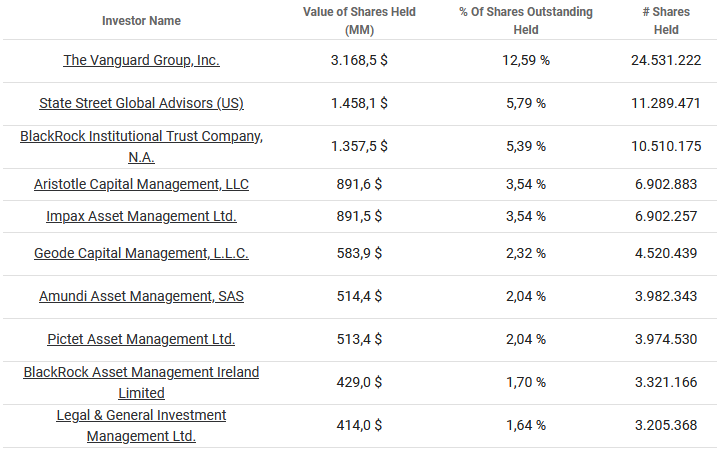
At the ownership structure of American Water Works is the exceptionally high proportion of Institutional investors which is not atypical for the utilities sector. At AWK, this amounts to over 90 percent and is usually fed by the "usual suspects" of the Asset manager such as Vanguard or BlackRock. A relatively high proportion of institutional investors can legitimately be interpreted as an appreciation of the company on the part of professional capital market representatives.
Industry profile and competitive situation
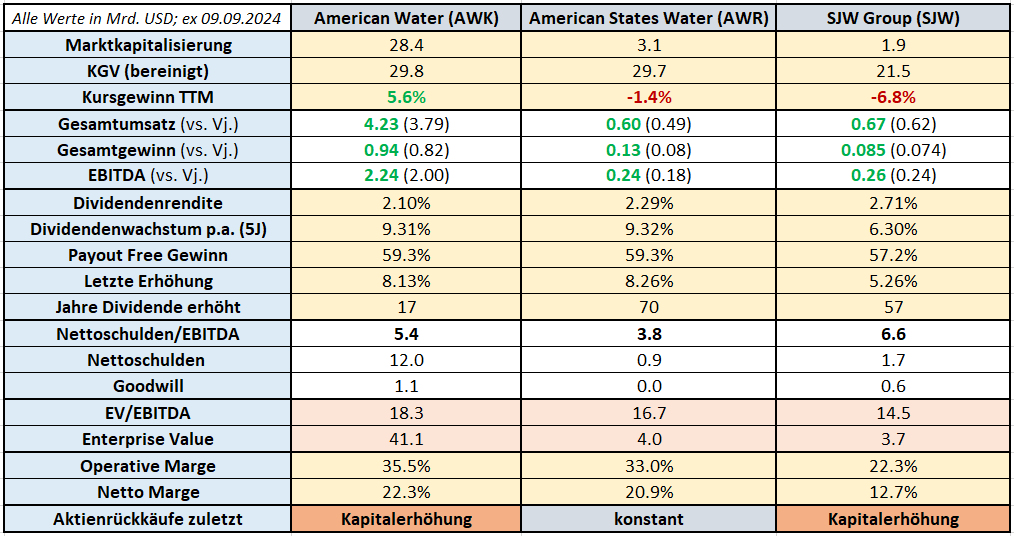
The characteristics of American Water Works' business model make it easy to compare it with its listed competitors, as there is no significant competitor in this scale as a "pure play" in the USA.
This must be taken into account in the table below, in which I have opted for the two competitors in an initial comparison. American States Water and the SJW Group decided. Whether this list is now extended by, for example Essential Utilitieswhich also generate a significant share of sales in the natural gas business, can be decided by each investor in a more detailed sector analysis.
Notes on the values contained in the table:
- Green or red coloring of the figures indicates growth or decline compared to the previous year
- All values are stated in US dollars
The financial situation of America Water Works
After gaining an overview of the industry in general and taking a closer look at the company, management and competition, we take a look at America Water Works' balance sheet and the key financial figures derived from it. The focus here is on the following aspects Growth, profitability and - particularly important for utilities - the Financing.
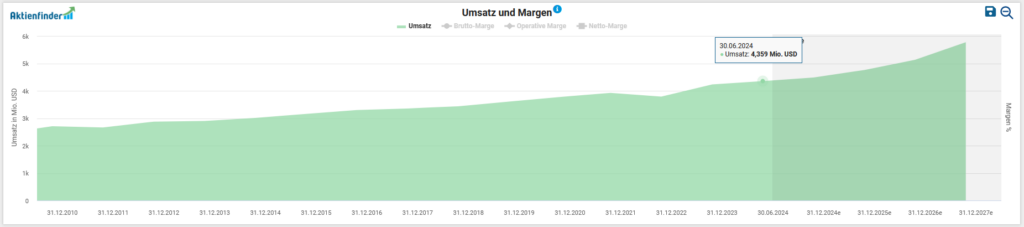
To analyze the financial situation, we first look at the development of turnover, profit and free cash flow. On average, the top line has grown over the last five years by 4.2 percent p.a. an.
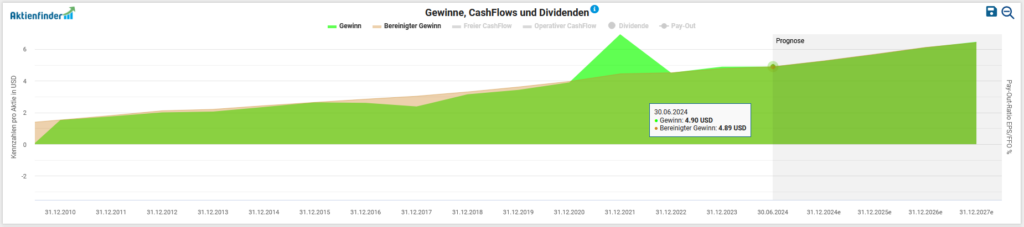
At Earnings per share we have seen a dynamic upward trend for ten years. If we look at the past financial year 2023, the Adjusted earnings per share by 5.8 percent (USD 4.77 vs. USD 4.51). In the past financial year, American Water Works generated a Net profit from USD 944 million (2022: USD 820 million).
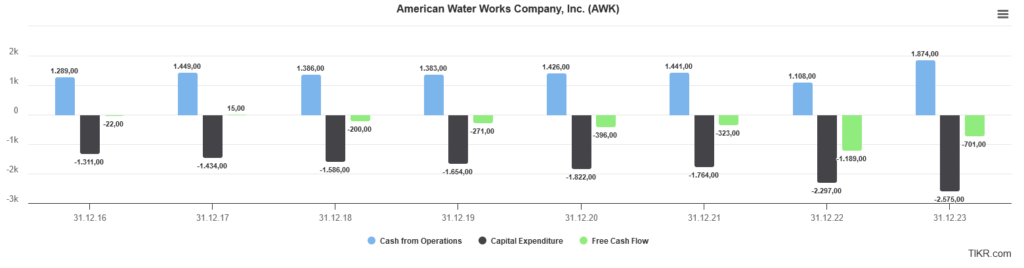
The amount available to the company Free Cash Flow can be used as part of the capital allocation policy to repay debt, expand via company acquisitions, pay out (increasing) dividends or buy back shares. At first glance, the picture of operating and free cash flow as well as capital investments in absolute figures for the period 2016 to 2023 is worrying. However, it should be noted at this point that free cash flow is not meaningful for capital-intensive business models with high maintenance costs. I discuss this point in more detail in the section on AWK's dividend quality.
A look at the Debt situation tells us that, based on the last financial year, American Water Works has a share of interest-bearing financial liabilities of USD 12.2 billion, which in turn is offset by cash and cash equivalents and securities totaling USD 0.5 billion. If we now divide the remaining net debt of USD 12 billion by the most recently generated EBITDA of USD 2.2 billion, we arrive at a value of 5.4. Although this value is well above the threshold value of 3, which is generally considered to be critical, if we divide the relevant value for this specific investment case by the EBITDA of USD 2.2 billion, we arrive at a value of 5.4. Industry context in our financial analysis, values double the standard (≥6) are not uncommon for the utilities sector.
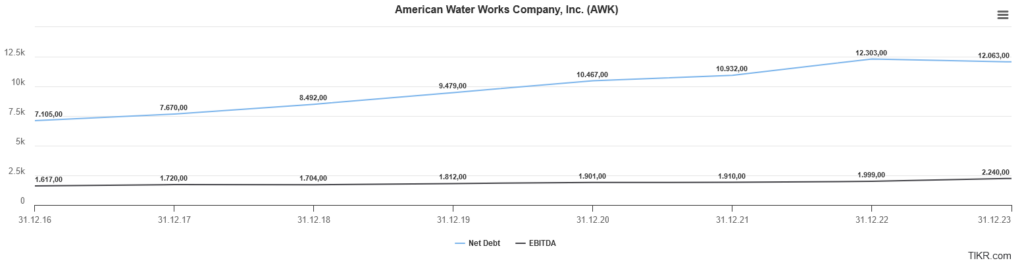
This also explains the superior performance in terms of Investment grade Rating of the creditworthiness of American Water Works by the well-known rating agencies.

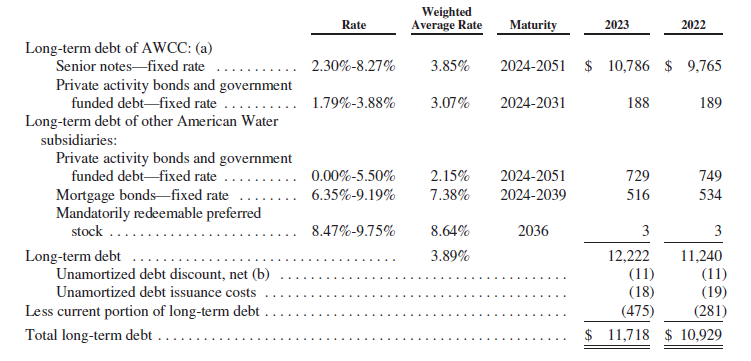
Around the topic Indebtedness and External financing it makes sense to look at the Interest profile and the Maturity structure of current liabilities. Finally, it is important to assess how vulnerable the company appears to be to the persistently high key interest rates and to what extent new financing or rescheduling of existing debt will be necessary in the near future. Up to End of 2026 a total of USD 2.57 billion of the non-current liabilities will fall due.
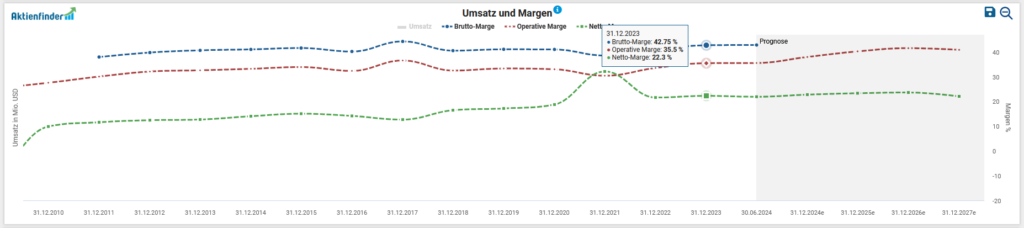
Finally, we look at the Profitability of American Water Works based on the development of gross, operating and net margins. The upward trend in recent years impressively underpins American Water Works' margin strength compared to its competitors. The net margin has almost doubled in the last ten years.
Opportunities & risks
The capital-intensive basic investments and the costly maintenance of the established infrastructure act as a barrier to competition for the utilities sector. Likewise, the value of critical infrastructure - especially water supply - is of national and public interest and therefore a sensitive domain for foreign acquisition efforts. This strengthens the existing market position of American Water Works in a non-cyclical sector.
While the existing business provides reliable cash flows, the US company is pursuing an ambitious investment program which, in addition to the mandatory maintenance of existing properties, also focuses on the further acquisition of regional water suppliers. The process of acquisition and the subsequent integration of the acquired utilities into the overarching business model is "business as usual" in the corporate practice of American Water Works. In the non-regulated business segment, there is still potential for expansion in the "Military Services Group", which should serve to achieve a higher degree of diversification in earnings streams.
One negative aspect of investments in the utilities sector illustrates the dependence on political decision-makers at both municipal and federal level when it comes to pricing. The approval of the regulator is required for the implementation of price increases or their inflation-related indexation. These procedures may be delayed by the so-called Public Utility Commission (PUC) significantly prolonged ("regulatory lag") and affect the profitability of water suppliers in the short to medium term. Possible legal disputes and claims for damages in connection with reduced water quality (e.g. water pipes made of copper or lead) could be very costly.
High expenditure is undoubtedly required to maintain and expand operations. In times of high interest rates for fresh borrowed capital, this can be an obstacle to further growth in view of the ambitious investment program for financing new projects. The development of long-term debt represents a financial risk. The average interest rate on long-term debt is currently 3.9%. The maturity structure of debt up to 2027 shows an annually increasing volume of repayment obligations.
Current valuation of the America Water Works share
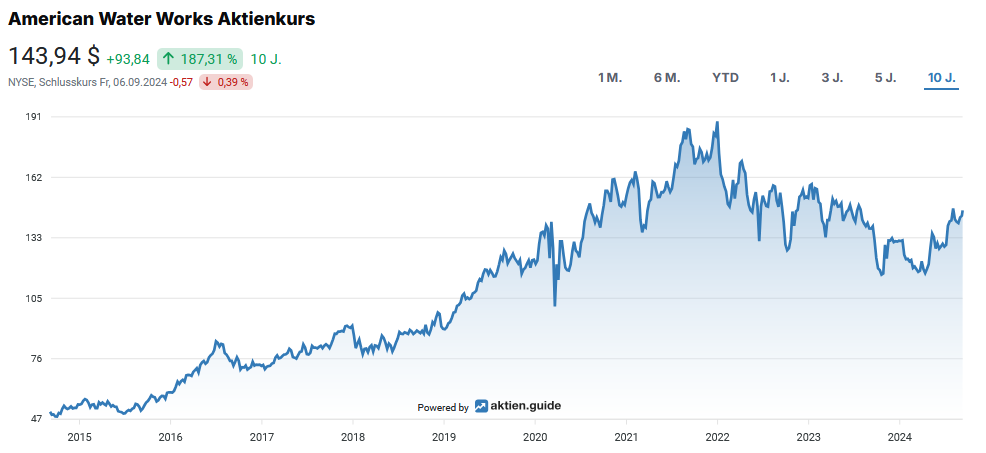
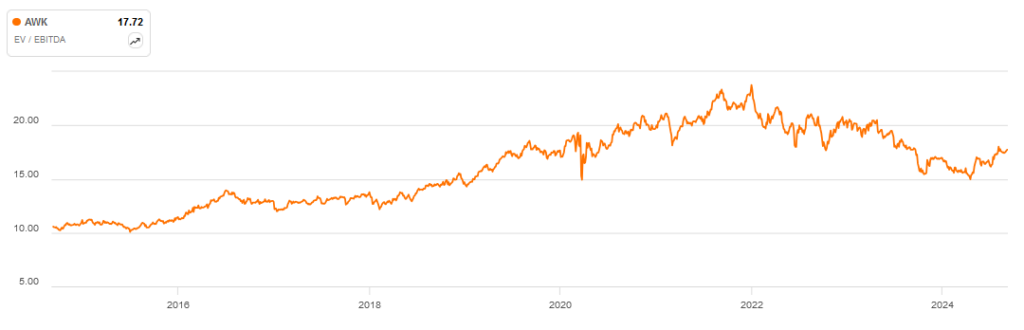
For the valuation of companies, I use the so-called Enterprise Value (EV) is used. In the case of a takeover, the EV indicates the amount required to purchase the assets required for operations and excludes the non-operating assets. I relate this key figure to operating profitability (before interest, taxes and investments (CAPEX)), expressed as EBITDA. The prevailing opinion is that a value of less than 10 indicates a „healthy valuation“ - as is always the case with generic Rules of thumb the company-specific context must be considered in the analysis by the careful investor himself. In the case of American Water Works, we have to consider a similar Valuation result of 17.7 not far in the past, the water supplier has been somewhat cheaper to purchase in recent months:
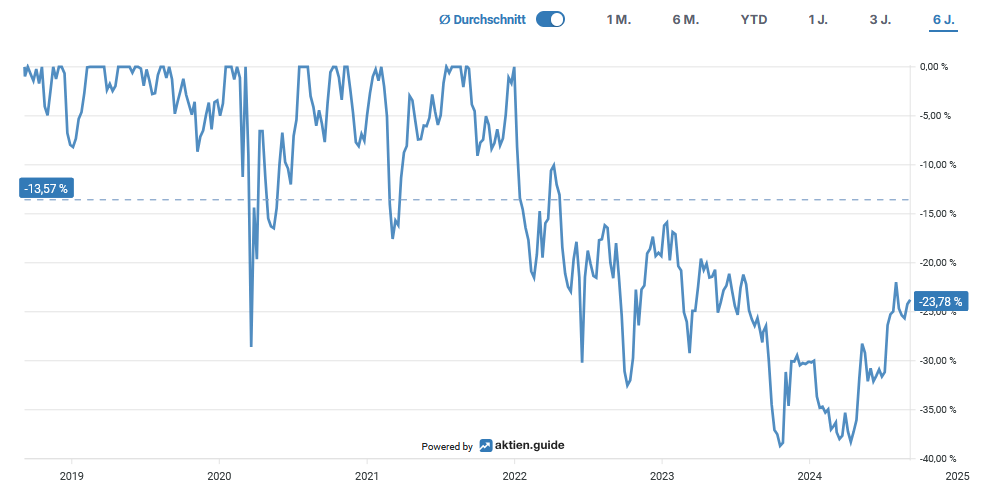
The Maximum decrease in the last six years amounted to approx. 38 Prozent in April of this year:
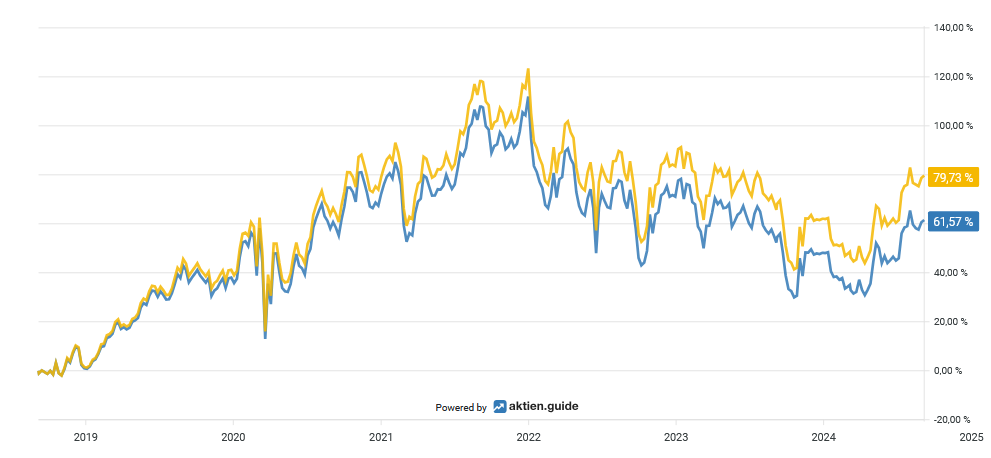
Over the past six years, an investment in America Water Works has yielded Total Return, including dividends received, a Overall performance from 79.7 percent for the investor:
Capital allocation
Looking at the immaculate Dividendenhistorie it is noticeable that American Water Works has been paying out a dividend that has grown every year since its IPO in 2008. This streak of dividend increases has now lasted for 17 years:
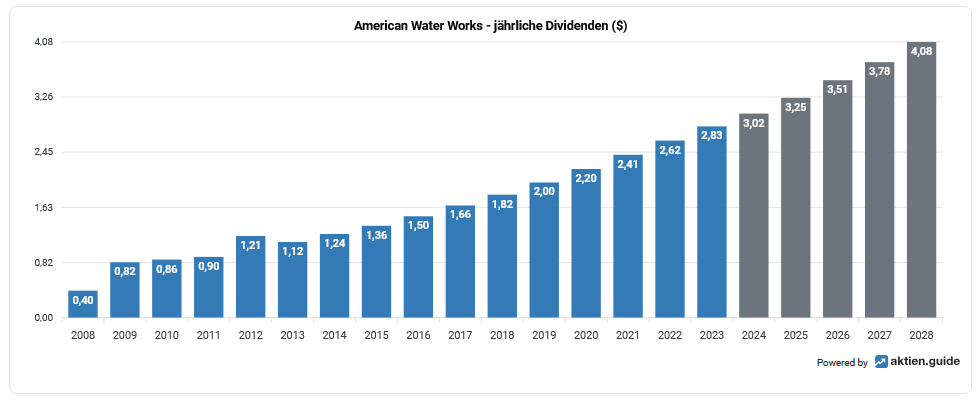
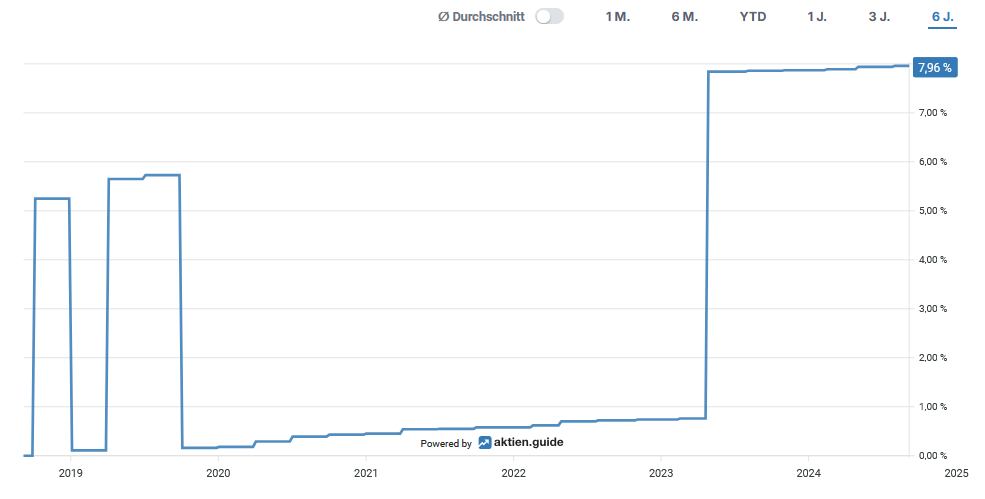
At the current share price of USD 143.94, this results in a Dividend yield from 2.1 percent. The Five-year dividend growth rate amounts to 9.3 percent p.a. or 9.8 percent p.a. in the Ten-year period. The company last increased its share price in May of this year by 8.1 percent the dividend. To round things off, here is an overview of the last five dividend increases:
- 2024: +8,1 %
- 2023: +8,0 %
- 2022: +8,7 %
- 2021: +9,6 %
- 2020: +10 %
The quartalsweise ausgeschüttete Dividende beträgt aktuell USD 0.765 per share and is paid out at the end of each quarter (March, June, September, December). If we take the average free cash flow of the last three years as the basis for determining the payout ratio, we end up with a result of 100% for the year under review. Payout ratio. At profit level, we see a payout ratio of around 60%. This reference figure is the relevant benchmark for utilities as, apart from capital investments, the entire cash flow is usually distributed to shareholders. This is mainly due to the fact that the regulator gives utilities a quasi-guarantee for the revenue side. On the other hand, the contracting authority has little joy with water prices at the expense of customers. Taking these special features of the utility sector into account, the financing of new infrastructure projects through secured funding as well as the progressive dividend policy of AWK is understandable and not at all contradictory, although a one-sided view of the cash flow statement might initially suggest this.
The Number of shares outstanding increased about 1.3 percent per year respectively 8 percent accumulated over the past six years. The issue of new shares to finance future projects is not atypical for capital-intensive sectors such as utilities. This component of capital allocation is therefore not actively used by management.
Conclusion: Considerations for my decision to invest in America Water Works
The question of whether investors should even include companies from the utilities sector in their portfolio is a fundamental decision. If you want to diversify your portfolio in this defensive sector, then an investment in water utilities can be part of your strategy. The share price of America Water Works has been moving north again for several months. It is still a good 20 percent short of its 2021 high. The ambitious capital investments are in line with American Water Works' strategic goals and identified growth drivers to drive scaling through inorganic growth. According to the management's ambitious plans, the customer base is to grow by two percent per financial year.
Thanks to strict cost management, American Water Works has an industry-leading net margin in its peer group, which has almost doubled in ten years. The existing business provides reliable cash flows that enable investments in the further development of the business model, an owner-friendly capital allocation and the expansion of the earnings base through inorganic growth.