The world of Real Estate Investment Trusts (REITs) consists of far more than just US real estate companies such as Realty Income (TWS abbreviation: O) or Prologis (TWS abbreviation: PLD). In the article "REITs worldwide - interesting REITs Outside the USA", we take a look at exciting international REITs that investors should have on their radar. We look at their business models, talk about their valuation and show what interested investors should look out for.
Xior Student Housing
business model
Xior Student Housing (TWS abbreviation: XIOR) is a European REIT specializing in student housing. With a portfolio focused on major university cities in Belgium, the Netherlands, Spain, Portugal, Poland, Denmark, Sweden and Germany, XIOR addresses a growing market that offers stable and sustainable growth opportunities. Cash flows yields. The demand for student residences continues unabated (there are de facto hardly any vacancies), as more and more young people are studying in the metropolitan areas.
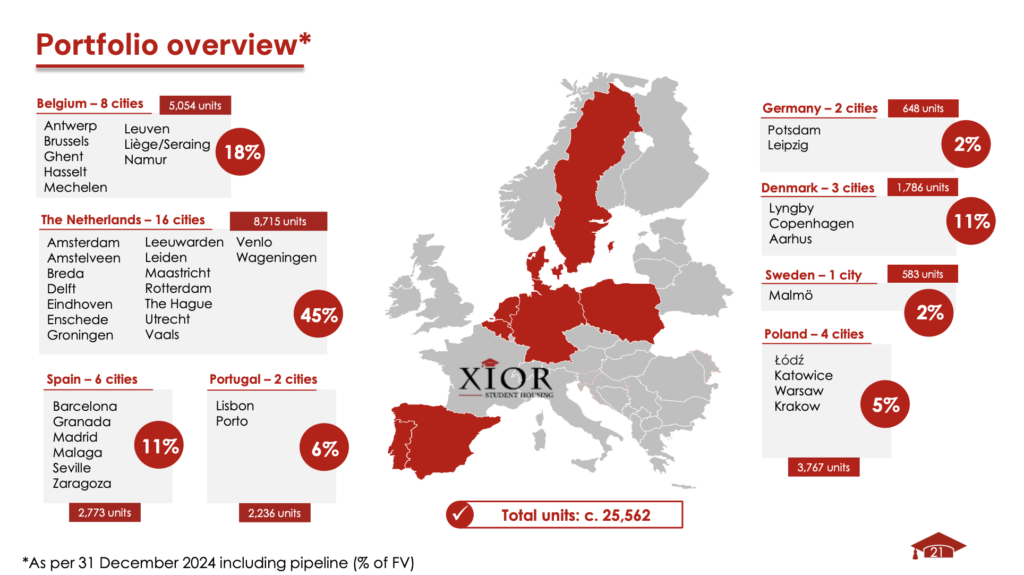
In addition, the company is also involved in the development of new student residences and is actually developing quite a few. This is probably one of the reasons why the debt is somewhat higher, at least higher than that of US REITs.
Kennzahlen
The higher level of debt referred to is >11x net debt/EBITDA at XIOR. The development arm would actually have to be factored out, but even then it is high in comparison, but completely within the range for European real estate companies. The LTV (loan-to-value) ratio, which indicates the ratio between a loan and the value of the financed property(ies), is a more commonly used key figure in Germany. This is slightly below 50%. As with all REITs, it is always important to keep an eye on the upcoming maturities. Significant refinancing is required from 2026 onwards. Incidentally, the interest costs amount to 3.10% and are likely to fall over time.
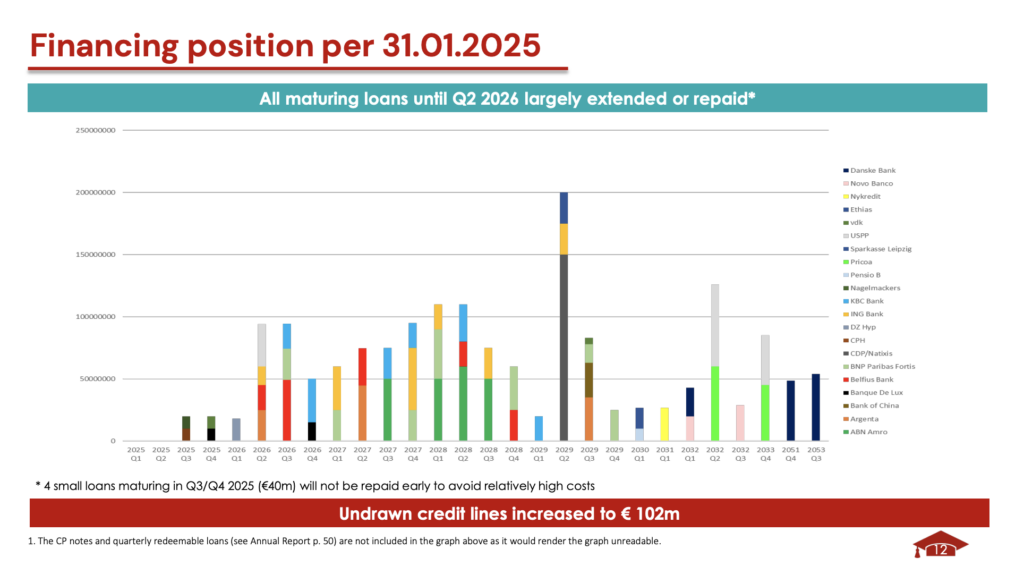
Another important key figure for REITs and ultimately almost all real estate shares is the net asset value (NAV). According to the latest publications, this is almost exactly €40 per share. The share price, on the other hand, is ~€27, so we have a significant NAV discount of >€30% here, which is also reflected in the P/FFO. This is also reflected in the P/FFO, which is around 12.5x, but has historically averaged 20x. The dividend yield is currently around 6.5%.
What to look out for?
The management's current focus is on debt reduction, but interested investors should keep an eye on the progress made here. And then there is the issue of taxes: Xior Student Housing is based in Belgium, which means that 30% withholding tax is payable on the dividends received. However, 15% of this can be reclaimed.
Corporacion Inmobiliaria Vesta
business model
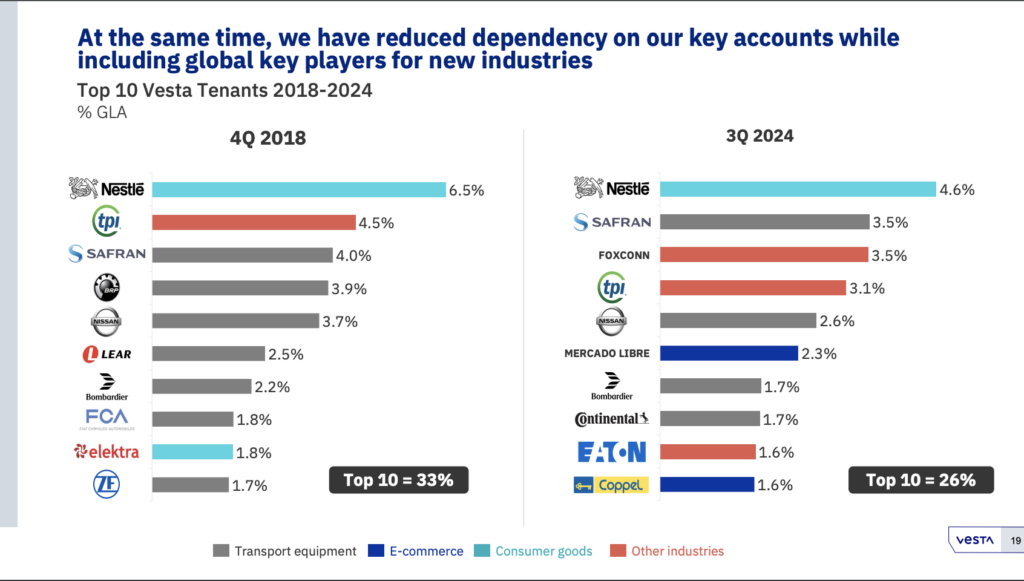
From Europe, we move back across the Atlantic, but not to the USA or Canada, but to the United States' other neighbor, Mexico. Corporacion Inmobiliaria Vesta (TWS abbreviation: XIOR) is a Mexican REIT that can benefit from megatrends such as nearshoring and rising punitive tariffs on Asian products (assuming the threat of punitive tariffs against Mexico does not materialize. VTMX has been listed on the NYSE since 2018. The company operates logistics and industrial properties, which are particularly interesting for companies that (want to) relocate their supply chains closer to the US market. The properties are very modern and the vacancy rate is currently quite low at ~4%. The portfolio is very diversified and the tenants include many well-known global companies.
Evaluation
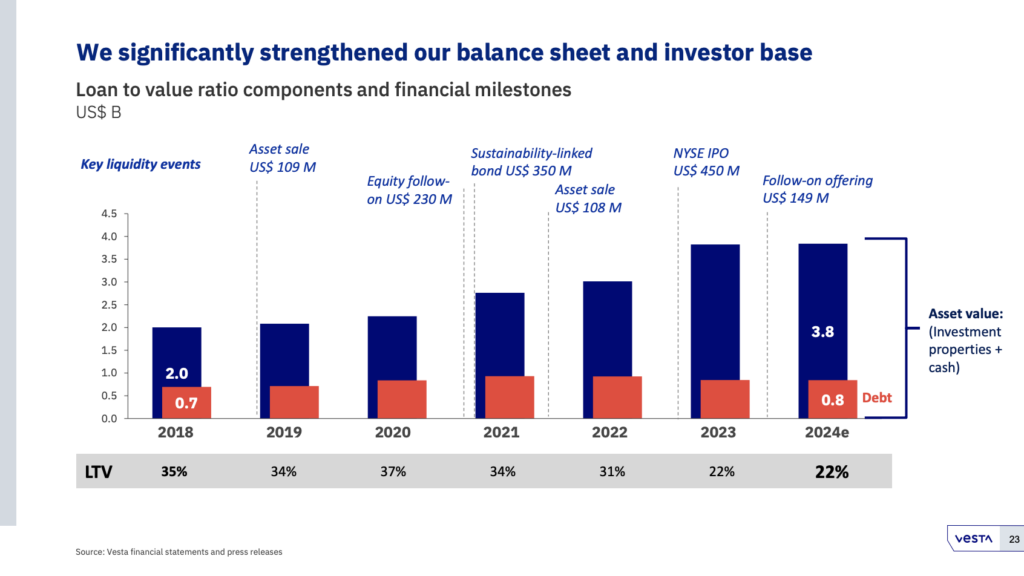
VTMX also has a decent NAV discount of >30%. But the Mexican REIT is also growing very strongly, with funds from operations at 10% p.a., for example. The P/FFO is 12-13x, the dividend yield slightly below 3% (fluctuates somewhat due to currency effects) and the dividends themselves are to be increased by 5% annually. Interesting is the low net debt/EBITDA of approx. 5.5x and LTV of only 22%. Overall, VTMX has a rare combination of massive undervaluation with strong growth potential.
What to look out for?
VTMX will certainly have to keep an eye on what the Trump administration has planned. Any punitive tariffs that come into force and a corresponding escalation are likely to have a negative impact on the share.
Big Yellow Group
business model
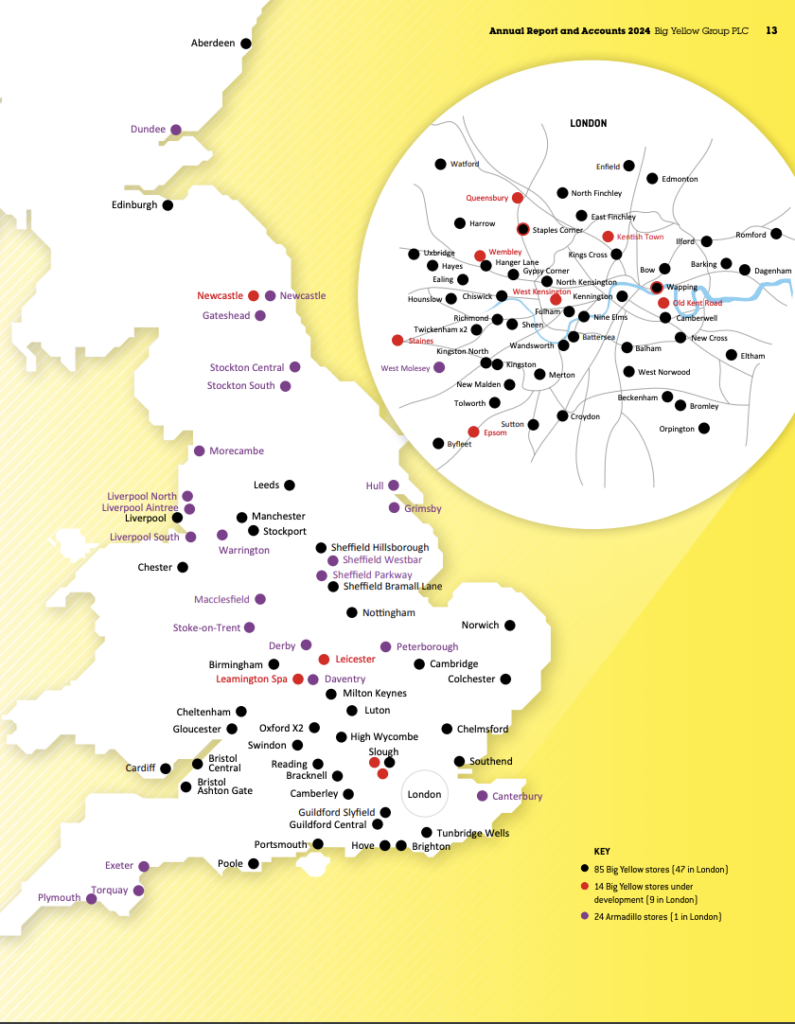
And once again we are heading back across the pond, this time to the UK. The Big Yellow Group (TWS ticker: BYG), which operates self-storage units, is based there. Self-storage is the REIT sector that has historically been the most profitable in the USA. BYG is trying to replicate the business model used by major players such as Public Storage (TWS ticker: PSA). Historically, it has been very successful, even if the last few years have been difficult.
Evaluation
P/FFO for the Big Yellow Group is 16-17x. Here, too, we have a NAV discount of around 30%. Interestingly, the net asset value has even risen recently. However, all this is well below the historical valuation of 21-22x. However, the vacancy rate (approx. 20%) has increased in recent years and rental growth has only been homeopathic because the supply of development projects coming onto the market has increased in times of pandemic. BYG also pays a nice dividend, the dividend yield is currently >5%.
What to look out for?
BYG will certainly also have a weaker year in 2025. Things could pick up again from 2026, but you should check whether this is also reflected in the quarterly reports (vacancy rate, rental growth). The withholding tax must also be taken into account. While "regular" UK shares are almost always exempt from withholding tax, this does not apply to UK REITs. Here, 22% withholding tax applies.
Segro PLC
business model
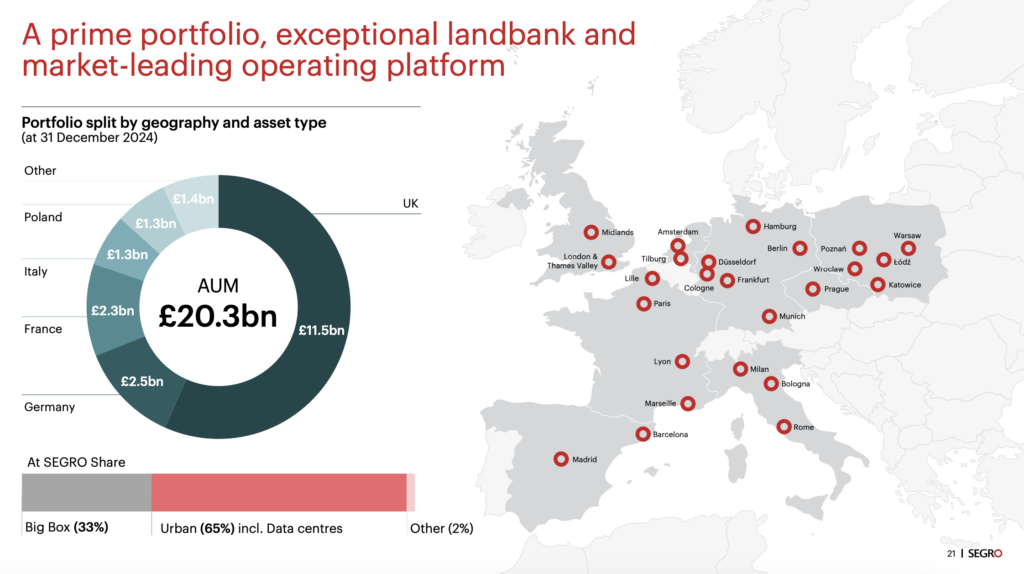
We are staying in Europe and the UK, but changing the REIT sector to Segro PLC (TWS ticker SGRO). This is one of the largest REITs in Europe with a focus on logistics and industrial real estate. It is represented in virtually every EU country, especially in the metropolitan regions, which have high entry barriers for peers. Although Segro is a British company, its portfolio is strongly focused on continental Europe.
Evaluation
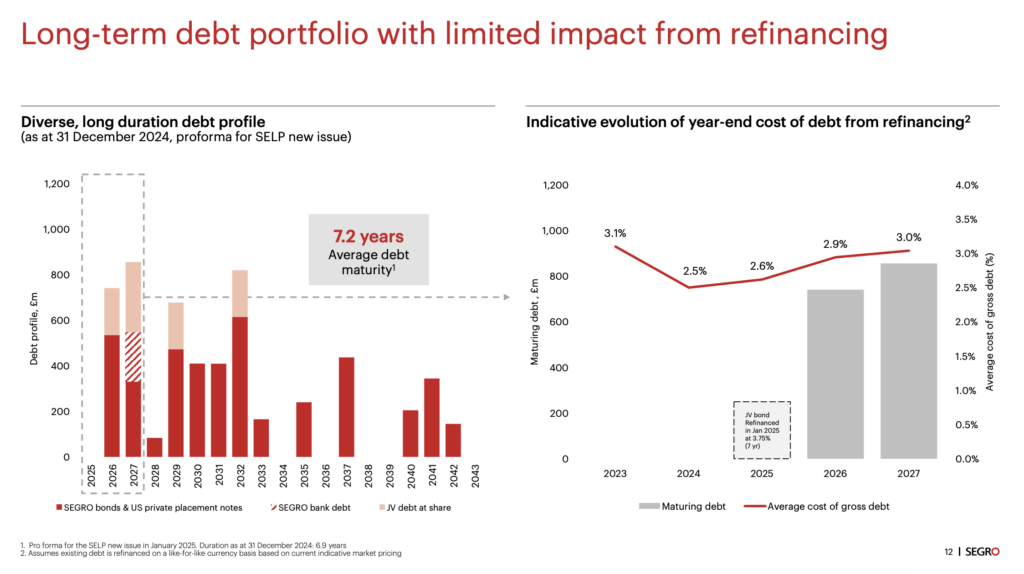
SGRO also has a decent discount to NAV of almost 30%, in the past the stock was valued at a premium. The P/FFO multiple is also currently around 20x, but historically 27x. Despite being in a different sector, the reasons are the same as for Big Yellow Group and the same that many REITs have to contend with, namely the rise in interest rates and a period in which many development projects were completed and had an impact on the occupancy rate and rental growth. On a positive note, Segro's relatively low level of debt (LTV approx. 20%) and the long (average) term of the maturities should be emphasized. Refinancing is not due again until 2026. The dividend yield is just over 4%.
What to look out for?
Segro PLC is also subject to 22% withholding tax on dividends if they are derived from real estate income.
Options trading
I myself am also active as an options trader, but almost exclusively as a so-called "Style holder". Therefore, I am naturally also interested in these REITs, which options are suitable for additional cash flow or for a favorable entry by means of a tender offer. Unfortunately, option chains are only available for SGRO, and it should be noted that the lot size is 1000, as they are traded on the London Stock Exchange.
Segro PLC
SGRO offers options with a Strike of 675 GBX in March or with a longer term with Strike 625 GBX in Octoberwhich, despite the lower volatility (VIX) and the high spread, still offer halfway reasonable premiums.
Conclusion
The blog post now presents four REITs outside the USA that also operate in different sectors. They have one thing in common, namely a significant undervaluation. Of course, this also applies to US REITs, but you have to take a closer look to find such attractive stocks. The article also shows that there are many opportunities in the REIT sector if you think outside the box, as the four companies mentioned are only a fraction of the investment opportunities.