


There are several ways in which you can protect yourself against inflation. One of the most effective methods is to diversify your assets. The best way to do this is to invest in Various investmentswhich tend to be less susceptible to the effects of inflation.

The most important in a nutshell
- Diversification is crucial: A mix of equities, options and commodities offers the best protection against inflation.
- Blue chip shares provide long-term protection: Stable companies with high pricing power and dividends are a proven strategy.
- Options offer flexibility: Options trading can be used both to hedge and to increase profits.
What is inflation protection and why is it necessary?
Inflation protection refers to measures and strategies to maximize the value of your money or investments before the Reduction in purchasing power due to inflation to preserve.
Inflation means that the prices of goods and services rise over time, making your money worth less. Without inflation protection, your assets lose value in real terms, even if you own the same nominal amount.
Correctly applied inflation protection allows you to benefit from the following advantages:
- Maintaining purchasing powerIf you simply leave your money in an interest-free current or call money account, it will lose value through inflation.
- Compensation for the rising cost of livingThe cost of housing, food, energy and other everyday products rises in line with inflation. Without appropriate measures, you will have less money available in real terms.

The best protection against inflation: trading options
Options trading allows you to profit from both rising and falling prices and at the same time hedge your capital against inflation. While many investors consider Inflation protection on real estate, options offer a flexible and cost-effective alternative.
Especially in times of high inflation, volatile markets are not uncommon. With options, you can speculate on price changes in a targeted manner and Hedging shares.
Good to know:
Inflation describes the increase in prices for goods and services over a certain period of time. An annual inflation rate of 3 % means that a basket of goods that costs €100 today will cost €103 in a year's time. This reduces the purchasing power of money.
Options trading not only offers you a Hedging against market fluctuationssuch as the Witches' Sabbathbut also an active Source of incomewhich helps you to in stagnating or falling Markets Profits to achieve.
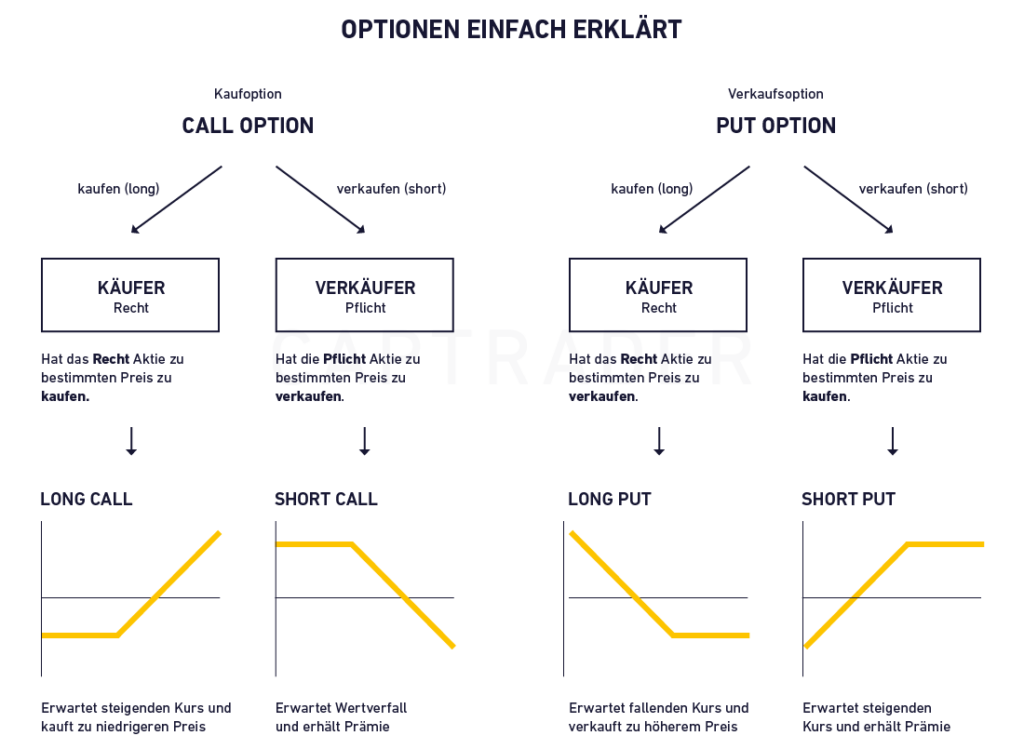
Options are financial derivatives that give the buyer the LawThe option to buy or sell a certain underlying asset (e.g. a share, an index or a commodity future) at a predetermined price (strike price) within a certain period or on a certain maturity date.


The two main types of options
- Call options: They give the buyer the right to purchase an underlying asset at a certain price. buy. Call options are often used when prices are expected to rise.
- Put options: They give the buyer the right to purchase an underlying asset at a certain price. Sell. Put options are used to speculate on falling prices or to hedge a portfolio against losses.
Important terms in options trading
- Underlying: The asset to which the option relates, e.g. a share or an index.
- Strike price: The price at which the buyer can exercise the option.
- Running time: Options have a fixed expiry date.
- Premium: The price that the buyer of the option pays to the seller.
- American vs. European options: American options can be exercised at any time before expiry, European options only on the expiry date.
Popular option strategies for inflation protection at a glance
There are different methods that options traders use to make money on a daily basis while effectively protecting against inflation. The most popular strategies are:
Covered calls (sale of covered call options)
Covered calls are one of the most popular and simplest strategies for investors who already hold shares in their portfolio.
The idea is to sell call options on shares that you own in order to receive an option premium. This premium represents a direct income and can significantly increase your return, especially if share prices move sideways or rise only moderately.
However, there are also risks: If the share price rises significantly above the strike price of the sold option, you have to sell the share at a lower price, which means you miss out on potential profits.
This strategy is therefore particularly suitable for investors who have a slightly bullish or neutral market expectation and are prepared to potentially sell their shares. The advantage is that you collect the premiums even if the share does not move or falls slightly.
Protective puts (hedging through call options)
One of the best ways to hedge against a sharp fall in share prices is to buy put options. This strategy works like an insurance policy: you pay a premium for the option, but have the right to sell your share at a predetermined price.
If the share price falls drastically, the profit from the put option compensates for the losses.
This strategy is particularly useful for investors who hold long-term equity positions but want to hedge short-term downtrends. The disadvantage is that you have to pay a premium for the option, which can reduce the return if the share remains stable or rises.
Cash-secured puts (sale of collateralized put options)
Selling put options is an often underestimated strategy that allows you to buy shares at a lower price while earning a premium.
You sell a put option on a share that you want to buy anyway and make sure that you have enough capital to buy the share if the strike price is reached.
If the share price does not fall below the strike price, you keep the premium as a profit. If the share price falls below the strike price, you still have to pay this for the share purchase.
This strategy is ideal for investors who want to buy shares anyway but want to achieve an extra return.
Spread strategies: Combined options to minimize risk
Another approach for advanced investors are so-called Spread strategieswhere you several options at the same time buy and sell. These strategies help to Risk and the capital expenditure to reducewhile at the same time attractive returns can be achieved.
- Bull Call Spread: You buy a call option with a lower strike price and simultaneously sell a call option with a higher strike price. This reduces the costs of the trade, but also limits the maximum profit.
- Bear Put Spread: Here you buy a put option and simultaneously sell a put option with a lower strike price. This strategy is suitable if you expect prices to fall but want to limit your risk.
- Iron Condor: A strategy for sideways markets where you simultaneously build a bull put spread and a bear call spread to capture premiums.
With Spread strategies can You precise Definehow much you maximum Win or lose which makes them a valuable addition to any trading portfolio.
By applying these options strategies in a targeted manner, you can not only improve your Portfolio gegen Inflation securebut also regular Revenue generate.
Especially in times of economic uncertainty, it is essential to rely on diversified trading strategies and to manage your own risks in a targeted manner.
Who the Options trading professionally should deal intensively with these methods and become more familiar with the subject of Trading Learn and the technical analysis employ.
Options vs. warrants: Important differences
Many beginners focus too much on individual aspects and confuse basic financial instruments such as options and warrants. But there are crucial differences. While real options are traded on futures exchanges such as Eurex or CBOE, warrants are derivatives issued by banks.
This means that they are often less flexible and more expensive. If you want to be successful in the long term, you should familiarize yourself with the difference between Options vs warrants to deal with.
Reliable inflation protection is better achieved with options trading.


Blue chip shares as an alternative inflation hedge
In addition to options, there is another tried-and-tested method: investing in Blue chip shares. These are shares in established, financially stable companies with high market capitalization.
Why are blue chip stocks an effective inflation hedge?
The attractiveness of blue chip shares as a hedge against inflation lies in several factors. Firstly, these companies have a High pricing power. They are able to pass on rising costs for raw materials, production and wages to consumers without their sales suffering as a result.
This means that profit margins can remain stable or even increase even in times of high inflation.
Secondly, many blue-chip companies offer an attractive and steadily growing dividend yield. Dividends are regular distributions to shareholders that not only provide a stable source of income, but also compensate for inflation-related currency devaluation.
Companies such as Nestlé, Johnson & Johnson and Procter & Gamble are among the so-called "Dividend Aristocrats". These are companies that have increased their dividends for at least 25 consecutive years. This enables investors to generate passive inflation protection through regular income.
Another decisive advantage is the stable price performance. While speculative investments and technology shares often suffer heavy losses during economic downturns, blue chip shares are more stable due to their market position and solid financial basis. This makes them an attractive long-term investment for investors who not only want to protect their assets, but also build them up continuously.
Finally, many blue-chip companies benefit from economic megatrends that exist independently of short-term economic fluctuations. Companies in the healthcare, consumer goods or energy sectors are essential to everyday life, which gives them a structural resilience to inflationary phases. They therefore not only offer protection against inflation, but also a sustainable growth perspective.
Which sectors are suitable as inflation protection?
Not every sector reacts to inflation in the same way. Some economic sectors are better equipped to withstand rising prices than others. Choosing the right sector is therefore crucial for successful inflation protection with blue chip shares.
1. consumer staples: everyday consumer goods as stable protection against inflation
Companies from the Consumer staples (Consumer Staples) are particularly resistant to inflation. These include manufacturers of Food, beverages, hygiene articles and household products.
These are goods that are in demand regardless of the economic situation. Consumers can afford to reduce their purchases of luxury goods, but they still need basic products such as soap, detergent, food and drinks.
This persistently high demand gives companies enormous stability. In addition, many of these companies are able to pass on rising raw material or transportation costs to their customers.
Brands such as Nestlé, Unilever and Procter & Gamble have a high recognition value and a loyal customer base that is prepared to pay higher prices for quality.
The following brands can probably be found in most households in Europe and North America. This is your chance to benefit from the huge demand.
Another advantage of this sector is the strong Dividendenhistorie of many companies. Companies like Coca-Cola or PepsiCo have continuously increased their dividends for decades, providing investors with a steady stream of income.
In combination with stable demand and pricing power, consumer staples stocks offer an excellent opportunity to hedge against inflation.
The following table lists international companies from the consumer staples sector, including their ISIN:
| Company | ISIN | Industry | Country |
| Nestlé | CH0038863350 | Food & Beverages | Switzerland |
| Procter & Gamble | US7427181091 | Household products | USA |
| Coca-Cola | US1912161007 | Drinks | USA |
| PepsiCo | US7134481081 | Food & Beverages | USA |
| Unilever | GB00B10RZP78 | Food & household products | Great Britain |
| British American Tobacco | GB0002875804 | Tobacco | Great Britain |
| PowerHeinz | US5007541064 | Food | USA |
| Altria | US02209S1033 | Tobacco | USA |
| Kimberly Clark | US4943681035 | Household products | USA |
| Walmart | US9311421039 | Supermarkets | USA |
| Target | US87612E1064 | Supermarkets | USA |
| Anheuser Busch | BE0974293251 | Drinks | Belgium |
| L'Oréal | FR0000120321 | Care products | France |
| Beiersdorf | DE0005200000 | Care products | Germany |
| Lindt & Sprüngli | CH0010570767 | Food | Switzerland |
2. energy industry: profiteers from rising commodity prices
Companies in the energy sector often benefit directly from inflation. The prices for Oil, Gas and others Raw materials often rise sharply during inflation-driven market phases, which Energy companies higher Turnover and margins. This makes them a natural inflation hedge for investors.
Oil and gas giants such as ExxonMobil, Chevron or Shell are among the biggest beneficiaries of high inflation. As energy consumption continues to rise globally and investment in renewable energies is also increasing, these companies can benefit from both short-term commodity price increases and long-term structural changes in the energy market.
Another inflation-resistant option in this sector are companies in the renewable energies. Companies like NextEra Energy or Iberdrola are investing heavily in solar and wind energy and benefiting from government subsidy programs and rising demand for green energy.
The following companies from the energy industry, for example, could benefit from rising commodity prices:
| Company | ISIN | Industry | Country |
| ExxonMobil | US30231G1022 | Oil and gas | USA |
| Chevron | US1667641005 | Oil and gas | USA |
| Shell | GB00BP6MXD84 | Oil and gas | Netherlands/UK |
| NextEra Energy | US65339F1012 | Renewable energies | USA |
| Iberdrola | ES0144580Y14 | Electricity and renewable energies | Spain |
| TotalEnergies | FR0000120271 | Oil and gas | France |
| BP | GB0007980591 | Oil and gas | UK |
| Eni | IT0003132476 | Oil and gas | Italy |
| RWE | DE0007037129 | Electricity and renewable energies | Germany |
| E.ON | DE000ENAG999 | Electricity and renewable energies | Germany |
| Vestas Wind Systems | DK0061539921 | Wind energy | Denmark |
| First Solar | US3364331070 | Solar energy | USA |
3. healthcare sector: essential services with stable revenues
The healthcare industry is a defensive sector, as medical products and services are needed regardless of the economic situation.
Pharmaceutical companies, medical technology manufacturers and biotech groups benefit from ageing societies, increasing healthcare expenditure and innovative medicines.
Companies like Johnson & Johnson, Pfizer or Novo Nordisk have a strong market position and a diversified product portfolio. They are in a position to offset rising production and research costs with higher drug prices.
In addition, many medications are subject to Patent protectionwhich ensures stable and high profit margins in the long term.
The healthcare industry therefore offers a Solid mix of growth, crisis resistance and inflation protection. Investors benefit here not only from Stable dividendsbut also from long-term innovations that ensure steady growth.
Popular companies in this area include:
| Company | ISIN | Industry | Country |
| Johnson & Johnson | US4781601046 | Pharmaceuticals/medical technology | USA |
| Pfizer | US7170811035 | Pharmaceuticals | USA |
| Novo Nordisk | US6701002056 | Pharmaceuticals | Denmark |
| Roche | US7711951043 | Pharmaceuticals | Switzerland |
| UnitedHealth Group | US91324P1021 | Health insurance | USA |
| Novartis | US66987V1098 | Pharmaceuticals | Switzerland |
| BioNTech | US09075V1026 | Biotech | Germany |
| Intuitive Surgical | US46120E6023 | Medical technology | USA |
| Fresenius SE | US35804M1053 | Healthcare provider | Germany |
| Amgen | US0311621009 | Biotech | USA |
| Merck & Co. | US58933Y1055 | Pharmaceuticals | USA |
| AbbVie | US00287Y1091 | Pharmaceuticals | USA |
Open a custody account: The first step towards inflation protection
So that you can implement the investment strategies presented, you should first have a Open an accountwhich enables you to invest in various financial products, such as Value Aktienbonds, funds and other investment products.
A well-structured portfolio is the Foundation stone for every reliable Inflation protection. The reason for this is that, unlike cash or bank balances, these assets do not lose purchasing power and can even increase in value.


Conclusion: Inflation protection with options and blue chip shares
Inflation remains one of the biggest challenges for investors. While cash is losing purchasing power, targeted investment strategies can not only provide effective protection against inflation, but also enable long-term growth.
Options are a flexible tool that can be used both to hedge existing positions and to increase returns. Strategies such as Covered calls, protective puts and spread strategies help to minimize risks and generate regular income.
In addition to active options trading Blue chip shares one Long-term, passive alternative to inflation protection. Companies from the following sectors Consumer staples, energy, healthcare and utilities are particularly resistant to inflation, as they either have high pricing power or offer essential products and services.
Many of these companies have been paying steadily increasing DividendsThis makes them particularly attractive for investors who value regular income.
It is important for successful inflation protection, diversify the portfolio and combine different asset classes. While blue-chip shares offer long-term stability, options enable targeted management of risks and returns.
If you deal with these strategies, you can Not only compensate for inflation, but even profit from it.
