


Earning money conveniently from anywhere in the world sounds too good to be true, but online stock market trading makes it possible. However, the entry threshold is comparatively high: For lasting success, you must first learn and master trading.
In this guide, we have compiled the most important basic rules for newcomers and experienced traders. Professionals will also find practical tips that can optimize their returns.
The most important in a nutshell
- Learning to trade professionally is a time-consuming process. It can take time to achieve reliable profits
- Scalping, swing trading, day trading ... there are hundreds of possible strategies available. You need to find and master your personal approach
- Support is available in the form of signaling services and tipsters. There is also plenty of learning material available
- There are no shortcuts or secret tips that are lucrative in the long term. You need to learn trading and follow strategies consistently if you want to be successful in the long term
Learning to trade: How does trading work?
The concept of trading is very simple: you buy exchange-traded products such as shares or derivatives and then sell them at a higher price. The difference between the buying and selling price represents your profit. You repeat this process as often as possible to generate a high income.
Of course, it's not quite that simple in practice. You have to correctly predict the price trend, you need capital for the purchase and you also have to pay taxes and fees. In the following guide, we look at all three problem areas as well as other areas that are important for online trading.
If you trade regularly, failures and losses are inevitable. No trader has a one hundred percent hit rate! The plan is much more, maximize profits and minimize losses. If successful, this results in a positive overall balance. Active trading is associated with high risks and a large number of participants are left with losses in the long term!
Despite the dangers, stock market trading and its potential profits are very appealing. Once you have reached a point where you can reliably generate a positive return, the approach can be scaled up almost infinitely. By investing more capital and using higher leverage, your profit will then increase further.
A popular target for traders is an annual return of 12 % or 1 % per month. In this case, the actual income (in euros or dollars) depends on the available capital. Once you have mastered trading, a high return is also possible. Day trading profit per day möglich.
Learning to trade is made more difficult by the huge choice. You can use dozens of assets: Shares, ETFs, cryptocurrencies, commodities, foreign currencies and more are available. These can be used directly or through various derivatives (contracts based on an asset) for transactions.
The large number of underlying assets with their special characteristics and the huge number of financial tools make trading appear very complex. Our first tip is therefore to start by limiting yourself to an asset class that suits you very well (for example, because you already have previous knowledge, either professionally or for personal reasons) and to master them.


Basic strategies
Investing randomly in different investment products is not a bad approach. Statistically speaking, the random principle even beats the returns of the average private investor. However, if you want to learn how to trade and achieve reliable profits, this method is unsuitable: It is simply too unpredictable!
Instead, they need to find a strategy with which they can generate profit as continuously as possible. You have a wide range of options at your disposal. For example, you can divide them according to the trading period:
- Extremely fast strategies how the Scalping rely on buying and selling every second. The smallest profits - often just a fraction of a percent - add up to a positive overall return. Due to the high speed, extensive automation and the use of computer-controlled pattern recognition and signal services are common.
- Trading strategies with a Term of maximum one trading day are referred to as day trading. They are so popular among professional traders that the term is now used as an umbrella term for all types of trading. Generally speaking, more time is available in this form so that potential trades can be analyzed intensively. Who Earn money with day trading you can choose from a variety of Trading signals but should also use the Technical analysis and other "basics" of the trading world.
- Also Strategies with a term of more than one trading day are possible. This category primarily includes the Swing trading strategieswhere the typical up-and-down price movements are used. Due to the longer term, there is less pressure on the trader. These forms are therefore often used in Trading for beginners but professionals can also generate reliable profits with this rather slow form of trading.
- Very long investment periods fall under the category of "investing" and are no longer considered active trading. The main difference lies in the direct intention to sell: a trader wants to sell an asset quickly and make continuous profits. An investor, on the other hand, builds up a long-term portfolio and plans to sell much later (sometimes only after decades) with a high, one-off profit.

In principle All three forms of active trading are valid strategies, with which talented traders generate high profits on a daily basis. However, if you want to learn how to trade, slower approaches such as the Swing trading strategies an.
Here you have more time to analyze each transaction and apply your newly acquired knowledge. Later, when you have already executed hundreds of successful trades, the whole process is easier and faster strategies are possible.
Our second tip is therefore to start with the slower techniques first and to take more time for the analysis.
Money management and risk management
To act successfully, they must Money management and risk management learn. The Money Management deals with all issues relating to your own capital, for example how much you invest per position and when you "take" price gains.
In contrast, risk management refers to the risks associated with a trade. The most interesting question here is when these risks are worthwhile and how they can be effectively reduced. This is where the Hedging into play: Hedging your own positions to avoid or at least minimize losses.
Our guide on the subject provides a very good insight into the importance of hedging Delta hedging.
Both money and risk management are key components of your trading success. Without them, profits may not materialize despite the best strategy and excellent implementation. Due to their importance and close interaction, they are sometimes regarded as a single field.
We recommend that you first test money management and risk management intensively, if you want to learn how to trade. Ideally, you should use the Demo account oder das Papertrade-Konto from CapTrader, where you can trade risk-free in a realistic environment.
Learn margin trading
Even the best trader with the highest returns won't get far if he doesn't have the capital to trade! The rule of thumb is very clear: The more money you invest in a business, the higher your profit in the event of success. However, if your plan backfires, your loss will also be higher.
In order to maximize this effect and generate the greatest possible return, experienced traders use their own assets as well as Borrowed capital a. This debt trading is an important part of stock market success. If you want to learn trading for the long term, you should therefore also familiarize yourself with this aspect.
The simplest and most common version of leverage is margin trading. This involves traders borrowing additional funds from their broker. The loan is limited to a specific transaction, for example the purchase of a derivative.

The trader uses the additional capital to open a significantly larger position than would be possible with his own assets alone. This also increases his profit in the event of success, as well as the loss in the event of failure. Once the position is closed, the money is returned to the broker.
The trader may keep the profit from the entire transaction for himself - minus a lending fee charged by the broker. If there is a loss, the trader must also assume this and settle it with his own capital.
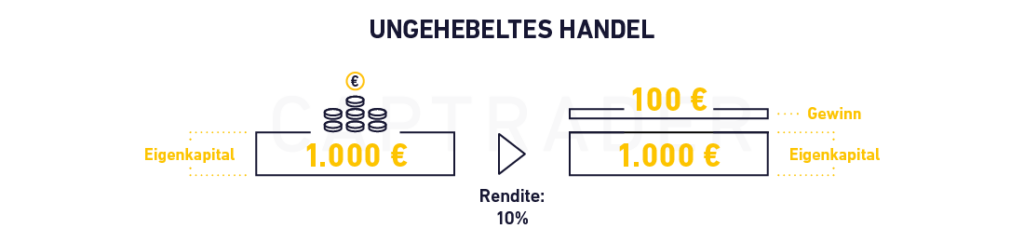
The broker can always track how the transaction is developing and keeps a particularly close eye on the borrowed capital. In the event of excessive losses, the broker will ask the trader to deposit additional money, reduce the position or close it so as not to jeopardize the loan - this is known as a margin call. In extreme cases, the broker automatically closes the position to limit losses.
Due to the amplification effect, such transactions are also referred to as "leverage". The use of leverage is an important part of professional trading. If you want to learn to trade, you therefore need to familiarize yourself with more than just leverage; You also need a broker that offers margin accounts!
Broker selection
The Choosing a suitable broker is a central component of successful trading. Not every provider is suitable for this: You need a large selection of different assets, favorable conditions and the option of margin trading.
Please also note the Number of trading venues: Shares are generally traded in higher volumes on their "home exchanges", which results in lower spreads. Also, if you trade other underlying assets or derivatives such as Trade options a corresponding selection is helpful to secure the best prices.
Many brokers are primarily aimed at private investors and are unfortunately unsuitable for budding traders: They do not offer margin trading or access to options, futures and other derivatives. If you want to learn how to trade, you should therefore choose a professional provider.
At CapTrader you will find with over 1.2 million securities guarantees the right product. With a Margin account you can use these titles very effectively in a wide variety of ways. The 150 stock exchanges available in 33 countries around the world contribute to your success.
Probably the greatest advantage, however, is the low fees be: With CapTrader, you can trade US shares from as little as $0.01 (order minimum: $2.00) and EU shares from 0.1 % of the order volume (order minimum: €2.00). Options are available from €2.00, FOREX pairs from €3.75 and futures from as little as €1.00.


Trading taxes
If you want to learn trading, sooner or later you will have to deal with the topic of Trading taxes deal with. Traders based in Germany must pay withholding tax on their profits of 25 % as well as the solidarity surcharge and, if applicable, church tax.
This means that just over a quarter of your return goes to the tax office. This makes it incredibly more difficult to trade profitably in the long term. Fortunately, however, there are some ways to reduce the tax burden:
- Individuals whose income tax rate is lower than the flat-rate withholding tax can use this to calculate their tax burden. They can arrange for a so-called "favorable tax treatment test", in which the tax authorities check whether relief is possible.
- For experienced traders with extensive assets, it may make sense to set up an asset-managing GmbH. This special type of company holds your capital in safekeeping in order to generate profits through investments or trading. Within the VvGmbH you benefit from extensive tax relief and Scope for structuring the offsetting of losses
- A tax advisor specializing in trading can provide invaluable services in avoiding overpayments.
A particularly effective but often overlooked method of saving on trading taxes is to use a foreign brokers. National providers must pay the final withholding tax directly to the tax office when they make a profit - foreign service providers are not obliged to do so.
Instead, you must inform the authorities of your income yourself as part of your next tax return. In extreme cases, there can be up to 20 months between the time you make a profit and the time you file your tax return (if the profit was made in January of a given year).
In addition, the tax office will need another few months to process your information. It can therefore easily take two years between profit and tax payment. During this period, the capital of an experienced trader generates further profits.
If we assume a typical target return of 12 % per year, this could generate additional income of 24 % - almost the same amount that is due under the final withholding tax! By using a foreign broker, you can therefore reduce the effective tax burden by up to one percent in the best case scenario.
CapTrader combines this advantage with a German headquartersAs a German company with German-speaking customer service, we offer you top-class service. From a legal point of view, however, we are a foreign broker and do not pay any withholding tax for you. With CapTrader, you can benefit from tax advantages without having to forego the convenience of a German service provider.
Trading diary
In a trading diary or Trading Journal retailers record their activitiesPositions, prices, times, profits/losses, trigger/signal for a trade, etc. Problems, cost traps and miscalculations can be discovered in a later evaluation. Positive results and surprising successes can also be found here and can then be reproduced in a targeted manner.
A diary like this helps us to act rationally and based on facts. Because the greatest danger to success on the stock market is always our own emotions: Greed, fear, anger or arrogance have so far brought down every trader concerned.
If you want to learn how to trade successfully, you first have to master your own emotions.
The sober evaluation of successes and failures in the trading journal allows us to define clear rules and optimize our activities. Ideal entry/exit points, position sizes, time periods and more can be precisely determined based on our written experience.
It is then much easier to implement these results in future trades. At the same time, the likelihood of our emotions gaining the upper hand and tempting us to make reckless decisions is reduced.
Our tip is therefore to create a journal as early as possible - ideally during the "demo phase" of your trading activity and record all transactions. The knowledge gained here will accompany you throughout your trading career and provide invaluable services!
First steps: Learn to trade and put it into practice
In general, it is possible for anyone to learn and successfully implement trading. People who have the following characteristics are particularly suitable:
- Good knowledge of the financial market and experience with various investment products
- Affinity and interest in statistics and mathematics
- Good ability to concentrate and detail-oriented way of working
- Can keep a cool head and is not prone to emotional or knee-jerk reactions
- Has sufficient capital available to start trading activities
- Has a steady income/is financially secure and is not under pressure to learn to trade and make a profit as quickly as possible
- Sufficient time to learn and try out trading in practice
If you do not fulfill one or more of these points, you do not have to write off trading just yet: With the appropriate discipline, any shortcomings can be easily overcome. There are also various tools at your disposal. For example, you can partially automate processes to avoid emotional decisions.
However, if the requirements do not match your personality at all, it makes sense to rethink. In addition to trading, there are other ways to operate successfully on the financial markets. For example, with a CapTrader you can Managed account rely on the expertise of professional traders and make attractive profits without having to do anything yourself.
Interestingly, women are not only better investors on average (they achieve around 1 % more return per year), but are also significantly more effective at trading. Studies showThis is because female traders carry out fewer transactions and examine each individual position more closely. They also act less emotionally than their male counterparts, which pays off especially during crises and setbacks.
This does not mean that men have to throw in the towel; however, it makes sense to take female traders as an example and act with more prudence, calmness and a cool head.
Step-by-step instructions
The individual building blocks of trading are easy to understand, but often difficult to put into practice. In addition, the many aspects can often be overwhelming, especially for newcomers. In order to learn trading effectively, we have therefore developed a Step-by-step instructions compiled:
- Create a Demo account at CapTrader. This account offers you the opportunity to access all the functions of a real CapTrader account in a realistic environment. However, you are using "play money", so there is no risk to your capital. If you want to learn to trade, this Demo account will be an indispensable companion for the first few months, helping you to master various strategies, technical analysis, money management and more.
- Select an asset class and strategy. Ideally, you already have a personal connection, prior knowledge or particular interest in an asset class. If not, we recommend starting with shares, as these are particularly "tangible" and easy to understand. In terms of strategy, swing trading for beginners has proven its worth. In this form, positions remain open for several days or even weeks, which reduces pressure and makes mistakes easier to control.
- Familiarize yourself with your chosen asset class and strategy. In addition to the CapTrader Blog, Webinars and Analyses there is a wealth of other learning materials available to you on the Internet. In this context, we can also recommend the further training courses offered by TraderFox recommend. Unfortunately, there are also numerous dubious providers with dubious methods in this area. You should therefore check paid offers (e.g. through independent customer reviews) before investing money in a training program.
- Learn the basics of money management and risk management. It is not necessary to master both aspects at first; a solid basic knowledge is sufficient to create your first trades in a test environment.
- Select a suitable signaling serviceto discover meaningful trades. These service providers provide you with ideas for potentially lucrative positions that you simply have to put into practice. They can provide valuable insights, especially for people who are just learning to trade.
- Put your strategy into practice in the CapTrader demo account. Use the tips from your signal service or determine yourself which positions could be lucrative. Follow the basic rules of money management and risk management. CapTrader offers you a standard amount of € 100,000 play money in the demo account to start with.
- Record all trades in your trading journal. Regular evaluations, for example once a week, reveal problems and potential. Then adapt your strategy to these findings in order to further optimize your approach.
- If you have reliably achieved a positive return over several weeks and dozens of trades, it is It's time to use your own capital. Follow your tried-and-tested strategy and the knowledge you have gained so far and do not be discouraged by setbacks.
- With increasing experience and continuous success, you are willing to engage in margin trading. By using leverage, you increase your profits, but also your risk. Only take this last step if your approach has proven itself and you are generating higher income than losses on average!
Conclusion: Learning to trade consists of numerous individual steps
People are fascinated by stock market trading. No wonder, as it is possible to trade from anywhere in the world. Earn money with day trading - at least in theory! In reality, most retailers fail in the long term. One important reason for this: you first have to learn how to trade successfully!
This is a broad field with many different aspects. For example, the select suitable investment products and a sensible strategy. When it comes to the actual investment of money, you should know the basics of the Money management and risk management to avoid unnecessarily jeopardizing your capital and your success on the stock market.
All active retailers must also familiarize themselves with the Trading taxes deal with. The Settlement tax is a serious blow to the profits of German traders, but can be reduced by numerous means.
Also a Trading Journal is part of trading. This is where you record all your trades so that you can evaluate them later and optimize your strategy. However, the undoubtedly most important building block for learning to trade is the CapTrader demo account. It allows you to access CapTrader's broad product portfolio in a realistic environment with "play money".
Only when you generate reliable profits here is it advisable to use your "real" capital. Once you have gained sufficient experience, you can use the Increase risk additionally through margin trading and thus improve your returns. However, we recommend taking the learning curve slowly at first!
